The Oscar Wilde Galop

wilde_galop.jpg

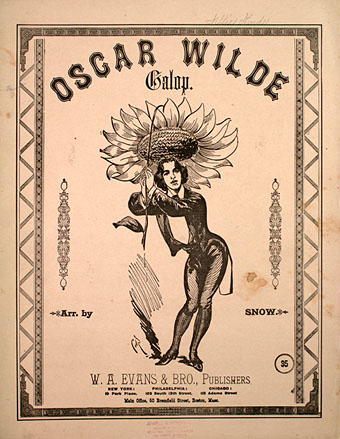
When Oscar Wilde arrived in America to begin his lecture tour in 1882 the excursion provoked considerable comment on both sides of the Atlantic. Wilde was there in his capacity as an ambassador for Aestheticism, a position which had already made him a figure of fun in the pages of Punch magazine while the Aesthetes generally and Wilde in particular had been caricatured the year before by Gilbert & Sullivan in their opera, Patience. The Oscar Wilde Galop was one of a number of topical dance pieces which capitalised on Wilde’s arrival in America, the full score of which can be seen in the Levy Sheet Music Collection at Johns Hopkins University. No one seems to give the name of the composer of these works for some reason, but this piece and others like it can be found on a CD, To Oscar: A Collection of Aesthetic Melodies.

I suspect Oscar would have been flattered by his portrayal on the sheet music, it’s milder than the Punch cartoons and gives him a wasp waist he never possessed even in his youth. Wilde enjoyed his lecture tour, and was always happy to be the centre of attention, of course, but America (and others) paid the price for the ribbing later on, as in this exchange from The Picture of Dorian Gray:

“I am told, on excellent authority, that her father keeps an American dry-goods store,” said Sir Thomas Burdon, looking supercilious.

“My uncle has already suggested pork-packing Sir Thomas.”

“Dry-goods! What are American dry-goods?” asked the duchess, raising her large hands in wonder and accentuating the verb.

“American novels,” answered Lord Henry, helping himself to some quail.

The duchess looked puzzled.

“Don’t mind him, my dear,” whispered Lady Agatha. “He never means anything that he says.”

“When America was discovered,” said the Radical member—and he began to give some wearisome facts. Like all people who try to exhaust a subject, he exhausted his listeners. The duchess sighed and exercised her privilege of interruption. “I wish to goodness it never had been discovered at all!” she exclaimed. “Really, our girls have no chance nowadays. It is most unfair.”

“Perhaps, after all, America never has been discovered,” said Mr. Erskine; “I myself would say that it had merely been detected.”

“Oh! but I have seen specimens of the inhabitants,” answered the duchess vaguely. “I must confess that most of them are extremely pretty. And they dress well, too. They get all their dresses in Paris. I wish I could afford to do the same.”

“They say that when good Americans die they go to Paris,” chuckled Sir Thomas, who had a large wardrobe of Humour’s cast-off clothes.

“Really! And where do bad Americans go to when they die?” inquired the duchess.

“They go to America,” murmured Lord Henry.

Elsewhere on { feuilleton }
The Oscar Wilde archive

Weekend links 9

arthur7.jpg

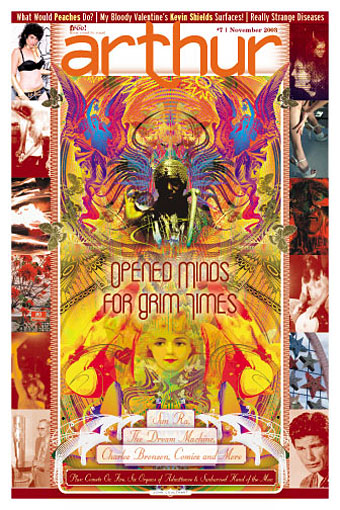
Own a copy of Arthur #7 (October 2003) with my swirling cover pic featuring cosmic jazz maestro Sun Ra. Lots of good stuff inside, details here.

Spinetingler Magazine announced their nominees the 2010 Spinetingler Award this week. Jeff VanderMeer’s Finch is one of the titles in the Best Novel category while my cover for Jeff’s book is in the Best Cover category.

• A Journey Round My Skull posted the results of the Raymond Roussel illustration contest. Entrants were asked to read Roussel’s story Bertha, The Child-Flower then create a picture based on that.

Has Dottie got legs? The New Criterion on the poetry of Dorothy Parker.

• The gays: Fuck Yeah Hot Weird Guys, more from the Tumblr hall of mirrors; Simon Callow reviews Gay Icons Through the Ages by Tom Ambrose; Wessel + O’Connor Fine Art is open again with a new exhibition at a new location in Lambertville, NJ; some things never change: “Secret tape reveals Tory backing for ban on gays.”

• “Make the inaccessible exciting.” Colin Marshall interviews Chris Bohn, editor of music magazine The Wire.

• More music: Jon Savage’s brief history of Krautrock. The new Soul Jazz compilation, Deutsche Elektronische Musik, is released next week.

Sage of the Apocalypse; Samuel R Delany’s Dhalgren comes to the stage in New York.

• Further Penguin fetishism: “Penguin Decades bring you the novels that helped shape modern Britain.”

• Yes, they’re out there, the Clients From Hell. For a palliative there’s Herbert W Kapitzki’s elegant poster designs from the 1960s.

• Song of the week: House of Glass (1967) by The Glass Family.

Robert Anning Bell’s Tempest

bell1.jpg

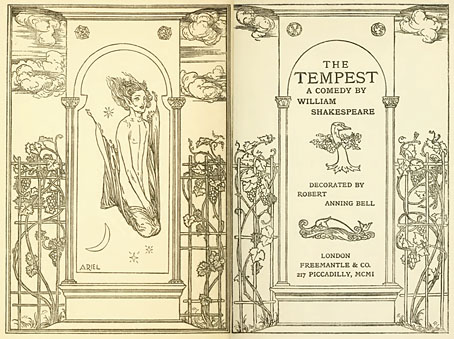
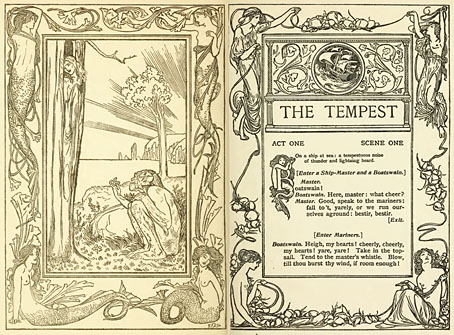
British artist and designer Robert Anning Bell (1863–1933) illustrates Shakespeare in this 1901 edition at the Internet Archive and the work seemed to give him an excuse to embellish many of the pages with writhing mer-folk. His adaptation isn’t as striking as William Heath Robinson’s Midsummer Night’s Dream from 1914 but then few books are. In style Bell is closer to his contemporary Charles Ricketts with very open line work and no heavy black areas. Ricketts produced his own version of Ariel’s Song to Ferdinand for The Magazine of Art in 1895 but doesn’t seem to have illustrated much more of The Tempest as far as I’m aware, although his Vale Press did issue an edition of Shakespeare’s complete works. It hadn’t occurred to me before how few illustrated editions there are of The Tempest; this seems surprising given the fantastic nature of the story. It might be that illustrated plays have never sold so well despite there having been a number of illustrated Midsummer Night’s Dreams. I’d love to have seen Harry Clarke tackling Ariel and Caliban.

bell2.jpg

bell4.jpg

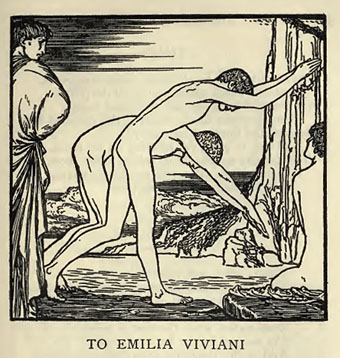
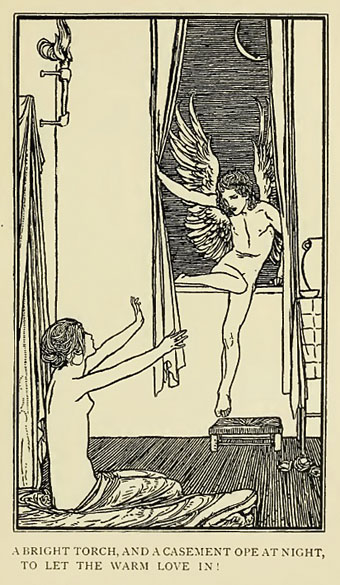
Also at the Internet Archive is a 1902 edition of Shelley’s poems illustrated by Bell (above) and an 1897 edition of Keats in the same series (below). Great poetry doesn’t necessarily lend itself to illustration so it’s no surprise that these books are less interesting than the Shakespeare.

bell3.jpg

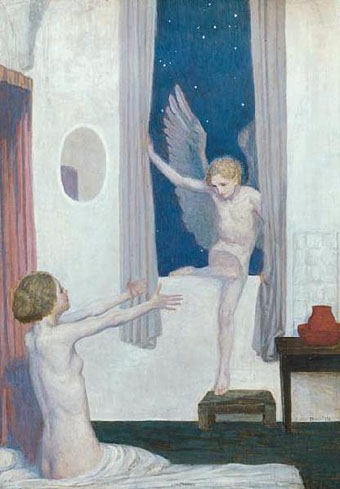
Bell later reworked his illustration for Keats’s Ode to Psyche as a painting which he called Cupid’s Visit. I much prefer the drawing to the painting.

bell5.jpg

Cupid’s Visit (1912).

Elsewhere on { feuilleton }
The illustrators archive

Previously on { feuilleton }
Charles Ricketts’ Hero and Leander
Another Midsummer Night
Arthur Rackham’s Midsummer Night’s Dream
The art of Charles Robinson, 1870–1937
William Heath Robinson’s Midsummer Night’s Dream

Weekend links 8

adur.jpg

Another label design of mine for the Adur Brewery. Much as I like Otto Weisert’s Arnold Böcklin typeface it’s something I’ve been reluctant to use in the past due to its lazy deployment by UK shop sign makers. The ribbon motifs and the hops are adapted from one of my Art Nouveau reference books, however, so it seemed appropriate in this case.

Dead Fingers Talk: The Tape Experiments of William S. Burroughs, a forthcoming exhibition at IMT, London, “presenting two unreleased tape experiments by William Burroughs from the mid 1960s alongside responses by 23 artists, musicians, writers, composers and curators.” Related: get a Naked Lunch t-shirt (or another cover design) at Out of Print clothing.

Ronald Clyne: American folk modernist. Rediscovering the album and book cover designer.

Better Things: The Life and Choices of Jeffrey Jones. A documentary about the work of artist Jeffrey Jones. Related: Mike Kaluta appears in the trailer and Golden Age Comic Book Stories has pages from Kaluta’s illustrated Metropolis (1988), a novel by Thea von Harbou.

• “I imagined myself as a giant penis launching off from earth like a spaceship.” WFMU’s Beware of the Blog explores Cary Grant’s use of LSD. Related: Orange Sunshine – The Brotherhood of Eternal Love and Its Quest to Spread Peace, Love, and Acid to the World, a book by Nicholas Schou.

• Britain’s armed forces have a lesson for the US: “Only 10 years ago, the Army was expelling soldiers for homosexuality. Now gay weddings get the regimental blessing.” A very modern military partnership.

Cassette tapes and their growing curiosity/fetish value. Related: Michael Stipe and Maison Martin Margiela’s sterling silver microcassette charm.

• Another week, another theremin link: Detergent bottles become theremins.

• “Edinburgh is a city built on the production of books”.

The National Archives UK’s photostream at Flickr.

Typographic playing cards.

• A song for Cary Grant: The Trip by Park Avenue Playground, an obscurity from 1967. And These New Puritans have a new video for Attack Music.