A Secret Wish by Propaganda

propaganda1.jpg

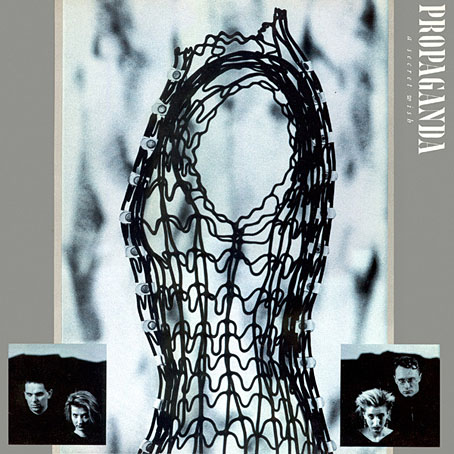
A Secret Wish (1985). Design by the London Design Partnership.

The dark Religions are departed & sweet Science reigns
— William Blake

It’s a hallmark of musical obsession when you find yourself buying the same album over and over. Propaganda’s meisterwerk from 1985, A Secret Wish, was finally released in a definitive double-CD version this week, the fourth edition I’ve bought (after the original vinyl and two other CD releases). This new set is easily the best of the lot.

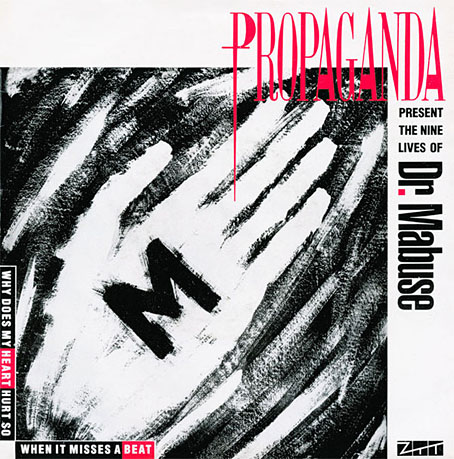
Propaganda were always my favourites among the early acts on Trevor Horn and Paul Morley’s ZTT label, smarter than Frankie Goes To Hollywood and more musical than the Art of Noise. How could I resist another quartet of Germans from Kraftwerk’s home city of Düsseldorf, a group memorably described in the music press as “ABBA from Hell”? The first single in 1984, Dr Mabuse, came along when I’d been immersed in Lotte Eisner’s celebrated study of German Expressionist cinema, The Haunted Screen; an avant-garde pop outfit devoted to the same material was just the thing I wanted to hear. Almost a mini-album, the single’s A-side was filled by an epic ten-minute song describing the nature of Dr Mabuse, a villainous anti-hero from several Fritz Lang films. On the B-side there was a cover of The Velvet Underground’s Femme Fatale (and another Lang reference in the subtitle, The Woman with the Orchid), followed by some metal bashing and a taste of the A-side’s Schönberg-esque orchestral stabs before Dr Mabuse returned again at the end. Cover versions were an important thing at ZTT, as was the idea of the 12-inch single as a self-contained work, Mabuse being a prime example. All of this came packaged in a sleeve whose Anton Corbijn painting referenced another Fritz Lang film, M… It felt as though they were doing this purely for my benefit.
propaganda2.jpg

Dr Mabuse (1984). Design by Anton Corbijn and XL.

The intertextual reference on this and subsequent releases isn’t surprising given the people involved. Paul Morley took a great delight in embellishing the ZTT releases with quotations—the Frankie album was probably the first chart-topping release with a recommended reading list—while band member Ralph Dörper had been with the Neue Deutsche Welle group Die Krupps prior to Propaganda, and it was his influence which gave the new group the abrasive industrial edge that I found so attractive. While between groups he released an experimental EP in 1983 under his own name featuring versions of In Heaven from Eraserhead and John Carpenter’s theme from Assault on Precinct 13, and it was Dörper who chose Throbbing Gristle’s Discipline as the demo song which the group used to catch the attention of ZTT. That particular cover version never made it to A Secret Wish although they did perform it live on The Tube, and a later version appeared on the remix album, Wishful Thinking. This recording is happily included on the second disc of the new reissue.

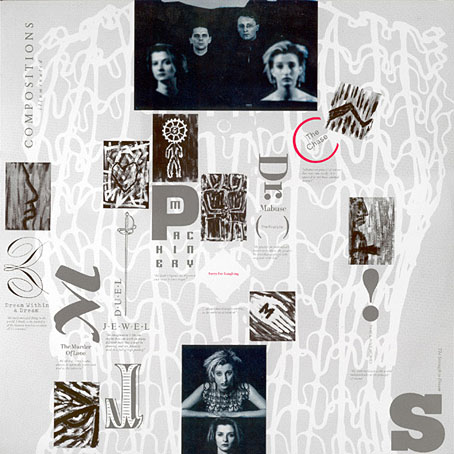
A Secret Wish was released in 1985 and pushed further buttons of obsession for me with the opening track, Dream Within A Dream, which is Edgar Allan Poe’s poem set to music. The album artwork came liberally decorated with Morley’s signifying quotes, the one for the Poe track being the opening lines from HP Lovecraft’s The Call of Cthulhu. Yes, they really were doing this for my benefit… Two further 12-inch singles appeared: Duel/Jewel was the same song presented in an “ABBA” version and a “from Hell” version: sweet and melodic versus harsh and industrial.
propaganda3.jpg

A Secret Wish inner sleeve.

The third and final single, p:Machinery, expanded the short mix from the album into another 9-minute epic whose vision of a population enslaved to industrial technology easily invokes Fritz Lang’s Metropolis, so much so that I used to play the single while running taped scenes from the film on TV. The enormous “Polish” mix of this song has always been scarce on CD, with a Japanese release in 1988, and a later reissue (with some shoddy and superfluous remixes) in 1995. Another benefit of the new edition of the album is that the extended mix provides the climax of the second disc and sounds even more enormous, its brass fanfares accurately described in a review at the time as conjuring images of cities rising from the sea.

Also present for the first time on the new CD is Do Well, the 20-minute Duel suite which was a cassette-only release, plus a number of other previously unavailable mixes. If you have this double-disc set and the Outside World single collection from 2002 then you’ll own pretty much everything that’s great about Propaganda. A lot of pop music from the 1980s sounds horribly dated now: tinny synths, empty production and a paucity of ambition. Propaganda sound as thunderingly magnificent as they did in 1985, and still unique. It’s a shame that A Secret Wish was their finest moment, things fell apart fairly soon after. But one masterpiece will always be worth fifty Duran Duran travesties.

Elsewhere on { feuilleton }
The album covers archive

Previously on { feuilleton }
Metropolis posters

Weekend links 22

pota.jpg

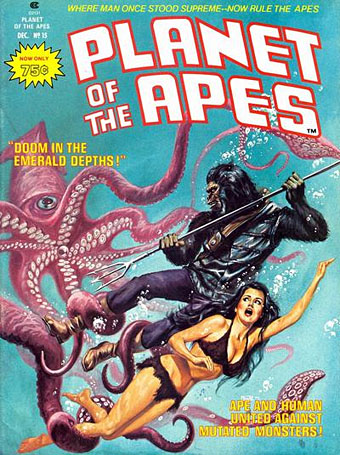
Planet of the Apes Magazine #15 (1975), art by Bob Larkin.

I never read any of Marvel Comics’ Planet of the Apes titles but the painted covers of the American editions are evidence of a distinctly lurid imagination. An excess of drugs—this was the Seventies, after all—or mere enthusiasm? You decide. Related: “The Soft Intelligence”: 5 Underrated Literary Cephalopods by China Miéville. Kudos to him for mentioning The Sea Raiders (1896) by HG Wells, a favourite story of mine when I was 12.

octopussy.jpg

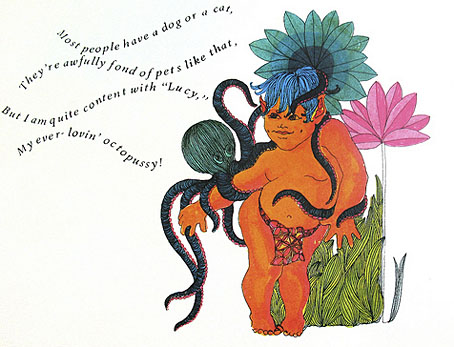
My ever-lovin’ octopussy (1970) by Jackie Black.

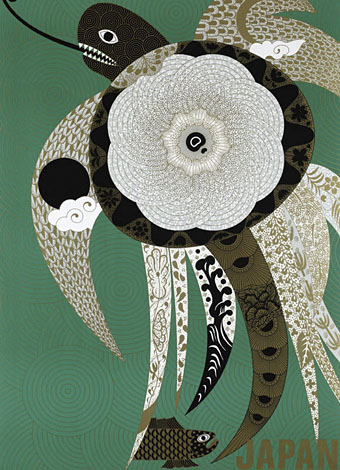
A Journey Round My Skull chooses selections from Ang Wyman’s flickr group Eye Candy (above), psychedelic illustration for children’s books by Nicole Claveloux, Peter Max, Heinz Edelmann and others.

• Watch out, there are “fancy gentlemen” about. It’s The Homosexual Menace!

• Design in opposition: Neville Brody announces the Anti-Design Festival.

• The Almias Rural Psychogeography Walk takes place on July 25th.

• Steven Heller on The Incredible Posters of Tadanori Yokoo.

Hipster Priest: Alan Moore interviewed at The Stool Pigeon.

FACT mix 167, a great selection by These New Puritans.

• The Orion Galaxy is a beautiful bespoke synthesizer.

• A radio portrait of Moondog at Speechification.

• RIP: Sugar Minott. RIP Tuli Kupferberg.

• Introducing Wizard’s Tower Press.

Octopus (1970) by Syd Barrett.

The Major Arcana by Jak Flash

arcana1.jpg

The Fool.

I’d like this photo series by young British photographer Jak Flash even if it didn’t feature attractive men; the eye candy is icing on a thaumaturgic cake. The Major Arcana takes the Trumps of the Tarot as its inspiration and manages to reinterpret the symbolism whilst retaining the hieratic nature of the traditional images. Of his reworking, the photographer says:

I developed my own themes based around things like geometric shapes so that I could encode my images with meaning. The images link to each other and can be read to some extent almost as a progressive story, or commentary. Various signifiers are used throughout the images such as cubes, triangles and spheres to help communicate my ideas. Cubes for example are a representation of the material world and triangles show transition. In an image such as The Hanged Man we see two men firmly seated on a large cube, whilst above their heads another cube breaks apart around them. … The Lovers image is an interpretation of the fall of man from Eden. The man represents mankind in his fall after taking the fruit of Knowledge, whilst being denied eternal life. (More.)

The Major Arcana is available in book form at Blurb. Via Homotography, doing all the leg work once again.

arcana2.jpg

top left: The Lovers; top right: Justice.
bottom left: The Wheel of Fortune; bottom right: The Sun.

Previously on { feuilleton }
The Sapphire Museum of Magic and Occultism
Strange Attractor Salon
The art of Pamela Colman Smith, 1878–1951
Layered Orders: Crowley’s Thoth Deck and the Tarot
In the Shadow of the Sun by Derek Jarman
The Major Arcana

Portuguese Diseases

disease1.jpg

This volume appears to be in print now, the Portuguese edition of The Thackery T Lambshead Pocket Guide to Eccentric and Discredited Diseases, a unique fantasy anthology compiled in 2003 by Jeff VanderMeer and Mark Roberts. The new edition is published by Saida de Emergência and translated by Luís Rodrigues, João Seixas and Vítor Morta. I didn’t design this cover with its eccentric kerning but I did design the original edition for Night Shade, to date still one of my most elaborate and detailed book designs, too elaborate for the larger publishing houses, in fact, who either dropped or amended the deliberately diseased title spread for their paperback editions. You can see some of the original pages below. I sent the Portuguese publishers all the artwork and layouts but since I haven’t seen a printed copy of the book I don’t know how the interior looks. I don’t even know whether my name appears on the cover as it does here since other examples online show a different design. However, it’s often the case these days that cover designs get sent out prematurely for marketing purposes before things have been finalised.

disease2.jpg

Title spread.

disease3.jpg

Contents spread.

Previously on { feuilleton }
Pasticheur’s Addiction

Weekend links 21

nagai.jpg

A poster by Kazumasa Nagai.

• Franco Maria Ricci creates the world’s largest maze. “The former publisher said he first confided his ambition to Jorge Luis Borges, who characteristically told him the world’s largest maze already existed and was called a desert.” Related: Mirror, Mask, Labyrinth, a review of two new collections of Borges’ poetry.

FACT mix 164 is a dubstep collection by Pinch and a promotion for the Dark Matter compilation which I designed earlier this year.

• One of the monuments of 20th century music, Bitches Brew by Miles Davis, is released in another new (and expensive) edition next month by Sony. Nice packaging, and there’s a vinyl edition included, but these things always come across as a cyncial attempt to milk the hardcore fans one more time. And have you noticed how all vinyl releases are now described as “audiophile”? If the big record companies had shown this much dedication to quality in the 1980s when they were jobbing out sub-standard vinyl pressings their reputation might be slightly higher today.

• More Gysin: Brion Gysin, William Burroughs, and the secret life of a building on the Bowery. And Ubuweb’s page of Gysin sound works and recordings.

Michael Moorcock: “I think I preferred my own imagination”. A two-part interview about the cover designs for Moorcock books.

The Pansy Project: “Artist Paul Harfleet plants pansies at the site of homophobic abuse, he finds the nearest source of soil to where the incident occurred and generally without civic permission plants one unmarked pansy. The flower is then photographed in its location and posted on his website, the image is entitled after the abuse … The Pansy Project also marks locations where people have been killed as a result of homophobic attack”

This Gaming Life: Travels in Three Cities. Jim Rossignol’s book is available as a free download.

Lost London. Also, the Victorian Catacombs of South London.

Dedalus Books had its Arts Council grant reinstated.

’Zine Lutefisk: fashion/art/escape.

Time Will Show The Wiser (1968) by Fairport Convention | She Moves Through The Fair (1969) by Fairport Convention | She Moved Through The Fair (1994) by Jam Nation.