Weekend links 97

conformist.jpg

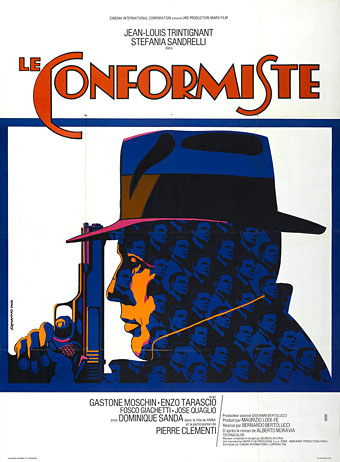
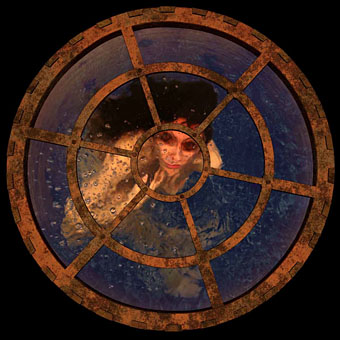
Illustration by Ermanno Iaia. Hard to believe that Bernardo Bertolucci’s The Conformist (1970) is only now appearing on DVD in the UK. Arrow Films release a dual-format edition at the end of this month.

• The week in perfume: Perfumes: The Guide by Luca Turin & Tania Sanchez is reviewed by Emily Gould (“this is a golden age of perfume criticism”) and prompts a meditation on the art and process of scent from Rishidev Chaudhuri.

Electrical Banana by Norman Hathaway & Dan Nadel is “the first definitive examination of the international language of psychedelia, focusing on the most important practitioners in their respective fields”.

Sacred Monsters is a forthcoming collection of essays and criticism by Edmund White. Related: Colm Tóibín from 1999 reviewing A History of Gay Literature: The Male Tradition by Gregory Woods.

Medium, a video by Clayton Welham and Sam Williams for Emptyset whose imminent release (also entitled Medium) I’ve designed. Related: Dave Maier on music versus noise.

• Couldn’t happen to a nicer guy: the face of US presidential contender Rick Santorum rendered as a collage of (mostly) gay porn. More provocation: All Dead Mormons Are Now Gay.

• Coilhouse discovered a rough copy of Bells of Atlantis (1952), an experimental film which features Anaïs Nin, input from Len Lye and an electronic score by Louis & Bebe Barron.

• “The idea that we should have but two options when it comes to our gender presentation, male or female, has always felt ludicrous to me,” says LaJohn Joseph.

Bely paints “a universe of strange manifestations” which drifts across Apollonovich’s consciousness every night before he falls asleep. We are even shown congeries of images that are shards of events which took place that day for the senator: “all the earlier inarticulacies, rustlings, crystallographic figures, the golden, chrysanthemum-like stars racing through the darkness on rays that resembled myriapods”

Malcom Forbes on Andrei Bely’s masterwork, Petersburg (1916).

RIP Barney Rosset, publisher of Grove Press books and the Evergreen Review.

The Brothers Quay will be at work in Leeds city centre this May. Lucky Leeds.

Warm Leatherette, a short film by Analogue Solutions.

Cormac McCarthy, Quantum Copy Editor.

The importance of being axonometric.

Always Crashing In The Same Car (1977) by David Bowie | Crash (1980) by Tuxedomoon | Crash Dance (1983) by Yello.

Mérigot’s Ruins of Rome

merigot1.jpg

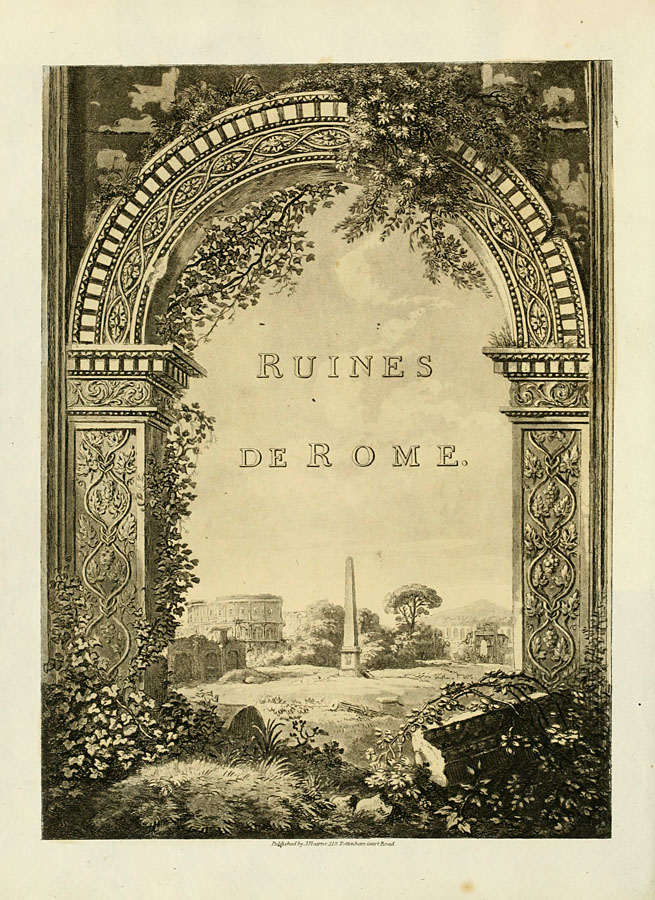
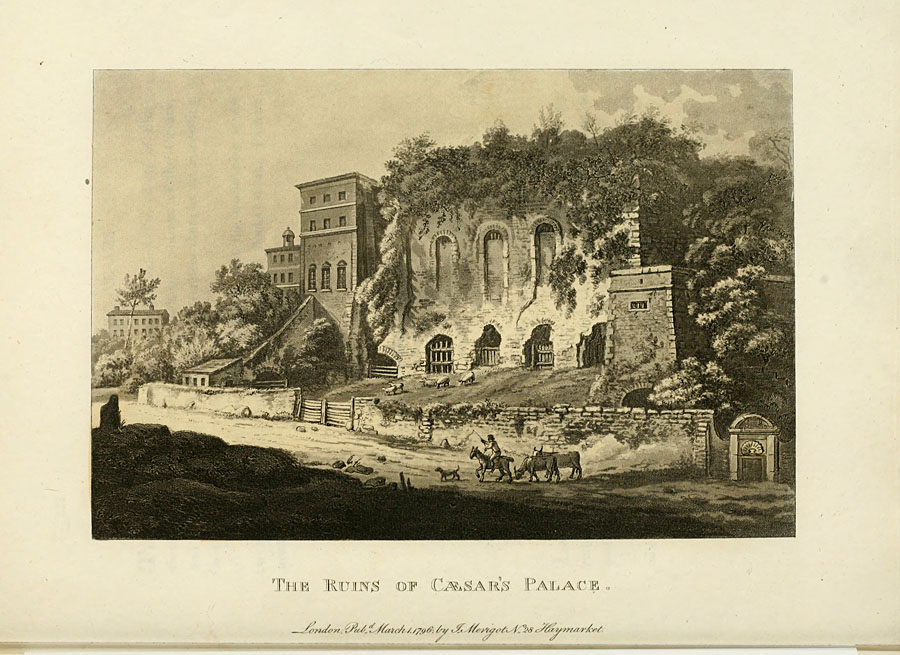
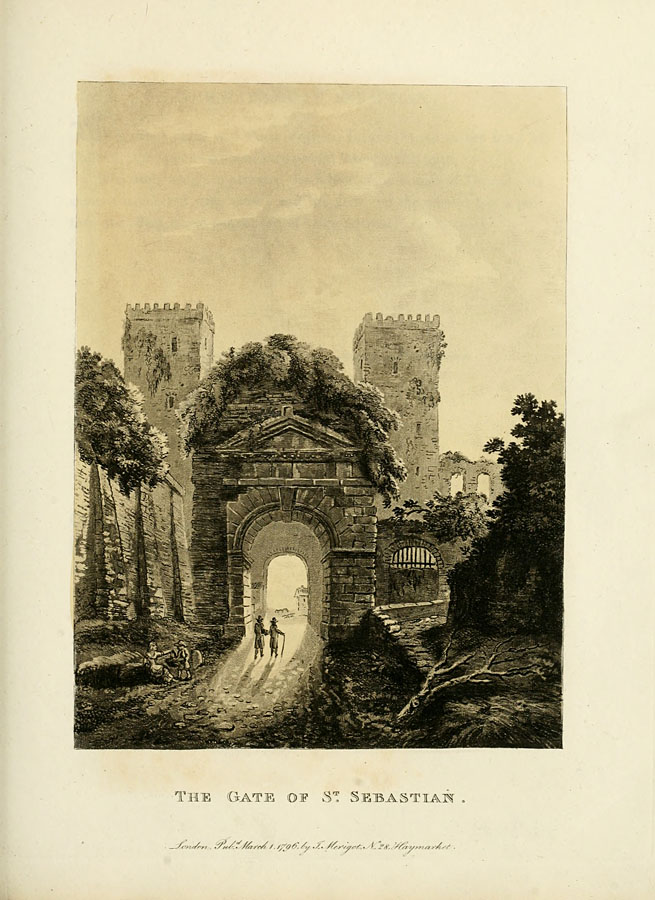
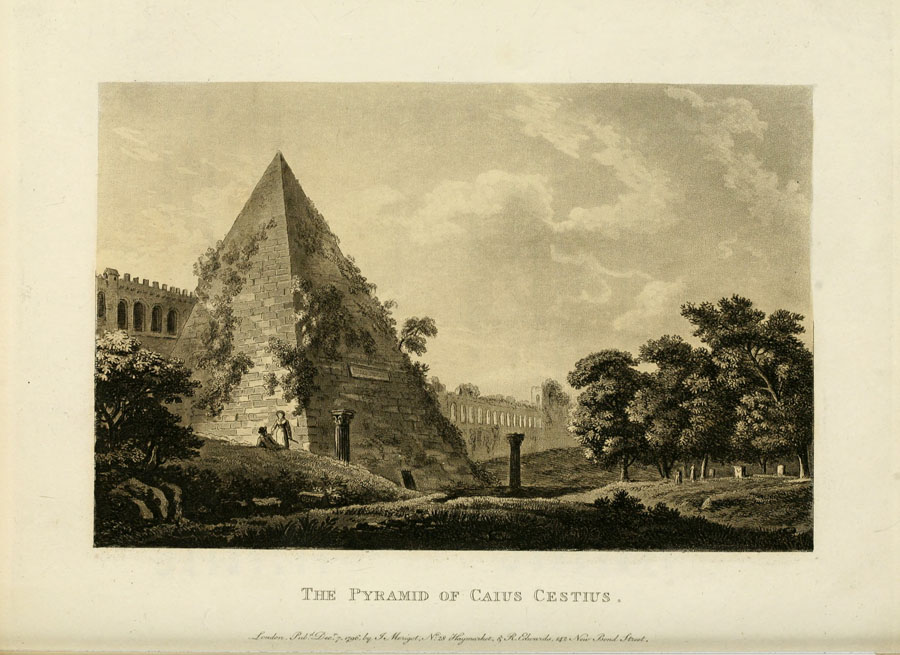
It may have been a thankless task for an artist of the 18th century attempting to compete with Piranesi’s matchless Views of Rome but that didn’t stop people trying. These aquatints by James Mérigot date from 1798, and can be found in a British book dating from 1815, A Select Collection of Views and Ruins in Rome and its Vicinity. They lack Piranesi’s antiquarian detail and flair for perspective but serve as a reminder of how the city would have looked at the height of the Romantic era when Rome embodied many Romantic obsessions, not least the traces of a vanished civilisation with monstrous appetites. Mérigot gives us the picturesque Rome that would soon disappear once the new breed of archaeologists got to work. The ruined buildings are still overgrown and sunk in the soil; many of them—like Caesar’s Palace below—are being used as places to keep farm animals. Pictures such as these always prompt ambivalent feelings: the romance in the contemplation of a ruin is situated partly in this very neglect, a neglect we’ll never be able to experience again with Rome, or Petra or the Pyramids now they’ve been polished, repaired and quarantined as tourist attractions. Further neglect would have destroyed many of these sites but their present condition often seems equally unsatisfactory.

merigot2.jpg

merigot3.jpg

merigot4.jpg

Elsewhere on { feuilleton }
The etching and engraving archive

Previously on { feuilleton }
Pleasure of Ruins
Vedute di Roma

Pleasure of Ruins

beny01.jpg

The ideas ruins evoke in me are grand. Everything comes to nothing, everything perishes, everything passes, only the world remains, only time endures. How old is this world! I walk between two eternities.

Denis Diderot, 1767

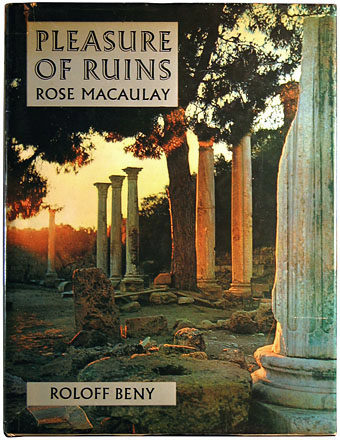
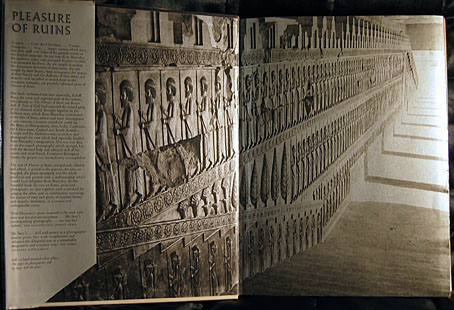
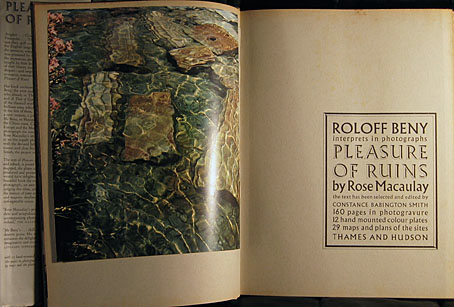
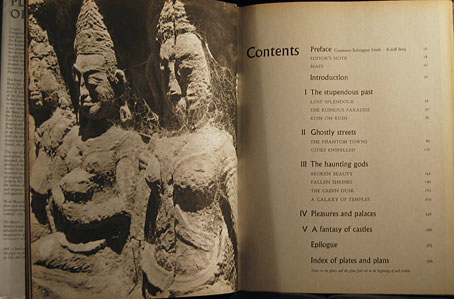
Ruins, as Diderot observed, are the memento mori of civilisations, a reminder that the apparent permanence of architecture is illusory: this too shall pass. Rose Macaulay explored the melancholy pleasure inspired by this contemplation in Pleasure of Ruins (1953), a book I was reminded of on two separate occasions this weekend. Before I get to those I can’t resist showing something of my own copy of Macaulay’s study, a heavyweight volume (286 pp, 346mm x 260mm) published by Thames & Hudson in 1964. This was the third book by Canadian photographer Roloff Beny who made a habit of photographing ancient ruins. Here he visits Angkor, Tintern Abbey, Persepolis, Petra, Baalbek, Leptis Magna, Chichen Itza, Machu Picchu and elsewhere to embellish Macaulay’s text with 160 photogravure pages, 12 tipped-in colour plates, and maps of the locations on fold-out spreads. Beny also designed the book which even in my rather scuffed and damp-afflicted copy is an impressive example of the mass-produced edition as work-of-art.

beny02.jpg

Metallic silver printing on the endpapers.

Rick Poynor provided the first mention of Macaulay’s book in a piece of polemic justifiably disputing the pejorative term “ruin porn”, an epithet that’s appeared recently among critics of those fascinated by photos of abandoned Detroit, or Battleship Island off the coast of Japan. If photos of ruins are “ruin porn” then Roloff Beny’s books must count as hardcore, while my National Trust Book of Ruins is evidently a government-sponsored sex manual. Poynor notes the criticism being a particularly American one, and wonders whether some Americans fail to appreciate the long cultural and political history of the ruin in Europe. Plenty of European cities have ruins in their midst, whether ancient ones like London Wall and the centre of Rome, or more recent ones like the Kaiser Wilhelm Memorial Church in Berlin and Coventry Cathedral, both partially destroyed during the Second World War. An appreciation of ruins began in the 18th century and evolved in tandem with the emergence of antiquarianism. Prior to this, ancient ruins were either a nuisance or a resource to be plundered for their stones. (Or, as can be seen in some of Piranesi’s Views of Rome, a convenient support for shops and houses.)

beny03.jpg

From ruin porn to Ruin lust: our love affair with decaying buildings, an essay by Brian Dillon which covers similar ground to Poynor’s piece, and discusses Rose Macaulay’s interest in ruins, an interest that survived being bombed out of her home during the war. This is a great run through the usual suspects, from the Romantics (with a nod to Fonthill Abbey) to JG Ballard’s obsession with the remnants of the Cold War and the Space Age. Dillon mentions the painting John Soane commissioned from Joseph Gandy showing his Bank of England building as a future ruin. And he also recounts the story (which I heard repeated recently in a Robert Hughes documentary) of Hitler’s demands to Albert Speer during their planning of the future capital of the Third Reich, Germania, that the buildings should make good ruins. It’s impossible to imagine anyone today planning a building as a future ruin even though many will end up that way, if they last at all.

beny04.jpg

If it wasn’t already apparent that ruins are the thing du jour, a current exhibition at Dundee Contemporary Arts is of photographic prints by Jane and Louise Wilson showing views of abandoned Pripyat, better known as the town at the heart of the Chernobyl Exclusion Zone. Rick Poynor refers to Pripyat in his piece, and it’s also an inevitable subject of discussion in Geoff Dyer’s latest book, Zona, an exploration of Andrei Tarkovsky’s Stalker where a disused power station adds a more sinister quality to the pleasure of ruins.

More pages from Roloff Beny’s book follow.

Continue reading “Pleasure of Ruins”

Weekend links 96

nunez.jpg

Sin título (monstruas) (2008) by Marina Núñez.   

• Salon asks Christopher Bram “Is gay literature over?” Bram’s new book, Eminent Outlaws: The Gay Writers Who Changed America, is reviewed here.

Robert Montgomery is profiled at the Independent as “The artist vandalising advertising with poetry.”

In addition to aesthetics, McCarthy noted a deeper link between great science and great writing. “Both involve curiosity, taking risks, thinking in an adventurous manner, and being willing to say something 9/10ths of people will say is wrong.” Profound insights in both domains also tend arise from a source beyond the limits of analytic reason. “Major insights in science come from the subconscious, from staring at your shoes. They’re not just analytical.”

Nick Romeo meets Cormac McCarthy at the Santa Fe Institute.

• For FACT mix 316 Julia Holter mixes radio broadcasts, street recordings and music.

• This week in the Tumblr labyrinth: fin de siècle art and graphics from Nocnitsa.

“There’s a widespread cultural barrenness across art and political culture. But there are some pockets of resistance on the extreme margins, like the techno-savvy protest movements, small press, the creator-owned comics, that seem to be getting some signs of hope for the future,” he says. “All of the genuinely interesting work is being done on the margins, with independent companies, self-producing, and alternative distribution networks.”

Alan Moore on Watchmen’s “toxic cloud” and creativity v. big business.

Stone Tape Shuffle, a 12” LP of readings by Iain Sinclair. Limited to 400 copies.

Monolake on how we cope with death: mythologies, rituals, drugs and Ghosts.

Kraftwerk perform at New York’s Museum of Modern Art in April.

Kathy Acker (in 1988?) interviewing William Burroughs.

pogany.jpg

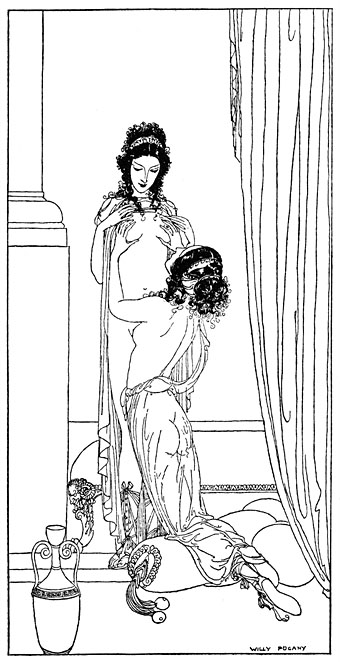
Willy Pogány’s erotica: illustrations for a 1926 edition of The Songs of Bilitis by Pierre Louÿs.

• Nicholas Lezard on David Lynch: director of dreams.

Did otherworldly music inspire Stonehenge?

Coilhouse has an Eyepatch Party.

Tanzmusik (1973) by Kraftwerk | The Model (1992) by the Balanescu Quartet | Trans Europe Express (2003) by the Wiener Sinfonie Orchestra & Arnold Schönberg Choir.

Vathek illustrated

vathek1.jpg

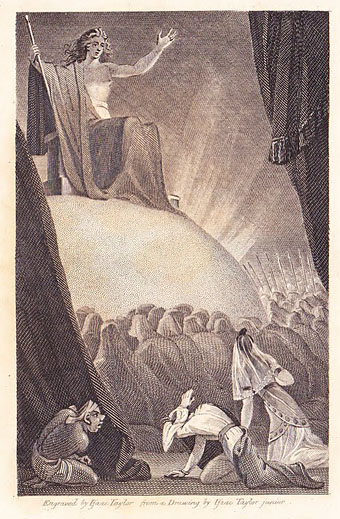
Frontispiece, 1815. Engraved by Isaac Taylor after a drawing by Isaac Taylor Jr.

After some time Vathek and Nouronihar perceived a gleam brightening through the drapery, and entered a vast tabernacle carpeted with the skins of leopards; an infinity of elders with streaming beards, and Afrits in complete armour, had prostrated themselves before the ascent of a lofty eminence, on the top of which, upon a globe of fire, sat the formidable Eblis. His person was that of a young man, whose noble and regular features seemed to have been tarnished by malignant vapours; in his large eyes appeared both pride and despair; his flowing hair retained some resemblance to that of an angel of light; in his hand, which thunder had blasted, he swayed the iron sceptre that causes the monster Ouranabad, the Afrits, and all the powers of the abyss to tremble; at his presence the heart of the Caliph sank within him, and for the first time he fell prostrate on his face.

Vathek by William Beckford

The inevitable follow-up to yesterday’s post. Vathek was, we’re told, written in three days and two nights in the winter of 1782 when William Beckford was only 21. The novel is an Orientalist fantasy that’s grotesque and arabesque in the original sense of those terms, very much influenced by The Arabian Nights and similar tales. Here’s HP Lovecraft with a description:

Vathek is a tale of the grandson of the Caliph Haroun, who, tormented by that ambition for super-terrestrial power, pleasure, and learning which animates the average Gothic villain or Byronic hero (essentially cognate types), is lured by an evil genius to seek the subterranean throne of the mighty and fabulous pre-Adamite sultans in the fiery halls of Eblis, the Mahometan Devil. The descriptions of Vathek’s palaces and diversions, of his scheming sorceress-mother Carathis and her witch-tower with the fifty one-eyed negresses, of his pilgrimage to the haunted ruins of Istakhar (Persepolis) and of the impish bride Nouronihar whom he treacherously acquired on the way, of Istakhar’s primordial towers and terraces in the burning moonlight of the waste, and of the terrible Cyclopean halls of Eblis, where, lured by glittering promises, each victim is compelled to wander in anguish forever, his right hand upon his blazingly ignited and eternally burning heart, are triumphs of weird colouring which raise the book to a permanent place in English letters. No less notable are the three Episodes of Vathek, intended for insertion in the tale as narratives of Vathek’s fellow-victims in Eblis’ infernal halls, which remained unpublished throughout the author’s lifetime and were discovered as recently as 1909 by the scholar Lewis Melville whilst collecting material for his Life and Letters of William Beckford. Beckford, however, lacks the essential mysticism which marks the acutest form of the weird; so that his tales have a certain knowing latin hardness and clearness preclusive of sheer panic fright.

Jorge Luis Borges noted some of the influences in his 1943 essay On William Beckford’s Vathek:

…I believe that Vathek foretells, in however rudimentary a way, the satanic splendors of Thomas De Quincey and Poe, of Charles Baudelaire and Huysmans. There is an untranslatable English epithet, “uncanny,” to denote supernatural horror; that epithet (unheimlich in German) is applicable to certain pages of Vathek, but not, as far as I recall, to any other book before it.

[Guy] Chapman notes some of the books that influenced Beckford: the Bibliothéque orientale of Barthélemy d’Herbelot; Hamilton’s Quatre Facardins; Voltaire’s La Princesse de Babylone; the always reviled and admirable Mille et une nuits of Galland. To that list I would add Piranesi’s Carceri d’invenzione: etchings, praised by Beckford, that depict mighty palaces which are also impenetrable labyrinths. Beckford, in the first chapter of Vathek, enumerates five palaces dedicated to the five senses; Marino, in the Adone, had already described five similar gardens.

Byron admired the novel enough to take the name “Giaour” for one of his poems, and it’s no surprise to read that Clark Ashton Smith penned additions to The Third Episode of Vathek. Beckford’s fantasy is very much a precursor of Smith’s equally lurid and sinister stories.
vathek2.jpg

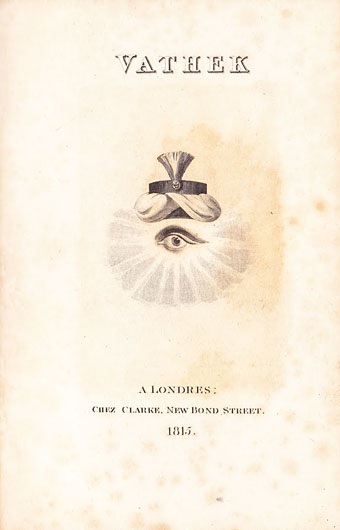
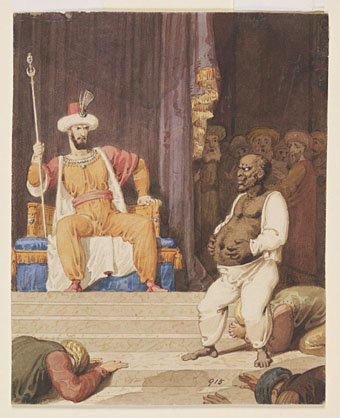
Given all this, it’s a surprise that more illustrators haven’t been attracted to the book. This may in part be a hangover of Victorian prudery: some of the novels of the Gothic period remained shocking to later sensibilities while Beckford’s scandalous reputation (Byron called him “the great Apostle of Paederasty”; to Hilaire Belloc he was “one of the vilest men of his time”) wouldn’t have made his name popular among the collectors of costly illustrated editions. Of the pictures here, the 1815 volume has a frontispiece showing Eblis perched on a hemispherical throne like the one John Martin later gave to Milton’s Satan. More of the uncredited edition from 1923 can be found at the Internet Archive while VTS has plates from the Marion Dorn edition. Mahlon Blaine not only put more effort into his illustrations but the content is also far more suited to his temperament; a shame there aren’t more of the drawings online. And it’s a shame too that Harry Clarke never tackled Beckford’s novel. Many of his contemporaries produced illustrated fairy tale books, as Clarke himself did with Charles Perrault’s stories. But none would have been able to match Clarke if he’d adapted Vathek with the same vigour he brought to Faust.
vathek6.jpg

The Caliph and the Giaour (c. 1800) by Richard Westall.

Continue reading “Vathek illustrated”