Reverbstorm: an introduction and preview

reverbstorm-covers.jpg

Reverbstorm: 1994–2012.

Art, intellectual pursuits, the development of the natural sciences, many branches of scholarship flourished in close spacial, temporal proximity to massacre and the death camps. It is the structure and meaning of that proximity that must be looked at. […] But there is a […] danger. Not only is the relevant material vast and intractable: it exercises a subtle, corrupting fascination. Bending too fixedly over hideousness, one feels queerly drawn. In some strange way the horror flatters attention, it gives to one’s own limited means a spurious resonance. […] I am not sure whether anyone, however scrupulous, who spends time and imaginative resources on these dark places, can, or indeed, ought to leave them personally intact. Yet the dark places are at the centre. Pass them by and there can be no serious discussion of human potential.

George Steiner, In Bluebeard’s Castle: Some Notes Towards the Re-definition of Culture (1971)

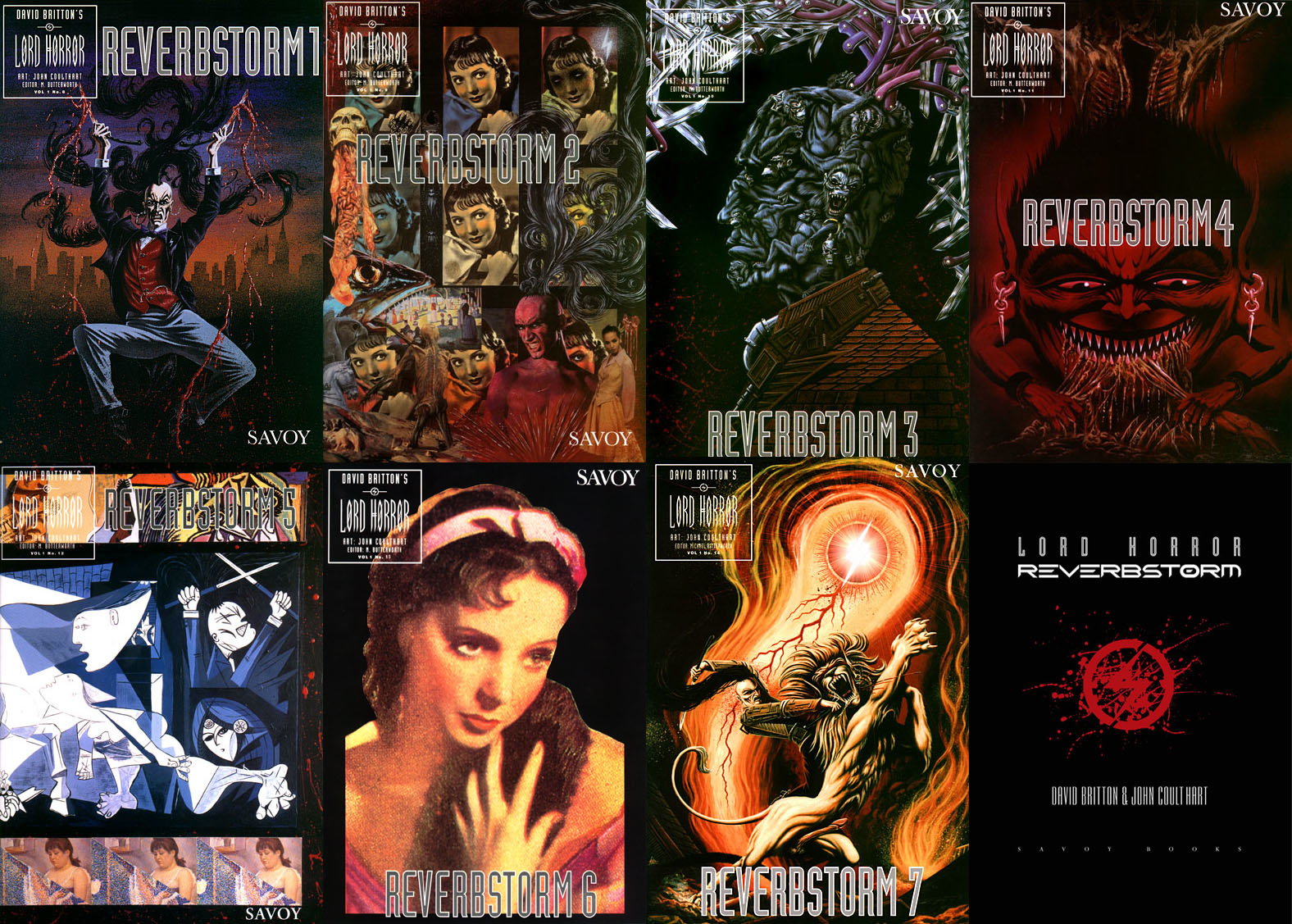
Reverbstorm is an eight-part comic series which I began drawing in 1990. Last week I finished work on the final section, and also completed the layout and design for the collected edition, a 344-page volume which Savoy Books will be publishing later this year. All the artwork has been scanned afresh, re-lettered and, in a few places, improved to fix compromises and print errors present in the published issues. This unfinished project has been hanging over me for so long that I make this announcement with some relief. The book will be published without a foreword so this post can serve as an introduction for the uninitiated. But before I get to the details, some history.
rev1.jpg

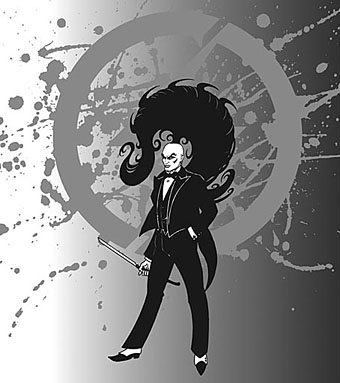
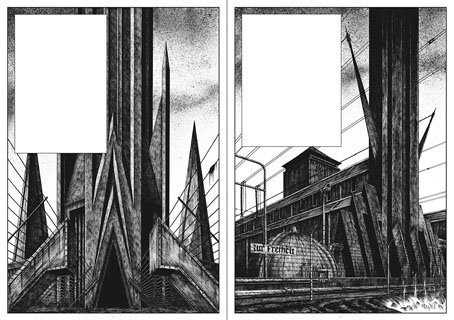
David Britton was the writer and instigator of Reverbstorm, the series being a continued exploration in the comics medium of his Lord Horror character. Lord Horror is an alternate-history equivalent of the real-life William Joyce, a member of the British Union of Fascists in the 1930s whose propaganda broadcasts to Britain from Nazi Germany during the Second World War led the press to dub him Lord Haw-Haw. The first five-part Lord Horror comic series, Hard Core Horror, showed the evolution of Horace William Joyce, aka Lord Horror, from charismatic politician to Nazi collaborator; the final two issues of the series concerned Horror’s involvement in the Holocaust. In Britton’s mythos James Joyce is the brother of Horace Joyce while Jessie Matthews, a popular British musical star of the 1930s, is Lord Horror’s wife. (Britton’s Lord Horror novels are examined in detail by Keith Seward in his Horror Panegyric essay.) My fellow artist at Savoy, Kris Guidio, drew the first four issues of Hard Core Horror; I drew issue five which was less a comic story, more a portfolio of static scenes of death-camp architecture. The series was well-received by regular Savoy readers but mostly ignored by the British comics world, with some justification: the comics were a glossy production but the narrative was very erratic, even technically inept in places. At Savoy the series was regarded as a failed experiment, Kris’s drawing style and flair for cartooning being more suited to the broad humour of the Meng & Ecker strips. But Dave liked what I’d done with the final issue and felt we could try something new that was also more original than a fictional skate through recent history.
rev2.jpg

In addition to producing comics in the late 1980s, Savoy had been recording a number of eccentric cover versions, most of them sung by PJ Proby. A music journalist, Paul Temple, came to interview Proby about the songs and stayed in touch. He subsequently approached the company with a song of his own entitled Reverbstorm, a bombastic number best described as “Wagnerian Northern Soul” which Savoy recorded in 1993. (Temple recounts the origin of the song here.) This gave a title to the new comic series that Dave was planning, the story outline being expanded from a scenario that he and Savoy colleague Michael Butterworth had sketched out when a film company showed some fleeting interest in Lord Horror. Kris Guidio and I worked on the opening pages, the initial idea being that Kris would continue drawing the Lord while I would do everything else. Once I’d convinced Dave that I could draw his Lordship to his satisfaction I took over the series while Kris carried on with the Meng & Ecker comics. I spent most of 1991–1996 drawing the first seven parts of Reverbstorm which were published as separate comics during that period. The first issue came with a CD single of Paul Temple’s song which was sung by Sue Quinn but credited to Jessie Matthews. (It’s now available on iTunes.) The last part of the series was always going to be something that differed from the preceding sections but I didn’t know how this might manifest until 1997 when I painted a series of monochrome double-spreads intended to form backgrounds for Dave’s text. That’s where the series stalled after the paintings had improvised themselves to such a degree of abstraction and incoherence that I didn’t feel able to continue. The breakthrough came a couple of years ago when I started scanning all the artwork into the computer and thinking again about the series. I realised I could complete everything now that my computer graphics skills were adequate enough to complement the earlier issues whilst also adding something new.
Continue reading “Reverbstorm: an introduction and preview”

Helmets

fmj.jpg

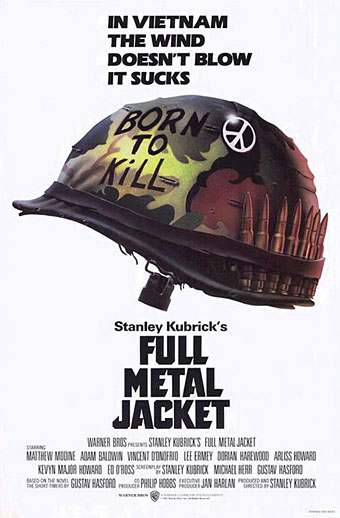
Full metal Jacket poster (1987). Illustration by Philip Castle.

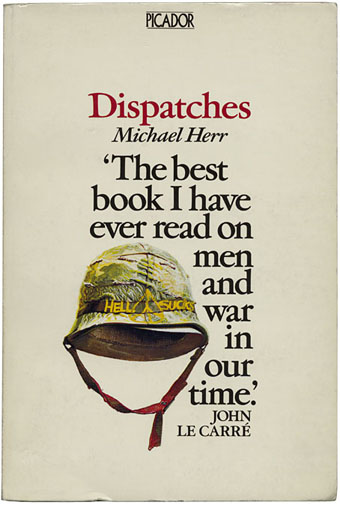
Watching Stanley Kubrick’s Full Metal Jacket on Blu-ray recently I was wondering again whether anyone has noted the similarity between the film’s poster design and the cover for the UK edition of one of its source books, Michael Herr’s Dispatches. At the risk of repeating some common piece of Kubrick lore, here goes.

Airbrush artist Philip Castle painted the helmet that’s become the perennial image used to promote the film. Kubrick often reused the services of people he trusted, and had earlier employed Castle as poster artist for A Clockwork Orange. Kubrick also oversaw the design of publicity materials for his later films so we can be reasonably sure this idea was one of his.

herr.jpg

Dispatches (1979). Illustration by Steven Singer.

Michael Herr’s collection of reports about the Vietnam war was first published in the US in 1977 with a UK edition following a year later. The cover of the US first edition is unremarkable compared to this typically excellent Picador design from 1979 (no designer is credited). That year saw the release of Apocalypse Now for which Herr wrote the narration. Kubrick was eager to turn Herr’s book into a film but neither of them could find a suitable story to provide a structure for Herr’s reportage until the director decided to weld Dispatches to the first two thirds of Gustav Hasford’s novel The Short-Timers (1979). Full Metal Jacket mixes episodes and speech/dialogue from both books: Hasford’s sniper attack on a jungle trail gets transplanted to Herr’s description of the fighting in Hue City.

hasford.jpg

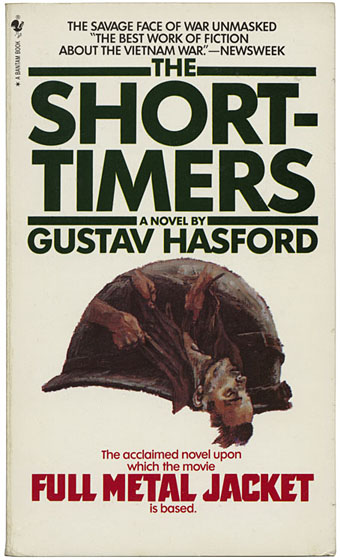
The Short-Timers (1987). No illustration credit.

Hasford’s novel was first published in the UK in this shoddy tie-in version with some generic war painting badly cropped into helmet shape in order to match the film poster. Such a good book really deserved better than this hack design. Much as I like Full Metal Jacket, when you read Herr and Hasford you have to admit that the film only captured a fraction of the horror and madness in the books. Herr’s writing is justly celebrated while Hasford’s novel seems to have been forgotten again. Anyone who likes Kubrick’s film ought to search it out, it’s an indelibly memorable and disturbing read. The sniper scene is far more brutal and chilling than its cinematic equivalent, and is delivered by stark prose like this:

The snipers zero in on us. Each shot becomes a word spoken by death. Death is talking to us. Death wants to tell us a funny secret. We may not like death but death likes us. Victor Charlie is hard but he never lies. Guns tell the truth. Guns never say “I’m only kidding.” War is ugly because the truth can be ugly and war is very sincere.

Also worth searching out is Herr’s short memoir, Kubrick, published the year after the director’s death, in which the writer describes his three-year collaboration on Full Metal Jacket‘s screenplay. It’s a generous and insightful piece of writing, worlds away from Frederic Raphael’s condescending and mean-spirited Eyes Wide Open.

Elsewhere on { feuilleton }
The book covers archive

Previously on { feuilleton }
Kubrick shirts

Virgil Finlay’s Tarzan

finlay.jpg

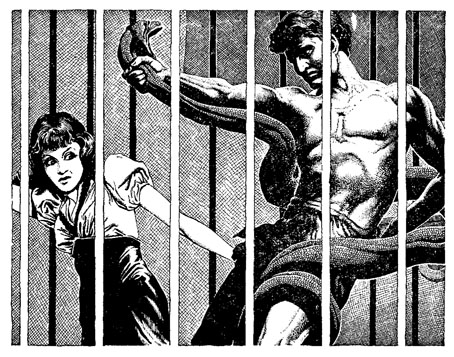
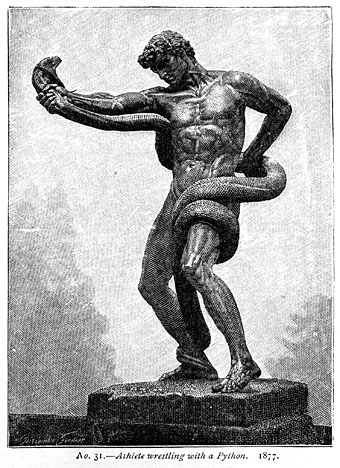
Thanks are due to Ty Reutel for alerting my attention to this one. I’d no idea that the great Virgil Finlay had illustrated Tarzan but here’s the proof, one half of an interior drawing for The Quest of Tarzan in Argosy Weekly for 1941. That’s the first surprise, the second, of course, was that Finlay had copied Frederic Leighton’s Athlete Wrestling with a Python (1877) ( below), a sculpture which has been a subject of discussion here recently. I’ve mentioned before my including Leighton’s work in one of my Lovecraft adaptations; I referred to many other artworks in those stories but never made any direct reference to Virgil Finlay even though he was the original illustrator of Lovecraft’s The Haunter of the Dark when it was first published in Weird Tales in 1936. Finlay’s illustrations for that story later appeared with some of my own in the enormous Centipede Press collection of Lovecraft art so it’s strange to find that we were also led to the same Leighton sculpture.

Tarzan illustration has been in my thoughts for the past few weeks while I’ve been at work (again!) on the collected Reverbstorm, many pages of which played variations on Burne Hogarth’s comic adaptations of the Tarzan stories. Reverbstorm is at long last very close to being finally, absolutely finished, and ready for printing in a single definitive volume. No production schedule just yet but any news will be announced here.

leighton4.jpg

Previously on { feuilleton }
Frederic Leighton’s sculptures
Virgil Finlay’s Salomé
Die Farbe and The Colour Out of Space
Lovecraft’s favourite artists revisited
Angelo Colarossi and son
The monstrous tome
Men with snakes

Maxwell Armfield’s Faery Tales

armfield01.jpg

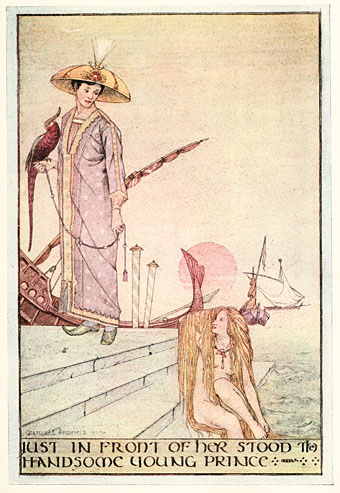
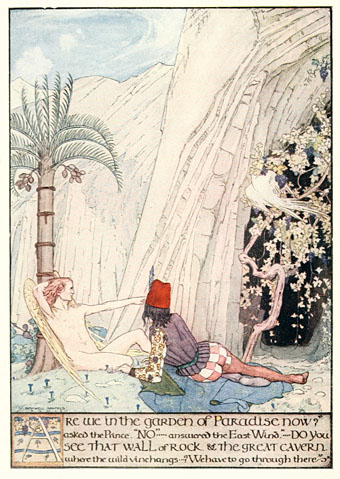
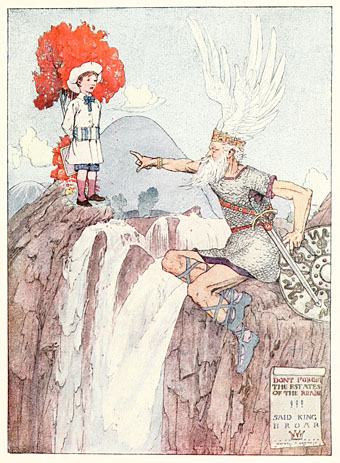
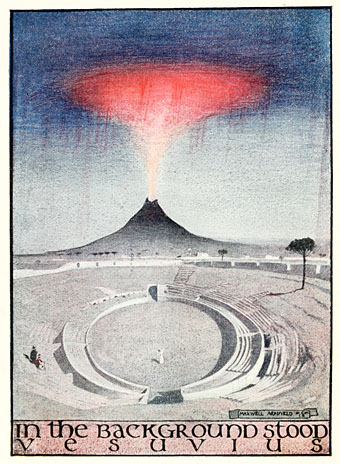
A selection of colour plates from Faery Tales from Hans Christian Andersen (1910) illustrated by British artist Maxwell Armfield. I hadn’t seen this collection before which turned up whilst searching for Tinderbox illustrations. Armfield does illustrate that particular story (here titled The Tinder Box—the title varies) but we don’t get to see the monstrous hounds. I was especially struck by the picture of Mount Vesuvius from What the Moon Saw which looks more like something by Hokusai than the usual fairy tale painting of the period.

armfield02.jpg

armfield03.jpg

armfield04.jpg

Continue reading “Maxwell Armfield’s Faery Tales”

The Tinderbox

tinderbox4.jpg

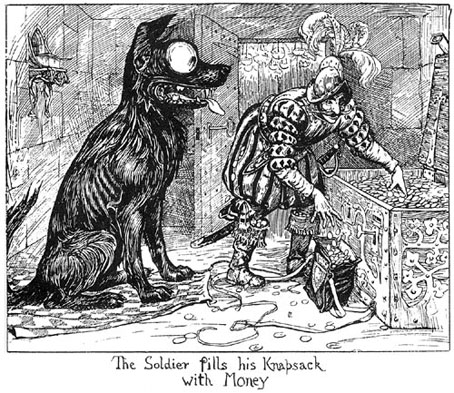
HJ Ford (1894).

“Do you see that great tree!” quoth the witch; and she pointed to a tree which stood beside them. “It’s quite hollow inside. You must climb to the top, and then you’ll see a hole, through which you can let yourself down and get deep into the tree. I’ll tie a rope round your body, so that I can pull you up again when you call me.”

“What am I to do down in the tree?” asked the soldier.

“Get money,” replied the witch. “Listen to me. When you come down to the earth under the tree, you will find yourself in a great hall: it is quite light, for many hundred lamps are burning there. Then you will see three doors; these you can open, for the keys are in the locks. If you go into the first chamber, you’ll see a great chest in the middle of the floor; on this chest sits a dog, and he’s got a pair of eyes as big as two tea-cups. But you need not care for that. I’ll give you my blue-checked apron, and you can spread it out upon the floor; then go up quickly and take the dog, and set him on my apron; then open the chest, and take as many farthings as you like. They are of copper: if you prefer silver, you must go into the second chamber. But there sits a dog with a pair of eyes as big as mill-wheels. But do not you care for that. Set him upon my apron, and take some of the money. And if you want gold, you can have that too—in fact, as much as you can carry—if you go into the third chamber. But the dog that sits on the money-chest there has two eyes as big as the round tower of Copenhagen. He is a fierce dog, you may be sure; but you needn’t be afraid, for all that. Only set him on my apron, and he won’t hurt you; and take out of the chest as much gold as you like.”

The Tinderbox (1835) by Hans Christian Andersen

tinderbox1.jpg

Helen Stratton (1910?)

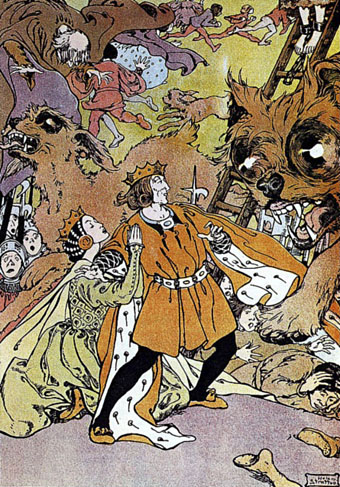
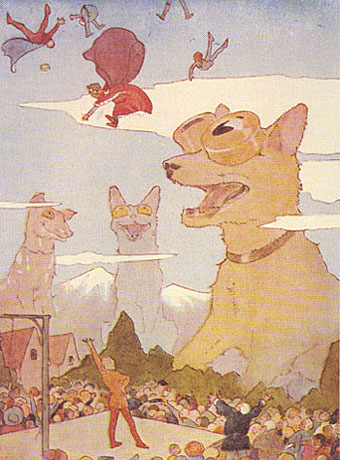
Will at 50 Watts is to blame for this one, the illustrations he posted last week were excessive enough to give even a master of exaggeration like Tex Avery second thoughts. Hans Christian Andersen’s fairy tales have proved so popular over the years that a core group of stories tend to drive out the less familiar works from fresh editions. The Tinderbox is one of these minor stories, the tale of a soldier with a magic tinderbox capable of summoning a trio of supernatural dogs with enormous eyes. My first contact with the story was via a German television adaptation, Das Feuerzeug, filmed in 1958 and later screened in the UK as filler for the children’s TV schedule along with that memorably creepy series (also from Germany), The Singing Ringing Tree. I remembered little about the story but was never able to forget those weird dogs even though their eyes in the TV version are nothing like the way they’re presented in illustrations. They may not be as freaky but the way they’re presented as huge and black makes me think now of the ghostly barghests or black dogs of British folklore.

Searching around for illustrations turned up the handful here. Many illustrators concentrate on other scenes but I’ve only been looking for the dogs. I’m sure there’s more to be found so this may well be a subject to revisit later. The Stratton and Tarrant pictures show the climax of the story when the soldier, about to be hanged for having used the dogs to kidnap a princess, summons his creatures to kill the king, queen and all the people who condemned him. Yes, it’s good wholesome fare for kids.

tinderbox2.jpg

Margaret Tarrant (1910).

Continue reading “The Tinderbox”