Weekend links 761

agate.jpg

• At Bandcamp: Marc Masters on The Curious Case of the Channeled New Age Tape; and Erick Bradshaw’s guide to Nurse With Wound.

• At Public Domain Review: Designing the Sublime – Boullée and Ledoux’s Architectural Revolution by Hugh Aldersey-Williams.

• The fifth installment of Smoky Man’s exploration of The Bumper Book of Magic has been posted (in Italian) at (quasi).

It does not follow that the scientific spirit of empirical inquiry runs against dreaming, and [André] Breton was wrong to think [Roger] Caillois’s investigative methods opposed wonder. Material mysticism led Caillois back to magical thinking, which he expanded further than the Surrealist interest in chance and coincidence as he probed for insights into the order of things. Caillois was equally, perhaps even more, fascinated with magic than the Surrealists, but he wanted to probe what might exist as phenomenally marvelous, beyond the subjective self—he was a scholar of the sacred, and from the episode of the jumping beans onwards, he looked for its character and its workings in actual phenomena. In this sense he was more of a believer—though not in a personal god or a religion. Where Breton exalted the perceiver, Caillois wanted to go beyond these anthropocentric limits.

Marina Warner on the imaginary logic of Roger Caillois

• Mixes of the week: DreamScenes – January 2025 at Ambientblog, and Unrush 093 at A Strangely Isolated Place.

• At Criterion.com: Reincarnations of a Rebel Muse – David Hudson on Delphine Seyrig.

• Old music renewed: Angherr Shisspa (Revisited) by Koenjihyakkei.

• At Dennis Cooper’s it’s Laura Dern’s Day.

Jussi Lehtisalo’s favourite music.

• Lynch music: The Beast (1956) by Milt Buckner | Honky Tonk (Part 1) (1958) by Bill Doggett | Something Wicked This Way Comes (1996) by Barry Adamson

David Lynch, 1946–2025

lynch.jpg

Photo by Frank Connor from The Elephant Man: The Book of the Film (1980).

I feel at a loss for words on this occasion, Lynch’s films have been a continual presence in my life since I saw The Elephant Man in 1981. I’d actually been thinking of watching some of them again, maybe even having a full-on Lynch season the way I did in 2018 when I watched everything in sequence, from his early shorts through to Twin Peaks: The Return which at the time had just been released on disc.

A few random thoughts:

• My first sighting of Eraserhead was on the big video screens at the Hacienda in Manchester in late 1982. Claude Bessy used to play clips from his video collection, all of them silent because a DJ was usually playing music at the same time, so you’d end up seeing confusing, contextless shots from films like A Clockwork Orange, Shogun Assassin, various Andy Warhol films, and so on. I got to see Eraserhead in full shortly after this at a proper cinema on a double-bill with George Romero’s The Crazies. The Romero was fun but the Lynch was a doorway to another world.

lynch3.jpg

Photo from Lynch on Lynch (1997).

• Anyone writing about Lynch’s early features, especially Eraserhead, ought to mention sound designer Alan Splet. Lynch himself was always full of praise for Splet; the pair worked on the soundtracks together but Splet had a unique way of processing sounds which is all over the early films from The Grandmother on. You can gauge Splet’s sonic invention by watching The Black Stallion, a Lynch-less film for which Splet won an Oscar, where the sounds of panting horses are stranger than anything in any other film about horses or horse-racing. If you were familiar with Splet’s weirdness then his absence from Wild at Heart was a significant loss; Randy Thom is a good sound designer but he’s not in the same league. As Paul Schütze noted in his Splet obituary for The Wire in 1995, the soundtrack of Eraserhead is one of the foundations of the whole “dark ambient” genre of music.

• Some favourite Splet moments in Lynch’s films: the industrial sounds that accompany Treves’ walk through the East End in The Elephant Man; the visit from the Guild Navigator at the beginning of Dune; Jeffrey’s dream in Blue Velvet.

• For all the times I’ve watched Blue Velvet I still don’t know what that thing is hanging on Jeffrey’s bedroom wall.

• Lynch films are dog films.

• It was difficult not to feel like a Lynch hipster in 1990 when the world at large was forced to confront Lynch’s imagination via Twin Peaks and (to a lesser extent) Wild at Heart. We had to endure a year of people who’d spent the past decade ignoring Lynch’s films offering their opinions, along with inane comments such as “But does he have anything to say?” It was a relief when Fire Walk With Me came out and drove away the lightweights. I remember Kim Newman pointing out in his Sight and Sound review that the Twin Peaks prequel was more of a genuine horror film than many films explicitly labelled as such. The same could be said of Lost Highway and Mulholland Drive.

lynch2.jpg

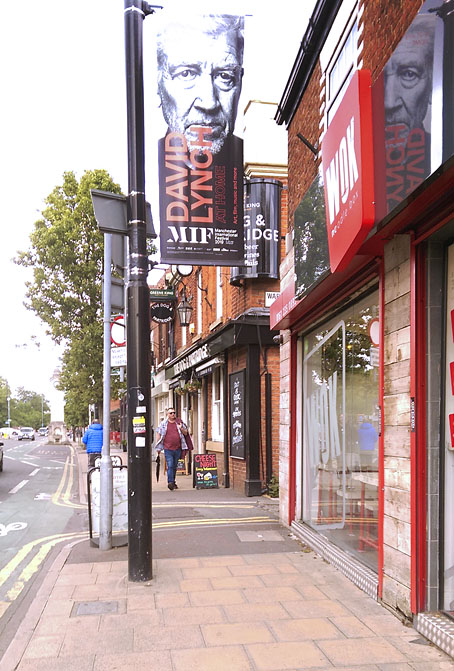
• I was pleased that Lynch was invited to contribute to the Manchester International Festival in 2019; I got to see some of his paintings and also buy Twin Peaks badges and Lynch postcards. Best of all, however, was the two weeks or so when his face was peering out of posters at tram stops and (as he is here) gazing down on pedestrians in my local high street. I’ve mentally tagged that pole as The David Lynch Lamp Post ever since.

Okay, maybe not so lost for words after all…

• Elsewhere:
(offline) Lynch on Lynch (1997), edited by Chris Rodley. 270 pages of interviews which aren’t always very revealing but which still contain a wealth of detail and anecdote about the making of the films. Also a fair amount of discussion about his paintings and other artworks.
(online) 46 issues of Wrapped in Plastic, the Lynch fan magazine.

Previously on { feuilleton }
Lynch dogs
42 One Dream Rush
Through the darkness of future pasts
David Lynch window displays
David Lynch in Paris
Inland Empire

Robert Anning Bell’s Poems by Percy Bysshe Shelley

bell01.jpg

This poetry collection was drawn to my attention a couple of weeks ago when Mr TjZ sent an email containing photos of a copy he’d recently discovered. Poems by Percy Bysshe Shelley was published by George Bell and Sons in 1902. The samples shown here are from a 1907 reprint, a “cheaper reissue” according to the print details which may explain why there’s so much print-through on the obverse side of the illustrated pages. I like Shelley’s poetry, and I like Robert Anning Bell’s illustrations; the pair work well together in this volume which looking back I see posted a link to years ago when writing about Bell’s illustrated edition of The Tempest.

bell02.jpg

The Shelley book may be a cheap reissue but several of the major poems still use red ink to highlight titles or illustrative details. The collection contains a number of Shelley’s longer works, opening with Alastor, or the Spirit of Solitude, a poem that always makes me think of Aleister Crowley. John Symonds in The Great Beast relates that Shelley was one of Crowley’s favourite poets, and that Crowley often identified himself in a pompously romantic fashion with Alastor, even though for most of his life the Beast was seldom without an attendant “Scarlet Woman” or a company of acolytes. Symonds nevertheless refers to Crowley as “Alastor” throughout his biography.

bell03.jpg

bell04.jpg

bell05.jpg

Continue reading “Robert Anning Bell’s Poems by Percy Bysshe Shelley”

Weekend links 760

varo.jpg

Ermitaño Meditando (1955) by Remedios Varo.

• Public Domain Review announces the Public Domain Image Archive. I’ve added it to the list. Meanwhile, the PDR regular postings include Francis Picabia’s 391 magazine (1917–1924).

• Among the new titles at Standard Ebooks, the home of free, high-quality, public-domain texts: The Well at the World’s End by William Morris.

• At Smithsonian Magazine: “See 25 incredible images from the Wildlife Photographer of the Year Contest”.

The ideas are more complex than the presentation suggests, but not vastly. Neither is it exactly breaking new ground. Art is everywhere, they say, from fingernails to fine dining; art is not a message to be decoded, but takes on new meanings in the mind of each viewer; art allows us to experience emotions in a “safe” context, like a form of affective practice; art helps us to imagine new worlds, thereby expanding the boundaries of what’s possible in the real world. The point isn’t to be original, though, but to distil a lifetime’s worth of practical wisdom and reflection. The result is a kind of joyous manifesto: just the thing to inspire a teenager (or adult) into a new creative phase. Eno and Adriaanse conclude with a “Wish”: that the book helps us understand that “what we need is already inside us”, and that “art – playing and feeling – is a way of discovering it”.

Brian Eno and Bette Adriaanse talking to David Shariatmadari about their new book, What Art Does: An Unfinished Theory

• “Crunchie: The Taste Bomb!” DJ Food unearths four psychedelic posters promoting Fry’s Crunchie bars.

• New music: Music For Alien Temples by Various Artists, and Awakening The Ancestors by Nomad Tree.

• At Wormwoodiana: Mark Valentine lays out a history of the Tarot in England.

Sun Ra & His Intergalactic Research Arkestra live on German TV, 1970.

• At Dennis Cooper’s: Chris Marker Day (restored/expanded).

• At the BFI: Anton Bitel on 10 great Mexican horror films.

Matt Berry’s favourite albums.

Tarot (Ace of Wands Theme) (1970) by Andrew Bown | Tarotplane (1971) by Captain Beefheart And His Magic Band | Tarot One (2012) by Tarot Twilight

Copyright-free images

images.jpg

In recent discussions about AI ethics I’ve been seeing the same question raised by commenters, something like the following: “Okay, this stuff is bad…but if we shouldn’t use it then what can I use instead for my book cover/album cover/Substack article…?” This post is intended to provide one answer to the question, a guide to some of the more substantial alternatives for those who complain they can’t afford to hire a human being to decorate their work. Many of these archives have been around for years but searching for single images doesn’t always bring you to a useful copyright-free solution right away, especially if you’re using Google’s deteriorated service.

Wikimedia Commons. An obvious yet indispensible resource, especially for illustration research, and one that’s continually updated and improved. I only noticed recently that Wikimedia now has very large scans of Ernst Haeckel’s Kunstformen der Natur that are much better quality than the books at the Internet Archive.

The Internet Archive. And speaking of which… The Internet Archive has its own images section but for years now I’ve been mining the texts section looking for illustrated books. This isn’t an ideal solution for most purposes, not when the best material is often hidden under blank library covers, but persistence can be rewarding, especially where old engravings are concerned. Many of the 19th-century illustrations sold by stock libraries may be found here for free.

Gallica. The public face of the Bibliothèque Nationale of France, and a very useful resource despite being cursed with a slow and buggy interface. There’s also a Gallica app but you’re better off using the website.

Library of Congress. Excellent for anything to do with US history. Also a great selection of photochromes, among other things.

NYPL Digital Collections. “Explore 1,060,155 items digitized from The New York Public Library’s collections.”

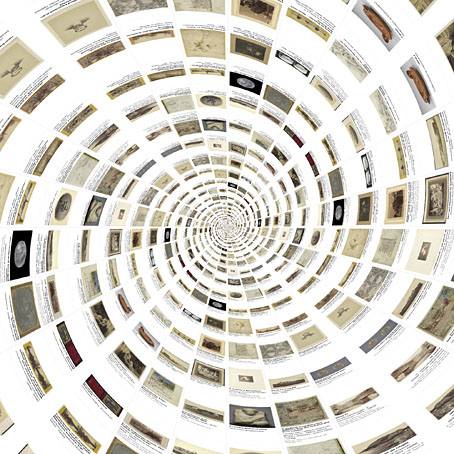
Public Domain Image Archive. “Explore our hand-picked collection of 10,046 out-of-copyright works, free for all to browse, download, and reuse. This is a living database with new images added every week.”

Smithsonian Open Access & Smithsonian Image Gallery

Biodiversity Heritage Library. Animals and plants.

Wellcome Collection. Public domain medical (and related) images.

Metropolitan Museum of Art Open Access.

The Getty Museum Open Content.

The British Library Flickr Albums. A shame it’s Flickr, they really ought to have a dedicated site of their own for images.

Europeana. “Discover Europe’s digital cultural heritage.”

David Rumsey Map Collection. Maps, maps and more maps.

NASA Image and Video Library. NASA materials have always been free to use so long as you also credit their source.

ESO. ESO is the European Southern Observatory which is housed at a number of sites in the Chilean Atacama Desert. As with NASA, the high-resolution images created there are free to use so long as credit is included.

National Library of Medicine. “Images from the history of medicine.”

Pixabay. “Stunning royalty-free images & royalty-free stock.”

Pexels. “The best free stock photos, royalty free images & videos shared by creators.”

Unsplash. “All images can be downloaded and used for personal or commercial projects.”

Exotic Animal Photo Reference Repository. “Artists creating derivative or transformative works without Generative AI have blanket permission to reference these photos.”

Heidelberg Universitäts-Bibliotek: Art and satirical periodicals. An invaluable resource for European periodicals of the late 19th/early 20th centuries, with downloadable of scans of The Studio, The Yellow Book, Ver Sacrum, Pan, Jugend, and many other titles. Heidelberg is only one of many university libraries which now make parts of their collection available as free downloads. I’d love to point the way to the best of the others but I don’t have a useful list to hand. A recent discovery, however, is Polona, the site for the National Library of Poland which has a large quantity of prints and photographs as well as whole books. Happy searching!

Update: Added a few more links.