Weekend links 409

steppenwolf.jpg

Poster for Steppenwolf (1974), a film directed by Fred Haines (his only one) based on the novel by Herman Hesse, and starring Max von Sydow and Dominique Sanda. No artist or designer credited.

• “…in her 20s, she heard two elderly folk singers and was struck by their ‘gentle dignity’. It cemented her own philosophy: ‘No dramatising a song, no selling it to an audience, no overdecorating in a way that was alien to English songs, and most of all, singing to people, not at them.'” Laura Snapes on Shirley Collins and her memoir, All in the Downs.

• Many of the BBC’s sound effects were available for years in necessarily small collections on vinyl, tape and CD. Now you can download over 16,000 of them for free here. The interface is still primitive so try typing some words into the search box to see what shows up.

Carl Swanson on Natalie Frank’s paintings based on Pauline Réage’s Story of O, and the problems these caused when she tried to exhibit them.

• Pictures of the Jazz Age: Regina Marler reviews three books about photographer Berenice Abbott.

• “The late Juraj Herz was a one-man wave of Czechoslovak horror,” says Kat Ellinger.

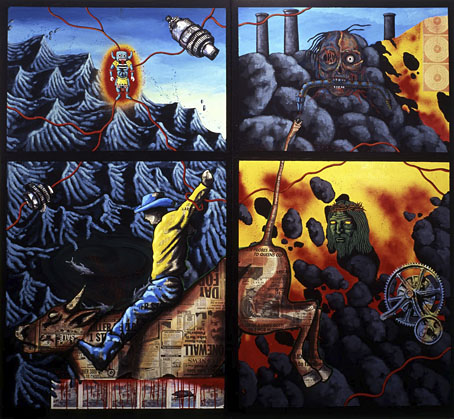
Mark Dery on William S. Burroughs and the dead-end horror of the Centipede God.

• Mixes of the week: FACT mix 648 by Laraaji, and XLR8R Podcast 538 by Fluxion.

Kashmir by Forming The Void, and Kazakhstan by Brian Eno.

• At Dennis Cooper’s: Dominique Sanda Day.

PixaTool by Kronbits.

Born To Be Wild (1968) by Steppenwolf | Steppenwolf (1976) by Hawkwind | Der Steppenwolf (2015) by Selofan

The Smoke

smoke01.jpg

London in 1898 was the most populous city in the world, a metropolis of “four million souls” as Arthur Conan Doyle continually reminds us in the Sherlock Holmes stories. The stereotypical representation of London in the 19th century is of a city wreathed in fog but the reality was closer to the dense smogs that plague Chinese cities today. The four million souls heated themselves by burning wood and coal, and the resulting smoke (and a fair amount of steam, no doubt) combined with the British climate to create the noxious, tinted “fogs” that fill the streets of Victorian fiction.

smoke02.jpg

Whatever the health hazards, the vaporous atmosphere had its champions in artists such as Claude Monet and James Whistler, both of whom relished the way the smoky air softened the silhouettes of the city. William Hyde may be added to the list for this superb series of etchings showing London at its most tenebrous, another chance discovery at the Internet Archive. London Impressions is an ambivalent celebration of the capital as a city of shadows, smoke and fog, the essays by Alice Meynell ruefully admitting that while the industrial cities of the north may rival London for their polluted atmosphere, their smaller size means that blue sky is never far away, something the Londoner of 1898 couldn’t take for granted. This is a marvellous book, and one I’d love to own if it wasn’t so rare; there’s a copy on eBay at the moment for $1,640. At least we can read it (and download the pages) here.

smoke03.jpg

smoke04.jpg

smoke05.jpg

smoke06.jpg

smoke07.jpg

smoke08.jpg

Continue reading “The Smoke”

Weekend links 408

sasada.jpg

Kujaku (2018) by Yasuto Sasada.

• “The Ernst picture [Of This Men Shall Know Nothing] has also been interpreted as depicting sexual alchemy, which also ties in with much of Peter Grey’s writing on Babalon and the goddess’ connection to sexual magic and the three ‘Fs’: f(e)asting, flagellation and fucking!” Hawthonn’s Phil & Layla Legard talk to Folk Horror Revival about their superb new album, Red Goddess (of this men shall know nothing).

• South London “Psychic Circuit”: A walk with London writer Iain Sinclair inspired by cult writer Steve Moore—from Shooter’s Hill and the Shrewsbury burial mound to Charlton House then Maryon Park and the locations used in Antonioni’s Blow Up.

• Czech filmmaker Juraj Herz, director of The Cremator (1969) and Morgiana (1972), died last week. One of his later films, The Ninth Heart (1978), featured an animated title sequence by Jan Švankmajer and Eva Švankmajerova.

• The week in psychedelic visuals: Ben Marks on Bill Ham’s San Francisco light shows (a piece from 2016), and Dangerous Minds on Astralvision’s Electric Light Voyage (1979), a light show on Betamax tape.

• “From glaciers to nuclear bunkers, photographer Chloe Dewe Mathews descends into the dark heart of the Swiss mountains that inspired Mary Shelley.”

• Mix of the week: Secret Thirteen Mix 250 by Sote, and XLR8R Podcast 537 by SNTS.

When The Horses Were Shorn Of Their Hooves, new music by Dylan Carlson.

Emily Temple on Edward Gorey’s illustrated covers for literary classics.

Hidden Hydrology: Coil’s Lost Rivers studio sessions.

Tube: Minimalist YouTube search

Sukhdev Sandhu is In Wild Air

• Lost Roads (1988) by Bill Laswell | Lost Sanctum (1994) by Lull | Lost Ways (2016) by Pye Corner Audio

Weekend links 407

alonso.jpg

Cover art by Alonso for a 1929 Spanish edition of The Canterville Ghost by Oscar Wilde.

• Major music news of the week is the announcement, after a hiatus of nine years, of a new Jon Hassell album. Listening To Pictures (Pentimento Volume One) will be released on Hassell’s new label, Ndeya, in June. Meanwhile, Paul Schütze has a new album (also his first in a long while), The Sky Torn Apart, released at the end of this month by Glacial Movements. For those impatient for new sounds, Red Goddess (of this men shall know nothing) by Hawthonn is out now, and very good it is too.

Ghost Story (1974): a British film directed by Stephen Weeks, and starring (among others) Marianne Faithfull, Penelope Keith, Murray Melvin and (in a rare appearance) Vivian MacKerrell, the real-life model for Withnail from Bruce Robinson’s Withnail and I. Also from 1974, a TV adaptation of Oscar Wilde’s The Canterville Ghost starring David Niven.

Nandini Ramnath on how an Indian film distributor in London (Mehelli Modi of Second Run DVD) is helping rescue forgotten classics from obscurity.

Simon Reynolds explains why he thinks Boards of Canada’s Music Has the Right to Children is the greatest psychedelic album of the ’90s.

• At I Heart Noise: an interview with Dylan Carlson about his forthcoming solo album, Conquistador.

• At Dennis Cooper’s: David Ehrenstein presents…Donald Cammell Day.

• Photos by David Graham of Mexico City’s “gay subway”.

Circuit Des Yeux‘s favourite albums.

The Gospel of Filth: a book list.

Fountain Of Filth (1974) by Devo | The Heart’s Filthy Lesson (1995) by David Bowie | Filthy/Gorgeous (2004) by Scissor Sisters

Décorations Peintes pour Devantures et Intérieurs de Magasins

guedy01.jpg

Once again, I was going to post something more substantial this week but I’m still exceptionally busy, and my plans were further thwarted by the arrival in my RSS feed of this new upload at the Internet Archive. Décorations Peintes pour Devantures et Intérieurs de Magasins is a short but beautiful collection of Art Nouveau signs and shopfronts compiled by Henry Guédy. The date—1905—places it near the end of the Art Nouveau movement but the style was evidently still popular enough at this point to warrant a guide for sign painters looking for something à la mode. The shopfront photos show the commercial application of the style in Parisian streets, although many of these façades will have since been replaced by less adventurous designs (see this post for an example). Monsieur Guédy’s book may be viewed in full and downloaded here.

guedy02.jpg

guedy03.jpg

guedy04.jpg

guedy05.jpg

guedy06.jpg

guedy07.jpg

guedy08.jpg

Previously on { feuilleton }
Hector Guimard’s Castel Béranger
Chemiserie Niguet
Rue St. Augustin, then and now
Hector Guimard elevations
Infernal entrances
Hector Guimard sketches
Temples for Future Religions by François Garas
Elizabetes Iela 10b, Riga
Atelier Elvira
Louis Bonnier’s exposition dreams
The Maison Lavirotte
The House with Chimaeras