Weekend links 825

demeric.jpg

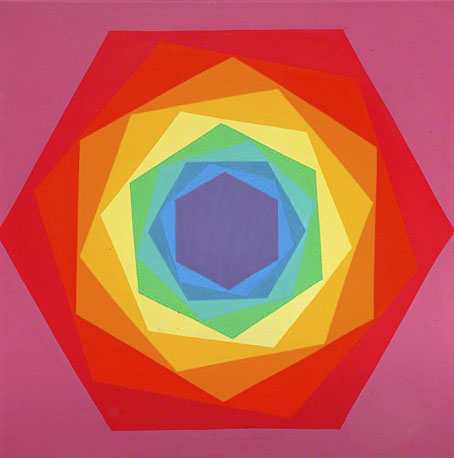
Hexagon Sequence II (c. 1970) by Rosalie de Meric.

• Boards Of Canada obsessives have been in a frenzy this week following the appearance of mysterious VHS cassettes sent at random to a small number of users of the Warp Records mail-order service. The contents of the tapes look like this. With the group having been silent for the past thirteen years there’s been an understandable flood of wild speculation on the BOC Reddit page, the supposition being that the tapes (and now an equally cryptic set of posters) mean that a new record release is on the way. We’ll find out soon enough. In the meantime, here’s DJ Food’s O Is For Orange 2025 (version 3), a Boards Of Canada-themed mix that I neglected to link to last year.

• “There is no artistic process that isn’t magical in that it’s an attempt to magically conjure an idea, something that is invisible and intangible, into material form…” Alan Moore (again) talking to Dominique Musorrafiti about art and magic. Also the comics business, which people really ought to stop asking him about when his reluctance to discuss his old work is so evident.

• “I’m not a commercial director—I’m not even a professional film-maker.” Jim Jarmusch talking to Amy Raphael about his career and his latest film, Father Mother Sister Brother. At Little White Lies, Claire Biddle examines the music in Jarmusch’s films and his collaborative albums.

• “Painting and sculpture influenced me greatly. You start to see the world, the outside, everything around you, the tone, with the eyes of seeing a picture that’s framed.” Irmin Schmidt talking to Adelle Stripe about his early life and Requiem, his new album.

• New music: All Clouds Bring Not Rain by Memorials; Afterlife Requiem by Those Who Walk Away; Where Light Pauses In The Silence Of The Sun by Abul Mogard & Rafael Anton Irisarri.

• At Colossal: Daniel Sackheim traverses Los Angeles’ noir side in The City Unseen.

• At Bandcamp Daily: Jim Allen on the sound of the ’70s French Underground.

• At the BFI: Rory Doherty selects 10 great Australian debut features.

• NASA Johnson

• Hexagon (1990) by Ruins | Octagon (1994) by Basic Channel | Triangles And Rhombuses (1998) by Boards Of Canada
Weekend links 824

earth.jpg

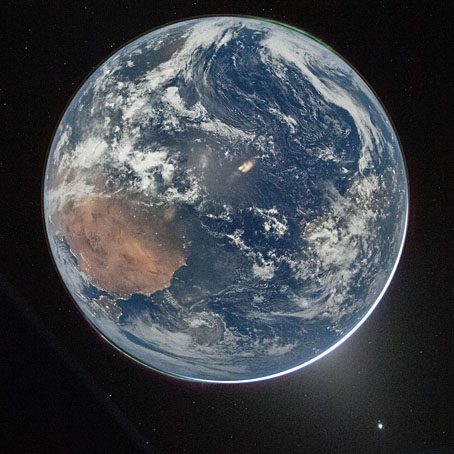
“A view of Earth taken by NASA astronaut and Artemis II Commander Reid Wiseman from one of the Orion spacecraft’s windows after completing the translunar injection burn on April 2, 2026. The image features two auroras (top right and bottom left) and zodiacal light (bottom right) is visible as the Earth eclipses the Sun.”

• I was surprised this week to find myself quoted by David Hudson at Criterion Current in an overview of the schedule for Cold War Visions: Nuclear Anxiety in Eastern Bloc Cinema, a short season of films that will be showing at the Barbican throughout this month. One of those films is Andrei Tarkovsky’s Stalker, a cult film round here, which a handful of lucky Londoners will be able to see on a big screen.

• 邪神三十六景 (Thirty-six Views of the Evil Gods) is collection of drawings by Takeki Yamada that combine Hokusai’s celebrated views of Mount Fuji with beings from Lovecraft’s Cthulhu Mythos. I’m a little underwhelmed by the results but the book is out there for those who want it.

• Among the new titles at Standard Ebooks, the home of free, high-quality, public-domain texts: Last and First Men by Olaf Stapledon. (Previously)

• Coming soon at Unquiet Things: The Art of the Unknown: A Visual Treasury of the Esoteric, Uncanny, and Unexplained by S. Elizabeth.

• At Public Domain Review: Elizabeth I’s manuscript copy of Pierre Boaistuau’s Histoires Prodigieuses (1559).

• New music: Enter the Nuummite Cosmos by Brotherhood Of Sleep.

• At the BFI: Where to begin with Peter Weir.

• A Brief History of the Dust Jacket.

• Out Of The Unknown (1984) by Died Pretty | Brian’s Nightmare / The Unknown, Part One (2005) by Robin Guthrie / Harold Budd | A Gift Of Unknown Things (2017) by Teleplasmiste

Tadami Yamada’s weird covers

yamada01.jpg

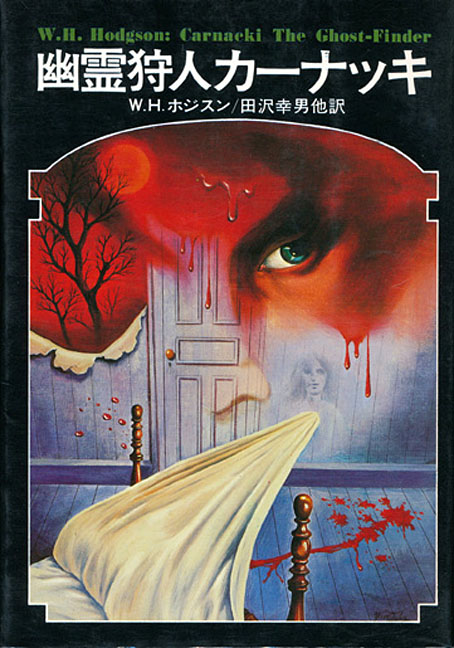
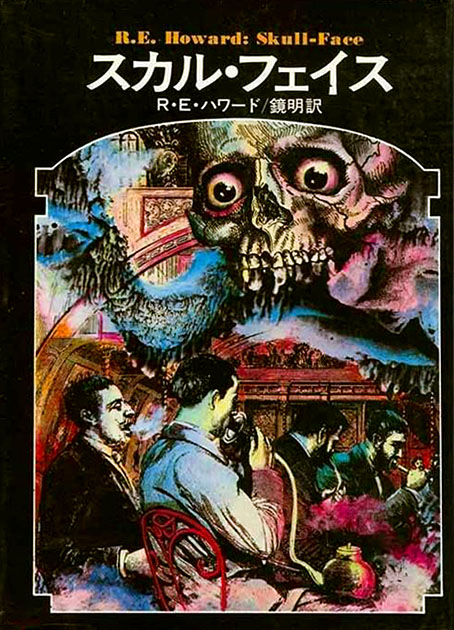
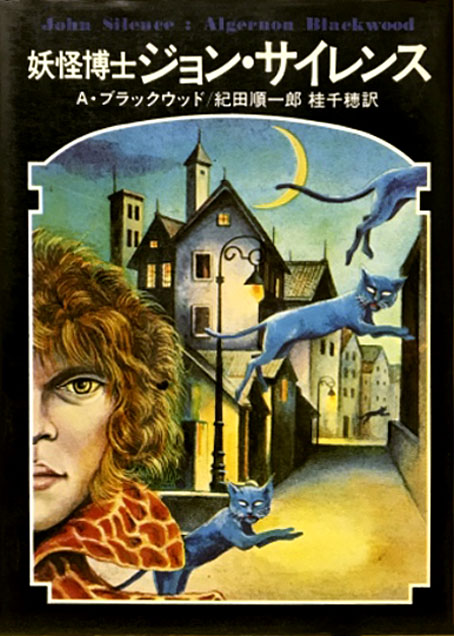
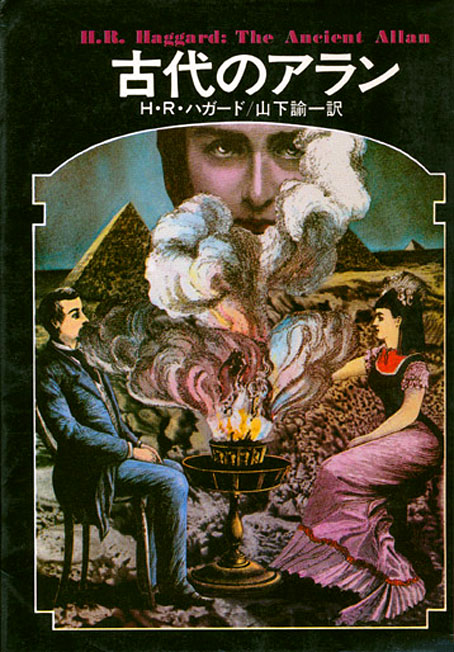
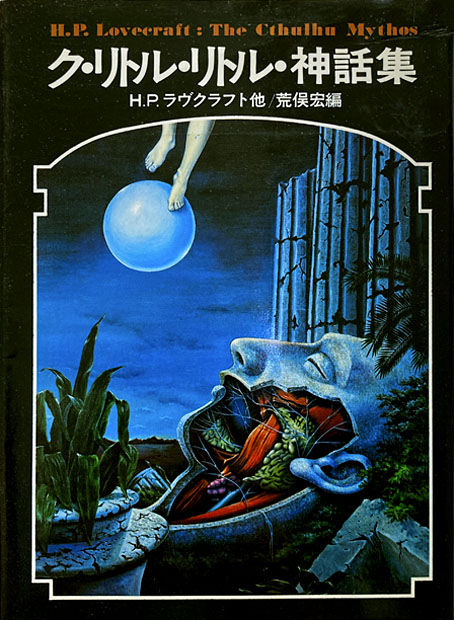
Earlier this year when I wrote about Tadami Yamada’s illustrations for William Hope Hodgson I mentioned the existence of books by other authors that were published along with the Hodgson as part of a series. Kokusho Kankōkai published ten of these books from 1976 to 1977, most of them being collections of short horror fiction by European and American authors, with the series as a whole being referred to as the “Dracula” editions. Yamada painted the covers and provided interior illustrations for eight of the books, including, as I suspected earlier, a Lovecraft collection. I was hoping I might be able to find copies of his interiors for the Lovecraft but so far nothing has turned up, Yamada’s web pages only featuring illustrations from the Hodgson and Henry S. Whitehead collections. Searching elsewhere is complicated by a number of factors such as the age of the books, their being Japanese publications, and the sheer quantity of Lovecraft-related material to sift through.

yamada04.jpg

Yamada says that his illustrations weren’t appreciated by readers who were expecting more typical horror imagery. This doesn’t surprise me given the Surrealist tenor of his work as a whole. The Hodgson illustrations are relatively orthodox but many of his other book illustrations from this period are collages that resemble the simpler things Max Ernst was doing in his collage novels. Collage is also evident on the “Dracula” covers, together with decalcomania, another Surrealist technique visible in the Hodgson illustrations. These books are a minor diversion in Yamada’s wide-ranging career but, as is often the case with Asian publications, none of them are currently listed at ISFDB. I’d still like to see his Lovecraft illustrations, if only to assuage my curiosity.

yamada07.jpg

yamada05.jpg

yamada03.jpg

Continue reading “Tadami Yamada’s weird covers”

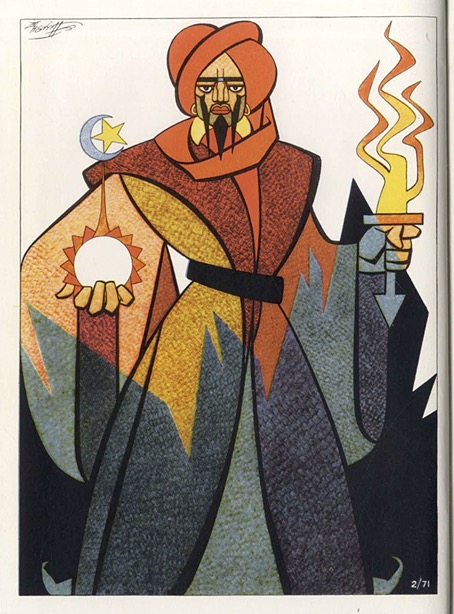
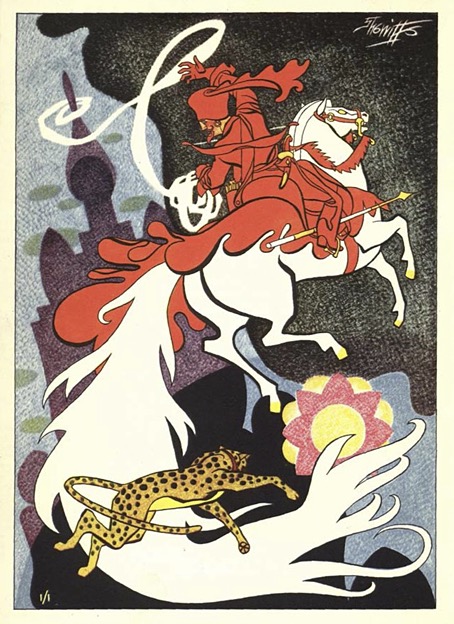
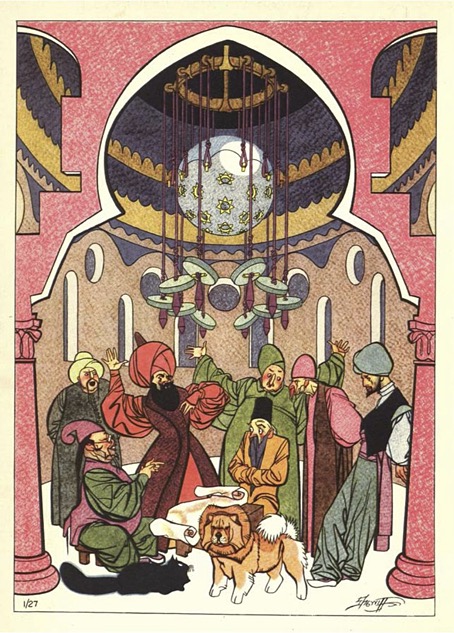
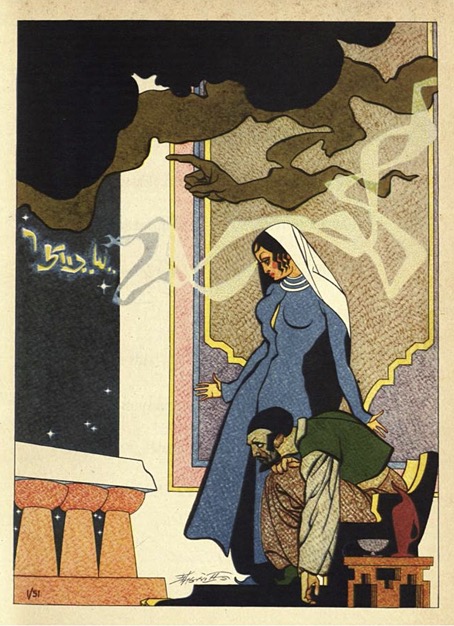
RS Sherriffs’ Rubáiyát

sherriffs01.jpg

You can’t really say there are always more Rubáiyáts—the Fitzgerald translation isn’t as popular today as it was a century ago—but there are many illustrated editions even though the poem makes for a slim volume when not bulked out by variant translations. The popularity of the text when combined with the ease of imitating Edward Fitzgerald’s quatrains led to the publication of many novelty versions—The Rubáiyát of a Persian Kitten, The Rubáiyát of a Motor Car, The Rubáiyát of a Bachelor, and so on—all of which came with their own illustrations.

sherriffs02.jpg

The 1947 edition illustrated by Scottish artist Robert Stewart Sherriffs is more serious than these, with an introduction by Laurence Housman, the texts of three different 19th-century translations, together with supplementary material about Edward Fitzgerald. Sherriffs worked for a number of years as a caricaturist for Punch magazine and other publications but prior to this he was also a book illustrator. Most of his drawings are black-and-white ink renderings; the Rubáiyát is a rare example of him working in colour throughout.

sherriffs03.jpg

sherriffs04.jpg

sherriffs05.jpg

Continue reading “RS Sherriffs’ Rubáiyát”

Weekend links 822

tomaselli.jpg

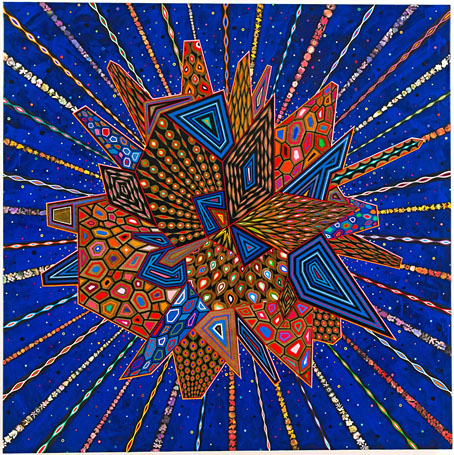
Untitled (2013) by Fred Tomaselli.

• The latest book from A Year In The Country is Ghost Signals: The Shadowlands of British Analogue Television 1968–1995, an exploration of “a shadowland of terrestrial TV hidden in plain sight across the unmediated and unmarketed corners of the internet”.

• New music: After The Rain, Strange Seeds by The Leaf Library; Music For Intersecting Planes by Leila Bordreuil + Kali Malone.

• RIP airbrush artist Philip Castle. Steve Mepstead talked to Castle in 2011 about his work for Stanley Kubrick and others.

Strassman began to see patterns in these encounters and created a typology: aliens; guides and helpers; clowns, jokers and jesters; elves and dwarves; or reptilian or insect-like figures. Variations and outliers notwithstanding, this spectrum remains remarkably consistent with DMT studies today. Strassman also looked into the historical literature and found similar descriptions as far back as Szára, who wrote that one of his subjects reported meeting “dwarfs or something.” Forty years later and a continent away, one of Strassman’s participants put it succinctly: “That was real strange. There were a lot of elves.”

A long read by Joanna Steinhardt on the history and nature of hallucinated spirit guides and “self-transforming machine elves”

• Jet Propulsion Laboratory: Ben Cardew on the pivotal role of Stereolab’s Super-Electric.

• At Colossal: Pejac transforms basic graph paper into detailed, trompe-l’œil tableaux.

• Sixty finalists from the 23rd Annual Smithsonian Magazine Photo Contest.

• At BLDGBLOG: The landscape architecture of auroras on demand.

• Mix of the week: Float V mix by DJ Food.

• We Have Always Been Here (1995) by ELpH vs Coil | 5-Methoxy-N,N-Dimethyl- (5-MeO-DMT) (1998) by Time Machines/Coil | Machine Elves (2024) by Polypores