Weekend links 20

wulfing.jpg

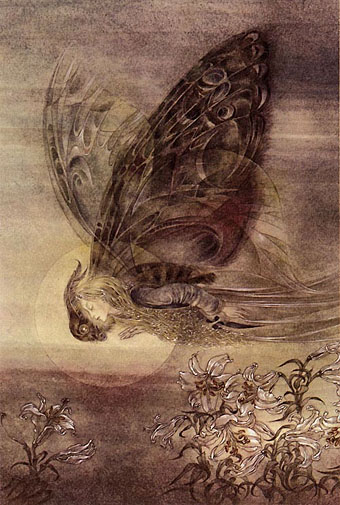
Transfiguration (1952) by Sulamith Wülfing.

• Observatory posted photos of its Lovecraft art exhibition; see if you can spot my pics. Related: Write Club has more photos. Also, A Word From Our Sponsor.

Taking the broooooaaaaad view of things: A Conversation with James Grauerholz on William S. Burroughs and Magick. Related: Beat Memories—The Photographs of Allen Ginsberg.

• Adam Curtis on BP and the Axis of Evil; how the the Anglo-Iranian Oil Company became British Petroleum and helped give Iran over to the Ayatollahs.

• The Quietus interviews Peter Christopherson (TG, Coil, etc) and Dr John.

The Strange World of Adolf Hoffmeister at A Journey Round My Skull.

An Artists’ Dialogue On CocoRosie’s Grey Oceans at Stereogum.

Werner Herzog and David Lynch combine their talents.

Jon Savage on The Residents versus The Beatles.

• BUTT magazine interviews James Bidgood.

• The Daily Drop Cap.

The Gay Rub.

Can on German TV in 1971.

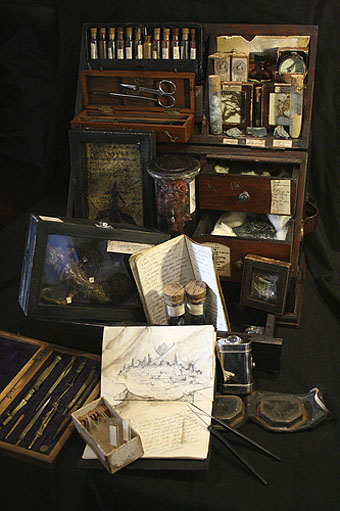
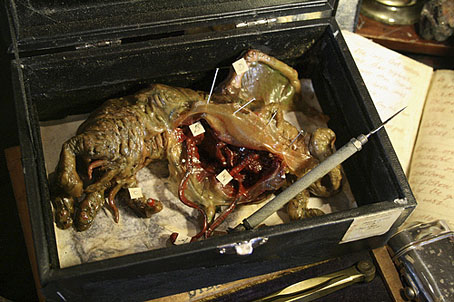
The specimens of Alex CF

alexcf1.jpg

Artist Alex CF makes beautifully detailed—and very authentic—cases for cryptozoological specimens. I think I’d seen examples of these before but not the Lovecraft exhibits like this collection which presents samples and studies retrieved from the Mountains of Madness. Among other Lovecraftiana there’s also a case devoted to artefacts from R’lyeh. These would have been ideal additions to the Lovecraft show at Observatory which (as a reminder) opens this Friday.

Via ~Wunderkammer~. (I think. If it wasn’t, it should be…)

alexcf2.jpg

Previously on { feuilleton }
At the Mountains of Madness
Walmor Corrêa’s Memento Mori
The art of Ron Pippin
Custom creatures
Cryptozoology
The Museum of Fantastic Specimens

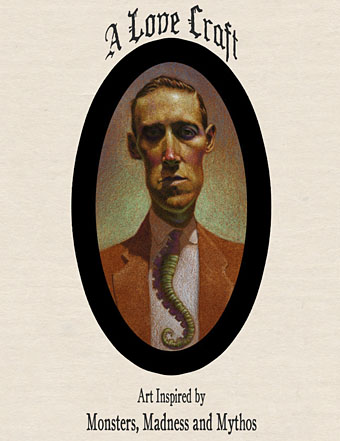
A Love Craft: Art Inspired by Monsters, Madness and Mythos

alovecraft.jpg

Painting by Matthew Buck.

I’ve linked in the past to previous shows at Observatory, an arts and events space in Brooklyn, NY, so I’m very pleased to be contributing to their forthcoming exhibition, A Love Craft: Art Inspired by Monsters, Madness and Mythos, which takes HP Lovecraft’s work as its theme. Other participants will include Aeron Alfrey, Esao Andrews, Matt Buck, Paul Carrick, Melita Curphy, Mike Dubisch, Bob Eggleton, FuFu Frauenwahl, Cyril van der Haegen, Dan Harding, Stephen Hickman, Joshua Hoffine, Kurt Komoda, Dieter Van der Ougstraete, Greg Ruth, Johnny Ryan, Andrew Scott, Allison Sommers, and AJ Wagar.

whateley.jpg

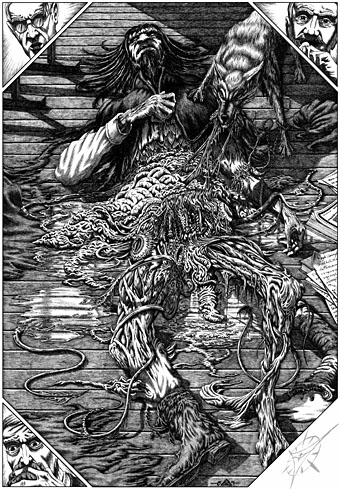
Wilbur Whateley from The Dunwich Horror (1989).

Prints of four of my Lovecraft-related works will be on display including everyone’s favourite rendering of Wilbur Whateley’s terminal moment from The Dunwich Horror. Visitors will have a rare opportunity to see my ink drawing of R’lyeh at a large size. I’m also told that prints of various works will be available for purchase but you’ll have to either visit the exhibition or contact Observatory for further details.

A Love Craft opens on Friday, June 11th at 7:00pm and runs to July 23rd, 2010.

Previously on { feuilleton }
The monstrous tome
Lovecraftian horror at Maison d’Ailleurs

Frank Frazetta, 1928–2010

frazetta1.jpg

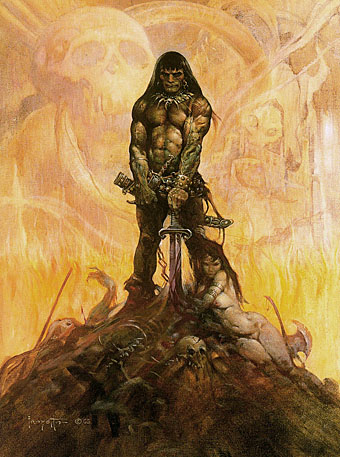
Conan the Adventurer aka The Barbarian (1965).

How to appraise Frank Frazetta? In November last year I wrote about this Conan portrait for an SF Signal Mind Meld feature on favourite book covers:

The covers that launched a thousand imitators. Lancer’s series of Conan books in the 1960s were the first appearance of Howard’s barbarian in paperback and came sporting cover art by Frank Frazetta. A great example of artist and subject being perfectly matched, these are the standard by which all subsequent barbarian art must be judged. Frazetta’s painting of a brooding warrior lord (which he reworked slightly for its poster edition) is for me the definitive portrait of Howard’s hero, battle scarred and proudly malevolent, with a chauvinistic blur of trophy female clinging at his feet. Other artists can do the muscles and monsters but none capture the physical presence and brute animality of Howard’s characters the way Frazetta does.

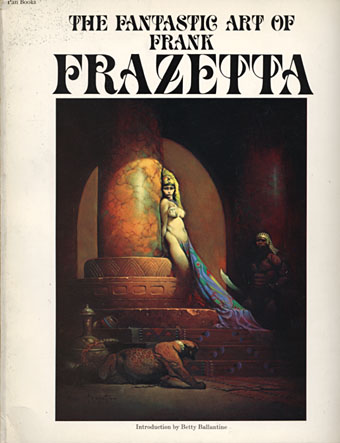
I found Frazetta’s work through the great series of fantasy art books which Pan/Ballantine published in the 1970s. I hadn’t read any Robert E Howard at the time, I only knew the diluted version of the Conan character in the Marvel comics series but Frazetta’s work was so powerful it was a spur to search out Howard, especially when I read that the writer had been a pen-pal of HP Lovecraft. I was never as interested in Frazetta’s other staple inspiration, Edgar Rice Burroughs, probably because Tarzan was too familiar from films and TV.
larkin_frazetta1.jpg

The Fantastic Art of Frank Frazetta (1975).

Both Howard and Frazetta defined a milieu which combined an intensity of vision with a projection of their own personalities into the worlds they created. (Many of Frazetta’s protagonists resemble their creator.) Both suffered from having that intensity of vision watered-down by ham-fisted imitators or the vulgarisations of films and comics. At their best, Howard’s Conan stories are a blend of heavyweight adventure story with supernatural horror; many of them were first published in Weird Tales magazine alongside other masters of the weird like Lovecraft and Clark Ashton Smith. What impressed me about Frazetta’s paintings was the way he managed to capture a sense of eldritch weirdness as well as the more obvious barbaric adventure in a manner which eluded so many of the sword and sorcery illustrators who followed. What’s even more remarkable when you read interviews is that he seemed to do all this instinctively. He’d learned from looking at earlier artists such as J Allen St John, Howard Pyle, Frank Schoonover and Roy Krenkel, and found the means to apply their painting style to his own internal aesthetics and sense of drama.
frazetta3.jpg

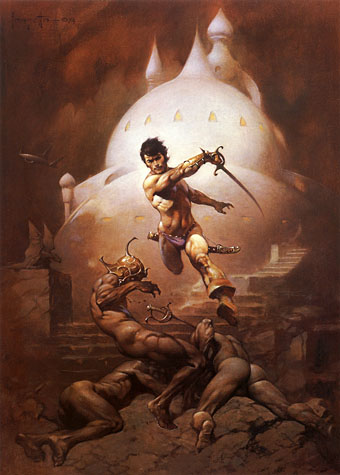
Swords of Mars (1974).

Aesthetics is one of the things I always come back to with Frazetta. I used to pore over these paintings wondering how it was that all the details of weapons and decor seemed absolutely right. Nothing was ever over-worked or too elaborate. Where did this invention come from? The other obvious feature is a raw sexiness which pervades everything. I’ve had people tell me that Frazetta must have been bisexual because of the equal care he lavished on his male and female figures. I’ve always disagreed with this. The point about Frazetta’s world is that everything is sexy: the people, the decor, the architecture, the animals, even the monsters; naturally the men are going to be as sexy as the women. In addition, he wasn’t afraid of giving his men real balls (so to speak) unlike the endless parade of costumed eunuchs filling the comic books. These figures may be dealing death but they’re filled with vigour and life when they’re doing it.
frazetta2.jpg

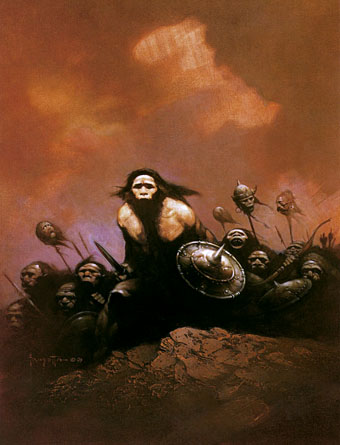
Bran Mak Morn (1969).

I said everything is sexy; I’ll make an exception for the extraordinary painting of Bran Mak Morn and his tribal horde, a picture of feral nightmarishness that goes beyond mere illustration and makes you feel the artist has shown you an atavistic glimpse of ages past. Robert E Howard would have been thrilled to see his characters brought to life with this kind of visceral intensity. For years Howard’s fiction was dismissed as pulp, now he’s a Penguin Modern Classic. And it’s as a modern classic that I’ll continue to think of Frank Frazetta.

Unofficial gallery site

Elsewhere on { feuilleton }
The illustrators archive

Previously on { feuilleton }
Frazetta: Painting with Fire
The monstrous tome
Men with snakes
My pastiches
Fantastic art from Pan Books
Weekend links: the queer edition

queer.jpg

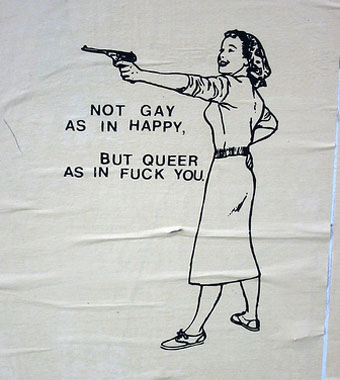
A T-shirt design by artist Daryl Vocat.

Tove Jansson: Out of the Closet. The unorthodox life and work of the woman who gave us the Moomins.

Submissions are now open for PANK’s October special online issue featuring Queer prose, poetry & art.

• More new magazines: Zeus and Made in Brazil Magazine, the latter being a spin-off from the justly-praised weblog of Brazilian hotness.

• An old magazine, called, er…Magazine: “Everything about Magazine was new, from the stark photoless cover design with its bold typeface to the way the men were photographed. The pictures weren’t overtly sexual, but proudly confronted the viewer in a different way: “To us, showing a face was the most important thing because back in 1980, gay people still had to hide their faces,” Lestrade says.” A few pictures from Magazine.

Revealed: The Tradition of Male Homoerotic Art, an exhibition at the Leslie-Lohman Gallery, NYC, from May 12th.

• The programme for the International Dublin Gay Theatre Festival which is running to May 16th.

scissors.jpg

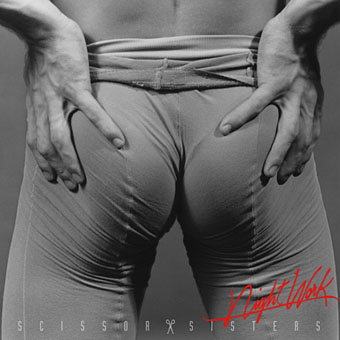
Scissor Sisters have a new album, Night Work, out next month. The cover picture is a photo of dancer Peter Reed by Robert Mapplethorpe. Antony and the Johnsons have announced a new album (and accompanying book) for October.

• Headline of the week: “Christian right leader George Rekers takes vacation with ‘rent boy’ ”. Rekers took issue with the story; his Rentboy.com escort took issue with Rekers’ issue-taking. Then things became unpleasant. And now another escort has come forward.

Henry & Glenn Forever, “a love story to end all love stories”. “Who knew Rollins was such a caring spouse? Who knew Hall and Oates were so infernally evil—yet so considerate?”

• This week’s Tumblr silliness: Lesbians Who Look Like Justin Bieber.

• I’m not on Facebook, nor will I ever be. If you are, however, here’s ten reasons why you should quit. The EFF has six things you need to know about Facebook Connections. Wired thinks that Facebook has gone rogue and an alternative is needed. What does Facebook publish about you and your friends? Finally, Gawker has ten reasons why you’ll be on Facebook forever.

The Prague Pneumatic Post.

How to serve absinthe.

Cthulhu is not cute.

• Song of the week: Gay Messiah by Rufus Wainwright.