Weekend links 149

bowie.jpg

It’s not cheap but it’s rather tasty: The Changing Faces of Bowie, a limited print at the V&A shop produced for the forthcoming David Bowie exhibition. One hundred artists and designers were asked to choose or create a Bowie-related type design, the collection being printed on holographic paper. Creative Review looked at some details. Related: Bowie’s new album, The Next Day, is now streaming in full at iTunes.

• Marisa Siegel reviews The Moon & Other Inventions: Poems After Joseph Cornell by Kristina Marie Darling, “a fully enchanting if somewhat mysterious collection of poems, written entirely as footnotes”. BlazeVOX has an extract here.

• “[Clement] Greenberg came round to our house in Camden Square. He started telling Bill what he should do to improve a work. Dad lost patience and kicked him out.” Alex Turbull of 23 Skidoo on sculptor father William Turnbull.

“You get the impression that a lot of these young directors have never gained much experience of life outside their film schools or their video-rental stores.”

Anne Billson met Roman Polanski in 1995 to discuss Death and the Maiden.

• Max Beerbohm’s The Happy Hypocrite, and Ronald Firbank’s Vainglory are available in new print-on-demand and ebook editions from Michael Walmer.

• “Bring Back the Illustrated Book!” says Sam Sacks. Some of us would reply that it never went away but merely remains subject to much unexamined prejudice.

The Forest and The Trees: A blog by Genevieve Kaplan about altered texts and book art by herself and other artists.

The Homosexual Atom Bomb: Sophie Pinkham on gay rights, Soviet Russia and the Cold War.

Who’s Afraid Of The Art Of Zang Tumb Tuum? A blog devoted to the ZTT record label.

• Nigel Kneale’s TV ghost drama, The Stone Tape, is reissued on DVD later this month.

• The drawings of Victor Hugo.

David Bowie at Pinterest.

•  The Man Who Sold The World (1994) by Nirvana | V-2 Schneider (1996) by Philip Glass | ‘Heroes’ (2000) by King Crimson

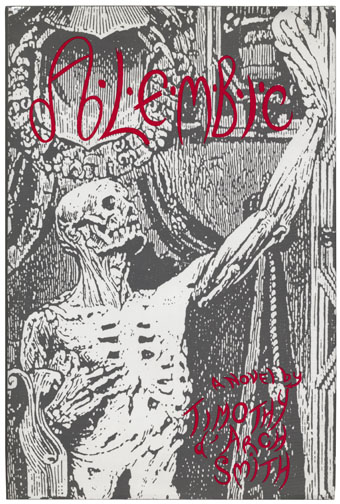
Alembic and Ligier Richier

alembic.jpg

Current reading is Alembic (1992), a curious novel by Timothy d’Arch Smith whose publishings prior to this were all non-fiction, among them a study of the Uranian poets, a bibliography of Montague Summers, and The Books of the Beast, one of the many books about Aleister Crowley. Alembic reflects some of these interests and blends them with others, notably alchemy and rock music, delivering the result in a digressive, comma-strewn prose style which I imagine many readers would find off-putting. From the jacket description:

Alembic is an unsettling novel about madness and alchemy, epistemology and rock and roll, magic and perversion. Thomas Graves, a young antiquarian, works for ALEMBIC, a British government office investigating the contemporary applications of the secrets of alchemy. The strange world of alchemy, however, is as eerie as the rock and roll world of Thomas’s friend Nicholas Spark, leader of a Led Zeppelin-like band called Celestial Praylin. Moving between these worlds, colourfully conveyed in d’Arch Smith’s sonorous prose – at times elegant, at times comic – Thomas Graves feels his grip on reality constantly imperilled; his attraction to the fourteen-year-old daughter of one of his colleagues complicates his existence further. A dramatic turn of events brings all of his fears and fancies out in the open, suggesting finally that the world is as mad as Thomas thought himself to be. Alembic is itself an alembic, a vessel that allows things to disintegrate and be transformed into new, refined substances. Set largely in the early 1980s, Alembic ends in the early years of the twenty-first century as alchemy engineers a new world order of darkness and perfection, destruction and eternal life, concluding a novel of great originality and ill-boding.

I don’t mind the style, it’s preferrable to the rudimentary bestsellerese that passes for much genre writing today. D’Arch Smith’s writing is witty, and there’s enough going on to sustain the interest. I thought at first the uncredited cover design would have had little to do with the contents but Ligier Richier’s celebrated sculpture of René de Chalon is referred to early on:

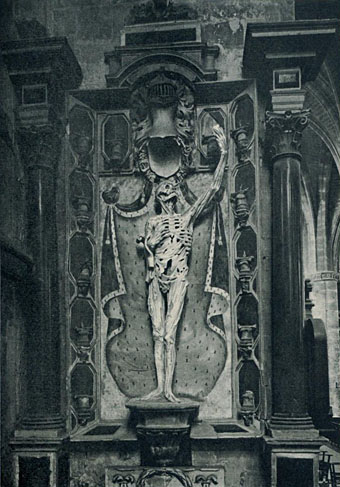
Nicholas had done himself to death. That was unequivocally stated in the garish red and black drawing depicted above the lyrics. In a grotesque parody of Ligier Richier’s funerary monument at Bar-le-Duc of the skeletal knight holding out his heart to God—possibly viewed by Ma during her historical tour of Alsace-Lorraine—Nicholas had been delineated in the same mortified yet exultant posture. The original figure was macabre enough, in the flaying of the naked body and the exposure of leg and arm muscles not yet rotted from the bones, to command attention, but the figure was imbued by Richier’s art with an enduring majesty that, though his design had been closely followed, was utterly overturned by the specious caricature of Nicholas Spark emblazoned down the waitress’s white cotton vest.

Given this, it’s a safe bet that the author would have asked for the capital “A” in the title to be given the same phallic connotations as it has in Aleister Crowley’s signature.

richier1.jpg

The web has plenty of photos of Le Transi de René de Chalon (c. 1545) but this view of Richier’s sculpture shows it to better effect than those where the background reduces the impact of the figure. The photos are from Ligier Richier, l’Artiste et Son Uvre (1911) by Paul Denis. As for Alembic, that’s currently out-of-print but copies are easy enough to find online.

richier2.jpg

Elsewhere on { feuilleton }
The book covers archive

Previously on { feuilleton }
Atalanta Fugiens
Splendor Solis revisited
Laurie Lipton’s Splendor Solis
The Arms of the Art
Splendor Solis
Amphitheatrum Sapientiae Aeternae
Cabala, Speculum Artis Et Naturae In Alchymia
Digital alchemy

Weekend links 146

snake.jpg

A Chinese postage stamp celebrating the Year of the Snake.

Cyclopean is a collaboration from Burnt Friedman, Jono Podmore and Can founding members Jaki Liebezeit, and Irmin Schmidt. The Quietus has a preview of all the tracks from their forthcoming EP. Great stuff.

Ten Things You (Possibly) Don’t Know About Kraftwerk. Related: a Speak & Spell emulator, and Atomium, a new single by Karl Bartos.

• In 1975 Barney Bubbles designed an inner sleeve for Hawkwind’s Warrior on the Edge of Time album, and this scarce recipe booklet.

• “We should all use language carefully. That is an obligation on the literate. But carefully doesn’t mean fearfully,” says Jenny Diski.

• Faber’s car-crash of a cover design for the 50th anniversary edition of The Bell Jar by Sylvia Plath caused an outbreak of parodies.

• At Strange Flowers: Ancient dreams and antique corruptions, Salomé via Gustave Moreau and Huysmans.

• FACT Mix 368 is a very varied collection of recent music and older pieces curated by Holly Herndon.

• At Ubuweb: eleven out-of-print recordings of Harry Bertoia’s sound sculptures.

Laurie Anderson and Brian Eno in conversation at Interview magazine.

Michael Chabon on Wes Anderson’s Worlds.

Snake Rag (1923) by King Oliver’s Creole Jazz Band | Rattlesnake Shake (1969) by Fleetwood Mac | Snakes Crawl (1980) by Bush Tetras | Ananta Snake Dance (1980) by Suns of Arqa | Snakeblood (2000) by Leftfield

Weekend links 144

thomas.jpg

Ruins 3 by Rachel Thomas and Dan Tobin Smith.

“Dan wanted to do something on a really large scale and was looking at a lot of Piranesi and started talking to me about ruins. I then started looking at modern interpretations of this idea, I was obsessed with the post modern architecture of SITE, Disney fantasy settings, Busby Berkeley, Sotsass ceramics, Art Deco motifs in general, Giorgio de Chirico’s paintings, Arabic temples and on and on…” Rachel Thomas talks to Daisy Woodward about Imaginary View, an exhibition currently showing at Somerset House, London.

• A brief description of The Yokel’s Preceptor (1855), a guide to Victorian London’s gay underworld by William Dugdale. When do we get to see a facsimile of this document? The slang is a treat.

• Mix of the week: Secret Thirteen Mix 054, a great selection by Biosphere of doomy ambience from the Post Punk/early Industrial era, 1979–1981.

fannyandstella.jpg

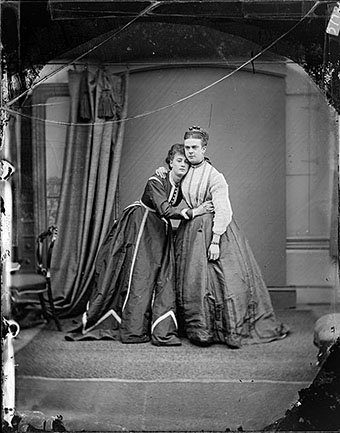
Stella (Ernest Boulton) with Fanny (Frederick Park) (c. 1860–1870).

While Stella and Fanny might be the most terrible show-offs, not to mention industrious sex workers, even they drew the line at coupling in public places. Over the course of the subsequent trial, and despite bribing witnesses, the prosecution failed to prove that sodomy had ever occurred, either between the two young men themselves, or within their circle of genteel “sisters”, or even in a dark corner behind the Haymarket with a passing guardsman. Eventually, and only after a second trial a year later, the young men were found not guilty and allowed to slip back into their lives of pro-am theatricals, touring together and separately in such limp pieces as A Comical Countess and A Morning Call.

Kathryn Hughes reviews Fanny and Stella: The Young Men Who Shocked Victorian England by Neil McKenna. Related: photographs of the pair.

The Twilight Language of Nigel Kneale, a book of essays and a cassette tape dedicated to the television dramatist.

Sheltered and Safe from Sorrow: “Victorian mourning rituals, tombstones, epitaphs, and other creepy things”.

Crate digging and the resurgence of vinyl. Related: Men & Vinyl, a Tumblr devoted to men and their discs.

• Designer Shirley Tucker talks about her cover for the first edition of The Bell Jar by Sylvia Plath.

• More Will Bradley at The Golden Age (formerly Golden Age Comic Book Stories).

The Mirror Reflecting (Part 2), a new track by The Haxan Cloak.

Psychedelic Press UK | Related: Catnip: Egress to Oblivion?

Paris in colour circa 1900.

Twilight (1983) by Pete Shelley | Twilight (2000) by Antony and the Johnsons | Twilight (2005) by Robin Guthrie & Harold Budd

Weekend links 142

bowie.jpg

Gratifying this week to see album cover art under discussion even if the heat-to-light ratio was as unbalanced as it usually is when pop culture is the subject. Jonathan Barnbrook, who also designed the Heathen (2002) and Reality (2003) packaging for David Bowie, wrote about the thinking behind the new cover on his blog. (And for the time being let’s note that this is still only a cover design, we don’t know what else is on its way.)

For my part I’ll point out that the artist-as-cover-image is the great cliché of album design, and the bigger the name the more the rule applies; Neville Brody complains about this in the first book of his work, as does Storm Thorgerson in the Hipgnosis books. In Bowie’s case the rule has been applied almost universally since his debut album in 1967, the only variations being illustrational ones or slight dodges like having his feet appear on the front of Lodger and his back facing the viewer on Earthling. Consequently the new design is a radical gesture from an artist who could have got away with a photo of himself du jour. By way of contrast, consider that Rod Stewart is a year older than David Bowie and presented the world with this artefact in October 2012.

Related: Hard Format responds to the cover, Chris Roberts on “Picasso resurrected in a Rolf Harris era“, and Alexis Petridis on The inside story of how David Bowie made The Next Day.

The Quicksilver typeface, designed by Dean Morris when he was only 16, bought by Letraset and now an indelible feature of pop design from the 1970s. Morris describes his experience here (“they shunned rapidographs!”) and collects examples of the print history here.

When the days are short, we are closest to the medieval world. To the avoidance of mirrors where death improves our portraits every morning with a few more lines and shadows. What would once have been a sermon, a conjuring of hellfire, a phantom slide show, is now an entertainment. But before we can begin again, we have to kick free of the embrace of our inconvenient predecessors, that compost legion of the anonymous dead. They come uninvited, requiring us to sign up for what the late Derek Raymond called the general contract: a brief turn in the light, then extinction. Eternal darkness. How to live with such knowledge? William Burroughs admired the unswerving bleakness of Beckett’s gaze, the way he reduced compensatory illusions to zero. Nowhere left to crawl. And nothing to crawl on. Last breath is last breath. Stare into the abyss and the abyss will stare right back.

Iain Sinclair reviews The Undiscovered Country: Journeys Among the Dead by Carl Watkins

Broadcast’s James Cargill on Morricone, Minidiscs and Scoring Berberian Sound Studio. Related: Melmoth the Wanderer posts a new mix, The Curious Episode of the Wizard’s Skull, and more spooky sounds are on their way from The Haxan Cloak.

• A Firm Turn Toward the Objective: Joanne Meister on meeting the great Swiss designer Josef Müller-Brockmann.

duchess.jpg

Twitter user @thisnorthernboy reworked Paul Emsley’s portrait of Kate Middleton. @barnbrook approved.

• The Beatles of Comedy: David Free on the Monty Python team.

• The history of the London Underground poster.

Impossible Architecture by Filip Dujardin.

• At Pinterest: Art Dolls & Sculpture

• Grace Jones’ Nightclubbing album has been on repeat play this week: Warm Leatherette/Walking In The Rain | I’ve Seen That Face Before (Libertango) | Demolition Man