Weekend links 514

kircher.jpg

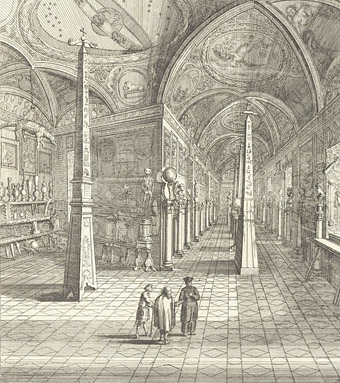
Athanasius Kircher welcoming two guests to the Collegio Romano, a detail from the frontispiece to his Romani Collegii Societatis Jesu Musaeum celeberrimum (1678).

Opium (1919) by Robert Reinert: “A Chinese opium dealer takes revenge on Westerners who have corrupted his wife.” With Werner Krauss and Conrad Veidt a year before their pairing in The Cabinet of Doctor Caligari.

Aubrey Beardsley at Tate Britain: in which the gallery thinks that 7 minutes is enough to give us a taste of a major exhibition that we can’t otherwise see.

Joe Pulver (RIP): His Highness in Yellow. A memorial piece that includes artist Michael Hutter talking about his paintings of Carcosa.

Court Mann on the strange history of Robert Smithson’s Spiral Jetty, 50 years old this month.

• “Invisible Little Worms”: Athanasius Kircher’s Study of the Plague by John Glassie.

Sophie Monks Kaufman on why literary lesbians are having a moment on screen.

• Photographer Ryan McGinley: “I was taught to believe in Satan. It scared me.”

• At Dennis Cooper’s: Ellen Burstyn Day, and the ghostly novels of WG Sebald.

Dorian Lynskey on where to start with Nina Simone’s back catalogue.

• Wie funktioniert ein Synthesizer? (1972). Bruno Spoerri explains.

• Banham avec Ballard: On style and violence by Mark Dorrian.

John Boardley on the most dangerous book in the world.

Improvisation for Sonic Cure by Ryuichi Sakamoto.

• The Strange World of…JG Thirlwell.

Diet Of Worms (1979) by This Heat | Stomach Worm (1992) by Stereolab | Heartworms (1998) by Coil
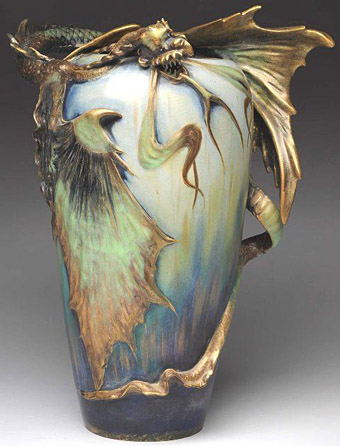
The ceramic art of Eduard Stellmacher

stellmacher01.jpg

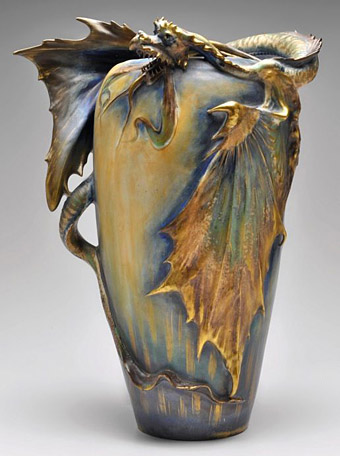
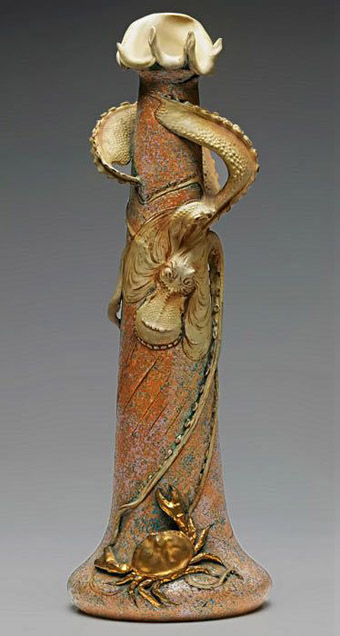
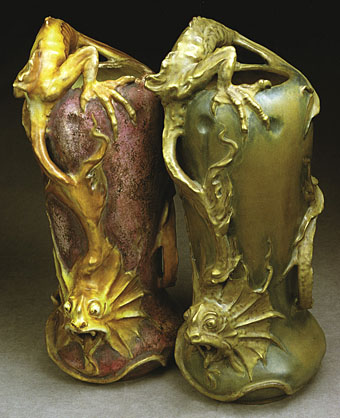
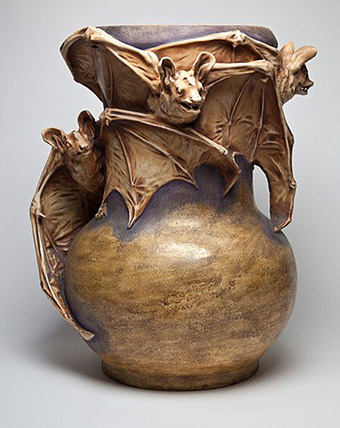
The Art Nouveau style is seldom more grotesque than in these vases and amphorae designed around the turn of the century by Eduard Stellmacher (1868–1945) for his father’s company, Amphora, in the Tur-Teplitz region of Bohemia. Art Nouveau (or Jugendstil as it was in Germany and Austria) emerged in Europe in the 1890s, and though its development ran parallel to the Decadence of the fin de siècle it wasn’t really a Decadent form in the literary sense of a dwelling on the perverse, the morbid or the blasphemous. The sinuous curves of Art Nouveau are too suggestive of vigorous life and energy to appear corrupt; Alphonse Mucha’s femmes are too healthy to be fatale, they’re nothing like the dissolute, hollow-eyed sirens seen in the drawings of Félicien Rops, an artist who wasn’t Nouveau (he died in 1898) but who was thoroughly Decadent.

stellmacher02.jpg

Stellmacher and co. created their share of delightful ceramic figures with Mucha-like tresses and flowing garments but Eduard’s designs around this time were preoccupied with ferocious creatures: bats, fish, lizards, octopuses, and a profusion of fire-breathing dragons. Even the plant forms have a diseased, unhealthy aspect. The designs may not have been intended as Decadent but they embody the quality more than anything used as vase decoration before or after this period. Art Deco also favoured predatory animals (snakes and leopards especially) but only in forms that were suitably sleek and abstracted.

stellmacher03.jpg

stellmacher04.jpg

stellmacher05.jpg

Continue reading “The ceramic art of Eduard Stellmacher”

Weekend links 487

october.jpg

Art by Joe Mugnaini (1955).

• Mixes of the week: The Ivy-Strangled Path Vol. XIX by David Colohan, and The Ephemeral Man’s Teapot 2—Atmosphere insomniac by The Ephemeral Man.

• Patrick Clarke talks to Morton Subotnick and Lillevan about Subotnick’s pioneering synthesizer composition, Silver Apples Of The Moon (1967).

• A second volume of London’s Lost Rivers, a walker’s guide by Tom Bolton with photography by SF Said, is published by Strange Attractor next month.

“That country where it is always turning late in the year. That country where the hills are fog and the rivers are mist; where noons go quickly, dusks and twilights linger, and midnights stay. That country composed in the main of cellars, sub-cellars, coal-bins, closets, attics, and pantries faced away from the sun. That country whose people are autumn people, thinking only autumn thoughts. Whose people passing at night on the empty walks sound like rain.”

Ray Bradbury quoted by Sam Weller in an examination of Bradbury’s dark tales and autumnal horror stories

Lumberjacks In Heat is 11 minutes of music from Mechanical Fantasy Box by Patrick Cowley, the latest Cowley collection from Dark Entries.

They Poured Out Their Light Until Only Darkness Remained: new eldritch vibrations from The Wyrding Module.

• Carmen Villain on the magic of Jon Hassell’s Aka / Darbari / Java: Magic Realism.

• An Evil Medium: Elizabeth Horkley on the films of Kenneth Anger.

• Cosmic gardens and boulder boulevards by Charles Jencks.

• At Dennis Cooper’s: Murray Melvin Day.

Richard Dawson‘s favourite music.

• RIP John Giorno.

My Girlfriend Is A Witch (1968) by October Country | The October Man (1982) by Bill Nelson | Late October (1984) by Harold Budd

Weekend links 484

qadiri.jpg

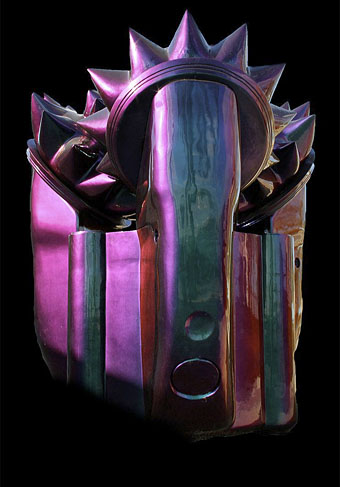
Alien Technology (2014) by Monira Al Qadiri.

• “William S. Burroughs wrote, in a long, zigzag ode: ‘You can hear metal think in the electromagnetic fields of Takis sculpture.'” Geeta Dayal on the sound sculptures of the late Panayiotis Vassilakis (1925–2019), better known as Takis.

• “Everything about this song is mysterious, from the creation to the lyrics to where it played on the radio…” David Browne on The Unsolved Case of the Most Mysterious Song on the Internet.

Moebius made many illustrations of Jimi Hendrix. Related: Giraud-Moebius pour le disque: 33 tours et plus dans les étoiles.

• London arts venue the Horse Hospital (where some of my work was exhibited a couple of years ago) is fundraising again.

• Sam Gafford: Number One—The Larch: John Linwood Grant remembers the late author, editor and friend.

• Mixes of the week: Cosmique Français by Tarotplane, and Secret Thirteen Mix 297 by Rosa Damask.

• More Magma: the group in live performance in 2009 playing the end of De Futura.

• At Dennis Cooper’s: The Horror Films of Terence Fisher Day.

Pye Corner Audio performs at the state51 Factory.

• A demo of Colour Me In by Broadcast.

• RIP Malcolm Whitehead.

• Alien Activity From The 45th Parallel (1978) by Cellutron & The Invisible | Alien (1981) by Ende Shneafliet | Alien Loop (2014) by Mica Levi

The Witch’s Cradle by Maya Deren

deren1.jpg

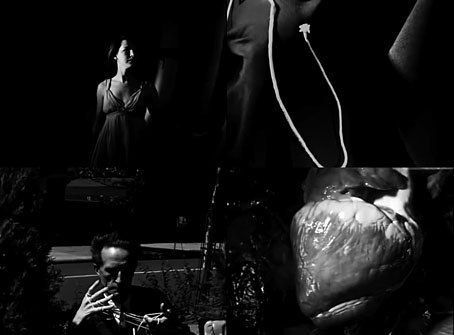
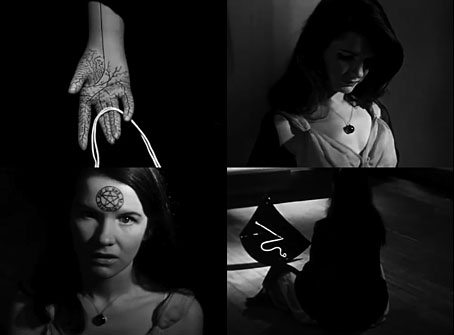
It’s taken a while for Maya Deren’s less familiar films to drift into YouTube’s Sargasso Sea so I hadn’t seen this one until now. The Witch’s Cradle (1943) isn’t really a film like Deren’s other short works, more a collection of fragments for something that was left unfinished. But the Surrealist tenor of the piece means that the diverse shot sequence and unusual imagery can be interpreted in a variety of ways. Pajorita Matta is the woman wandering like a Cocteau heroine through the darkened rooms of one of Peggy Guggenheim’s galleries where we catch glimpses of sculptures and a Max Ernst painting, Blind Swimmers (1934). Prior to this there are brief shots of Marcel Duchamp with this fingers tangled in a cat’s cradle, and later on we see that Pajorita Matta has a pentacle drawn on her forehead, a precursor of Deren’s subsequent occult explorations in Haiti. Disjointed as it is, I prefer this to the solo films that Deren produced after her collaboration with Alexander Hammid, Meshes of the Afternoon (1943), most of which were filmed dance performances. The Witch’s Cradle offers another taste of enmeshed mystery.

deren2.jpg

Previously on { feuilleton }
Alexander Hammid
Meshes of the Afternoon by Maya Deren