Miró: Theatre of Dreams

miro1.jpg

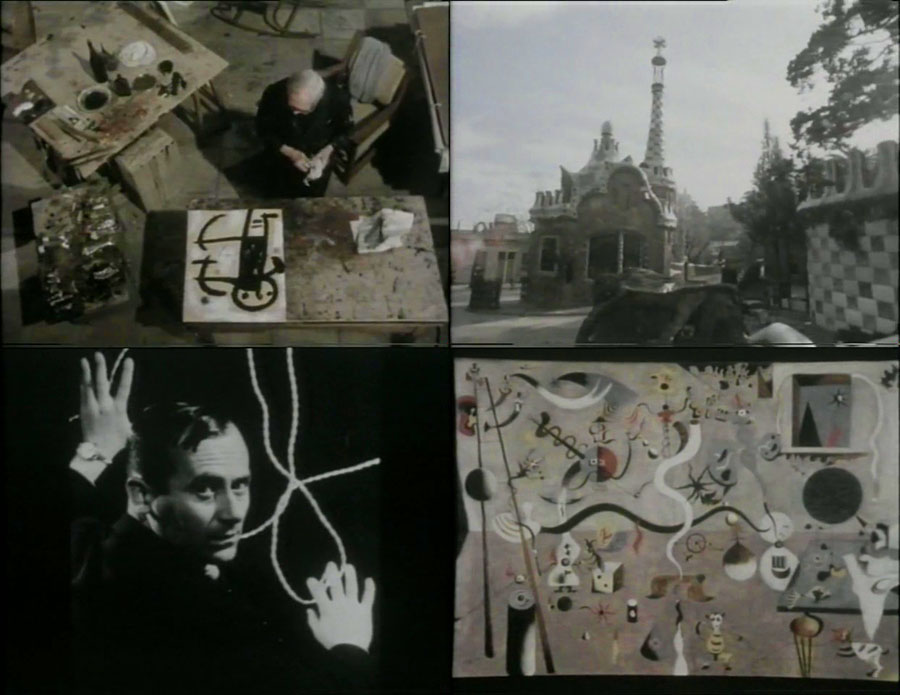
More old TV, and something you might call Portrait of the Artist as an Old Man. Miró: Theatre of Dreams is a documentary about the Spanish (or as he might have preferred, Catalan) artist Joan Miró. This was broadcast by the BBC in 1978, and again in 1984, but it’s one I hadn’t seen until now. Robin Lough’s film was the first television profile of the artist in which Miró talks at length with his British friend, Roland Penrose, an artist and writer who did much to champion Surrealism in its early years. Penrose also narrates the film, describing Miró, who he’d known since the 1930s, as “the last of the great Surrealists”. I can imagine another Catalonian artist, Salvador Dalí, who was still very much alive in 1978, having something to say about this opinion. Between the conversations we see rehearsals for a Miró-designed theatrical performance centred around a monstrous Ubu-like tyrant whose character is part folk-figure, part analogue for Francisco Franco. The latter had only been dead for three years after being in power since the 1930s so performances like these were acts of exorcism as much as entertainment.
miro2.jpg

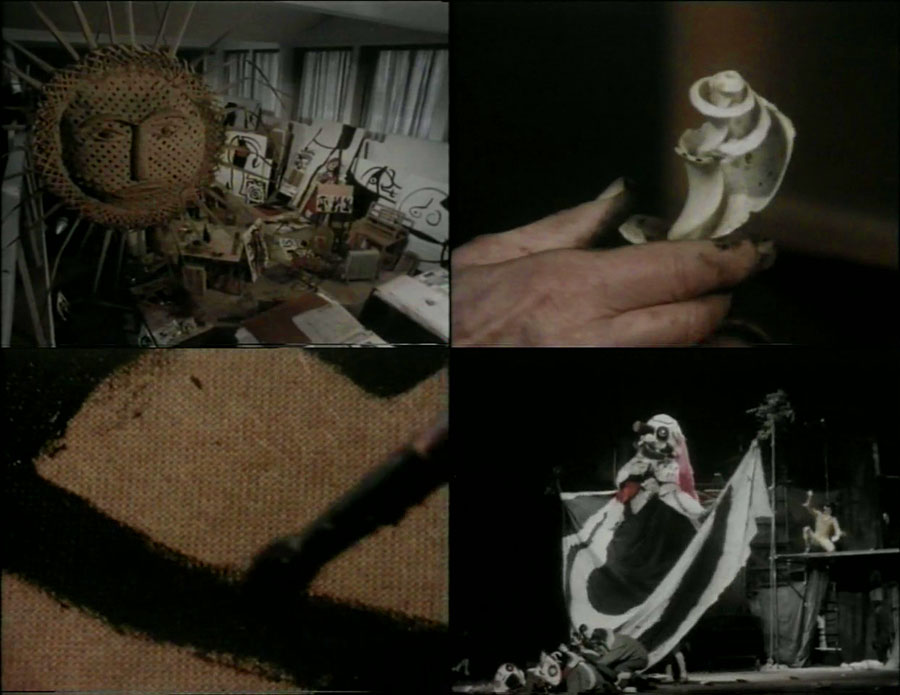
Penrose was a good writer who enjoyed demystifying modern art; I always recommend his book on Picasso as the one to go for if you’re only going to read a single account of Picasso’s life and work. The observations he makes here about Miró’s early love of the amorphous constructions that Antoni Gaudí created for the Parque Güell in Barcelona are reinforced later when Penrose and Miró are examining some of the objects in the artist’s studio. Miró suggests that the spiral form of an eroded seashell might be used as a model for skyscrapers to replace what he calls the matchboxes of New York City, a proposal which doesn’t seem as fanciful today as it did in 1978. We also see Miró painting on the rough side of a sheet of hardboard while enthusing about the textured surface of the material. This is unusual—most artists, if they use hardboard at all, paint on the smooth side—and, for me, a little surprising. There’s no such thing as right or wrong when it comes to art materials, but I’ve painted on the rough side of hardboard on a couple of occasions, and felt guilty about doing so when it always seemed like a cheap and rather crude alternative to using primed canvas. This is the first example I’ve seen of another artist doing the same. That it happens to be Joan Miró makes me feel better about the whole business.

Elsewhere on { feuilleton }
The Surrealism archive

Previously on { feuilleton }
Televisual art
Max Ernst by Peter Schamoni
Leonora Carrington and the House of Fear
Weekend links 659

harunobu.jpg

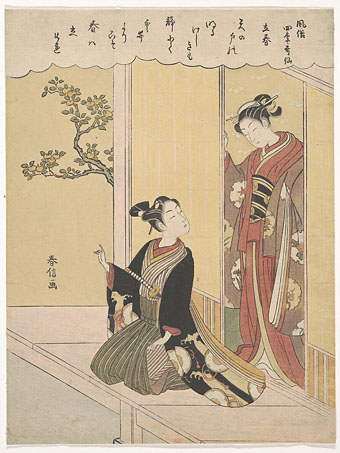
The First Day of Spring (Risshun), from the series Fashionable Poetic Immortals of the Four Seasons (c.1768) by Suzuki Harunobu. Risshun in Japan begins on the 4th of February.

• “…after centuries of imbibing alcoholic beverages as their main source of potable water, European’s new fondness for boiled drinks—coupled with the psychoactive properties of caffeine—swapped societal tipsiness with a mindstate primed for the Enlightenment’s intoxication with reason.” Hunter Dukes on A Treatise Concerning the Properties and Effects of Coffee (1792) by Benjamin Moseley.

• Steven Heller on John Wilcock, Master of the Underground: “[He] was one of the great ‘happening’ characters of midcentury America, beat myth to Hippie legend. He was founder of half a dozen underground papers, and started one of the first citizen-access cable television shows. His achievements are a dense package.”

• At Fonts In Use: Florian Hardwig explores the origin of “the Dune font” as used on the covers of Frank Herbert’s novels during the 1970s and 80s.

• At Smithsonian Magazine: “Hundreds of Frank Lloyd Wright’s designs were never built. Here’s what they might have looked like.”

• Mix of the week: Fact Mix 893 by KMRU & Aho Ssan & Sevi Iko Dømochevsky.

• New music: Hypnagogia by Martina Bertoni, and Cosmos Vol. II by Ran Kirlian & Jaja.

• “Forgotten ‘Stonehenge of the north’ given to nation by construction firm.”

• At Aquarium Drunkard: Soft Machine live at Jazz Bilzen, 1969.

• RIP Tom Verlaine.

Goofin’ At The Coffee House (1959) by Henri Mancini | Bring Me Coffee Or Tea (1971) by Can | Starfish And Coffee (1986) by Prince

Now It’s Dark

dark1.jpg

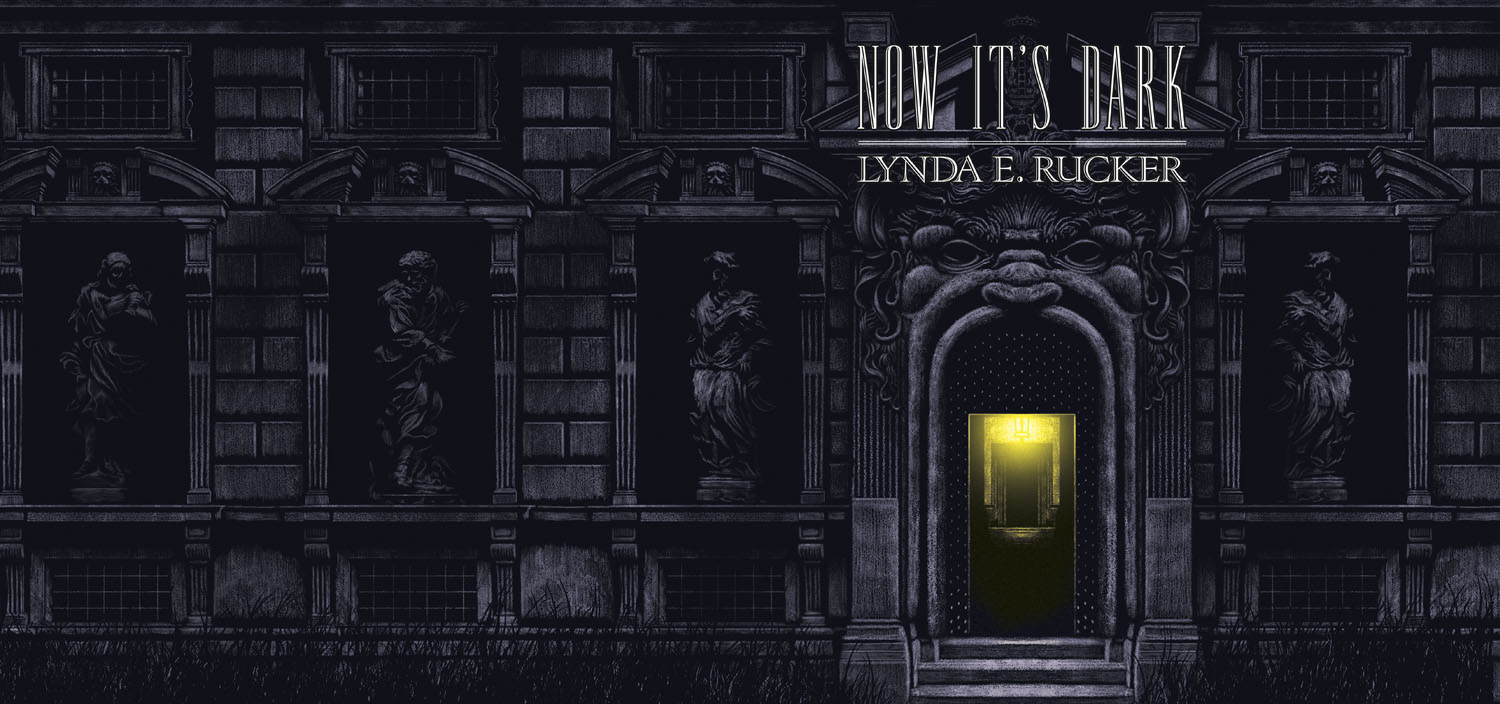
Now It’s Dark by Lynda E. Rucker; cover art by John Coulthart; jacket design by Meggan Kehrli; introduction by Rob Shearman; edited by Brian J. Showers and Timothy J. Jarvis; copyedited by Jim Rockhill; typeset by Steve J. Shaw; published by Swan River Press.

Hardback: Published on 27 January 2023; limited to 400 copies of which 100 were embossed and hand numbered; signed by Lynda E. Rucker, Rob Shearman, and John Coulthart; xii + 225 pages; lithographically printed on 90 gsm paper; dust jacketed; illustrated Wibalin boards; sewn binding; head- and tail-bands; ISBN: 978-1-78380-043-8.

dark2.jpg

Dust jacket.

dark3.jpg

Printed boards.

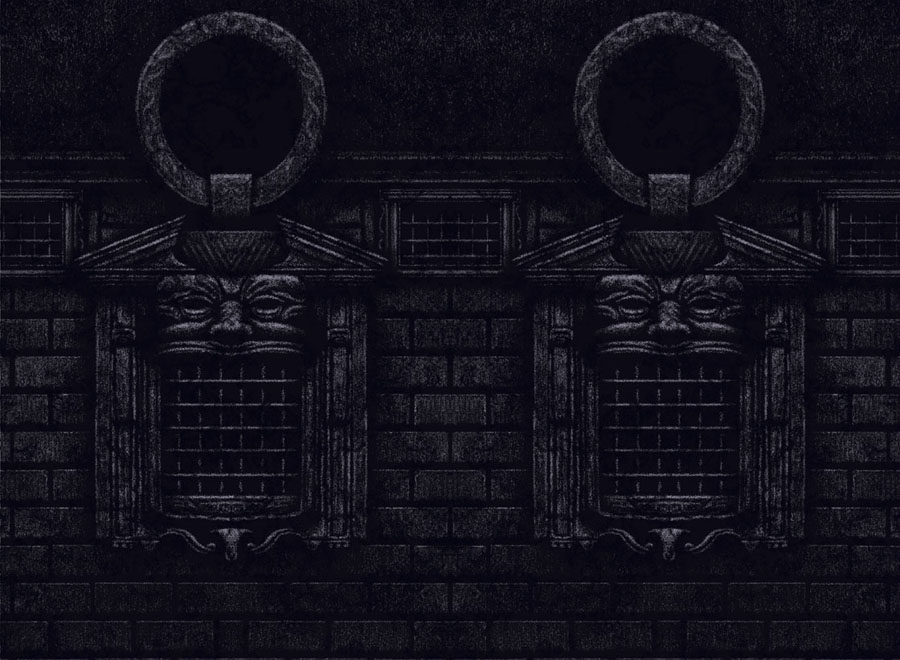
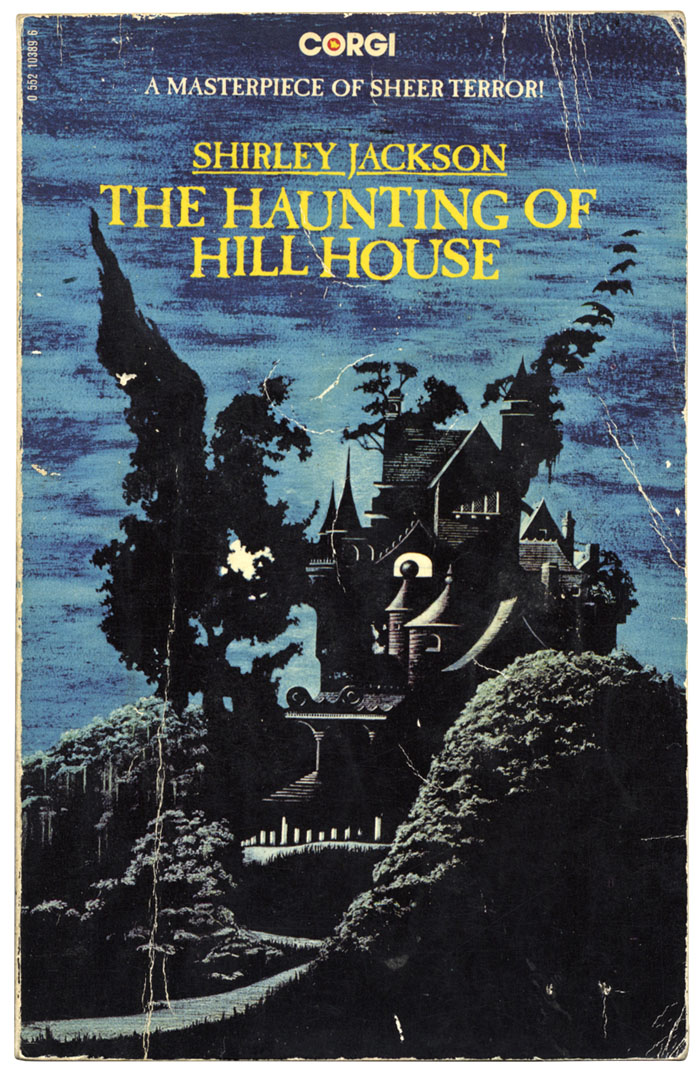
This is the last of the books I was working on last year, and being another design for Swan River Press means that once again the artwork is a wraparound cover with printed boards under the wrap. Now It’s Dark is a collection of horror stories (or possibly “strange stories” à la Robert Aickman), and a very fine collection it is. I was given carte blanche with this one so the cover is a mood piece rather than anything directly illustrational. One of the stories concerns the god Pan, which tempted me at first to do something with a satyr-like face, possibly as an architectural feature like a mascaron. But focusing on a single story in this way usually makes me worry about giving that story too much attention if it hasn’t also provided the title of the collection. Thinking about mascarons and their positioning above arched doorways led to the design you see here, a gesture towards a minor trend in horror illustration that makes use of the Arcimboldo effect, as with my battered Shirley Jackson paperback.

haunting.jpg

Corgi Books, 1977. No artist credited.

zuccari1.jpg

A Boy and His Dog on a Staircase in Rome (1886) by Niels Frederik Schiøttz-Jensen.

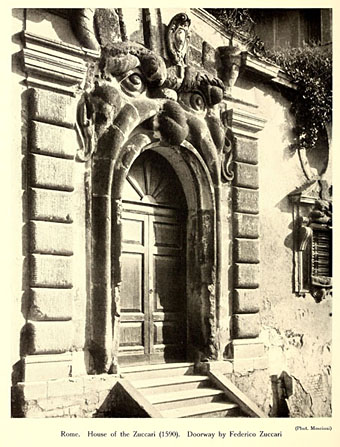
My cover is a variation on a real place, the “House of Monsters” entrance of the Palazzo Zuccari in Rome which today houses the Bibliotheca Hertziana. I placed the portal into an extended Baroque facade while moving the monstrous windows to the boards of the book. Given the way the grotteschi concept was a common feature of the Baroque you’d expect there to be more doorways like this but the palazzo street entrance seems to be unique. Equivalents such as the Ogre’s Head at Bomarzo are more like theme-park attractions than architectural features. I’ve never seen Umberto Eco mention the Palazzo Zuccari but I imagine he would have enjoyed seeing an infernal mouth as an entrance to a library.

zuccari2.jpg

Previously on { feuilleton }
Infernal entrances

Weekend links 658

ein-dor.jpg

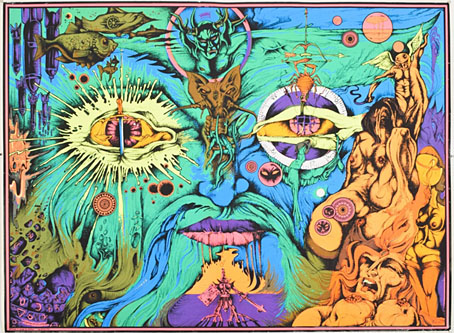
Also Sprach Zarathustra (1972), a blacklight poster by Asher Ein Dor.

• “Squaring the Circle (The Story of Hipgnosis) is a reasonably informative, if rather dry, look at a subject with much more potential for exploration,” says Dan Shindel, reviewing Anton Corbijn’s feature-length documentary about the album-cover design team. Sounds like a missed opportunity, on the whole, although the history of Hipgnosis has been so thoroughly explored over the course of several books (including a very recent one by Aubrey Powell) that any documentary seems almost superfluous. What I’d most like to see is something we’ll never have, a film about the company directed by the late Storm Thorgerson. And on that note, Thorgerson’s two-part documentary about art and drugs, The Art of Tripping (previously), has resurfaced on YouTube here and here.

• “LunaNet consists of a set of rules that would enable all lunar satellite navigation, communication and computing systems to form a single network similar to the Internet, regardless of which nation installs them. Setting lunar time is part of a much bigger picture. ‘The idea is to produce a Solar System internet,” says Gramling. ‘And the first part would be at the Moon.'” Elizabeth Gibney reports on plans to create a consistent time zone for the Moon.

• “Listening to 12, one cannot help but be struck by this deep expression of Sakamoto’s pain, of his human frailty, strength, and uncertainty about the future.” Geeta Dayal on Ryuichi Sakamoto’s latest album.

• At Public Domain Review: Illusory Wealth: Victor Dubreuil’s Cryptic Currencies by Dorinda Evans.

• At Aquarium Drunkard: Journey to inner space with The Groundhogs.

• DJ Food investigates the High Meadows psychedelic poster site.

• New music: Sub-Photic Scenario by Runar Magnusson.

• At Wyrd Daze: Disco Rd: 23 pages 23 minutes.

The Strange World of…Chris Watson.

Lunar Musick Suite (1976) by Steve Hillage | Lunar Cruise (1990) by Midori Takada & Masahiko Satoh | Luna Park (2006) by Pet Shop Boys

The Magic Art of Jan Švankmajer

svankmajer1.jpg

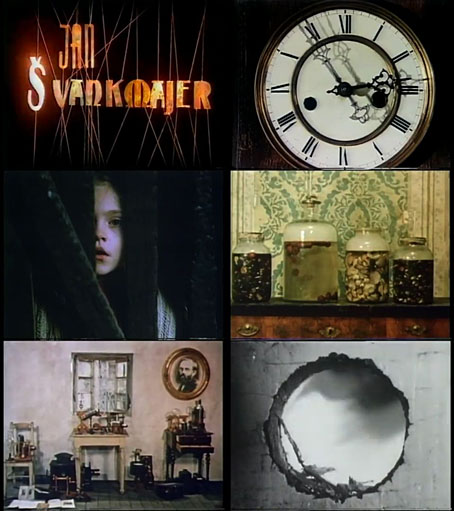
Three years ago I binged on all the Jan Švankmajer feature films after buying the box of blu-rays released by the director’s Athanor company. Once I’d worked my way through that lot, and rewatched the BFI collection of Švankmajer’s short films, I went through all the documentaries I’ve managed to accumulate, including this two-part BBC study which I taped when it was first broadcast in 1992. It’s likely that Švankmajer’s approach to film and to Surrealism no longer requires the kind of introduction that seemed necessary in the 1990s, but for those who do need such a thing this is a good place to start.

svankmajer2.jpg

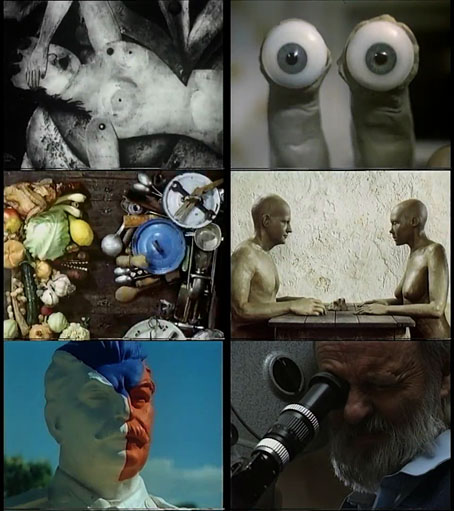
Ben Fox’s documentary was made to coincide with an exhibition of Švankmajer’s films and artworks being shown at an animation festival in Cardiff. The two installments examine a different aspect of Švankmajer’s cinematic works: “Memories of Mysterious Beings” concerns the films that deal with childhood dreams and fears, while “The Naming of Demons” concentrates on his use of Surrealism as a tool for satire or social critique. In between lengthy extracts from the films the camera prowls around some of the director’s artworks while an actor reads statements Švankmajer has made about his interests and intentions. This last feature isn’t something I enjoy very much, not when the actor’s nasal delivery is so different from Švankmajer’s own voice. It’s a common ploy in documentaries, having someone impersonate an interviewee to avoid using subtitles, but it’s one I find distracting when done like this.

eva.jpg

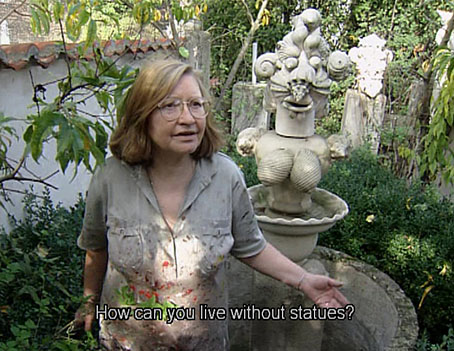
Eva liked statues.

At this point I would have directed your attention once again to Jan Švankmajer, Director, a documentary about Czech cinema which featured the man himself talking at length about his activities in the 1960s, but this has now been removed from YouTube. In its place, however, there’s a more recent upload, Les Chimères des Švankmajer, an 80-minute documentary for French TV by Bertrand Schmitt and Michel Leclerc which is included among the extras on the BFI’s collection of Švankmajer’s short films. The only trouble here is that the YT copy has no subtitles, you’ll need to be a French speaker to understand the voice-overs which run throughout. This is one of the best of all the Švankmajer documentaries since it shows the range of activities conducted by Švankmajer and his late wife, Eva Švankmajerová, as artists and foremost members of the Prague Surrealist Group; film-making, as Švankmajer has often stressed in interviews, was only one outlet for his creativity. (It was also one he was forbidden to practice for several years when the Communist authorities took exception to his work.) In addition to seeing the Švankmajers preparing an exhibition of their creations, Schmidt and Leclerc show us something of their home outside Prague, an artwork in itself that combines the sculpture park and Wunderkammer. Eva Švankmajerová was the creator of many of those sculptures, a celebrated artist in her own right whose contribution to her husband’s films has often been overlooked.

Elsewhere on { feuilleton }
The Surrealism archive

Previously on { feuilleton }
Švankmajer’s cats
Jan Švankmajer: The Animator of Prague
Jan Švankmajer, Director
Don Juan, a film by Jan Švankmajer
The Pendulum, the Pit and Hope
Two sides of Liška