National Portrait Gallery snubs Kylie Minogue and picks Nelson Mandela for gay icons list
Category: {art}
Art
Hip Gnostics and more Moore
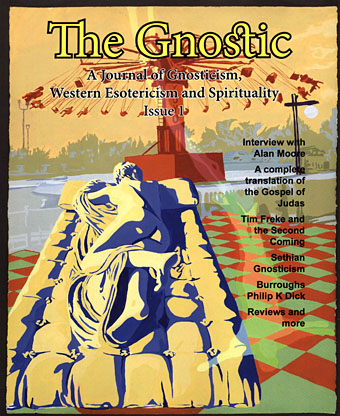
Coincidence abounds: on Wednesday I was following a few referral URLs to see who’d been linking here and was led to a Lexic.us page about hermaphrodites which in turn had me looking again at the wonderful Borghese Hermaphroditus in the Louvre. Thursday’s postal delivery brought issue 1 of The Gnostic which prominently features the Louvre sculpture on its cover. Inside there’s my portrait of William Burroughs illustrating a piece about Burroughs’s Gnostic identification by Sven Davisson. (I linked to another essay on the same theme in 2007.) The Gnostic is an excellent publication which, the Alan Moore interview aside, I’ve only skimmed through so far. Alan’s piece is very enlightening since the discussion stays fixed around religion, science and the occult and includes the most thorough extrapolation I’ve seen to date of his long work in progress, Jerusalem. There’s also a transcript of part of his William Blake piece from 2001, Angel Passage. If you want to know more I suggest you order a copy ($12 / £8 / €9) from Bardic Press.
Coincidence further abounds as this arrived just as Pádraig Ó Méalóid publicly announced his discovery of the long-lost and unpublished third issue of Alan Moore’s Big Numbers. This was Alan’s self-published “real life” comic series from 1989 which got off to a great start then fatally collapsed when artist Bill Sienkiewicz, then his replacement, Al Columbia, both dropped out of the project. It’s one of the great lost projects of contemporary comics and seeing the third issue sustaining the quality of the first two is deeply frustrating.
The last piece of Moore news concerns The Mindscape of Alan Moore once again which is now available to buy through iTunes. $9.99 will only get you the feature-length documentary, however. If you buy the double-disc DVD you also get my groovy interface design and an extra disc of interviews with major comic artists.
Update: Alan Moore has certainly ruled the week in this household with the delivery on Friday of The Extraordinary Works of Alan Moore, a new edition of George Khoury’s book-length autobiographical interview with Alan, and an essential purchase for anyone with more than a cursory interest in Alan’s life and work. The book features copious artwork examples by many Moore collaborators including my CD designs and the cover for the forthcoming Moon & Serpent Bumper Book of Magic.
Previously on { feuilleton }
• William Burroughs: Gnostic visionary
The White Peacock

The White Peacock (1910).
A typical piece of mysterious erotica by Austrian illustrator and pornographer Franz von Bayros (1866–1924). Like all good Decadents, Bayros used peacocks and peacock feathers as decorative motifs in his pictures but this is the first I’ve seen where the peacock itself is the result of amorous attention. If that sounds overly-perverse, you haven’t seen his Sweet Snail.
Elsewhere on { feuilleton }
• The illustrators archive
Previously on { feuilleton }
• Kafka’s porn unveiled
• The art of ejaculation
• The art of Félicien Rops, 1833–1898
Voo-doo: Hoochie Coochie and the Creative Spirit
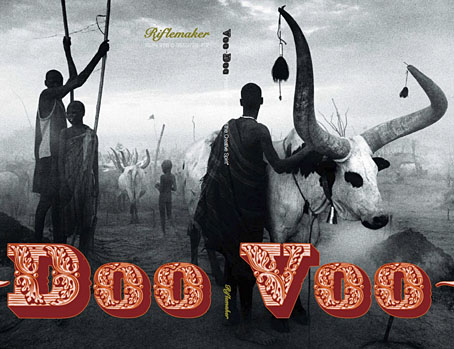
Better late than never mentioning this exhibition which has been running at Riflemaker, 79 Beak Street, London, since mid-January.
The exhibition features those artists, writers and musicians who acknowledge the need to reach a heightened or ‘altered state’ in order to create their work. We look at the mystery of the creative act; not the inexplicable ‘spark’, aka inspiration, but the fire; the non-doing before the doing, the summoning up of elemental spirits from within, or without, during the preparation of some visual or musical work, some theory or idea. This welling-up or ‘possession’, this ‘fever in the heart of man’, this spirit, this spell, might sometimes be referred to as Voodoo.
Among the very varied selection of work the chief attraction for me would be the rare opportunity to see one of Mati Klarwein‘s major paintings, Crucifixion. I referred to this large and detailed picture last year as I was fortunate to be able to use it for the packaging of Jon Hassell’s Maarifa Street CD. And while we’re on the subject of Mr Hassell (who had a track entitled Voodoo Wind on his second album) he has a new CD out on ECM, Last Night the Moon Came Dropping Its Clothes in the Street.
Voo-doo runs until April 4, 2009.
Elsewhere on { feuilleton }
• The fantastic art archive
Previously on { feuilleton }
• The art of Mati Klarwein, 1932–2002
• Exuma: Obeah men and the voodoo groove
• Voodoo Macbeth
Le Sacre du Printemps
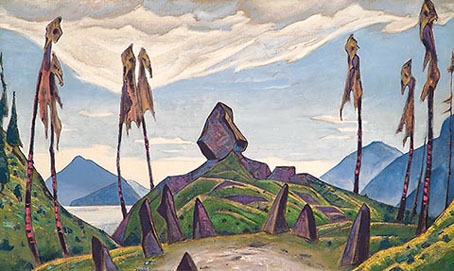
Backdrop for the League of Composers’ production, Philadelphia, 1930.
Something for the vernal equinox. The painting is a stage design by artist, writer and theatre designer Nicholas Roerich (1874–1947) for an American production of Stravinsky’s Rite of Spring. Roerich designed the costumes and decor for the riotous Paris performance of 1913 and the Roerich Museum has a selection of designs for this and subsequent performances. Stravinsky’s fiercely primitive ballet has long been a favourite musical work of mine so it’s especially satisfying when one enthusiasm bleeds into another. I’ve noted before HP Lovecraft’s praise for Roerich’s paintings of whom he wrote in 1937:
There is something in his handling of perspective and atmosphere which to me suggests other dimensions and alien orders of being—or at least, the gateways leading to such. Those fantastic carven stones in lonely upland deserts—those ominous, almost sentient, lines of jagged pinnacles—and above all, those curious cubical edifices clinging to precipitous slopes and edging upward to forbidden needle-like peaks!
Roerich is also mentioned in At the Mountains of Madness and some of his designs for the Rite—which are, after all, backdrops for a ritual sacrifice—might easily serve as a scene of Cthulhoid invocation. Writer Mike Jay has a fascinating piece about the artist which proposes that he should perhaps be given more credit for the origin of the Rite of Spring. He’s not the first to note that it was the stage designer who nurtured a lifelong passion for mysticism and esoteric ritual, not the composer.
Finally, some slightly more contemporary music: Can performing Vernal Equinox for the BBC in 1975.
Previously on { feuilleton }
• HP Lovecraft’s favourite artists