Anita Berber

dix.jpg

Anita Berber (1925) by Otto Dix.

If you’re going to live fast and die young you can do worse than be immortalised by a great painter, as Anita Berber was by the German Expressionist Otto Dix. An “exotic dancer” (among other things) in the Berlin cabarets of the 1920s, Ms Berber died at the age of 29 from a bout of TB but it’s likely that drink and drugs (she was fond of both) would have ruined her eventually. She left us with this striking picture, many equally striking photos, and tales of scandalous behaviour involving nude dancing and sexual partners of any gender. Rather than paraphrase further, I can point you to a typically fine piece about the wild woman at Strange Flowers. Ten Dreams has more paintings by the great Otto whose Berber portrait was used on a German postage stamp in 1991. Impossible to imagine the Royal Mail putting a bisexual drug addict on a postage stamp here, no matter how celebrated the artist.

The Art of the Book

aotb1.jpg

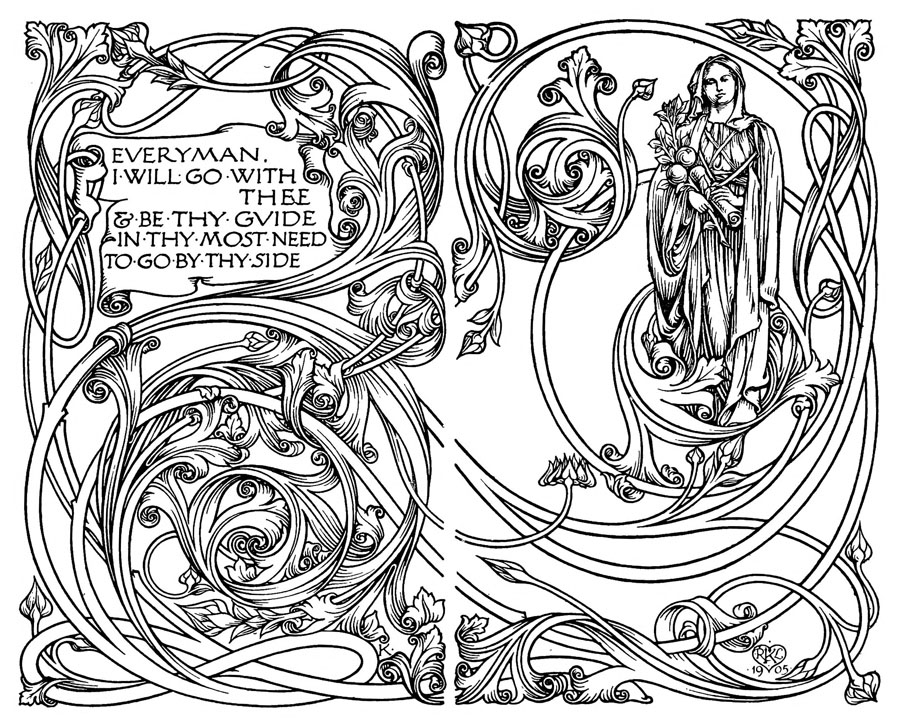
Endpaper design by Reginald L Knowles for JM Dent’s Everyman’s Library series.

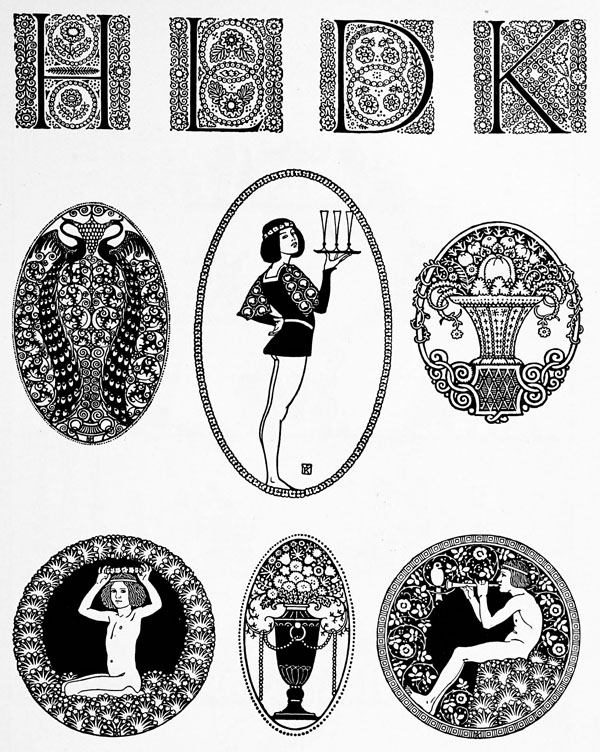
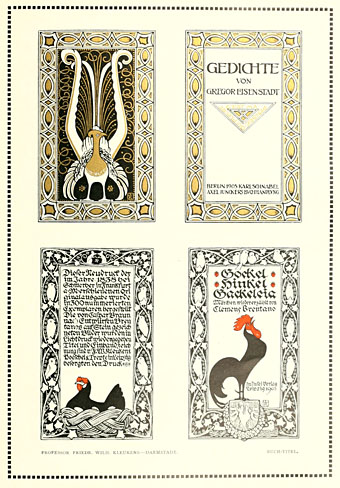
A few of the many illustration samples to be found in The Art of the Book, an overview of book design published in 1914. The editor was Charles Holme, also the editor of leading art magazine The Studio from whose contents and resources books such as this were easily compiled. The Internet Archive has a collection of Holme’s books, and this particular volume includes work from Hungary and Sweden, two countries which are often overlooked in creative surveys. I’ve selected illustrations here but the book contains many examples of binding design and page layouts.

aotb2.jpg

Initial letters and ornaments by Friedrich Wilhelm Kleukens.

Continue reading “The Art of the Book”

Jean Genet… ‘The Courtesy of Objects’

chaimowicz.jpg

Jean Genet… ‘The Courtesy of Objects’ is an exhibition by Anglo-French artist Marc Camille Chaimowicz currently running at The Gallery at Norwich University College of the Arts. Chaimowicz presented a show entitled Jean Cocteau in Norwich last year; this new exhibition will include “works on paper, theatrical props, furniture, slide projections, documentation and an imaginary casting session for Genet’s 1947 play The Maids and videos charting Chaimowicz’s pilgrimages to the author’s childhood home in Burgundy, France, and to his grave on the Moroccan coast.” (More.) About Genet, Chaimowicz has this to say:

Jean Genet, in his fashion, loved Jacky Maglia. Jacky was the stepson of Genet’s lover Lucien Senemand. Genet was generally attracted to heterosexual men, often delinquents or petty criminals… and Jacky stole cars… Genet actively encouraged Jacky to take up motor racing and later managed his fledging career. In Norfolk he bought Maglia a Lotus Elan… They grew very close, travelling widely together and illicitly entering the US to cover the 1968 Chicago Democratic Convention for Esquire. Fame and critical success were suddenly and violently echoed by financial gain… Genet was at one point Gallimard’s highest-earning author… This having the converse effect in that the more rich and famous he became, the less he was able to write. For so long the outsider and now the literary celebrity, it was as though he felt alienated from his own unique and cherished sense of alienation.

The exhibition is free and runs until May 21st when it will move to Nottingham and then New York. See here for opening times and other details.

Previously on { feuilleton }
• Querelle again
• Saint Genet
• Emil Cadoo
• Exterface
• Penguin Labyrinths and the Thief’s Journal
• Un Chant D’Amour by Jean Genet

Weekend links 57

softmachine.jpg

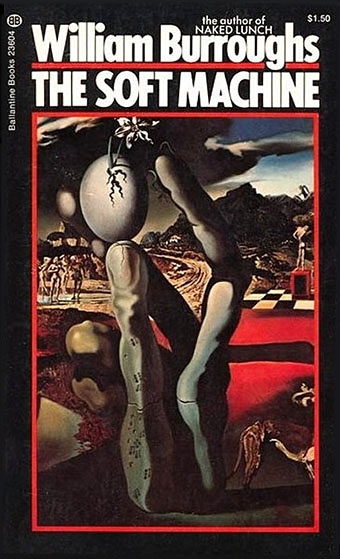
A 1973 Ballantine edition of William Burroughs’ novel with a cover illustration from Metamorphosis of Narcissus (1937) by Salvador Dalí. Via the Burroughs Book Covers archive.

The Sel Publishing House, Turkey, published a new translation of The Soft Machine by William Burroughs in January, an edition which is now under investigation by the Istanbul Prosecutor’s Office following a report by the (deep breath) Prime Ministry’s Council for Protecting Minors from Explicit Publications. The Council lodged a number of complaints, among them assertions of “lacking unity in its subject matter,” “incompliance with narrative unity,” “using slang and colloquial terms” and “the application of a fragmented narrative style.” Details here. Does Turkey still want to join the EU? Because this kind of persistently illiberal bullshit (see the earlier treatment of Orhan Pamuk) isn’t helping their case at all.

• Related to the above: Evan J Peterson reads Allen Ginsberg’s Howl in the toilet of a Seattle gay bar; Ginsberg himself reads Kaddish and other works here.

• More illiberal bullshit: LGBT activists arrested during royal wedding; Queer Resistance released a statement about the arrests. MPs, activists and trade unionists condemn new attacks on the right to protest.

• The Dorian Gray That Wilde Would Want Us To Read. Harvard University Press publishes an uncensored and annotated edition of Wilde’s novel. Kudos for using Caravaggio’s Narcissus on the cover.

One weekend in late 1967, they all decamped to a hotel suite in California’s Ojai Valley for a brainstorming session. Amid clouds of pot smoke, they talked all weekend with the tape recorder running. [Jack] Nicholson then took the tapes and turned the conversations into a screenplay; according to Rafelson, he structured it while on LSD.

Revisiting The Monkees’ psychedelic movie, Head.

kraftwerkicons.jpg

Kraftwerk icons for Windows and Mac OS X by Dave Brasgalla.

• Robert Louis Stevenson gets his revenge on sneaky literary agent – 120 years later. And Michael Moorcock imagines tales of unseen Mervyn Peake pictures.

Painting doesn’t look so good on the web. It looks better in life. Sculpture looks better in life. What you end up with is just a reproduction. Whereas with film or with sound or with poetry, you get the deep primary experience not the secondary experience. The web delivers those primary experiences very well.

Ubuweb’s Kenneth Goldsmith interviewed.

• Arkhonia’s Another Dispatch in a World of Multiple Veils is now a free download.

• The story of This Is The Sea: An interview with Mike Scott of The Waterboys.

• Fairlight: The Rolls Royce of synthesizers.

• Haeckel Clock, a free app for the iPad.

• What is totalitarian art?

• Porpoise Song (1968) by The Monkees | Hope For Happiness (1969) by The Soft Machine | I’m A Believer (1974) by Robert Wyatt.

Deutsche Kunst und Dekoration #21

dkd21-01.jpg

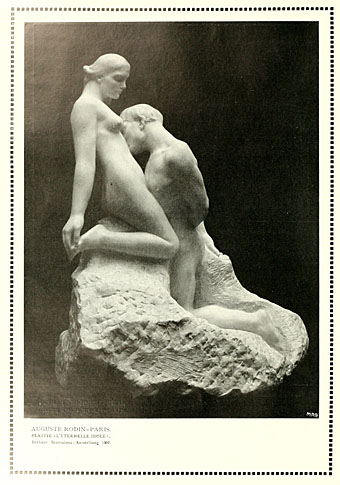
The Eternal Idol by Auguste Rodin.

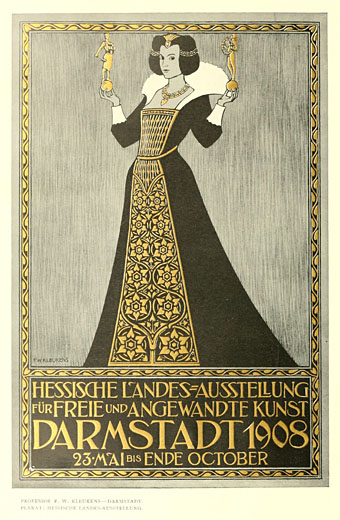
Continuing the delve into back numbers of Deutsche Kunst und Dekoration, the German periodical of art and decoration. Volume 21 covers the period from October 1907 to March 1908, and the highlight of this issue is a feature on the black-and-white art of Julius Klinger, an artist whose drawings appeared regularly in Jugend.

If you’ve been following this series it’s worth noting that volume 3 which is missing from the collection at the Internet Archive can be found at the University of Heidelberg. I would have featured it here but it turns out to be surprisingly dull compared to the other early editions. As before, anyone wishing to see these samples in greater detail is advised to download the entire number at the Internet Archive. There’ll be more DK&D next week.

dkd21-02.jpg

dkd21-03.jpg

Continue reading “Deutsche Kunst und Dekoration #21”