The paper architecture of Brodsky and Utkin

brodskyutkin.jpg

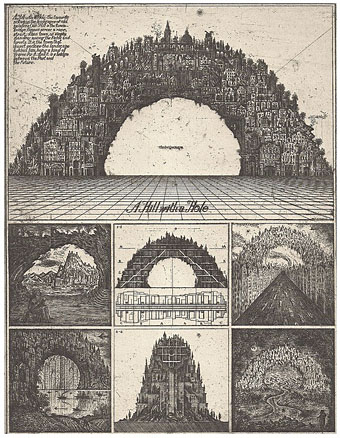
A Hill with a Hole.

Searching around for Kafka images yesterday turned up a reminder of the etchings of Alexander Brodsky and Ilya Utkin, a pair of Russian “Paper Architects” who channelled their frustration with the intransigence of Soviet authorities in the 1980s into a series of remarkable drawings. As with much architectural fantasy, these are part unrealistic exaggeration and part serious proposal, with the viewer left to decide whether the world really needs a hill with a hole.

Princeton Architectural Press published Brodsky & Utkin: The Complete Works by Lois Nesbitt in 2003 which is no doubt the source of the available scans. Of those, there’s a small Flickr collection here, while the late, lamented Nonist had a post about the book which repeats some of the same imagery. For more about Russia’s other paper architects see Russian Utopia.

Elsewhere on { feuilleton }
The etching and engraving archive

Previously on { feuilleton }
The art of François Schuiten
Hugh Ferriss and The Metropolis of Tomorrow

Richard Hamilton, 1922–2011

whitealbum.jpg

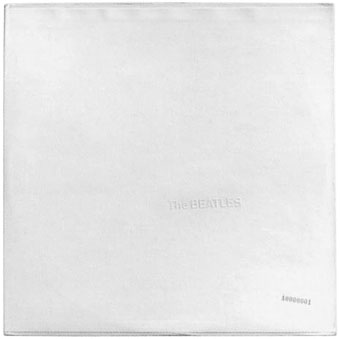
The Beatles aka The White Album (1968) by The Beatles. Design by Richard Hamilton.

Hamilton admires Hunger but he has little time for the other Young British Artists. He can’t imagine a conversation with Tracey Emin lasting more than five minutes – too tedious! – and though he was quite interested in Hirst’s sharks, his paintings bore him half to death. He believes that this generation is “ignorant… they have no understanding of art history. [Their work] is a waste of time. So much of what they’re doing has already been done, and not only by Duchamp, even. You think: you’re 50 years too late, mate.” Don’t even get him started on Sarah Lucas and her antics with cigarettes.

Richard Hamilton: A masterclass from the father of pop art

A few words to note the passing of British artist Richard Hamilton whose death was announced this week. I’ve retained an affection for Hamilton’s work over the years for a couple of reasons. As the creator of the 1956 collage Just What is it that Makes Today’s Homes So Different, So Appealing? he inadvertently gave a name to the emerging Pop Art movement with which he was to be indelibly connected, and I’ve written a few times here about my teenage enthusiasm for Pop Art and Surrealism. Hamilton’s work was more familiar to me at the age of 13 than that of many other artists. I responded to the immediacy of Pop Art even though it was over by the 1970s, just as I responded to the inherent weirdness of Surrealism which at that time was back in fashion. On my first visit to London in the mid-70s I rushed to the Tate Gallery (as Tate Britain was then known) to see some of the paintings and sculptures I’d been reading about in art books, and it was one of Hamilton’s works that stood out on that first visit, Swingeing London 67 (f), his painting of Mick Jagger’s drug arrest which I knew from photos although I hadn’t seen it in colour before. Most surprising—and something which reproductions still don’t quite convey—was seeing the pieces of metal stuck onto the canvas to form the handcuffs on the wrists of Jagger and Robert Fraser. It was already a shock that day being in one of the world’s major art galleries; it was even more of a shock to see this painting whose metal elements gave it a vivid presence beyond the pictorial surface as though it was caught halfway between painting and sculpture. It’s a presence which brings to the fore the “aura” which Walter Benjamin discusses in The Work of Art in the Age of Mechanical Reproduction (1936), an atmosphere possessed by an original work which will always be absent from a reproduction.

Another work I was fascinated by that day was the 1966 version of Marcel Duchamp’s The Bride Stripped Bare by Her Bachelors, Even (aka The Large Glass) which Hamilton had meticulously copied from the original at the Philadelphia Museum of Art. Hamilton made copies of a number of Duchamp’s works with the artist’s permission, and while his painting of Mick Jagger may have its own substantial aura, his Duchamp copy also has an aura of its own despite being a reproduction. What would Walter have made of that, I wonder? Duchamp is the first conceptual artist, and some trace of his inspiration can be found in Hamilton’s design two years later for The White Album, the 1968 release by The Beatles whose blank sleeve with its embossed name and unique serial number made it the first conceptual album cover. Hamilton has never received the same credit for this as Peter Blake receives for his Sgt. Pepper sleeve. On the packaging for the recent White Album CD acknowledgement was given to the designers who put the reissue together but the only mention of Hamilton was in the tiny list of thanks from the original printing. It’s a small detail from a long career but we can at least remember his contribution to music history today.

Guardian obituary | Richard Hamilton in pictures | Richard Hamilton’s altered images

Hive Culture and Shamanic Illuminations

bell.jpg

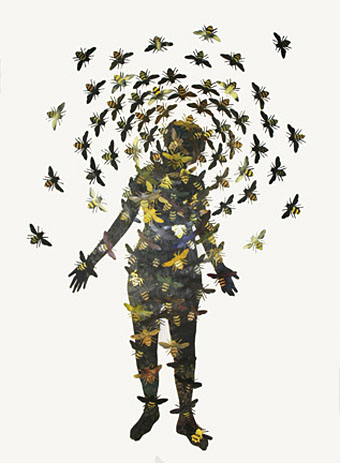
Apiphobia (2011) by Anonda Bell.

A couple of exhibitions opening this week for those in the New York area. Hive Culture: Captivated by the Honeybee is at the Glyndor Gallery at Wave Hill where 18 artists present works inspired by our favourite pollinating insects:

Painting, prints, sculpture, photography and video are featured, by artists Jennifer Angus, Anonda Bell, Deborah Davidovits, Anda Dubinskis, Cara Enteles, Rose-Lynn Fisher, Sally Gall, Hope Ginsburg, Talia Greene, Judi Harvest, Rob Keller, Andrea Lilienthal, Holly Lynton, Lenore Malen, Julia Oldham, Michelle Rozic, Jeanne Silverthorne and Draga Šušanj.

This isn’t solely an art exhibition. In October Wave Hill will be staging a series of bee- and honey-related events, details of which can be found on their press release (PDF).

amaringo.jpg

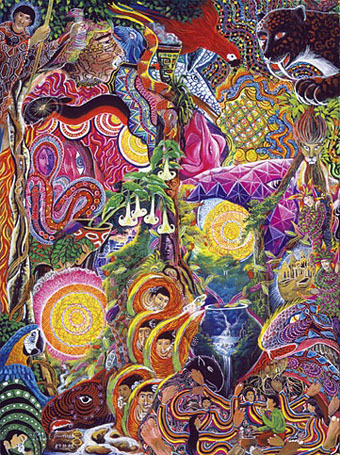
El Encanto de las Piedras by Pablo Amaringo.

Over at the ACA Galleries, Shamanic Illuminations which opens on Thursday will feature the art of Pablo Amaringo, Alex Grey and Mieshiel. There’s little detail at the moment on their website but they have a preview of the paintings including a number of Amaringo’s vivid, ayahuasca-inspired works which are psychedelic in every sense of the word. Shamanic Illuminations runs from September 15 to October 22. Via Phantasmaphile.

Danby’s Deluge

danby1.jpg

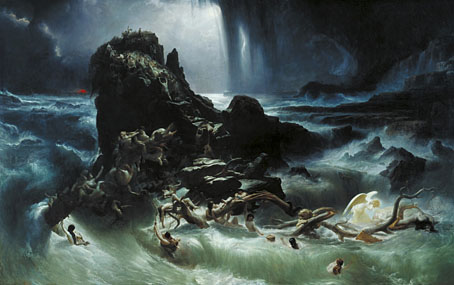
Since John Martin’s tumultuous canvases are back in the news it’s worth remembering another 19th-century painter of Biblical cataclysm, Francis Danby (1793–1861), whose enormous The Deluge (1840) used to hang in the same room as the Martins at Tate Britain. Danby was a contemporary of Martin although not as enthusiastic about this kind of subject matter. Visions of apocalypse proved to be popular, however, so Danby painted his Flood and similar works with reluctance. (Even Turner wasn’t above painting the occasional disaster.) Danby’s Deluge impressed me as much as Martin’s work when I first saw it not least for its having some believable human figures which give the vast canvas a tragic dimension. Martin’s figures are perfunctory and invariably dwarfed by the scale of events.

danby2.jpg

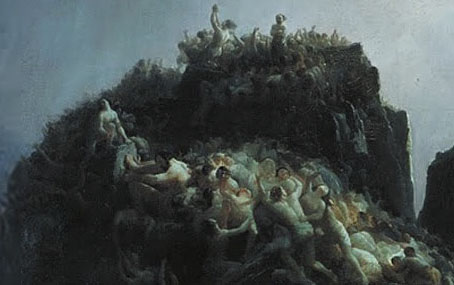
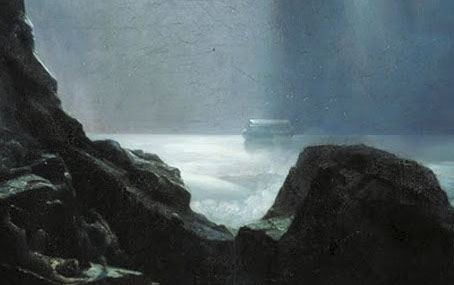
These details are from the Google Art Project which unfortunately don’t show us as much detail as they might. This is one of those paintings which encourages a lengthy contemplation, with a composition that draws the eye away from the swirling waters to a glowering sun and the shape of Noah’s ark on the distant horizon.

danby4.jpg

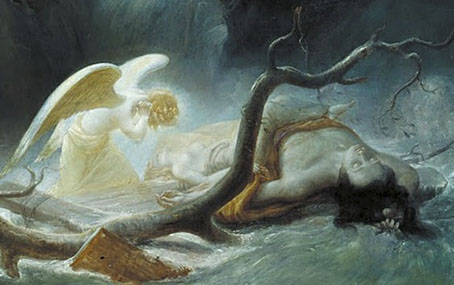
I’ve always been intrigued by the curious detail of the angel caught in the flood, and the even more curious detail of a drowned giant beside it. For the first time, however, I’ve noticed that the angel is peering into the face of a dead woman draped over the giant’s body. Paintings such as these often toured the country accompanied by the artist responsible who would lecture a paying audience about the various details. Besides the storytelling Danby gives the water in the foreground an astonishing transparent quality which Google’s photos can’t replicate. All the more reason to see his paintings for yourself if you’re in London.

Francis Danby at Tate Britain

danby3.jpg

Previously on { feuilleton }
John Martin: Heaven & Hell
Darkness visible
Death from above
The apocalyptic art of Francis Danby

Weekend links 75

darde.jpg

Eternal Pain (1913) by Paul Dardé. (And also here)

Rain Taxi caused a stir this week with its savaging of Hamlet’s Father by science fiction writer Orson Scott Card. The book is another of Card’s blatherings about the hell of being homosexual dressed in garments stolen from the unfortunate William Shakespeare. Rain Taxi made the obvious point about many of Shakespeare’s sonnets being homoerotic. For my part I was more appalled by the quoted extract which reduced one of the greatest plays in the language to that lifeless, cardboard-character-speak which is endemic in bad genre writing. News of the travesty quickly spread to gay news blogs, The Outer Alliance and elsewhere, ensuring that what’s left of Card’s reputation continues to spiral down a Mel Gibson-shaped black hole.

• “Sounds only like itself, like no one before or after.” Julian Cope on Tago Mago by Can which will be reissued in a new edition in November. Nice to see the return of the original sleeve design, something I saw once in a record shop then didn’t see again for years. For a long time I thought I’d imagined it. Related: two German art exhibitions inspired by the group.

The Responsive Eye (1965), a catalogue for the MoMA exhibition that launched Op Art. Also at Ubuweb: La femme 100 têtes, a film by Eric Duvivier based on the collage work by Max Ernst.

• More apocalyptic art: William Feaver on John Martin whose exhibition will be opening at Tate Britain later this month. There’s a trailer here.

Borges and I, an essay by Nandini Ramachandran. Related: Buenos Aires: Las Calles de Borges, a short film by Ian Ruschel.

• “Who was JG Ballard? Don’t ask his first biographer,” says Robert McCrum.

Biologically-inspired fabric and material design by Neri Oxman.

• Cross-pollinating subgenres: “Steampunk ambient” at Disquiet.

In the Shadow of Saturn, a photo by the Cassini spacecraft.

• The art and fashion designs of Alia Penner.

Fleet of hybrid airships to conquer Arctic.

• RIP Jordan Belson, filmmaker.

• Ten years of Ladytron whose new album is released on the 12th of September: Playgirl (2001), Seventeen (2002), Destroy Everything You Touch (2005), Sugar (2005), Ghosts (2008), Ace Of Hz (2011).