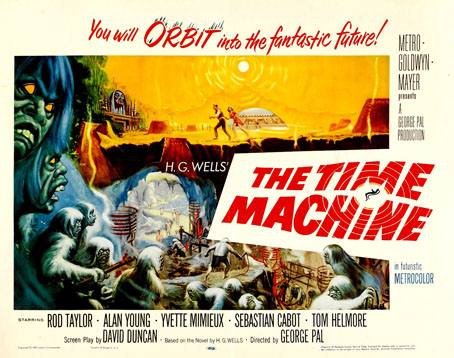
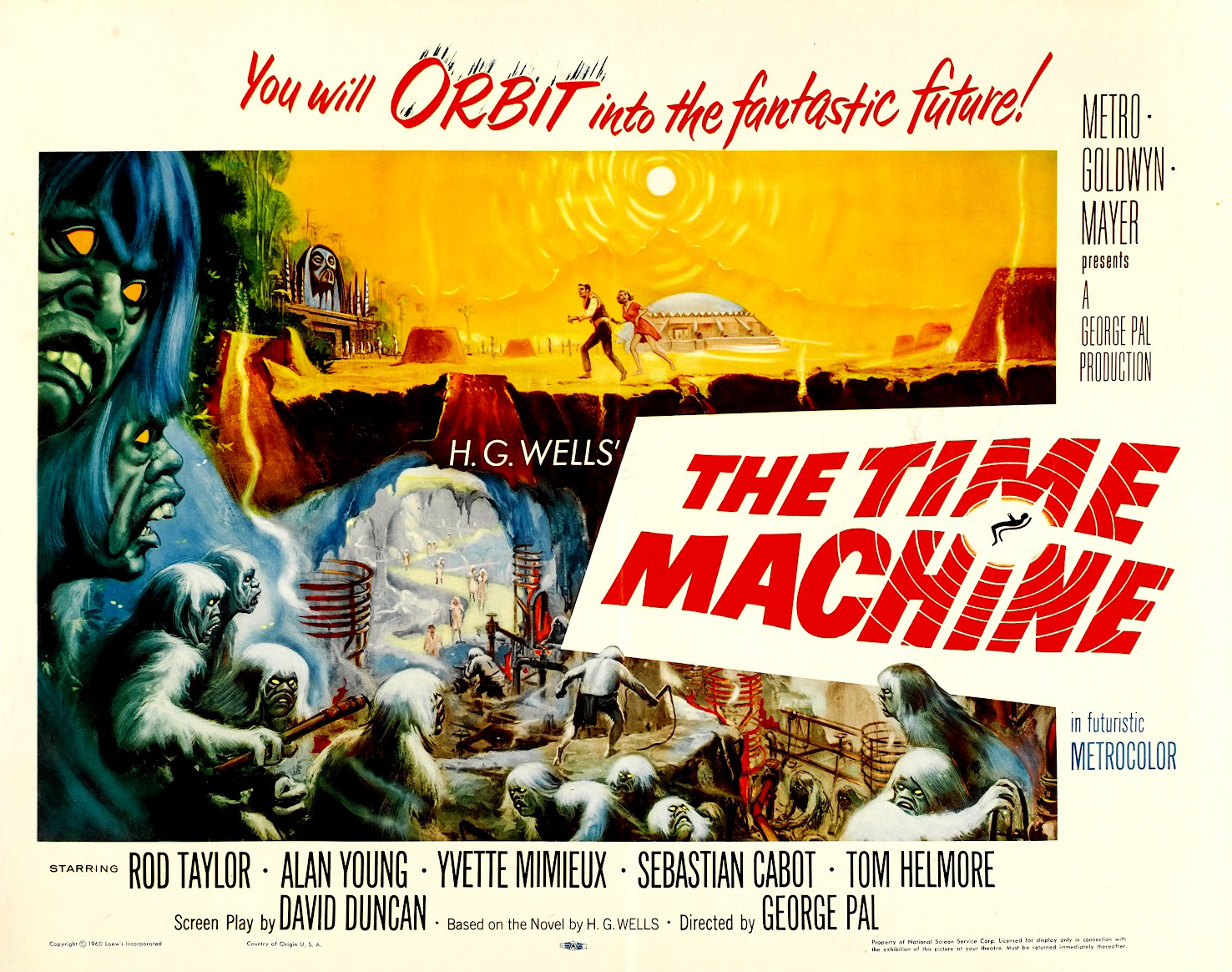
The Time Machine (1960).
The turning over of the calendar from one year to the next makes this day the ideal moment to write something about HG Wells’ celebrated story. Having re-read The Magic Shop before Christmas I decided to refresh my reading habit—lapsed these past months due to pressure of work—by revisiting more of Wells’ short stories, many of which I haven’t looked at for years.
As I said in that earlier post, it was The Time Machine that led me to Wells’ written work after being excited at an early age by George Pal’s 1960 film adaptation. Reading the story again I’m still astonished by how advanced it is compared to everything else being published in 1895. Michael Moorcock’s excellent introductory essay, The Time of ‘The Time Machine’ (1993), notes that time travel per se wasn’t a new idea for Victorian readers, there were many novels and stories using the theme, most of them merely displacing a character from one age to the next in a very simple manner. Wells’ innovation was the idea of a machine which would give the user mastery of Time itself. Moorcock also notes that Wells considered this to be his one great idea which he always felt he never exploited as fully as he wished. The need to make a living forced him to set down the story in some haste when it was accepted for serialisation in WE Henley’s New Review. (Moorcock’s introduction can be found in a recent collection London Peculiar and Other Nonfiction).
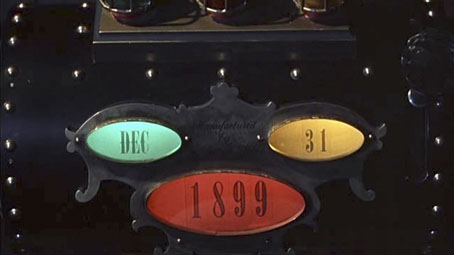
The other notable feature this time round—and this means more to me than it would to many other readers—was being struck by the way Wells’ story prefigures so much of the fiction William Hope Hodgson would be writing a decade or so later. It’s a commonplace among Hodgson scholars that The Night Land (1912) owes something to the scenes when the Time Traveller journeys beyond the age of the Eloi and Morlocks to a period when the Earth is dead and the Sun has swollen to a baleful giant. Some of the more cosmic moments of The House on the Borderland (1908) can also be traced back to these scenes. I’d argue that the Time Traveller’s earlier battles with the Morlocks prefigure and possibly influence similar battles in The Night Land, and the attacks of the Swine-Things in Borderland. There’s even a moment near the end of Wells’ story when the Time Traveller is menaced by giant crustaceans like those which infest Hodgson’s Sargasso Sea. This may not be a fresh observation but it’s not one I’ve seen elaborated before.
Regular readers will know it’s a habit here to seek out illustrations of favourite stories. In the case of The Time Machine there are hundreds to choose from so the following selection barely scratches the surface. Something I’d not noticed before when looking at comic strip adaptations is that none of the works derived from Wells’ story (George Pal’s film included) seem able to countenance the Time Traveller’s abandoning of Weena to the Morlocks when the pair become trapped outdoors at night; all show the Time Traveller doing his best to rescue her. William Hope Hodgson’s fiction is filled with rescues, sieges and the defence of the weak against marauding and inhuman forces; The Night Land concerns an epic and apparently suicidal rescue mission across the most inhospitable terrain imaginable. It may be stretching a point but it’s possible to see much of Hodgson’s fiction as being a riposte to this incident in Wells’ story.
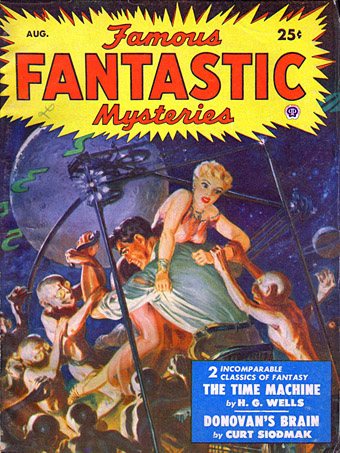
Illustration by George Saunders (August, 1950).
Recurrent points of interest in illustrations of Wells’ story are i) How is the Time Machine itself depicted? (The author’s descriptions are evasive), and ii) How are the Morlocks depicted? Wells describes them thus:
‘I turned with my heart in my mouth, and saw a queer little ape-like figure, its head held down in a peculiar manner, running across the sunlit space behind me. It blundered against a block of granite, staggered aside, and in a moment was hidden in a black shadow beneath another pile of ruined masonry.
‘My impression of it is, of course, imperfect; but I know it was a dull white, and had strange large greyish-red eyes; also that there was flaxen hair on its head and down its back. But, as I say, it went too fast for me to see distinctly. I cannot even say whether it ran on all-fours, or only with its forearms held very low.
George Saunders’ small Gollum-like creatures are closer to Wells’ conception than many later depictions. Saunders’ Weena, on the other hand, is far too tall for the equally diminutive Eloi.
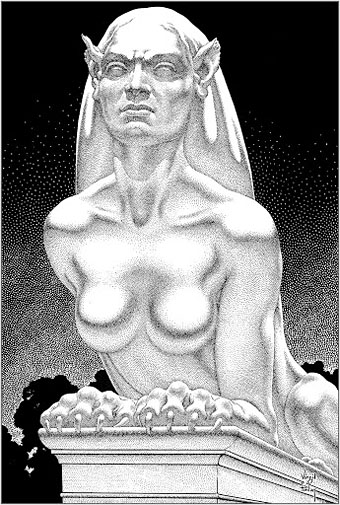
Virgil Finlay (1950).
This is still my favourite Time Machine illustration but then Finlay has a tendency to beat everyone when it comes to these assignments. His illustrations appeared inside the August, 1950 issue of Famous Fantastic Mysteries. Wells’ sphinx has wings which I imagine Finlay might have included if he wasn’t restricted by the space allowed for his illustration. He also provided the illustration of a Morlock below.
Continue reading “The Time Machine”



+2.jpg)