Weekend links 190

lipton.jpg

Seam Stress (1987) by Laurie LiptonThe Drawings of Laurie Lipton is out now from Last Gasp.

• The Quietus continues to be essential reading: John Doran talks to Richard H Kirk about Cabaret Voltaire | Sarah Angliss, musician and inventor of music machines, talks to Stuart Huggett | “…the most overt literary lodestar for The Art Of Falling Apart is John Rechy, trailblazing chronicler of the gay underbelly of hustlers and queens zig-zagging across America, and author of Numbers, the book from which Soft Cell’s song takes its name.” Matthew Lindsay looks back at Soft Cell’s second (and best) album.

• “The English have something of a tradition where they like to scare you out of your mind at Christmas, a kind of sobering up of the senses by forces that seem to be beyond them.” Colin Fleming on The Signal-Man by Charles Dickens. More ghosts: Lisa Kerrigan explains why she loves Nigel Kneale’s 1989 TV adaptation of The Woman in Black by Susan Hill, and the BFI resurrects The Mistletoe Bough (1904), “the oldest film version of a classic Christmas ghost story”.

• “…the story is filled with a whole mess of embarrassed and embarrassing euphemisms for (ahem) big dick—stiff language, so to speak, like ‘bludgeon,’ like ‘giant concupiscence’ and ‘ostentatious organ.'” Steven Cordova on A Visit to Priapus and Other Stories by Glenway Wescott.

• “Never produced, the screenplay for The Way to Santiago is credited to Orson Welles. A quick look at the text leaves no doubt it was the work of the Citizen Kane filmmaker when he was at the peak of his arrogant brilliance. The script begins: ‘My face fills the frame.'”

• If you’re at all interested in the current state of the British musical underground, the end-of-year lists at Ears For Eyes are worth your attention.

Pee-wee’s (Remastered) Christmas Adventure: An interview with Paul Reubens. Related: Grace Jones sings Little Drummer Boy for Pee-wee.

• “I’m like a drag queen at Halloween.” John Waters on his favourite time of year: Christmas.

• Mix of the week: Secret Thirteen Mix 099, an “(anti)Christmas mix” by Robert Curgenven.

• The British Library makes over a million free-to-use images available at Flickr Commons.

• Lost in Translation: Notes on adapting Ballard by Calum Marsh.

MR James at Pinterest.

Book Map by Dorothy.

Martin (1983) by Soft Cell | Ghost Talk (1985) by Cabaret Voltaire | For Laika (2011) by Spacedog

Aleister Crowley: Wandering The Waste

crowley1.jpg

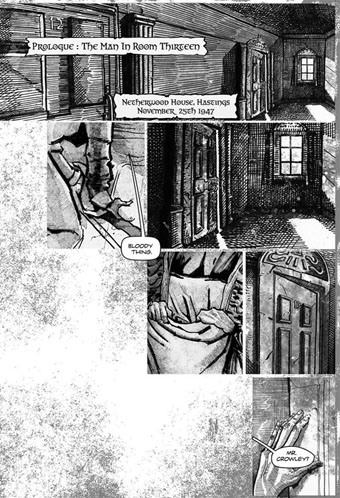
I mentioned this graphic biography of Aleister Crowley earlier in the year but pressure of work has meant it’s taken me all this time to finally read it. Aleister Crowley: Wandering The Waste is written by Martin Hayes and illustrated by RH Stewart. The title alludes to Alastor, or The Spirit of Solitude, a Shelley poem concerning an itinerant poet with whom Crowley often identified.

Crowley isn’t a stranger to the comics world but this book is the first I’ve encountered that devotes itself to the facts of the man’s life rather than using his notorious persona as a general purpose scare figure. Crowley’s life was nothing if not eventful: in addition to the numerous rituals and magickal exploits, he was also a serious mountaineer, and something of a globetrotter before his inheritance ran out; he wrote novels, memoirs, several volumes of poetry, even more volumes of occult philosophy, and was a world-class drug-taker and libertine in an age when sexual escapades of the mildest sort could provoke the deepest outrage.

Given all of this you’d expect somebody to have tried to film his life by now, but doing so presents a number of problems. Period biopics are by their nature very expensive which is why they tend to take the least controversial figures for their subjects. Crowley isn’t only controversial, his life’s work remains esoteric and difficult for a general audience; you’d have to work hard to dispel Devil Rides Out clichés for people who’ve never opened an occult book. There’s no life without the magick, however, so you’re unlikely to get either trying to follow the costume-drama route. In the past I’ve thought that a better solution would be to adopt the jigsaw approach used in François Girard’s Thirty Two Short Films About Glenn Gould (1993); significant moments could be dramatised as they are in the Gould film while other sections could be more graphical, abstract or theoretical.

crowley2.jpg

Hayes and Stewart’s book goes for the traditional biopic approach (albeit with some deviations), there being no reason not to when you have an unlimited budget. It’s 1947, and Crowley in his Hastings nursing home remembers his life for a young visitor, delivering a narrative that ranges across seventy years, and which acknowledges the more scandalous moments whilst also repudiating some of the rumours. Hayes backs up his facts with copious endnotes, some of which offer more detail about disputed incidents. Alan Moore and Eddie Campbell’s From Hell is the obvious progenitor here; both books show the strength of comics in being able to deliver historical material in a visual form without having to worry about the constraints of cinema.

Stewart’s artwork is from the sketchy, collaged Sienkiewicz/McKean school of comic art. In some scenes I would have preferred more visual detail but then having drawn historical comics myself I know how difficult it can be having to research the appearance of every last piece of clothing or furniture. (The lettering is also afflicted with a few typos.) Some of the scenes away from 1947 are delivered in a fragmented, hallucinatory style in which occult figures and symbols are confused with Crowley’s memories. The technique enables many years to be covered without padding the book to doorstop size while also keeping the magick as a continual background presence. It’s quite a change to have the aged Crowley as the focus for once, a dishevelled magus rather than the usual libidinous firebrand. After so much turmoil, there’s always a sombre atmosphere around the Great Beast’s less-than-beastly final days, although they were considerably more peaceful than those of some of his wives and associates. Whatever regrets or disappointments Crowley may have felt, his books are still in print, and we’re still talking about him.

The Atlantis Bookshop in London has been showing some of Stewart’s artwork throughout this month. I’ve always liked the way the Atlantis doubles as a mini-gallery, I saw some Austin Spare drawings there a few years ago; it’s a good venue, and the ideal place to view this work. The exhibition will run to December 24th.

Previously on { feuilleton }
Brush of Baphomet by Kenneth Anger
Rex Ingram’s The Magician
The Mysteries of Myra
Aleister Crowley on vinyl

Gare d’Orsay to Musée d’Orsay

orsay01.jpg

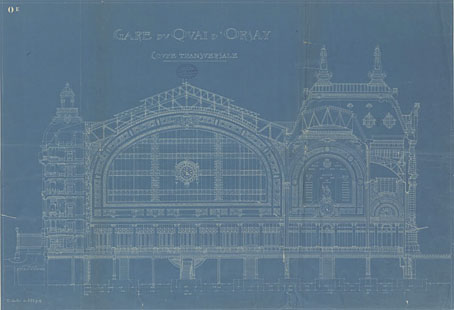
Gare d’Orsay, coupe transversale (1898). Plan de Victor Laloux.

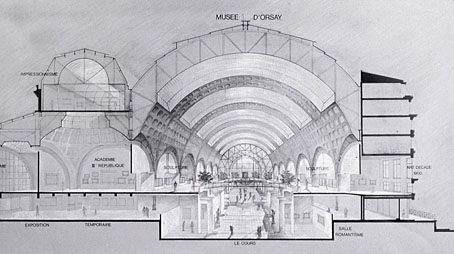
The Google Art Project is currently featuring a slideshow history of the Musée d’Orsay in Paris, showing the museum’s evolution from the world’s first all-electric rail terminal to its current status as a major repository of 19th-century art. The Gare d’Orsay was built to bring visitors to the Exposition Universelle of 1900, an event regular readers should be familiar with by now, a connection which only compounds the interest I have in the place. (See this recent post and the links below it for more on the subject.)

orsay02.jpg

Projet A.C.T. Architecture (Renaud Bardon, Pierre Colboc, Jean-Paul Philippon). Coupe perspective générale, Octobre 1979.

orsay03.jpg

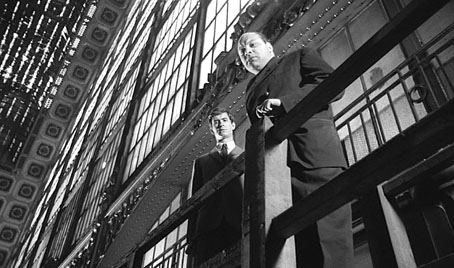
The Trial.

In addition to the building being one of the few structures remaining from the exposition, its dishevelled splendour provided Orson Welles with a fantastically evocative (and cheap!) set for his 1962 film of The Trial. It’s surprising to read that people objected to this, believing the spaces to be too large. The disjunction of space in Welles’ film is one of its great strengths, as is the confusion of architectural styles and detail. Much of this was improvisation imposed by necessity—money not being available for the sets that were planned—but it makes the film all the more labyrinthine and disorienting.

Continue reading “Gare d’Orsay to Musée d’Orsay”

Eduardo Paolozzi at New Worlds

paolozzi00.jpg

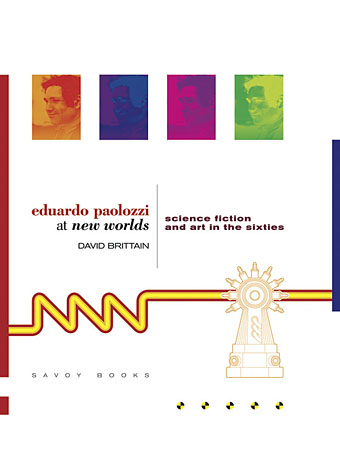
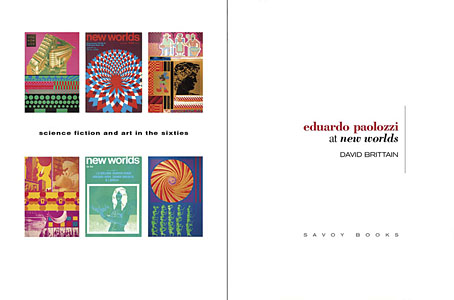
I was working on this book throughout the autumn, and it could hardly be more different to some of the visual extravagance that came before and after. Eduardo Paolozzi at New Worlds is published by Savoy Books this month. Predominantly an examination by David Brittain (no relation to David Britton) of the connections between artists such as Paolozzi and Richard Hamilton with New Worlds magazine in the 1960s, the book is also a rare study of the science fiction magazine when it was making its greatest impact in the late 60s and early 70s.

Brittain highlights many examples of Paolozzi’s sf-influenced art of the period, and examines the development of the magazine under Michael Moorcock’s editorship during which time New Worlds evolved from being a slightly moribund sf title in the early 60s to what JG Ballard later called “one of the most exciting magazines of any kind in this country”. An appendix features interviews with some of the key creators and contributors: editor Moorcock, designer Charles Platt, art editor Christopher Finch, contributor Michael Butterworth, and critic John Clute. Writer and illustrator Pamela Zoline created some original artwork for the endpapers. The introduction is by Rick Poynor.

paolozzi01.jpg

Despite being pressured for time I was very pleased to be designing this book. I’d liked Paolozzi’s work since I first encountered it in the Tate Gallery in the 1970s; a couple of years later I was buying up anthologies featuring New Worlds stories (I was too young for the 60s magazine), so discovering that Moorcock had made Paolozzi the magazine’s “Aeronautics Advisor” made perfect sense. In the past I’ve said that New Worlds ruined my taste for hard sf but that’s not really true since I never really liked the stuff beyond a few Arthur C. Clarke books. Too much bad writing, too many cardboard characters shuffling around between chunks of explanation about made-up technology. The discovery of New Worlds merely demonstrated that there were other ways of approaching sf, and you didn’t have to put up with the rubbish.

I also enjoyed the magazine’s bolshy attitude, a quality shared by Harlan Ellison in his Dangerous Visions anthologies. Moorcock says in Brittain’s interview that NW sympathised with the Underground of the late 60s but also tried to be more disciplined in its approach, especially where the design was concerned. You couldn’t have treated fiction to the semi-legible printing that Oz and Frendz often deployed. But the radical attitudes of the Underground can be discerned in the stance NW adopted. Some of the reviews and polemical articles by Moorcock (often under his “James Colvin” pseudonym), M. John Harrison and John Clute are bracingly vitriolic to a degree which if delivered today would probably see them ostracised for life.

paolozzi02.jpg

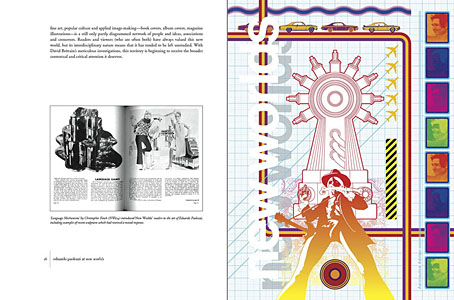
With the design the main intention was to present the information clearly and let the visuals speak for themselves. The book is heavily illustrated throughout, with many examples of Paolozzi’s marvellous prints. The layout nods obliquely to the period; before getting started I spent some time looking at the work of Erik Nitsche. I like the way Nitsche laid out the books he designed in the 1960s, and there’s also a connection in his work as a designer for the General Dynamics corporation: one of Paolozzi’s print series of the period is entitled General Dynamics F.U.N.

Being full-colour throughout, the print run for this book is smaller than usual so anyone interested is advised to move swiftly. Official publication is December 16th but it’s on sale now at Savoy and at Amazon.

paolozzi03.jpg

Continue reading “Eduardo Paolozzi at New Worlds”

Steampunk Calendar

00steampunkcalendar.jpg

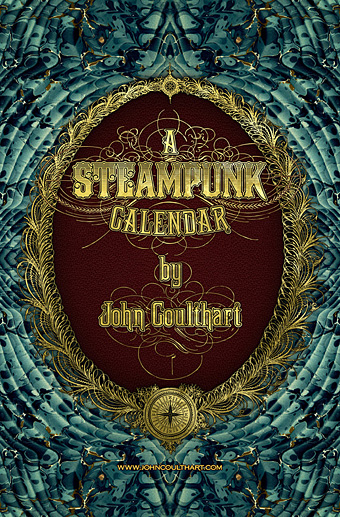
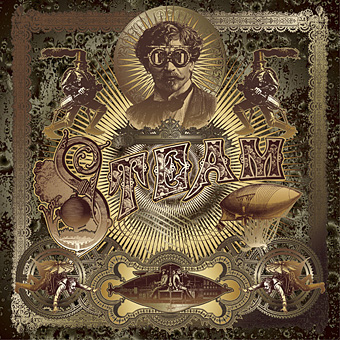
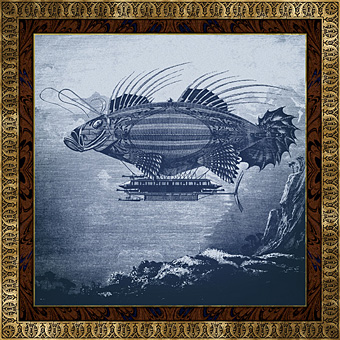
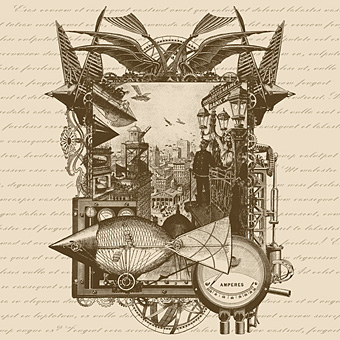
This one arrives two months late, the months of October and November being overly preoccupied with other work. I chose a steampunk theme for this year since this has been a productive area recently. The idea was one of those simple notions—rework some book covers into calendar pages—that in practice ended up taking much longer than anticipated. Larger copies of the pages may be seen here while the CafePress purchase page is here. My thanks to everyone who’s been buying things recently.

For those who dislike over-decorated 19th-century science fiction but may still want a Coulthart calendar there’s the Cthulhu Calendar (still a popular item), the Psychedelic Wonderland calendar, and the Through the Psychedelic Looking-Glass calendar. Note: Calendars at CafePress can now be purchased throughout the year so make sure that you select January as the starting month if you want the months to run for a single year only.

01steampunkcalendar.jpg

02steampunkcalendar.jpg

03steampunkcalendar.jpg

Continue reading “Steampunk Calendar”