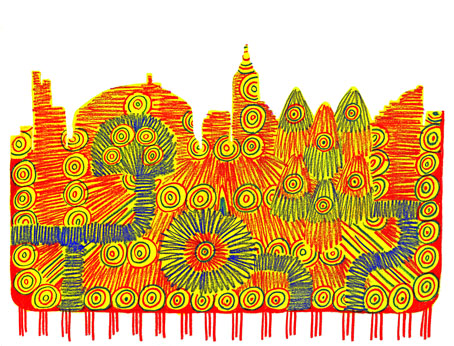
Brion Gysin record covers

gysin01.jpg

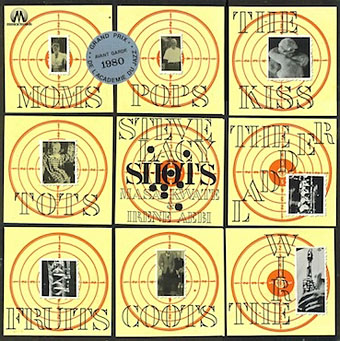
Shots (1977) by Steve Lacy.

Continuing an occasional series about artists or designers whose work has been used on record sleeves. The life and work of Brion Gysin (1916–1986) is the subject of a new exhibition, Unseen Collaborator, that opened last week at October Gallery, London. The gallery page mentions Gysin’s connections to the music world: among other things, it was Gysin’s enthusiasm for the Master Musicians of Jajouka that gave those people and their music global prominence, with a little help from Brian Jones. But there are other connections, whether as a collaborator with Steve Lacy, or as a decorator of album covers. Some of these uses are posthumous but this small collection includes a few releases I’d not come across before.

gysin02.jpg

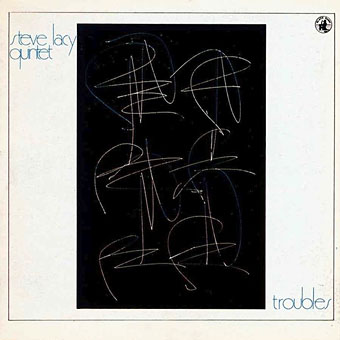
Troubles (1979) by The Steve Lacy Quintet.

gysin03.jpg

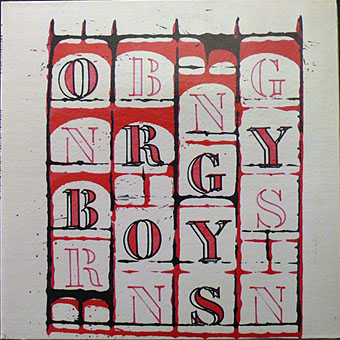
Orgy Boys (1982) by Brion Gysin.

A 12-inch single with Gysin reading from William Burroughs and his own writings. “Songs dedicated to his orgy pals: William S. Burroughs, Mick Jagger, Keith Richards, Iggy Pop, David Bowie, Fafa de Palaminy, Patti Smith, Allen Ginsberg and John Giorno…”

Continue reading “Brion Gysin record covers”

The art of Aleksandr Kosteckij

ak06.jpg

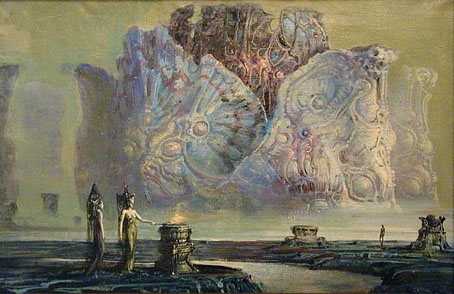
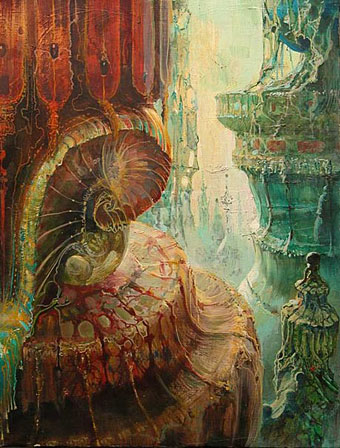
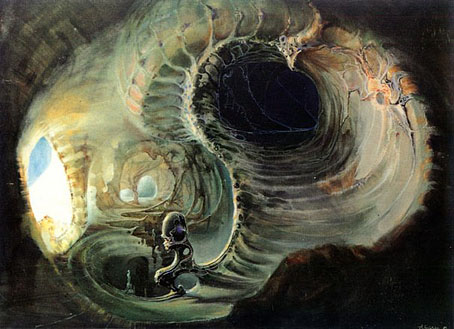
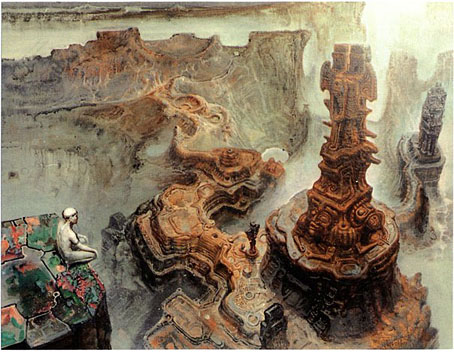
This is the kind of fantastic art I like a great deal: nebulous landscapes whose vast forms may be some kind of hybrid architecture; implications of the alien and mystical that retain some ambiguity; dreamlike without slipping into post-Surrealist cliché. Monsieur Thombeau at Full Fathom Five (whose excellent eye I have to thank once again) describes the paintings of Aleksandr Kosteckij/Kostetsky (1954–2010) as being “like Gustave Moreau, Salvador Dalí, and Max Ernst put in a blender and left out in the rain.” I’d place them somewhere between Ernst Fuchs and Bruce Pennington but Moreau’s chimeras are certainly present. You’d think an artist of this calibre with a large body of work would be better known, most of the attention at the moment seems to be on Russian websites. Let’s hope that changes soon.

Update: Thanks to Joe for pointing the way to this dedicated website, something I missed in my haste.

Examples chosen from these sites:
http://vk.com/album-32941665_175452413 (139 images)
http://www.2photo.ru/en/post/18614

ak07.jpg

ak02.jpg

ak03.jpg

Continue reading “The art of Aleksandr Kosteckij”

Weekend links 266

dune.jpg

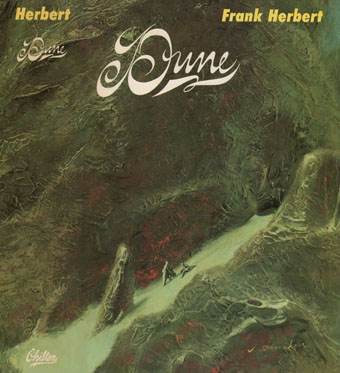
Spine and cover art by John Schoenherr for the first American edition of Dune, 1965.

• “[Herbert] had also taken peyote and read Jung. In 1960, a sailing buddy introduced him to the Zen thinker Alan Watts, who was living on a houseboat in Sausalito. Long conversations with Watts, the main conduit by which Zen was permeating the west-coast counterculture, helped turn Herbert’s pacy adventure story into an exploration of temporality, the limits of personal identity and the mind’s relationship to the body.” Hari Kunzru on Frank Herbert and Dune, 50 years on. Related: “To save California, read Dune,” says Andrew Leonard. There’s a lot more Dune cover art at ISFDB.

• “Embedded in Adam’s footage were several dark forms, human-ish in outline, unidentifiable but unmistakable, visible within the leaves or the shadows.” Holloway is a short film by Adam Scovell based on the book by Robert Macfarlane, Dan Richards and Stanley Donwood.

The Library of the Lost: In Search of Forgotten Authors by Roger Dobson; edited and with an introduction by Mark Valentine. Roger and Mark were my first publishers in 1988 when their Caermaen Books imprint produced the large-format edition of The Haunter of the Dark.

• “…over the years he created a series of ‘Pharmacies’: rows of glass bottles filled not with medicines to cure the body…but objects to stimulate the mind.” Clare Walters reviews Joseph Cornell: Wanderlust, an exhibition at the Royal Academy, London.

• “The sound machines we build today are invariably one-offs, made from salvaged parts, with all the precariousness of a prototype.” Sarah Angliss on the art of making music machines.

Mission Desire is a new single by Jane Weaver whose video is “set to scenes from Marie Mathématique – the French 1960s mini-series about Barbarella’s younger sister”.

• Ghost signs, ginnels and hidden details: an alternative guide to Manchester by Hayley Flynn aka Skyliner.

• “I want to be despised,” says John Waters who has a new art exhibition at Sprüth Magers, London.

Sonic Praise, an album of “Krautprogbikermetal” by Ecstatic Vision.

• The Evolution of the Great Gay Novel: an overview by Rebecca Brill.

• At Bibliothèque Gay: more homoerotic drawings by Jean Cocteau.

Wyrd Daze Lvl2 Issue 3 is a free download.

Nicolas Winding Refn: vinyl collector.

Art With Naked Guys In It

Caladan (2011) by Roly Porter | Giedi Prime (2011) by Roly Porter | Arrakis (2011) by Roly Porter
Invisible Cities: Miscellanea

cities01.jpg

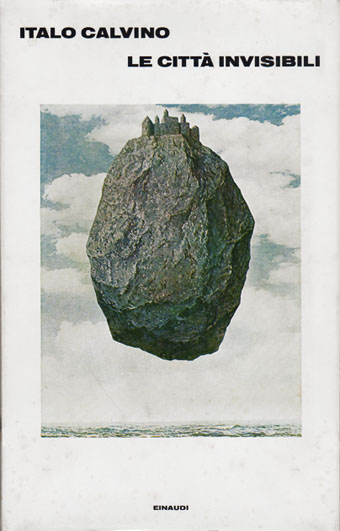
Cover art: The Castle in the Pyrenees (1961) by René Magritte.

A final post for this week devoted to Italo Calvino’s Invisible Cities, and it occurs to me that “Miscellanea” could easily be the name of one of Marco Polo’s cities.

One thing that’s become apparent over the past few days is that this subject is a very popular one with artists, especially in Italy. This is understandable but it also means you could probably fill another week of posts pursuing further illustrations and homages. Rather than belabour things I’m ending with a few of the more notable derivations including some cover designs. The Einaudi volume above was the first printing in Italy in 1972.

cities03.jpg

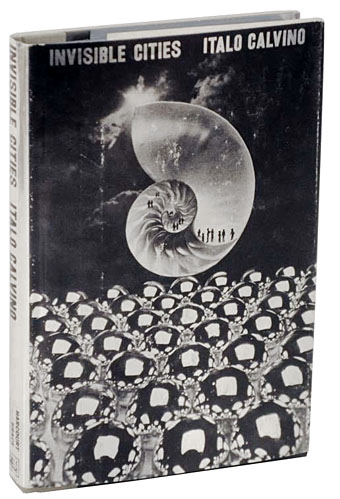
Cover design by Arnold Skolnick.

And this was the first American edition from Harcourt, Brace and Jovanovich in 1974. The cover is printed in silver foil which makes the book a particularly desirable item. This might explain why it’s also rather expensive today.

cities04.jpg

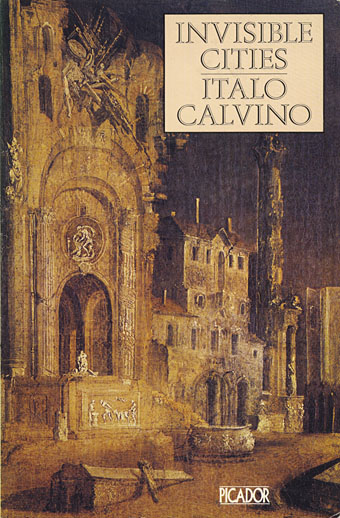
Cover art: Martyrdom of a Saint by Monsù Desiderio.

The 1979 Picador edition is one of two paperback editions I own. The enigmatic “Monsù Desiderio” has a confused identity (see this post), and specialised in curious architectural paintings so this is an apt choice.

Continue reading “Invisible Cities: Miscellanea”

Seeing Calvino: Invisible Cities

seeing1.jpg

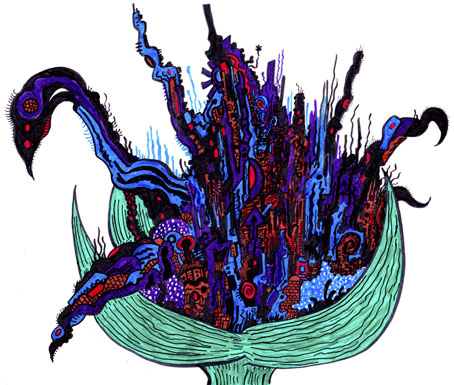
Continuous Cities 4: Cecilia by Leighton Connor.

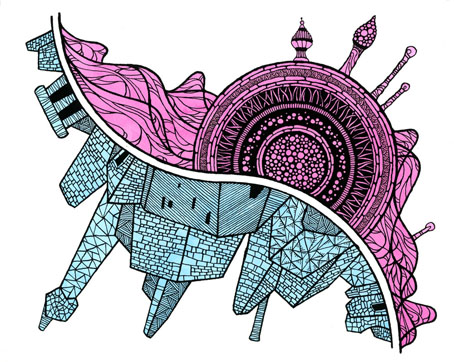
Seeing Calvino is the most recent of the illustration projects featured this week, a group effort by three artists—Leighton Connor, Matt Kish and Joe Kuth—dedicated to picturing all 55 of the Invisible Cities. Matt Kish has been mentioned here before since he and I were among the many artists adapting literary works for The Graphic Canon (2012), a huge three-volume endeavour edited by Russ Kick. (Matt chose Moby-Dick while I worked on the rather less daunting Picture of Dorian Gray.) The depictions for Seeing Calvino are bold, vivid, and almost abstract at times. The trio completed their Invisible Cities project in April this year but there’s a promise on their Tumblr to commence work on an adaptation of Calvino’s astronomical fantasia, Cosmicomics.

seeing2.jpg

Thin Cities 4: Sophronia by Matt Kish.

seeing3.jpg

Cities and the Sky 1: Eudoxia by Joe Kuth.

Elsewhere on { feuilleton }
The illustrators archive

Previously on { feuilleton }
Gérard Trignac’s Invisible Cities
Colleen Corradi Brannigan’s Invisible Cities
Le Città In/visibili
Mikhail Viesel’s Invisible Cities
Bookmark: Italo Calvino
Crossed destinies revisted
Crossed destinies: when the Quays met Calvino
Tressants: the Calvino Hotel