The Monstrous

monstrous01.jpg

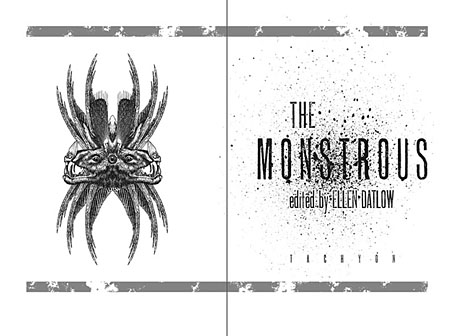
One of the books I was working on over the summer is officially published this week. The Monstrous is a horror anthology edited by Ellen Datlow, and the third Datlow collection that I’ve designed for Tachyon Publications after Lovecraft’s Monsters (2014) and Darkness: Two Decades of Modern Horror (2010).

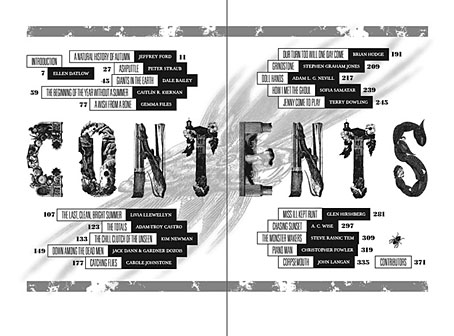
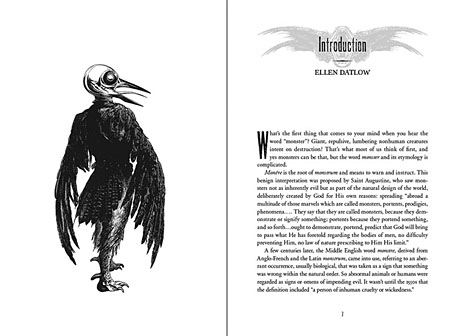
My work on this new collection isn’t as full-on as for the Lovecraft volume: I designed the interior, and also illustrated each story but this time many of the illustrations are details or vignettes rather than full-page pictures. There are still 20 stories and over 20 illustrations, however, illustrating pieces by Jeffrey Ford, Peter Straub, Dale Bailey, Caitlín R. Kiernan, Gemma Files, Livia, Adam-Troy Castro, Kim Newman, Jack Dann & Gardner Dozois, Carole Johnstone, Brian Hodge, Stephen Graham Jones, Adam L. G. Nevill, Sofia Samatar, Terry Dowling, Glen Hirshberg, A. C. Wise, Steve Rasnic Tem, Christopher Fowler, and John Langan. Not everything here is a monster in the common sense of that word, the collection explores monstrousness in many different forms, from Sumerian demons and Japanese ghosts to Peter Straub’s disturbing portrait of a psychotic school teacher.
monstrous02.jpg

Missing from this selection of pages is additional pictorial material from Fortunio Liceti’s De Monstris (1665). The capitals on the contents pages are the collaged letterforms by Roman Cieślewicz taken from Dover’s book of bizarre and ornamental alphabets.
monstrous03.jpg

Continue reading “The Monstrous”

Oz magazine online

oz1.jpg

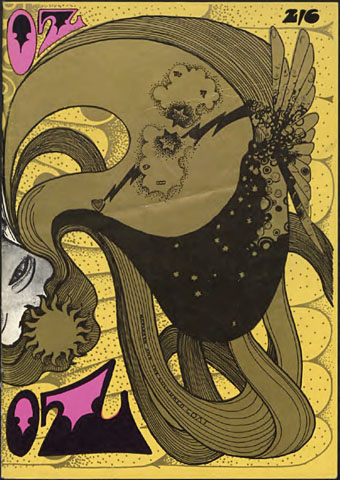
Oz 4. Cover art by Hapshash and the Coloured Coat.

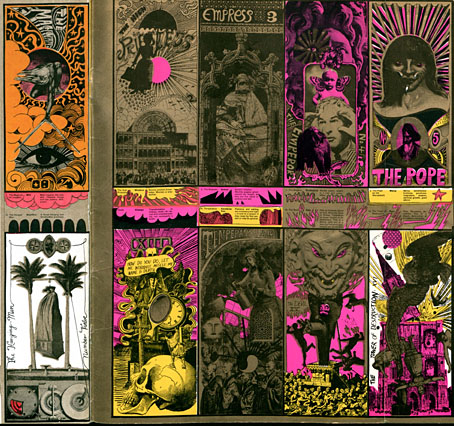
From a television series out of time to a magazine very much of its time. The Prisoner and Oz magazine are exact contemporaries: issue 4 of Oz (June 1967) would have been on sale when Patrick McGoohan and co. were busy turning Portmeirion into The Village. In the past anyone interested in Oz had to either scour eBay for expensive paper copies or content themselves with the incomplete scans made available several years ago. But no longer, thanks to the University of Wollongong and editor Richard Neville who have made the entire run available as downloadable PDFs. These are much better quality than the previously available copies, and they also have poster inserts available as separate downloads. The wonderful set of Tarot designs created by the late Martin Sharp for issue 4 were faded and torn in the old scans so it’s a real pleasure to see this and other artwork looking so good.

oz2.jpg

Tarot designs from Oz 4 by Martin Sharp.

Continue reading “Oz magazine online”

Weekend links 281

fini.jpg

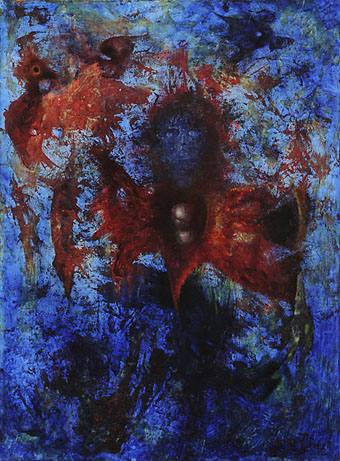
Chimère du soir (1961) by Leonor Fini. Réalisme irréel is an exhibition of Fini’s work currently running at the Weinstein Gallery, San Francisco.

• ” ‘Paris invented the flâneur,’ he notes, ‘and continues to press all leisurely and attentive walkers into exercising that pursuit, which is an active and engaged form of interaction with the city, one that sharpens concentration and enlarges imaginative empathy and overrides mere tourism.’ ” David L. Ulin reviewing The Other Paris by Luc Sante.

• “A lot of posters promise so much that how can they ever deliver?” Nicolas Winding Refn talking to Mat Colegate about his book, The Act Of Seeing, a collection of posters for exploitation films.

• “Sexuality is present throughout and often subverts a narrative we might read entirely differently from a straight poet.” Callum James reviews Physical by Andrew McMillan.

This movie will lose a lot of people along the way, but then again, as far back as 1962, Ballard wrote a manifesto for a new form of science fiction, Which Way to Inner Space?, in which he insisted that “from now on, most of the hard work will fall, not on the writer, but on the readers. The onus is on them to accept a more oblique narrative style, understated themes, private symbols and vocabularies.” This is exactly what Wheatley wants from his audience.

Mike Holliday comparing Ben Wheatley’s forthcoming film of High-Rise with JG Ballard’s novel. Ballard’s suggestion for a new SF now seems increasingly like a road not taken. But that’s another discussion entirely…

The Lost Library of John Dee, an exhibition of books owned by the Elizabethan magus, opens at the Royal College of Physicians museum, London, in January.

Clive Hicks-Jenkins has been writing about his illustration heroes including Alexander Alexeieff.

Cameron: Cinderella of the Wastelands. The exhibition has just finished but the art is still online.

• Mixes of the week: FACT Mix 518 by Fis, and Secret Thirteen Mix 165 by Damien Dubrovnik.

• At Dirge Magazine: Tenebrous Kate on Fantômas, the French King of Crime.

• Suitably seasonal: Polish Night Music by David Lynch & Marek Zebrowski.

Kickin’ In, a previously unreleased EP of music by Patrick Cowley.

Jean-Michel Jarre‘s favourite albums.

Seeing It As You Really Are (1970) by Hawkwind | Seeing Out The Angel (1981) by Simple Minds | Seeing Red (1998) by Red Snapper

Metzengerstein

satty.jpg

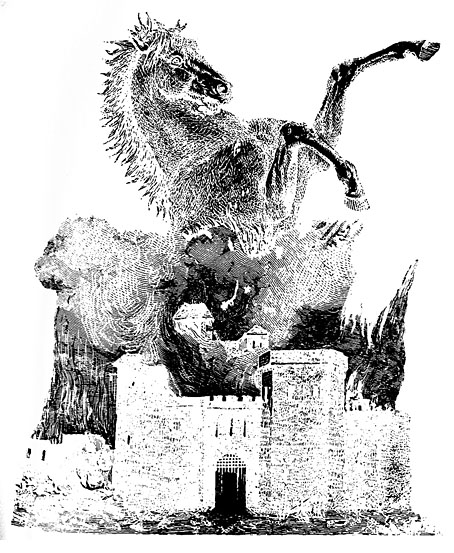
Metzengerstein by Wilfried Sätty.

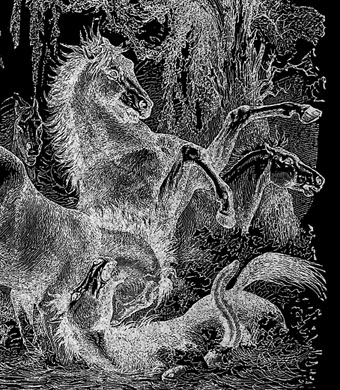
One of the horses in yesterday’s post seemed familiar until I realised it had been used by Wilfried Sätty for his final Metzengerstein illustration in The Illustrated Edgar Allan Poe (1976). This has been happening a lot since I started delving into the book scans at the Internet Archive, Sätty’s collage sources leaping abruptly from old engravings. The horse is a good example of Sätty’s evolved approach to collage which often reversed the printing of assembled artwork, or used a printing press (or PMT process) to duplicate and mirror his collage elements.

Not all Poe illustrators bother with this Gothic pastiche, and those that do don’t always provide an effective rendering of the climax when the clouds of smoke above a smouldering castle assume the form of a colossal horse. Byam Shaw’s illustration is typical, with the horse standing inertly above the flames. Sätty’s picture only occupies half a page but is much more successful, as are many of the other illustrations in a volume that remains one of the very best Poe collections, and the finest of Sätty’s books.

horses3.jpg

Previously on { feuilleton }
The original Gandharva
The Occult Explosion
Wilfried Sätty album covers
Nature Boy: Jesper Ryom and Wilfried Sätty
Wilfried Sätty: Artist of the occult
Illustrating Poe #4: Wilfried Sätty
Gandharva by Beaver & Krause

Elaine Hanelock’s Hollywood stars

hanelock04.jpg

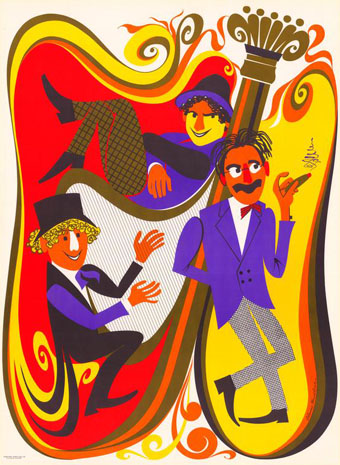
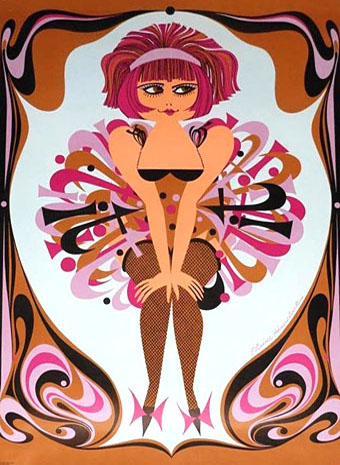
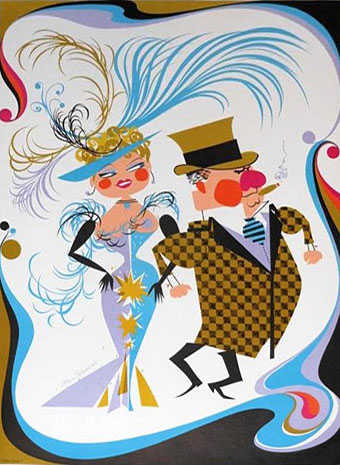
The essay I wrote about psychedelic art for Communication Arts earlier this year had a word limit so there was little mention of the way the psychedelic style was swiftly co-opted by advertising and commercial art as a means of reaching a youthful audience. This is a really a subject in itself, the way in which an aesthetic that was countercultural in 1965 was becoming mainstream by 1968, and was still rippling through the world of graphic design in the early 1970s.

Elaine Hanelock’s posters of Hollywood stars of the 1920s and 30s were published by Royal Screen Craft Inc, Los Angeles, in 1968, and combine two trends: psychedelic art and the nostalgia for old Hollywood that emerged in the mid-60s. There are ten posters in the set: The Marx Brothers, Clara Bow (the “It Girl”), Mae West & WC Fields, Laurel & Hardy, John Barrymore, Charlie Chaplin, Clark Gable, Jean Harlow, Will Rogers, and Wallace Beery & Marie Dressler. Nobody seems to know anything about Elaine Hanelock’s career elsewhere but her posters continue to find an audience among collectors.

hanelock07.jpg

hanelock01.jpg

Continue reading “Elaine Hanelock’s Hollywood stars”