Rodler’s Fine, Useful Booklet

rodler01.jpg

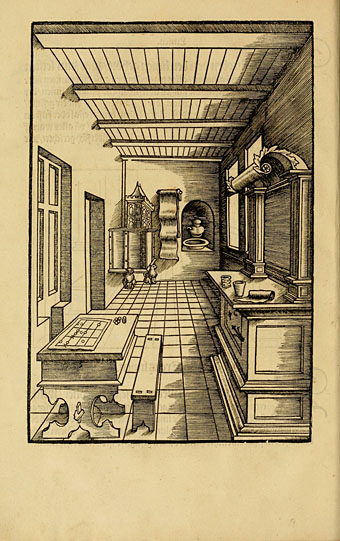
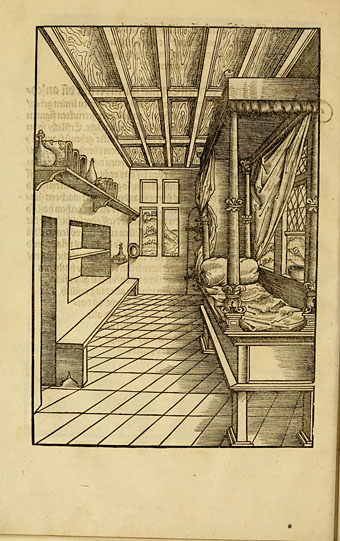
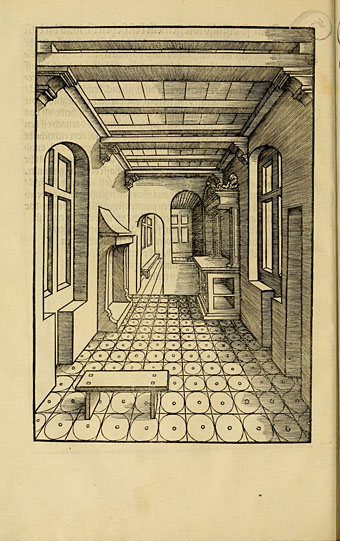
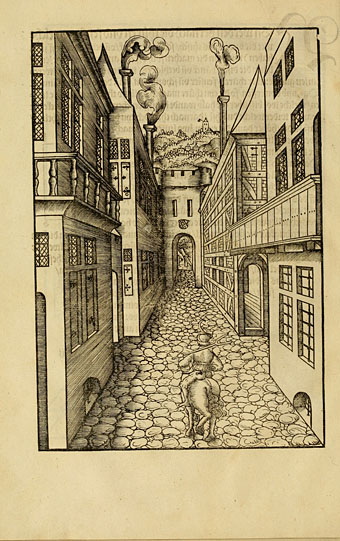
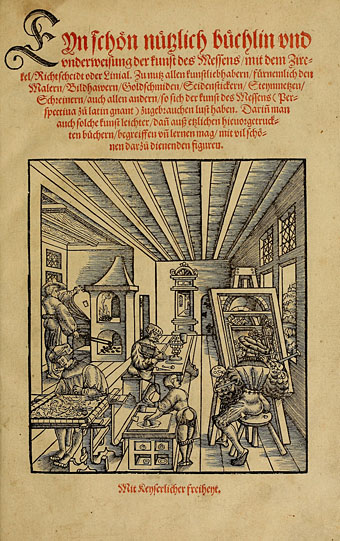
Another treatise on perspective, and an older one than Pozzo’s so the drawings are somewhat cruder. Eyn schön nützlich büchlin und underweisung der kunst des Messens (A Fine, Useful Booklet and Instruction in the Art of Measurement) by Hieronymus Rodler was published in 1531, and features a number of full-page views where the perspective is accurate but also alarmingly severe in places. The emptiness and unusual appearance of the scenes has an unintentional charm, they remind me of the illustrations from The Dumas Club (1993) by Arturo Pérez-Reverte where the mysterious drawings—based on old alchemical illustrations—contain subtle variations. Rodler’s book made an appearance at Giornale Nuovo in 2005 so I’ll point you there for further discussion of its technical qualities. The book itself may be browsed here or downloaded here.

rodler02.jpg

rodler03.jpg

rodler04.jpg

rodler05.jpg

Continue reading “Rodler’s Fine, Useful Booklet”

Antony Little’s echoes of Aubrey

little1.jpg

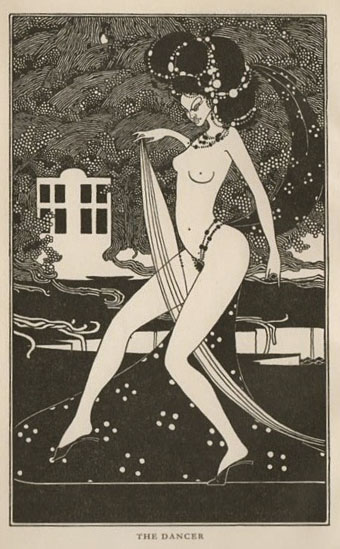
The Dancer (1967) by Antony Little.

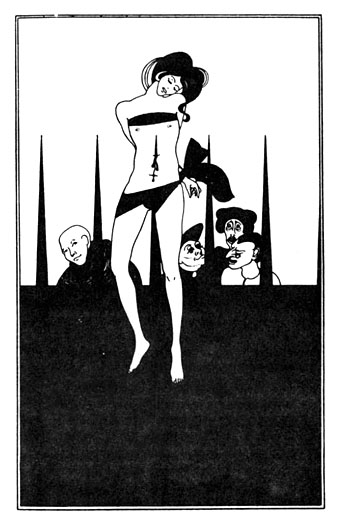
My thanks to Sweet Jane this time for alerting me to her post about a series of Beardsley-inspired illustrations from 1967 by Biba designer Antony Little. The Wandering Jew and Other Stories was the first translation in English of Apollinaire’s 1910 collection L’Hérèsiarque et Cie. I’ve known about this book for a while but few of the illustrations have been on view anywhere until this post. There are eight in all, each of them very adeptly capturing different phases of Beardsley’s drawing style, from the spare black-and-whites to the more detailed renderings seen in his later work. The drawing below is another in the series from a post of Callum’s which also includes a favourite of mine by Beresford Egan.

Little’s designs, and the prominence of the Biba stores, did much to make Art Nouveau in general, and Beardsley in particular, a crucial component of London fashion in the late 1960s. For more on that subject see this Sweet Jane post featuring yet more Beardsley borrowings and monochrome design, plus Osborne & Little’s fantastic Chinese Dragon wallpaper which made a memorable appearance last year in Only God Forgives.

little2.jpg

Elsewhere on { feuilleton }
• The Aubrey Beardsley archive
• The illustrators archive

Aubrey in LIFE

life.jpg

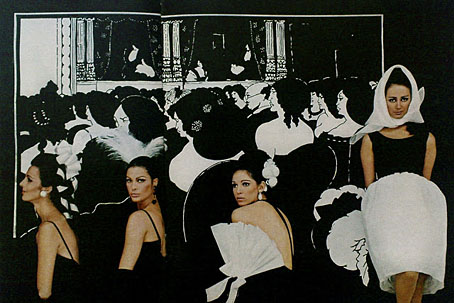
Turned out for a big night at the opera like Beardsley’s Wagnerites, girls wear bare-backed blacks by Trigère. Coiffed heads are by Hugh Harrison and Halston of Bergdorf Goodman’s; Halston also made the pouf-skirted dress. (Photo session by Milton Green & Joe Eula.)

Being determined to catalogue every last piece of Beardsley trivia from the 1960s, I’m compelled to note this post which I’d missed at Sweet Jane’s Pop Boutique a couple of years ago. An earlier post here showed one of the photos from a LIFE fashion feature using Aubrey’s drawings but the Sweet Jane post has scans of all the photos, plus accompanying text. This was published in February 1967, a few months after the summer exhibition at the V&A in London which introduced Beardsley’s work to a new generation, an exhibition which set in motion a wave of popular interest in his work.

I’m intrigued by the way the colour of the women’s bodies emerges from the drawings given the date when the magazine appeared. I’ve long seen 1966 as a very black-and-white year in graphic and aesthetic terms, whereas 1967 is obviously full-colour; the difference between the sleeves of the Beatles’ (Beardsley-derived) Revolver and Sgt Pepper albums are only two of the more prominent examples. These fashion photos could be regarded as being caught mid-way between the shift from one state to another. There are more shots of the Wagnerites above on this page. Thanks to Ian for drawing my attention to the Sweet Jane post.

Elsewhere on { feuilleton }
• The Aubrey Beardsley archive

Weekend links 203

budich.jpg

A Dune-inspired piece by Joshua Budich for In Dreams: an art show tribute to David Lynch at Spoke Art.

• “[Montague] Summers was a friend of Aleister Crowley and, like [Jacques d’Adelswärd] Fersen, conducted homoerotic black masses; whatever eldritch divinity received their entreaties was evidently propitiated by nude youths.” Strange Flowers goes in search of the Reverend Summers.

• More Jarmania: Veronica Horwell on the theatrical life of Derek Jarman, Paul Gallagher on When Derek Jarman met William Burroughs, and Scott Treleaven on Derek Jarman’s Advice to a Young Queer Artist.

• Robert Henke of Monolake talks to Secret Thirteen about his electronic music. More electronica: analogue-synth group Node have recorded a new album, their first since their debut in 1995.

This hypertrophied response to decay and dilapidation is what drives the “ruin gaze”, a kind of steroidal sublime that enables us to enlarge the past because we cannot enlarge the present. When ruin-meister Giovanni Piranesi introduced human figures into his “Views of Rome”, they were always disproportionately small in relation to his colossal (and colossally inaccurate) wrecks of empire. It’s not that Piranesi, an architect, couldn’t do the maths: he wasn’t trying to document the remains so much as translate them into a grand melancholic view. As Marguerite Yourcenar put it, Piranesi was not only the interpreter but “virtually the inventor of Rome’s tragic beauty”. His “sublime dreams”, Horace Walpole said, had conjured “visions of Rome beyond what it boasted even in the meridian of its splendour”.

Frances Stonor Saunders on How ruins reveal our deepest fears and desires.

• Gustave Doré. L’imaginaire au pouvoir: Four short films from the Musée d’Orsay to accompany their current exhibition, Gustave Doré (1832–1883): Master of Imagination.

• At Dangerous Minds: Remembering Cathy Berberian, the hippest—and funniest—lady of avant-garde classical music.

• “Merely a Man of Letters”: Jorge Luis Borges interviewed in 1977 by Denis Dutton & Michael Palencia-Roth.

• Luke Epplin on Big as Life (1966), a science-fiction novel by EL Doctorow which the author has since disowned.

• The Psychomagical Realism of Alejandro Jodorowsky: Eric Benson talks to the tireless polymath.

• A video essay by Matt Zoller Seitz for the 10th anniversary of David Milch’s Deadwood.

• Eugene Brennan on Scott Walker’s The Climate of Hunter (1984).

• Dune at Pinterest.

• Prophecy Theme from Dune (1984) by Brian Eno | Olivine (1995) by Node | Gobi 110 35′ south 45 58′ (1999) by Monolake

Title pages

title1.jpg

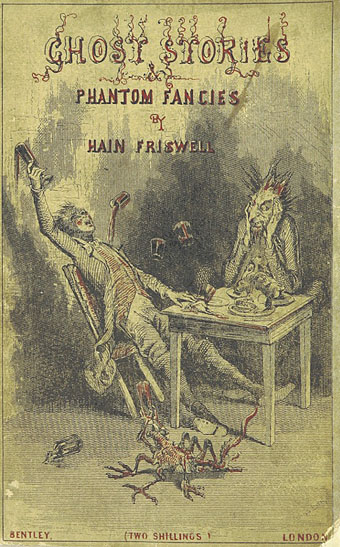
Ghost Stories and Phantom Fancies (1858) by James Hain Friswell.

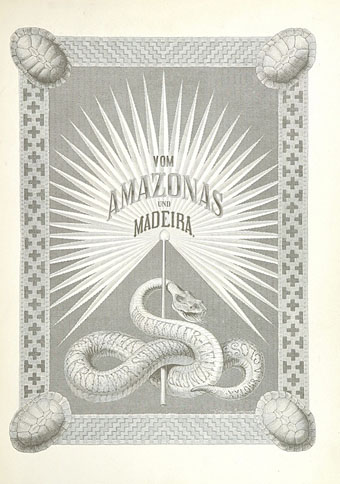
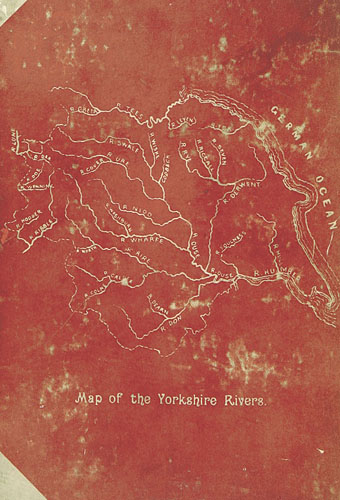
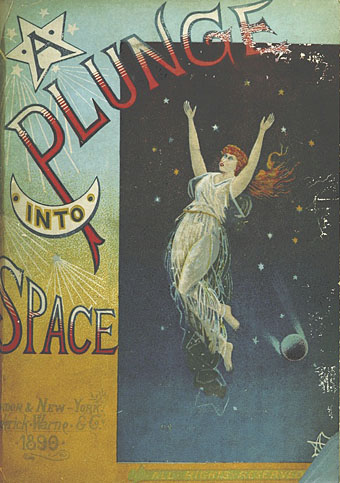
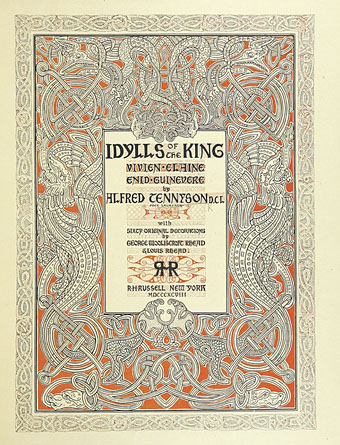
The vast repository of copyright-free images from the British Library is still being sifted into Flickr sets. These are a few examples from a set of 786 title pages which range from elegant book plates to Dime Westerns and Penny Dreadfuls. A Plunge into Space is a science-fiction novel about a journey to the planet Mars in a spaceship called The Steel Globe. Robert Cromie was also the author of A New Messiah (1901), and The Crack of Doom (1895). The latter—which has some great chapter titles: The Universe A Mistake!, The Murder Club, A Telepathic Telegram—may be read here.

title5.jpg

Vom Amazonas und Madeira (1874) by Franz Keller-Leuzinger.

title2.jpg

Yorkshire Rivers. Reproduced from The Yorkshire Weekly Post (1890) by Tom Bradley.

title3.jpg

A Plunge into Space (1890) by Robert Cromie.

title4.jpg

Idylls of the King (1898) by Alfred Tennyson. Illustrated by George and Louis Rhead.

Previously on { feuilleton }
• A Trip to Mars