
Weekend links 460

treister.jpg

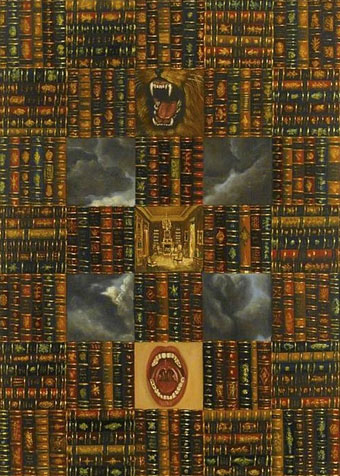
Black Hole (1987) by Suzanne Treister.

• “Most people who are considered heroes are always to be found messing about in someone else’s affairs, and I don’t think that’s very heroic.” Robert Altman talking in 1974 to Jan Dawson about The Long Goodbye.

• “Tea is calming, but alerting at the same time.” Natasha Gilbert on the science of tea’s mood-altering magic.

• Alien spaceship, Hammer horror? Philip Hoare on the pulsating visions of Harry Clarke.

“…world cinema, particularly European cinema…hasn’t shied away from sex and, in fact, has often found ways of using sex to tell a story. Movies like The Duke of Burgundy or Sauvage or BPM gracefully integrate eroticism into the narrative—even when the sex itself is far from graceful. Even the American films that have focused on sex tend to do it with a leer and luridness, regarding sex with a certain narrative fetishism, as opposed to matter-of-factly.”

Rich Juzwiak talking to Catherine Shoard about the current state of sex in the cinema

• Chernobyl again: photographs by David McMillan from inside the exclusion zone.

Lasting Marks: the 16 men put on trial for sadomasochism in Thatcher’s Britain.

• Before Tarkovsky: Michael Brooke on the Russian TV adaptation of Solaris.

• Mix of the week: XLR8R Podcast 588 by Rouge Mécanique.

• Dustin Krcatovich on The Strange World of Mark Stewart.

• Your Surrealist literature starter kit by Emily Temple.

John Peel’s Archive Things (1970)

5fathom: Things rich and strange

Hole In The Sky (1975) by Black Sabbath | Thru The Black Hole (1979) by Metabolist | Black Hole (1993) by Total Eclipse

Weekend links 455

brocken.jpg

• At Expanding Mind: Tarot expert Mary Greer talks with Erik Davis about Tarot artist Pamela Colman Smith, the Golden Dawn, the art of illustration, Jung’s active imagination, Smith’s musical visions, and the recent study of Smith’s life and work, Pamela Colman Smith: the Untold Story.

• Almost five years have passed since the last album from Earth (if you discount the Bug vs. Earth collaboration Concrete Desert) but the band will release a new album, Full Upon Her Burning Lips, in May. Cats On The Briar is a taster.

Charles Bramesco on Sergei Bondarchuk’s astonishing 7-hour adaptation of War and Peace. I watched the whole thing last weekend: all superlatives are justified.

• The History of the Future: James Conway on leaving Australia for a life in Berlin and publishing. Related: Where is Rixdorf?

• At Spoon & Tamago: Keisuke Aiso‘s artworks, including the Ubume sculpture that became the face of the Momo Challenge hoax.

• Mixes of the week: Secret Thirteen Mix 282 by Tourist Gaze, and Big Sister’s Scratchy Singles Vol 1 by radioShirley.

Alexander Rose on the 26,000-Year Astronomical Monument Hidden in Plain Sight.

Rebecca Cole and Janise Elie go in search of the Brocken spectre on Burley Moor.

M. John Harrison: Critical Essays, edited by Rhys Williams and Mark Bould.

Forest of Resonating Lamps – One Stroke, Cherry Blossoms by teamLab.

• Tour de France: Jonathan Meades selects 13 exercise-bike Classics.

• At Greydogtales: The Cthulhu Mythos for Beginners.

The Black Tower (1987), a short film by John Smith.

• At Dennis Cooper’s: Jean Rollin Day.

Ishmael Reed doesn’t like Hamilton.

Babylonian Tower (1982) by Minimal Compact | The Tower (Black Advance) (2007) by Mordant Music | The Tower (Empty Fortress) (2007) by Mordant Music

Salvador Dalí’s Maze

dali13.jpg

Maurice Yves Sandoz (1892–1958) was a Swiss composer and writer who published a handful of works of fantastic fiction, none of which are especially well-known today. One of these, a novel entitled Le Labyrinthe (1945), will be familiar to most people via the film version directed by William Cameron Menzies in 1953, Menzies’ final effort in a chequered directing career. The Maze is a low-budget horror film that was shot in 3-D, and which works well for the most part, at least until its rather absurd ending. I hadn’t heard about the novel until a recent conversation with the knowledgeable Mr TjZ during which he mentioned that Salvador Dalí had illustrated Sandoz’s novel when it was republished by Doubleday, Doran in 1945. Dalí illustrated a number of novels throughout his career but The Maze is one of the few original works (as opposed to a reprint of a classic), the fruit of Sandoz’s social connections with the art world. 1945 was the year that Dalí’s brand of Surrealism was fully embraced by America—he was working on Hitchcock’s Spellbound at this time—so it’s surprising that Sandoz’s novel isn’t better known. Dalí also provided illustrations for two collections of Sandoz’s short stories: Fantastic Memories (1944) and On the Verge (1950).

dali14.jpg

I haven’t seen a copy of the novel so the illustrations here are no doubt wrongly sequenced. Secondhand copies of the Dalí Sandoz titles aren’t as expensive as you’d imagine so I’m tempted to track down copies. I’m also curious to know how the novel compares to the film. Thanks to TjZ for the tip!

(And having written the above, I notice from my tags for the post that I’d linked to copies of the short story illustrations in a weekend posting several years ago. Among other things, this blog is a useful memory jolt. But The Maze was definitely news.)

dali05.jpg

dali01.jpg

dali02.jpg

Continue reading “Salvador Dalí’s Maze”

Weekend links 448

becher.jpg

Gas Tanks 1965–2009 by Bernd Becher and Hilla Becher.

• At Dangerous Minds: the drawings produced by Moebius for Maxwell House in 1989 are better than the coffee whose sales they were intended to assist.

Jarman Volume 2: 1987–1994, the BFI’s second collection of Derek Jarman films, is now available for pre-order.

• More Gorey: Cara Giaimo on Edward Gorey’s hoards and collections.

That movie [Susan Slade]—and I even have the paperback novelization of it—is a moment. That’s a perfect example. They would never release that image as a still of the movie. Come see a baby catch on fire! To me, I’m kind of rewriting the films as these scenes. That was a real shock to me as a teenager when I saw that. And I thought, Did that just happen? Her baby caught on fire? I remember in Serial Mom I had a big fight with a film executive who said that you can’t have her set her kid’s friend on fire. You can’t do that. And I said, “Why, it’s been in movies forever.” And I’m thinking of Susan Slade, but I’m thinking there’s no point using that in the argument.

John Waters talking to Gina Telaroli about his films but mostly about his works for the art gallery

Georgina Guthrie on how green became cinema’s loneliest colour.

• Tom Crewe reviews Edward Burne-Jones at Tate Britain.

• Mix of the week: FACT Mix 688 by Steve Hauschildt.

• At Strange Flowers: 19 books for 2019.

Jenzeits Cosmic Worlds by Jenzeits.

• Green Onions (1962) by Booker T. & The MGs | Green (1966) by Ken Nordine | Green Fuz (1969) by Randy Alvey And The Green Fuz

Weekend links 446

pca.jpg

The Ghost Box label releases a new album by the excellent Pye Corner Audio in February (previews are here). The spectral design, as ever, is by Julian House.

• “In October 1966, Phyllis Willner arrived on motorcycle in San Francisco as a teenage Jewish runaway from Jamaica, Queens. She quickly fell in with the Hell’s Angels, the San Francisco Mime Troupe and, most crucially, the Diggers, who were just getting their street radical thing together in the Haight-Ashbury. The next two years would be eventful: many extraordinary highs, some really terrible lows.” Jay Babcock talks to Phyllis Willner about her involvement with “the executive branch of the hippie movement”, the Diggers.

• At Expanding Mind: Erik Davis talks with religious scholar Diana Pasulka about UFOs, scientific believers, book encounters, elite cabals, studying weirdness, and her new book American Cosmic: UFOs, Religion, Technology.

• Kenneth Anger is now 91 but he still appears hale, and looks even more magus-like than ever. This short film by Floria Sigismondi finds him reminiscing in the antiquated confines of the Chateau Marmont hotel on Sunset Boulevard.

David Wojnarowicz did not write dark fantasy. He wrote real life. In The Waterfront Journals he brilliantly captures electric tales from the mouths of strangers, those he described as “junkies, prostitutes, male hustlers, truck drivers, hobos, young outlaws, runaway kids, criminal types”, whose lives echo his own ostracized existence. He was thirteen when he was first paid for sex and sixteen when he started “turning tricks” regularly. His mother kicked him out of the house. By the time Wojnarowicz came out to friends in New York, he was in his early twenties. He was on the cusp of finding his voice as a writer and his confidence as an artist. It was the mid-1970s. AIDS was about to tear through the gay community.

Lara Pawson reviews three books by artist and writer David Wojnarowicz

John Banville reviews Kafka’s Last Trial by Benjamin Balint: “A scrupulous study of the squabble between Germany and Israel over Kafka’s papers, and the two women caught in the middle.”

• A sitting with the diva of the diode: electronic musician Suzanne Ciani in conversation with Christine Kakaire.

• Mixes of the week: Secret Thirteen Mix 076 by KK Null, and XLR8R Podcast 574 by SHXCXCHCXSH.

Cassie Packard on the colorful and clairvoyant history of aura photography.

Edward Gorey’s Children’s Books Illustrations, Revisited.

Alison Flood on the fascination of miniature books.

Magic Hollow (1967) by The Beau Brummels | Hollow Stone (1972) by Khan | Through Hollow Lands (For Harold Budd) (1977) by Brian Eno