Thomas Mackenzie’s Crock of Gold

mackenzie13.jpg

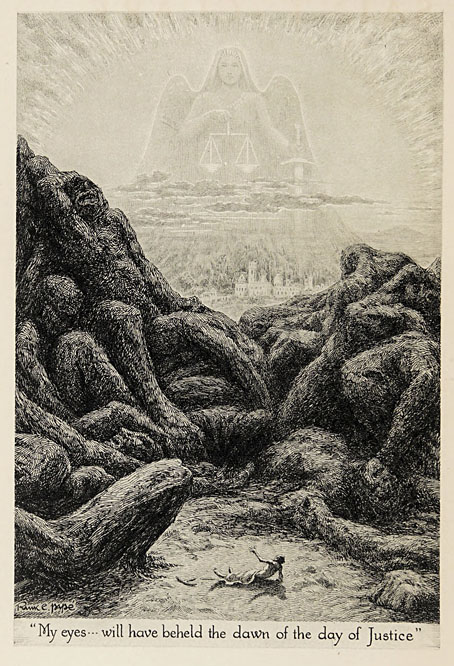
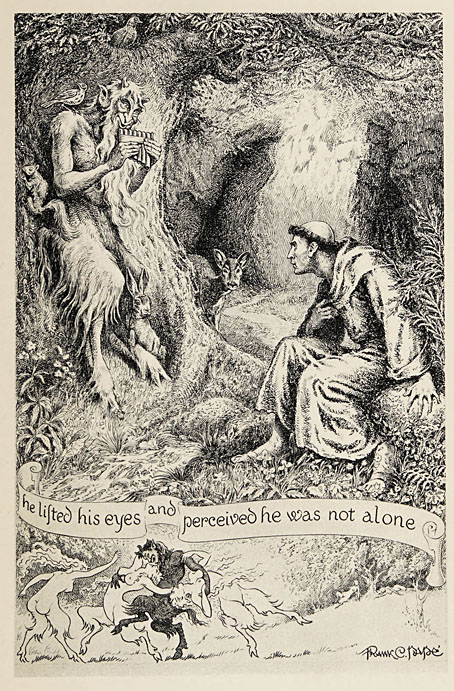
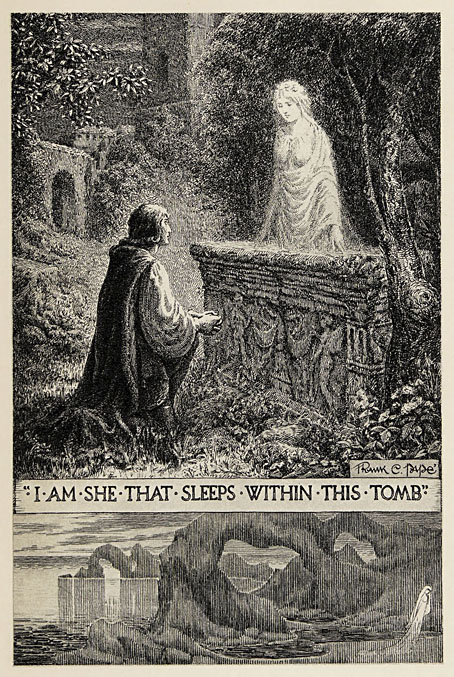
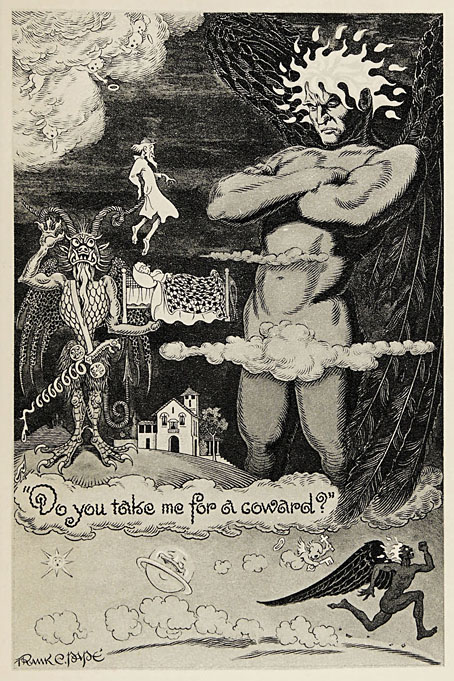
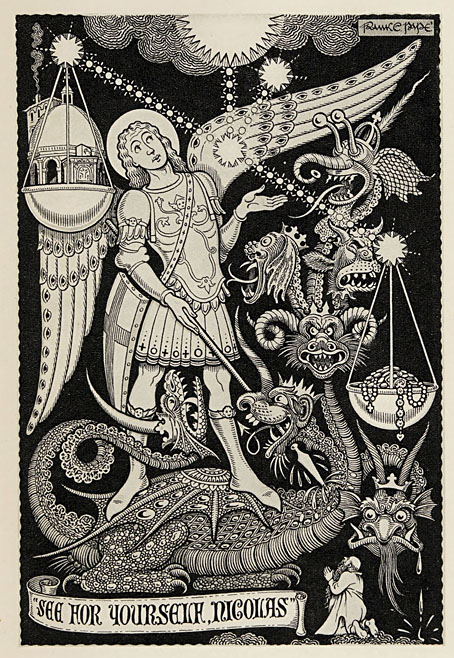
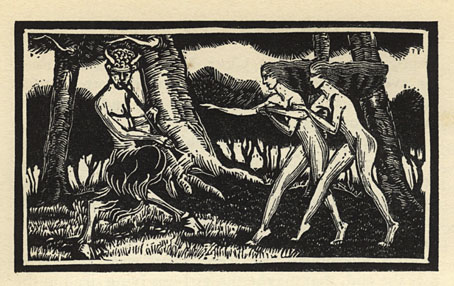
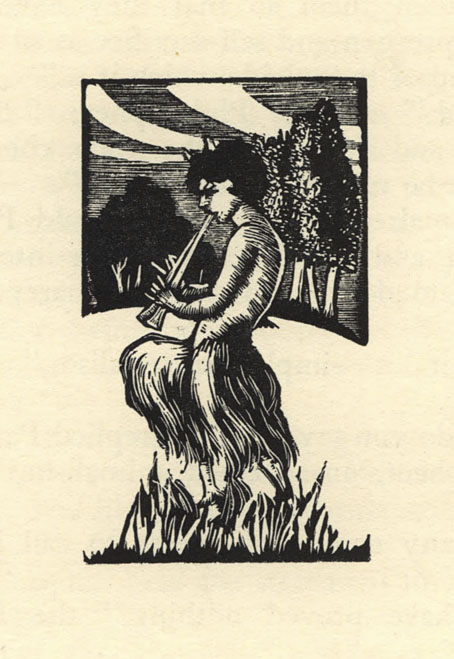
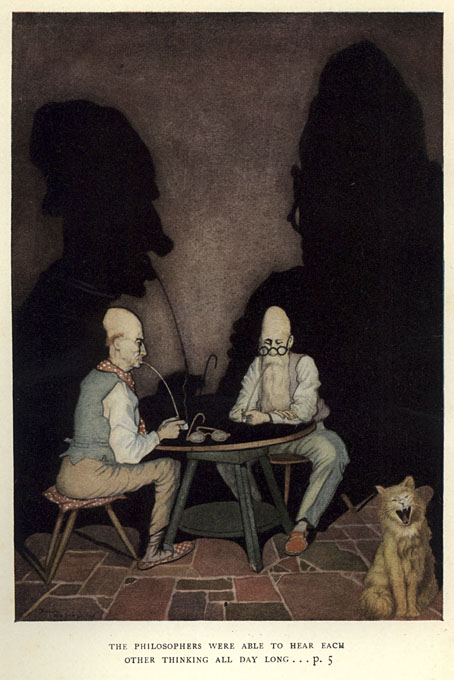
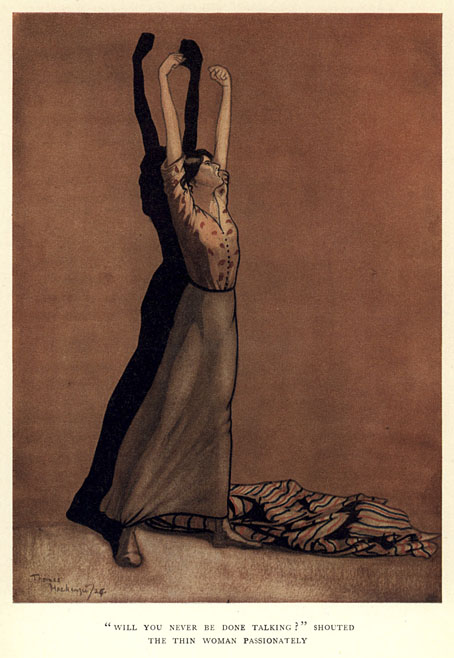
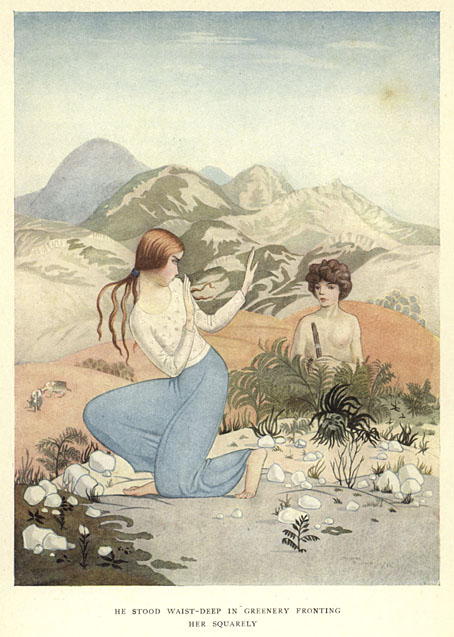
Thomas Mackenzie (1887–1944) was an English illustrator whose work has appeared here before via his illustrations for a verse rendering of the Aladdin story by Arthur Ransome, a typical product of the 1920s’ boom in illustrated children’s books. James Stephens’ The Crock of Gold (1912) is a vessel of a different kind, too sophisticated for children yet suffused with a fairy-tale quality, this is more like a fable for adults:

A mixture of philosophy, Irish folklore and the “battle of the sexes”, it consists of six books, Book 1 – The Coming of Pan, Book 2 – The Philosopher’s Journey, Book 3 – The Two Gods, Book 4 – The Philosopher’s Return, Book 5 – The Policemen, Book 6 – The Thin Woman’s Journey, that rotate around a philosopher and his quest to find the most beautiful woman in the world, Cáitilin Ni Murrachu, daughter of a remote mountain farm, and deliver her from the gods Pan and Aengus Óg, while himself going through a catharsis. (more)

The illustrations, which Mackenzie created for a 1926 edition, are a little different to his earlier work, tending in places towards that Hellenic stylisation that became increasingly popular in the graphic art of the 1920s and 30s. The depictions of Pan remind me that I once tried to catalogue all the appearances of the god in prose and poetry from the 1890s on. The years from 1890 to 1930 saw Pan become a persistent presence in English literature, while also giving a title to one of the leading Jugendstil journals. The idea of trying to document all this activity is an attractive one until you set to work and find that there are many more examples than you imagined, not all of them indicated in the titles of the works.

mackenzie14.jpg

mackenzie01.jpg

mackenzie02.jpg

mackenzie03.jpg

Continue reading “Thomas Mackenzie’s Crock of Gold”

Weekend links 734

mechau1.jpg

Illustration by Frank Mechau for The Love of Myrrhine and Konallis (1926) by Richard Aldington.

• At A Year In The Country: The Delaware Road: “A surreal post-war Albion and Quatermass meets Tinker, Tailor, Soldier, Spy.”

• At Colossal: Rajesh Vora photographs the unique Punjabi tradition of adorning homes with sculptural water tanks.

• At Unquiet Things: The fragile eternity of Margaretha Roosenboom’s floral still lifes.

mechau2.jpg

Illustration by Frank Mechau for The Love of Myrrhine and Konallis (1926) by Richard Aldington.

• New music: Damaged by Ghost Dubs, and Selene by Akira Kosemura & Lawrence English.

• At Public Domain Review: Allison C. Meier on The Dance of Death across centuries.

• RIP Shelley Duvall. Related: Anne Billson on Shelley Duvall: her 20 greatest films.

• At Dennis Cooper’s: Galerie Dennis Cooper presents…Félicien Rops.

• Steven Heller’s font of the month is Sisters.

Eno Williams’ favourite records.

Two Sisters (1967) by The Kinks | All Your Sisters (1996) by Mazzy Star | Two Sisters (2017) by Gel-Sol

Weekend links 732

toshikata.jpg

Chasing Fireflies, A Lady of the Tenmei Era, from the series Thirty-six Elegant Selections (1894) by Mizuno Toshikata.

• While working on the Herald of Ruin cover late last year I was wondering when we might get to see the BFI or Eureka releasing Louis Feuillade’s silent serials on Region B blu-ray discs. Six months later, Eureka have announced this very thing: Louis Feuillade: The Complete Crime Serials (1913–1918), a box comprising the Gaumont restorations of Fantômas, Les Vampires, Judex and Tih Minh. I’ll probably have more to say about this in September.

• At A Year In The Country: Wyrd Explorations: A Decade Of Wandering Through Spectral Fields, a book which collects revised and extended pieces from the first ten years of A Year In The Country posts.

• At The Paris Review: Eliza Barry Callahan visits and revisits Joseph Cornell’s house at 37-08 Utopia Parkway, NYC.

• New music: Jinxed By Being by Shackleton & Six Organs of Admittance.

• Browse artworks by Pablo Picasso at the Picasso Museum, Paris.

• At Unquiet Things: Victor Kalin’s Paradoxical Paperback Art.

Strange Transmissions: The World Of Experimental Radio.

• At Dennis Cooper’s it’s Satoshi Kon‘s Day.

Aaron Turner’s favourite music.

• DJ Food’s haul of Acid Badges.

Acid Head (1966) by The Velvet Illusions | Acid Heart Mother (2000) by Acid Mothers Temple & The Melting Paraiso U.F.O. | Acid Death Picnic (2013) by Cavern Of Anti-Matter

The art of Hannes Bok, 1914–1964

bok01.jpg

Altars of Patagonia (1946)

Like the huge cache of Virgil Finlay art that turned up at the Internet Archive a couple of years ago, the pictures here are from a two-volume collection made by an enthusiast gathering together yet more illustrations from the pulp magazines of the 1940s and 50s. Hannes Bok (real name Wayne Francis Woodard) wasn’t as prolific as Virgil Finlay, but the careers of the two men intersected in the pages of Weird Tales where they both used stipple shading to compensate for the poor reproduction of pulp paper. Bok’s work tended to be more stylised than Finlay’s, with a quirkiness that makes his art easy to spot once you’ve seen a few examples.

bok02.jpg

Boomerang (1947)

The two volumes contain a total of over 300 illustrations so any selection will only be a small sampling. Many of the drawings were new to me. The first volume is mostly work from magazines such as Weird Tales and the minor SF mags; the second includes book covers, calendar illustrations and other work. As with the Finlay collections, both volumes are available in a range of file formats which include cbz files, a format I prefer to pdf for browsing image-heavy documents. For more about cbr/cbz files, see the end of this post.

bok03.jpg

Cross of Mercrux (1942)

bok04.jpg

Daughter of Darkness (1941)

bok05.jpg

Dimensional Doors (1944)

Continue reading “The art of Hannes Bok, 1914–1964”

Weekend links 725

Springtime in Paris (1923) by Georg Kretzschmar.

• I’ve been asked to mention that the tribute book put together for Alan Moore’s 70th birthday, Alan Moore: Portraits of an Extraordinary Gentleman, is still available. As before, the book features contributions from many well-known comic artists, a foreword by Iain Sinclair, and this piece of my own.

• “I never posted any lecture of mine on Tumblr, even though Tumblr would seem to have plenty of elbow-room for hour-long, learned, European public lectures (with many lecture slides).” Utopian Realism, a speech by Bruce Sterling.

• Reading the Signs: John Kenny in conversation with Mark Valentine about Mark’s new collection Lost Estates.

There remains something suspect about blotter, a stain that is both a blessing and a curse. As the blotter producer Matthew Rick, who started selling sheets as non-dipped ‘art’ collectables at festivals in 1998, puts it: ‘[B]lotter is the last underground art form that’s going to stay underground, simply because you’re creating something that looks like and functions like a felony.’ In other words, blotter is ontologically illicit; it is, as Rick says, ‘drug paraphernalia by its very existence’.

Erik Davis (again) on LSD and the cultural history of the printed blotter

• At Colossal: Uncanny phenomena derail domestic bliss in Marisa Adesman’s luminous paintings.

• Standing stones, urban hellscapes and male nudes: Andrew Pulver on Derek Jarman’s Super-8 films.

• “ [breaking news] An anomaly on earth has brought the cats to over 150 meters. Please be patient.”

• At We Are The Mutants: Alien Renaissance: An interview with illustrator Bob Fowke.

• At Dennis Cooper’s: Spotlight on…René Crevel My Body and I (1926).

• At Public Domain Review: The Little Journal of Rejects (1896).

• Steven Heller’s font of the month is Sandhouse.

• RIP Steve Albini.

Sandoz In The Rain (1970) by Amon Düül II | Bon Voyage Au LSD (2001) by Acid Mothers Temple & The Melting Paraiso U.F.O. | Careful With That Sheet Of Acid, Eugene (2019) by Jenzeits