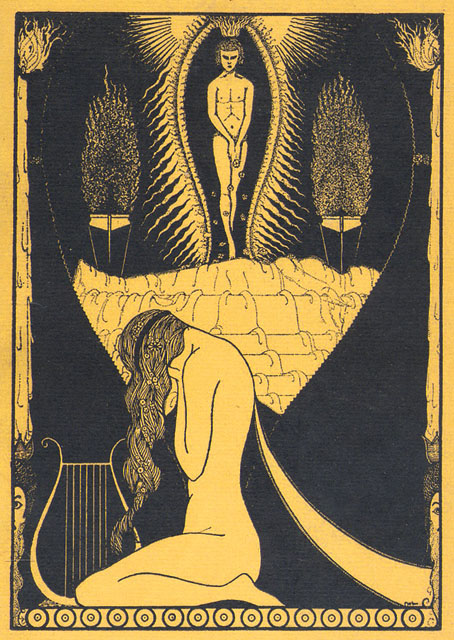
The art of Denton Welch, 1915–1948

welch04.jpg

Symbolist Figure (1946).

The visual art, that is, not the novels and short stories. Last month I finally got round to reading Denton Welch’s first two novels, Maiden Voyage (1943) and In Youth is Pleasure (1945). Finally, because I’ve known Welch’s name for a long time, mostly via William Burroughs—who dedicated The Place of Dead Roads to him—and John Waters—who often lists In Youth is Pleasure as one of his favourite novels. This was also the book that Burroughs favoured, and he wrote an introduction for a US reprint in 1983. At first glance, Welch would seem a surprising choice for the pair: the protagonist in each book is a thinly fictionalised avatar of the author—he’s even named Denton Welch in the first—an effete upper-middle-class English teenager who hates his school and most of the people he meets, and who spends as much time as possible wandering alone, looking for affordable antiques and any old buildings that may be of interest. The homosexual undercurrents in each book generate persistent tensions which are an obvious attraction for many readers, even though nothing is ever stated overtly and there’s no hand-wringing over unrequited passions. Welch’s boys are most passionate about the things they collect, and their determination to be left alone to pursue their interests when all the adults around them are trying to push them in different directions. Having been a similar school-hating, art-obsessed, introverted teenager, if I’d read In Youth is Pleasure when I was the same age as the beleaguered Orvil Pym it would have made a huge impression.

welch07.jpg

Self-portrait With Cat.

Art was the interest that Welch most wanted to pursue but it’s the writing for which he’s remembered. Few people have good things to say about his drawings and paintings but there’s a strange quality to many of them that I like, an atmosphere of menace that lurks beneath the often naive renderings. I was surprised how gloomy and claustrophobic many of them are. The refined sensibilities in the novels lead you to expect something lighter, frivolous even, like the paintings and illustrations of his contemporary, Rex Whistler, or other artists of the Neo-Romantic school of the 1930s. In fact looking at Whistler’s work again, it’s the Whistler style I most expected even though it’s unfair to compare the two. Welch and Whistler shared a taste for pictorial decoration, and a blithe indifference to the avant-garde trends of the day, but Whistler was a formidable talent, the kind of successful illustrator that Welch could only dream of being. (That said, both artists were commissioned by Shell for the company’s poster series showing views of Britain.) Yet lack of ability sometimes takes an artist into places that a professional wouldn’t reach. Whistler would have given us a perfect cat, not the strange creatures with almost human faces that Welch liked to draw. I’m curious to know which, if any, contemporary artists Welch preferred. His diaries are now earmarked for a future reading.

A Voice Through A Cloud: Discovering Denton Welch

welch05.jpg

Hadlow Castle, Kent (1937).

welch06.jpg

Horse and Moon (1943).

welch03.jpg

Continue reading “The art of Denton Welch, 1915–1948”

Weekend links 714

agar.jpg

An Exceptional Occurrence (1950) by Eileen Agar.

• New music: The Endless Echo by Pye Corner Audio, coming soon from Ghost Box. PCA continue to fly the flag for the original Ghost Box mission of bringing various forms of weirdness to electronic music. The new album “draws inspiration from scientific and science-fictional notions about the nature of time and the idea that it may be entirely unreal”. Over at Bandcamp there’s Here by Stefano Guzzetti and Ian Hawgood.

• “Powell and Pressburger emerge from this film, more than ever, as sui generis: inventors of their own kind of film, gentleman amateurs of cinema in some ways…” Peter Bradshaw reviewing Martin Scorsese’s Made in England: The Films of Powell and Pressburger.

Velocity and Creation, a pair of short films by Vadim Sherbakov made with magnets, glitter and inks. The scores are too bombastic but I like the visuals.

Art is for increasing life. That, I believe, after all the other purposes receive their due, is really what it’s for—why we revere it, why we give our hearts to it. What do I mean by increasing life? How can we live more, given that we can’t live longer? Through attention and intensity. Being fully present to the world, and feeling without reservation: the two things that making art requires and that experiencing it involves.

William Deresiewicz on thirteen ways of looking at art

Modern Illustration is a project by illustrator Zara Picken, featuring print artefacts from her extensive personal collection.

• Mix of the week: Aquarium Drunkard presents Pulp Jazz: Twenty-First Century Groove Music. Great stuff.

• At Public Domain Review: Tales of the Catfish God: Earthquakes in Japanese Woodblock Prints.

• At The Quietus: Jonathan Meades interviews Saint Leonard. And vice versa.

• At Dennis Cooper’s: Michelangelo Antonioni Day.

• The Strange World of…Bill Laswell.

Creation (1971) by Arthur Brown’s Kingdom Come | Création Du Monde (1971) by Vangelis | Creation (1977) by Tangerine Dream

Weekend links 710

Menace (1974) by Ivan Tovar.

• “I find myself going back to Early Water more and more in recent years. It should be better known.” B. Sirota reviewing the one-off musical collaboration between Michael Hoenig and Manuel Göttsching. (Previously.) It should indeed be better known.

• At Unquiet Things: “Come for the cosmic awe, stay for the skeletons in spacesuits”; S. Elizabeth talks to Adam Rowe about the science-fiction art of the 1970s.

• “The architectural style wars have started all over again.” Owen Hatherley on the unending debate between traditionalists and modernists.

• At Public Domain Review: Clear Shadows (1867), a book of Japanese silhouette portraits by Ochiai Yoshiiku.

• New music: Flux Gourmet Original Motion Picture Soundtrack by Various Artists, and Volta by Loula Yorke.

• Meta machine mantras: Steve Barker on the birth of the Buddha Machine.

Cosmohedron, a short animated film by Duncan Hatch.

• Mix of the week: isolatedmix 125 by Sa Pa.

Chelsea Wolfe’s favourite music.

• At Dennis Cooper’s: Mirrorers.

A Silhouette Of A Man And A Wasp (1995) by Add N To (X) | A Silhouette Approaches (2005) by Robin Guthrie & Harold Budd | Silhouette (2015) by Julia Holter

Weekend links 709

tanning.jpg

Guardian Angels (1946) by Dorothea Tanning.

• “If photographs can outlive their subjects, and memory works like photography, do images somehow endure in the brain after death? Could these undead memories be recovered with the right technologies?” Speculative fiction from 1899 in Dr Berkeley’s Discovery by Richard Slee and Cornelia Atwood Pratt.

• Mix of the week: Astral Loitering: Excursions In New Age, 1970–1989: 210 minutes of well-chosen selections that continue where I Am The Center left off. In a similar zone, albeit more recent, there’s the regular monthly report from Ambientblog, DreamScenes—January 2024.

• At American Scientist: The Source of Europe’s Mild Climate: “The notion that the Gulf Stream is responsible for keeping Europe anomalously warm turns out to be a myth”. An article from 2006 that you’d think would be more widely known today.

The Anomalist: “World News on UFOs, Bigfoot, the Paranormal, and Other Mysteries at the Edge of Science”. Too many of the links lead to worthless tabloid filler but the headlines can be fun.

• Coming soon from Strange Attractor: Two-Headed Doctor: Listening for Ghosts in Dr John’s Gris-Gris, a book by David Toop which analyses the Doctor’s voodoo-themed debut album.

• At Unquiet Things: Beyond The Shadows Of The Labyrinth: Exploring the Groovy Kaleidoscope of Ted CoConis’ Art.

• DJ Food unearths a batch of Portuguese Hauntology via Prisma Sonora Records.

• At Dennis Cooper’s: John Waters Day (restored/expanded).

• New music: Moon by Retep Folo & Dorothy Moskowitz.

New Age (live) (1969) by The Velvet Underground | New Age (1980) by Chrome | 1966 – Let The New Age Of Enlightenment Begin (2014) by Sinoia Caves

Ragnar von Holten’s Maldoror

vonholten1.jpg

More Maldoror, and more collage, this time from Swedish artist and art historian Ragnar von Holten (1934–2009). The Historical Dictionary of Surrealism describes von Holten as a Gustave Moreau enthusiast who first contacted the Paris Surrealists in 1960 when he was organising a retrospective of Moreau’s work at the Louvre. André Breton had long been a champion of Moreau, especially in the decades when the artist was out of fashion, and wrote a preface for von Holten’s L’Art Fantastique Gustave Moreau. One of the many things I like about the Surrealists is the continuity they provide with the history of fantastic and visionary art.

vonholten2.jpg

Von Holten’s Maldoror collages were begun in the late 1960s and completed in 1972 when they were published in a Swedish edition of the novel. I don’t know how many illustrations there were in all but you can see more at the Moderna Museet website. Not all the collages are labelled as being derived from Maldoror but many of the titles refer to the text all the same. Also there are two drawings intended as vignettes, one of which depicts in a rather literal fashion Lautréamont’s most popular metaphor.

vonholten3.jpg

vonholten4.jpg

Elsewhere on { feuilleton }
The Surrealism archive

Previously on { feuilleton }
Harry O. Morris’s Maldoror
Covering Maldoror
Kenneth Anger’s Maldoror
Chance encounters on the dissecting table
Santiago Caruso’s Maldoror
Jacques Houplain’s Maldoror
Hans Bellmer’s Maldoror
Les Chants de Maldoror by Shuji Terayama
Polypodes
Ulysses versus Maldoror
Maldoror
Books of blood
Magritte’s Maldoror
Frans De Geetere’s illustrated Maldoror
Maldoror illustrated