Harry O. Morris’s Maldoror

morris01.jpg

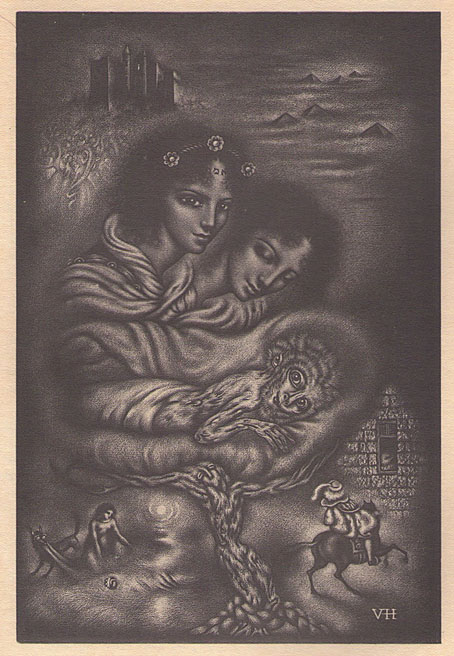
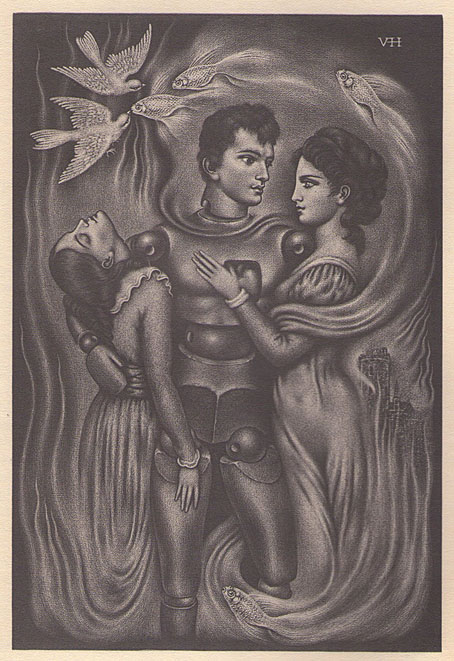
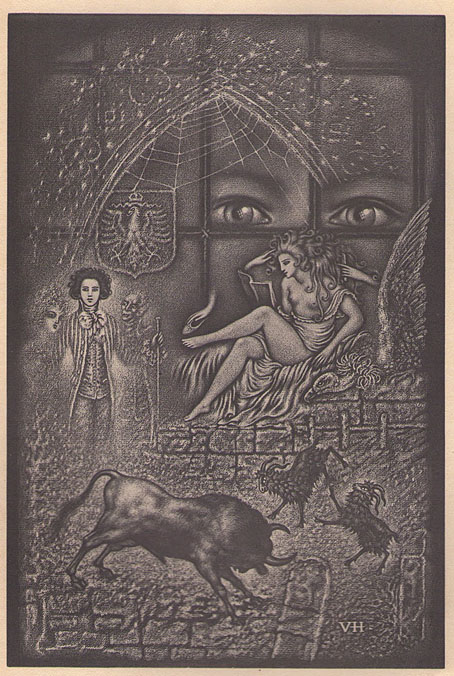
Lautréamont’s delirious prose poem/novel/proto-Surrealist dream-text is sufficiently wild and free-ranging to inspire many visual interpretations. One of the peculiarities of the book is that all these interpretations are valid to some degree, although some still suit the general tone better than others. Quite a few of the well-known Surrealist artists had a crack at illustrating Les Chants de Maldoror but artists who don’t illustrate on a regular basis have a tendency to gesture vaguely at the given text while offering yet more of their own concerns.

morris02.jpg

Expert collage artist Harry O. Morris does a better job than Dalí, Magritte and co. in his depictions of Lautréamont’s mutable scenarios. Maldoror is very much a collaged text, a product of its author’s enthusiastic plagiarism, which suggests that if the book has to be illustrated at all then collage is the technique to use. Morris’s interpretation was published in 1983 as Scenes from Lautréamont’s Maldoror, a portfolio of 10 plates. A note from the artist on this page acknowledges the influence of photo-montagist JK Potter, Morris being better known for his collages of engraved illustrations and other pictorial matter.

morris03.jpg

morris04.jpg

morris05.jpg

Continue reading “Harry O. Morris’s Maldoror”

02024

clarke.jpg

The Devil’s Wife and her Eldest (1924) by Harry Clarke.

Happy new year. 02024? Read this.

djo-bourgeois.jpg

L’Inhumaine poster (1924) by Georges Djo-Bourgeois.

doesburg.jpg

Counter-Composition V (1924) by Theo van Doesburg.

grot.jpg

The Thief of Bagdad poster (1924) by Anton Grot.

kandinsky.jpg

Linea Capricciosa (1924) by Wassily Kandinsky.

Continue reading “02024”

Georges de Feure’s Gate of Dreams

defeure01.jpg

The gate in question, La Porte des Rêves (1899), is a collection of stories by Symbolist writer Marcel Schwob, illustrated in its first edition by Georges de Feure (1868–1943). The collection is actually a kind of “best of Schwob”, being compiled from stories which had already appeared a few years before in other collections. Both Schwob and de Feure were French, and the artist is one of the few whose work may be found in collections of Symbolist art as well as books about Art Nouveau design; you’d think there’d be many more among the conterminous movements but this isn’t the case.

defeure02.jpg

Women are a persistent subject in de Feure’s work, especially the sinister variety who were a staple in fin-de-siècle fiction. Some of these may be found in La Porte des Rêves which features a larger quantity of de Feure’s black-and-white drawing than I’ve seen elsewhere. In a reversal of my usual preferences, I prefer de Feure’s colour work, but anything of his is worth seeing. For a taste of Marcel Schwob’s approach to writing, which included textual collage, see this interview with translator Kit Schluter.

defeure03.jpg

A triple-page spread.

defeure04.jpg

defeure05.jpg

Continue reading “Georges de Feure’s Gate of Dreams”

The Parade and Baron Verdigris

parade01.jpg

Design by Paul Woodroffe.

The Parade, subtitled An Illustrated Gift Book for Boys and Girls, is something that children with wealthy parents or relatives might have received as a Christmas present in December 1897. The contents are an unusual mix of fairy tales, frivolous seasonal fare—A Christmas Mummery, complete with songs and music—and adventure stories set in other parts of the world. The collection was edited by Gleeson White, an art critic whose former position as editor of The Studio magazine explains the very Studio-friendly choice of illustrators.

parade02.jpg

The design on the title page is a curious piece by Aubrey Beardsley, one with less authority than the most of the other drawings he was producing in his penultimate year. Those dots filling out the arabesque plant forms are the kinds of things that amateurs do when they’re uncertain about whether or not to decorate a design. The tendril which terminates in a tasselled confection is, however, a typical example of the artist’s bizarre invention, the kind of caprice that used to infuriate the critics who disliked his work. Beardsley’s career had been launched four years earlier with a profile in The Studio, but by 1897 he was often struggling for money after being fired from The Yellow Book in the wake of the Oscar Wilde scandal. Gleeson White is to be commended for supporting him at a time when many others refused to do so.

parade03.jpg

L. Leslie Brooke.

Elsewhere in The Parade there are contributions both written and pictorial from Beardsley’s friend, Max Beerbohm; also a story by Richard Burton, a writer you wouldn’t usually expect to find in a book aimed at children. The list of illustrators includes Charles Robinson, Laurence Housman and Manchester’s own Alfred Garth Jones. Beardsley didn’t draw anything else for The Parade but he’s mentioned again in a list of titles advertised in the book’s final pages as having provided a frontispiece for Baron Verdigris, “A Romance of the Reversed Direction” by one Jocelyn Quilp. The title was unfamiliar, and I wasn’t sure at first whether I’d seen the illustration, but the drawing shown below appears in two of my Beardsley books—albeit at small sizes—including the copious Brian Reade collection from 1967.

beardsley.jpg

“Baron Verdigris” sounds like a minor character from Michael Moorcock’s Dancers at the End of Time trilogy, while the improbable “Jocelyn Quilp” turns out to be a nom de plume of Halliwell Sutcliffe whose book is described as a “singular novella, a curious amalgam of parodies based on a time-travelling theme“; shades of the Dancers again. It’s tempting to think that this may be the sole example of Aubrey Beardsley illustrating science fiction (or something like it)—the book is generic enough to be listed at ISFDB—but Brian Reade describes the story as “pseudo-mediaeval and facetious”, “dedicated to ‘Fin-de-Siécle-ism, the Sensational Novel, and the Conventional Drawing-Room Ballad'”. That does at least explain the peculiarities of the drawing. Maybe the Moorcock comparison is an apt one after all.

More illustrations from The Parade:

parade04.jpg

Charles Robinson.

parade05.jpg

Léon V. Solon.

Continue reading “The Parade and Baron Verdigris”

Alastair’s Manon Lescaut

alastair01.jpg

The illustrated works of Alastair aren’t always easy to find, not when Hans Henning Voigt (as the artist was known to his German parents) chose a nom de l’art shared by a large portion of Scottish manhood, past and present. This 1928 edition of Manon Lescaut by the Abbé Prévost is a recent arrival at the Internet Archive. The publisher, John Lane, specialised in illustrated editions, and their Manon Lescaut gives an idea of what we might have seen from Aubrey Beardsley had he survived into the 20th century. John Lane had published collections of Beardsley’s drawings together with related works like Robert Ross’s memories of the artist. It was in their interest to continue the posthumous association, hence the pairing of Alastair with a novel that Beardsley himself might have illustrated. Alastair not only positioned himself as an inheritor of Beardsley’s filigreed drawing style but in photographs appears to be adopting the persona of one of Beardsley’s etiolated characters.

alastair02.jpg

This edition of the novel is an English translation by DC Moylan, with an introduction by Arthur Symons, Beardsley’s friend and collaborator when the pair were teamed as editor and art editor of the short-lived Savoy magazine. Symons was an astute critic, his essays are always worth reading; he remembers his friend here while stepping lightly around Alastair’s imitation of Beardsley’s decorations. As for Alastair himself, he did a good job with the illustrations. The figure-drawing isn’t as uncertain as in some of his earlier works, and each piece is printed in two colours (“the colour of fire and night” as Symons describes it), a process he favoured elsewhere. The leading study of Alastair’s art, Alastair: Illustrator of Decadence (1979) by Victor Arwas, reproduces five of the fourteen drawings, only one of which is shown in colour.

alastair03.jpg

alastair04.jpg

alastair05.jpg

Continue reading “Alastair’s Manon Lescaut”