Weekend links 580

kausch.jpg

The Collective Lie We All Live By, a cut-paper collage by Allan Kausch from Maintenant 15, A Journal of Contemporary Dada Writing and Art.

• “It’s unusual that an album manages to be at once so much of its moment, yet so much outside it. Time was unmistakably a response to the electronic and synth waves that rose in the wake of punk. It was also a concept album about time travel, which couldn’t have been more pre-punk had it been focus-grouped that way.” David Bennun on Time (1981), ELO’s masterwork of science-fiction pop. The first song on the album, Twilight, is a thundering piece of synth bombast that prefigures Trevor Horn’s equally bombastic productions, and was used to memorable effect in the copyright-infringing animation made in 1983 for the opening of Daicon IV.

• New music: Disciples Of The Scorpion by The Rowan Amber Mill, and Shade by Grouper.

• “Psychedelic spirituality: Inside a growing Bay Area religious movement“.

• “It’s time to farewell this project,” says Ballardian.

• At Wormwoodiana: the seven greek vowels.

• A playlist for The Wire by Douglas Benford.

Norman Blake‘s favourite albums.

Astronomia Playing Cards.

• RIP Dusty Hill.

Time (1973) by David Bowie | Time (1976) by La Düsseldorf | Time (1992) by Lull

Weekend links 577

preisler.jpg

Black Lake (1904) by Jan Preisler.

• Upcoming releases on the Ghost Box label will include a new album by {feuilleton} faves Pye Corner Audio, plus the surprising appearance of figures from Bruegel on a Ghost Box cover design.

Tilda Swinton and Olivier Saillard pay tribute to the films of Pier Paolo Pasolini. (Or to Pasolini’s costume designer, Danilo Donati.)

• New music: Spectral Corridor by The House In The Woods, and Re:Moving (Music for Choreographies by Yin Yue) by Machinefabriek.

• At Spoon & Tamago, Technopolis gets all the good things: “Giant kitty now greets commuters at Shinjuku Station.”

Anil Ananthaswamy on the ways in which psychedelics open a new window on the mechanisms of perception.

• Mixes of the week: Isolated Mix 112 by Suna, and GGHQ Mix #56, “An Unfortunate Kink”, by Abigail Ward.

• In this week’s impossible task, Alexis Petridis attempts to rank The Velvet Underground’s greatest songs.

• DJ Food unearths more flyers for London’s Middle Earth club, plus covers for the East Village Other.

• Global signals: Aki Onda on Holger Czukay and radio’s power to connect.

• At The Paris Review: Paintings and collages by Eileen Agar (1899–1991).

Will Sergeant’s favourite albums.

The Babel Tower Notice Board

Shaking Down The Tower Of Babel (1983) by Richard H. Kirk | Pärt: An Den Wassern Zu Babel (1991) by Estonian Philharmonic Chamber Choir conducted by Paul Hillier | The Black Meat (Deconstruction Of The Babel-Tower of Reason) (1994) by Automaton

Weekend links 573

strutt.jpg

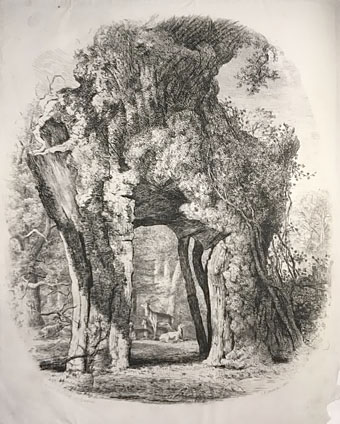
The Greendale Oak, Welbeck, Nottinghamshire, from Joseph George Strutt’s Sylva Britannica (1822/1830).

• “…a single page from Max Ernst’s collage novel Une semaine de bonté (A Week of Kindness, 1934) uncovers the weird brooding threat in Tenniel’s image of Alice in the railway carriage.” Mark Sinker reviewing the Alice: Curiouser and Curiouser exhibition at the Victoria and Albert Museum, London. I don’t know what Ernst page Sinker is referring to but I made the connection between an Ernst collage and Tenniel’s drawing here in 2010.

• At Wormwoodiana: “Calum Storrie’s 36 Elevations is a book of drawings of imaginary architecture, with the emphasis on towers, stairs, ladders, globes, oblique angles, gantries, finials etc.”

• At The Quietus: Jennifer Lucy Allen on The Strange World of…Don Cherry, and Dustin Krcatovich on Don and Moki Cherry’s Organic Music Theatre.

Call it the new orthodoxy of the digital middlebrow, “the rise of safely empowering stories with likeable protagonists who move through short sentence after short sentence towards uplifting conclusions in which virtue is rewarded.” The laudable goal of increasing the diversity of literary voices has somehow morphed into a series of purity tests designed to ensure that any artistic representation ticks the same boxes as its ostensible author. “On this,” Tyree writes, “conservative religious evangelicals secretly agree with their puritanical secularist enemies on a censorious attitude and checklist approach to art as either ‘acceptable’ or ‘offensive’ to whatever program one happens to prefer for cleansing all vileness from the world.” The result?

[A]rt is increasingly viewed by both the right and the left as a sub-branch of medicine, therapy, hygiene, or good manners. Art is no longer that which tells us the truth but rather that which makes us feel better—a deflated ideology that is spawning a sort of unofficial school of palatability.

And this, I fear, is what’s afflicting many of my students…

Justin St. Clair reviewing The Counterforce: Thomas Pynchon’s Inherent Vice by JM Tyree. Since I’m currently in the midst of a Pynchon reading binge this is all very timely

• “Researchers create self-sustaining, intelligent, electronic microsystems from green material“.

• From 2018: Ryuichi Sakamoto and David Toop live at The Silver Building.

• New weirdness: Catwalk Of The Phantom Baroque by Moon Wiring Club.

• Mix of the week:Episode #391 of Curved Radio by radioShirley & mr.K.

• At Dennis Cooper’s: Illegible autographs.

Elevation (1974) by Pharoah Sanders | Elevation II (1997) by Vainqueur | Elevations And Depths (2010) by Locrian

Weekend links 562

ernst.jpg

Teenage Lightning (Les Éclairs au-dessous de quatorze ans) (c. 1925) by Max Ernst.

• “There has never been another director who has lain in wait for us with the same wrath or disgust. He is so complicated that finally he became the very thing he was nervous of admitting, a true artist best measured in the company of Patrick Hamilton, Francis Bacon, or Harold Pinter. He saw no reason to like us or himself.” David Thomson on why Alfred Hitchcock’s films still feel dangerous.

• New music: “Habitat, an environmental music collaboration by Berlin based composer Niklas Kramer and percussionist Joda Foerster, is inspired by the drawings of Italian architect Ettore Sottsass. Each of the eight tracks represents a room in an imaginary building.”

• “You could describe Lambkin’s work as a rich sort of ambient music, but largely without the synthetic textures that ambient music often possesses.” Geeta Dayal reviews Solos, a collection of recordings by Graham Lambkin.

Tom of Finland: Pen and Ink, 1965–1989 is an exhibition at the David Kordansky Gallery, Los Angeles, which runs to 1st May. The website includes a virtual tour.

• More revenant gay art: Bibliothèque Gay reviews a new Spanish translation of Baiser de Narcisse by Jacques d’Adelswärd-Fersen.

• Introducing Ark Surreal: “Surreal collages by Allan Randolph Kausch. Some cute and sweet, others dark and intriguing.”

• At Artforum: Albert Mobilio on Extra Ordinary: Magic, Mystery, and Imagination in American Realism.

• At Spoon & Tamago: Shizuoka is installing monuments inspired by their plastic model industry.

• At Dennis Cooper’s: Jordan Belson Day.

Museum of Everything Else

• RIP Bertrand Tavernier.

Teenage Lightning 2 (1991) by Coil | Teenage Lightning (1992) by Skullflower | Teenage Lightning (Surgeon Remix) (2001) by Coil

Ghost Box and The Infinity Box

yuggoth.jpg

It’s less of a surprise than it may seem to go searching for the source of a quote only to find yourself immediately faced with one of your own artworks. The posts here go back almost 15 years, and when so many of them cover niche interests any attempt to further explore a particular niche can circle back to something I’ve already posted. The latest example is an unusual one, however. The picture above is the Haeckel collage I created for the Starry Wisdom collection of Lovecraftian fiction in 1994, a piece that was later digitally refashioned for The Haunter of the Dark book. The quote I was pursuing is as follows:

“Inside the infernal box are impossible spaces, dark screens and mirrors, terrible traces of light, calcified thought forms and endless idiot mutterings. The switch is thrown and the magnetic coils begin to generate their obscene flickering images. This contraption might have been conceived by the Old Ones long before it was assembled by human hands.”
—The Infinity Box, Alan Causley & MB Devot

The description appears together with a dialogue extract from Nigel Kneale’s The Stone Tape on the fourth Ghost Box release, Ouroborindra (2005) by Eric Zann, a one-off album of spooky sample soundscapes created by a pseudonymous Jim Jupp in between his Belbury Poly albums. All the Ghost Box releases feature significant quotes, most of which are genuine extracts from stories, novels, non-fiction works, etc. The description of the Infinity Box raised my suspicion about its authenticity when the only references to either it or Causley and Devot are in listings for the Eric Zann album. My Yuggoth collage appears on this page which further compounds the confusion by making it seem that my art is somehow connected to Causley and Devot and their mysterious box. This isn’t a complaint but it doesn’t help clarify the situation. Alan Causley has no credits anywhere outside the quote but there is another Causley, the celebrated poet, Charles, whose poems are sampled on later Ghost Box releases by The Focus Group, aka Ghost Box co-founder Julian House. Scrutiny of the other Ghost Box albums reminded me that quotes from MB Devot’s writings appear elsewhere on the early releases but I hadn’t bothered to look up the name until now.

ouroborindra.jpg

It’s often the case with posts such as this that mild curiosity turns into deeper intrigue. The web of connections becomes more tangled on the first Ghost Box release, Sketches And Spells by The Focus Group, which has a Devot quote from a text with the apt title The Tangled Beams, and a final track with the title Starry Wisdom. Devot is described by reviewers as either a fictional writer or an authentic scholar, the latter designation being supported by a Wikipedia page. Wikipedia may be prone to errors but it isn’t known for fake entries so this was a surprising discovery; Devot is also referenced on the page for parapsychologist TC Lethbridge who happens to be another source of Ghost Box quotes. Suspicion returns when you try to search for any of Devot’s listed publications, none of which turn up in WorldCat or similar catalogues. One of the Wikipedia print sources is an issue of Fortean Times from 1989 but there’s nothing about Devot listed in the contents of that issue. Issue 53 was a crop circle special, however, so it certainly fits the Ghost Box interest in the paranormal as it manifests in the British countryside. We now know that crop circles were man-made, not the product of flying saucers or other phenomena, so this may be fitting as well.

devot.jpg

I would have left the search there but I did find one further Devot connection that I might otherwise have missed. Folklore and Mathematics is the title of a one-off Ghost Box periodical published in 2007 for people subscribed to the label’s mail order service. It’s a typically fine Julian House artefact that complements the Sketches And Spells album in both its title and its graphics. Inside we find “From the archives of MB Devot”, and discover another reference to the Infinity Box. Apparently the black-and-white graphics that cover all the early Ghost Box discs are vibration patterns—”verberations”—created by Devot’s occult apparatus.

otherwhere.jpg

I wrote above that “any attempt to further explore a particular niche can circle back to something I’ve already posted” so I wasn’t too surprised to have all these explorations finding their way back here. In 2009 Julian House exhibited three invented books as part of The New Spirit Happening, an exhibition of Ghost Box-related work at the Architect’s Gallery in Teddington. I posted two of the covers after the exhibition but couldn’t recall who the books were credited to. The authors are—inevitably—”A. Causley” and “MB Devot”, and the volumes feature by-now familiar phrases: “The Tangled Beams”, “The Infinity Box”. Also more Lovecraftian verberations: “Heavens Other Colour”, “The Eye at the Threshold”. So Causley and Devot have been lurking here for the past decade, in which case having my artwork attached to their names no longer seems like an arbitrary association. “Inside the infernal box are impossible spaces, dark screens and mirrors…”. Indeed there are.

Previously on { feuilleton }
Unearthly tones
Owls and flowers
The White People by Arthur Machen
Stone Tapes and Quatermasses
The Ghost Box Study Series
A playlist for Halloween: Hauntology
Forbidden volumes
The Séance at Hobs Lane
Ghost Box