The Cosmic Grill

hotmg1.jpg

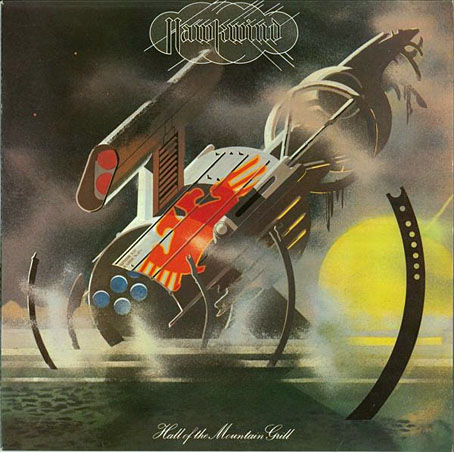
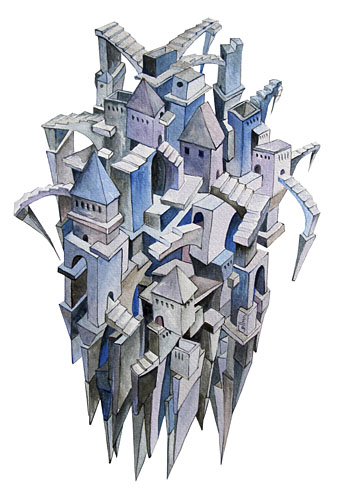
Design and illustration by Barney Bubbles.

The past week’s music listening has alternated between the back catalogue of Seattle band, Earth (who I recommend highly), and the early recordings of my erstwhile employers, Hawkwind. The latter were reissued recently in a 10-CD box, This Is Your Captain Speaking…Your Captain Is Dead (The Albums And Singles 1970–1974) which I also recommend, it’s very good value, and packages the albums in those facsimile card sleeves that now seem de rigueur for album reissues. A swathe of my rare Hawkwind vinyl got sold off circa 1990, and I’ve never replaced any of the albums or singles so this was a good opportunity to catch up. If you like this period of the band there’s the added bonus of the complete Greasy Truckers concert from the Roundhouse in 1972, a ramshackle performance that nonetheless sounds pristine (my Greasy Truckers vinyl—which I do still own—was ruined by a previous owner with a spillage of tea on the Hawkwind side); there’s also the entirety of the 1999 Party concert from Chicago which I’d not heard before.

hotmg2.jpg

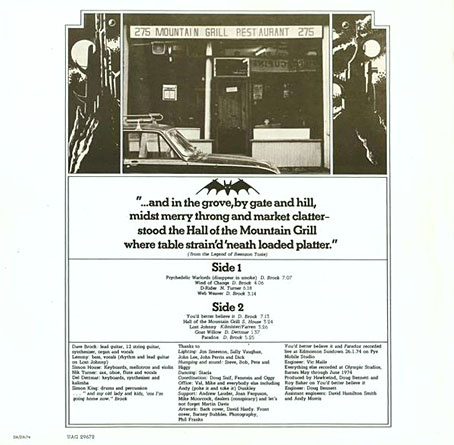
Listening again to Hall Of The Mountain Grill (1974) had me thinking about the origin of the album’s title. Hawkwind never took themselves as seriously as many of their contemporaries, but naming an album of ostensible space rock after a very mundane café in the Portobello Road was one of their more eccentric moments. The humour is compounded by Barney Bubbles’ cover design which for the title uses the kind of typeface (Palace Script) that you see on menus; on the inner sleeve there’s a photo of the fabled restaurant flanked by a pair of Barney’s futuristic towers. The verse beneath the photo (“from the Legend of Beenzon Toste”) refers to nearby Ladbroke Grove, and, of course, to Notting Hill Gate which in 1974 was still a haven for counterculture freaks, the very antithesis of that film. The verse was probably the work of Robert Calvert who explained the attraction of the restaurant in Pete Frame’s Hawkwind family tree:

The Mountain Grill was a working man’s café in Portobello Road—frequented by all the dross and dregs of humanity. Dave Brock always used to go and eat there—which is how I first met him…because I used to eat there too, when I worked on Frendz magazine. It was a kind of Left Bank café/meeting place for Notting Hill longhairs—a true artists’ hangout…but it never became chic, even though Marc Bolan, David Bowie and people like that often went there to eat lunch.

portobello.jpg

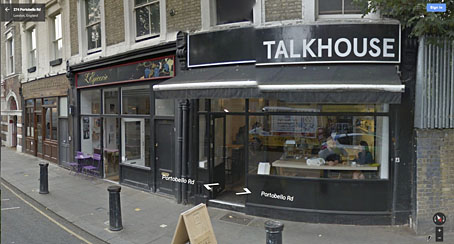
Photos on Flickr show how the place looked in 1977 when the sign from the album sleeve was still intact, and also in 2003 shortly before the restaurant closed down. The premises are a very different kind of eaterie today, remodelled and upmarket as befits a gentrified area.

Previously on { feuilleton }
Void City
Hawk things
The Sonic Assassins
New things for July
Barney Bubbles: artist and designer

Weekend links 261

hardie.jpg

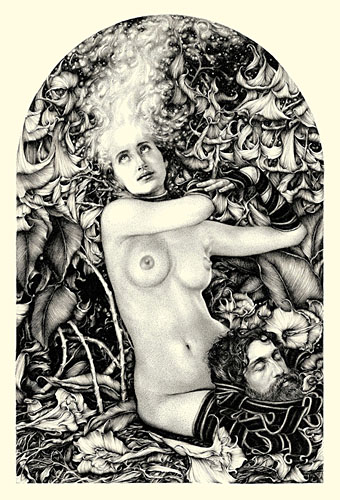
Salome (2013) by Lucie Hardie.

Aickmanesque, “A list of films that possess the same strange ambiguities, disturbing illogicalities, grim mundanities, psychological unpleasantness, narrative open-endedness, Freudian oddness and genuine disturbing moments of horror as the short stories of Robert Aickman.” One of those films, Symptoms (1974), has been out of circulation for a long time but may be watched at YouTube.

• “If this was psychedelia, then it had more in common with the variety peddled by US bands like The Rain Parade, The Three O’Clock…and The Bangles…all of whom had been grouped into a movement known as The Paisley Underground.” Joseph Stannard looks back at Around The World In A Day by Prince And The Revolution.

• “…what I do is not magical realism. I do realistic magic.” Alejandro Jodorowsky talking to Ilan Stavans about writing and filmmaking. A substantial interview in which Jodorowsky isn’t forced to express himself solely in English.

[Angela] Carter thoroughly upset the bien pensants with her essay The Sadeian Woman (1978) where she argued that Sade “was unusual in his period for claiming rights of free sexuality for women and in installing women as beings of power in his imaginary worlds … I would like to think that he put pornography in the service of women, or, perhaps, allowed it to be invaded by an ideology not inimical to women.” She also makes the connection between Sade’s misanthropy, as she calls it, and his splitting of women’s bodies from “the mothering function”. McQueen seems to me to fascinate for similar reasons. Some of the pull he exerts on huge numbers of people arises from this side of his sensibility: there’s no hint of motherhood; he disliked the way that traditional décolletage revealed the breasts, and instead encased the whole female torso in coiled silver, mussel shells or razor clams—even glass.

Marina Warner on Alexander McQueen whose Savage Beauty exhibition is currently running at the V&A

• London’s American poster king: Graham Twemlow on E. McKnight Kauffer’s posters for the London Underground.

• At Celluloid Wicker Man: Electronic music and mental illness in cinema.

• Mix of the week: Secret Thirteen Mix 154 by Moniek Darge.

#1 (1994), the first album by Skylab, has been reissued.

Vir·tu·al Ge·om·e·try

Tamborine (1985) by Prince And The Revolution | Indigo (1994) by Skylab | Metronomic Underground (1996) by Stereolab

Weekend links 260

burgher.jpg

Bachelor with “demons” (Sleezy) [sic] (2015) by Elijah Burgher. One of a new series of artworks by Burgher showing at Zieher Smith & Horton, NYC.

• The week in HR Giger: Belinda Sallin on her documentary, Dark Star: HR Giger’s World; Ron Kretsch on the unseen cinema of HR Giger; Matthew Cheney thinks the Gigeresque has become too familiar. I can see his point but originality is always in short supply; asking for something new means setting yourself up for a long wait.

Pwdre ser, or Star jelly, is “a pale, foul-smelling jelly traditionally associated with meteorite falls”. The Rot of the Stars at the ICA, London, is an audio-visual art collaboration between Jo Fisher and Mark Pilkington dealing with the mysterious substance.

• Mixes of the week: A Tri Angle Records birthday DJ set by Björk; OreCast 196 mix by Ilius; Secret Thirteen Mix 153 by M!R!M.

To assume that a given group of people would be similar because of birthdate, Ryder thought, was to risk committing a fallacy. “The burden of proof is on those who insist that the cohort acquires the organised characteristics of some kind of temporal community,” he wrote. “This may be a fruitful hypothesis in the study of small groups of coevals in artistic or political movements but it scarcely applies to more than a small minority of the cohort in a mass society.”

Generational thinking is a bogus way to understand the world says Rebecca Onion

The plan for an airport above the streets of Manhattan. Related: Charles Glover‘s similar plan for London.

Errol Morris on how typography shapes our perception of truth.

Michael Moorcock enjoyed The Vorrh, a novel by Brian Catling.

Clive Barker on almost dying, hustling, and killing Pinhead.

• A new Penguin Books website for Angela Carter.

• Callum James on artist Philip Core.

A Beginner’s Guide to King Tubby

King Tubby Meets Rockers Uptown (1976) by Augustus Pablo | Star Cannibal (1982) by Hawkwind | Sleazy (1983) by Jah Wobble, The Edge, Holger Czukay

Inventorium of Traces, a film by the Brothers Quay

inventorium.jpg

Inventorium of Traces was made in 2009 but it’s taken a while to make its way out of Poland in any complete form. In this 25-minute video piece the Quays turn their attention to Lancut Castle, a celebrated Polish stately home, and the former residence of the Potocki family. Of the latter, Jan Potocki would have an understandable attractions for the Quays being the author of The Saragossa Manuscript, a book that’s briefly alluded to when the Saragossa region is glimpsed on a map. The first half of the film shows visitors to the Castle being observed by statues and paintings, one of which is a portrait of Jan Potocki; in the second half, night falls, the building is locked, and some typical Quay business begins with flickering light and spectral animation. The music is by Krzysztof Penderecki, a composer the Quays used a year later for their superb animation, Maska, and also the composer of the soundtrack to the Wojciech Has adaptation of Potocki’s novel. The quality of the uploaded video could be better (the frame seems to be cropped) but it’s good enough for Quay obsessives. Watch it here.

Elsewhere on { feuilleton }
The Quay Brothers archive

Weekend links 258

stalenhag.jpg

Simon Stålenhag‘s SF artwork will be published in book form if funding is secured. In the future everything will be crowdfunded for 15 minutes.

• Mixes of the week: FACT Mix 494 is a fantastic dub selection by Colleen; Secret Thirteen Mix 151 is by Sally Dige; Stephen Mallinder‘s return to the doom-laden Industrial music of the 1980s suits the post-election mood. Mallinder’s mix is helping promote Industrial Soundtrack for the Urban Decay, a documentary by Amélie Ravalec.

• “…it felt more like real life to me than the average hour-long television show.” Sopranos creator David Chase on what he enjoyed about Twin Peaks. Related: Twin Peaks Tarot cards.

Sound & Song in the Natural World edited by Tobias Fischer & Lara Cory. A book about animal music and communication with a 60-minute CD of field recordings.

• “The psychedelic renaissance has already begun, and for the most part I welcome it,” says Erik Davis in a wide-ranging interview with Sean Matharoo.

• It rumbles on: Brown Pundits on “An Embarrassment at PEN”. A useful collection of stories, reactions and polemic from the past two weeks.

Fanny and Stella: The Shocking True Story, a play by Glenn Chandler about Victorian London’s scandalous pair of cross-dressing men.

• Artist Charles Ray causes a problem for the Whitney Museum of American Art with his sculpture of a naked Jim and Huckleberry Finn.

• “Don’t believe Orson Welles,” says his biographer Simon Callow, “especially when he calls himself a failure.”

• A return to Adolph Sutro’s Cliff House features several photos I’d not seen before.

• More Tarot: Arcana: The Tarot Poetry Anthology is looking for funding.

• At Dangerous Minds: The ancient magic of the record label.

Foreign Movie Posters

Tarot (Ace of Wands theme, 1970) by Andy Bown | Distant Dreams (Part Two) (1980) by Throbbing Gristle | The Devil In Me (1982) by Stephen Mallinder