Ray Bradbury, 1920–2012

bradbury.jpg

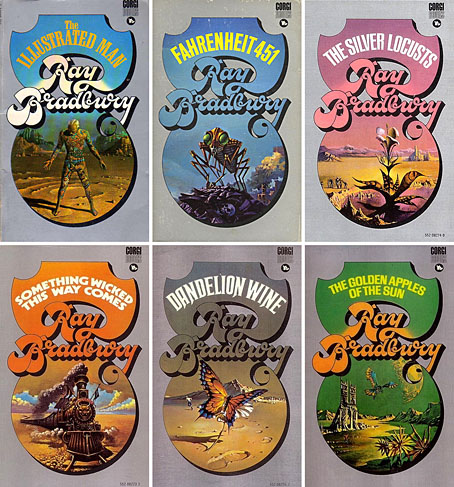
I always liked these paperback covers, a very of-their-time series published by Corgi Books in the UK from 1969 to 1970. A sea of metallic silver ink surrounded the paintings by Bruce Pennington. Seeing them together makes me wish I had the full set.

Mr. Electrico was a beautiful man, see, because he knew that he had a little weird kid there who was twelve years old and wanted lots of things. We walked along the shore of Lake Michigan and he treated me like a grown-up. I talked my big philosophies and he talked his little ones. Then we went out and sat on the dunes near the lake and all of a sudden he leaned over and said, I’m glad you’re back in my life. I said, What do you mean? I don’t know you. He said, You were my best friend outside of Paris in 1918. You were wounded in the Ardennes and you died in my arms there. I’m glad you’re back in the world. You have a different face, a different name, but the soul shining out of your face is the same as my friend. Welcome back.

Ray Bradbury’s life was like a Ray Bradbury novel. From an amazing interview at the Paris Review.

Some memorial links:
The New Yorker unlocked two Ray Bradbury stories.
• Evan says “Loves, did you know Bradbury was a poet? Now you do.”
A man who won’t forget Ray Bradbury by Neil Gaiman.

Elsewhere on { feuilleton }
The book covers archive

Previously on { feuilleton }
The fantastic and apocalyptic art of Bruce Pennington
Downside Up

downsideup.jpg

Downside Up (1984)

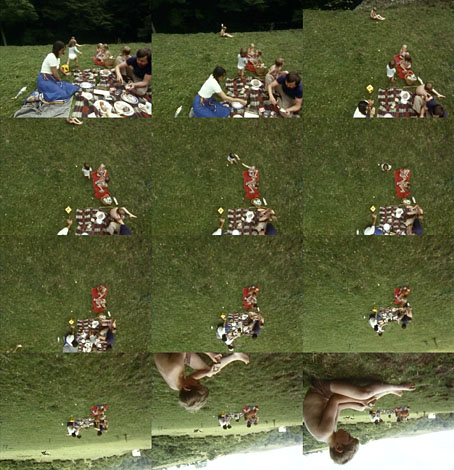
For a long time I didn’t know which came first, Downside Up, a 16-minute short by experimental filmmaker Tony Hill, or Sensoria, the Cabaret Voltaire music video directed by Peter Care. Both were made in 1984 and both employ the same technique of a camera fixed to a special rig that allows shots to begin at ground level, rise parabolically into the air then descend to the ground again showing a reverse angle. Thanks to this Quietus interview with Peter Care last year we now know that Tony Hill’s film came first and that Care borrowed the rig for his video. Both are memorable pieces of work. Hill starts out with a series of slow shots accompanied by sounds that imply the camera is passing through the earth. This is contradicted later (and with gathering speed) when some of the shots are rotated through ninety degrees so they materialise out of building walls. Care stripped the technique down using faster shots that he cut with stop-motion footage of Richard Kirk and Stephen Mallinder. It’s the best of the promo videos made for the group.

Previously on { feuilleton }
The Crackdown by Cabaret Voltaire

Eleanor Fortescue-Brickdale’s illustrated Tennyson

brickdale01.jpg

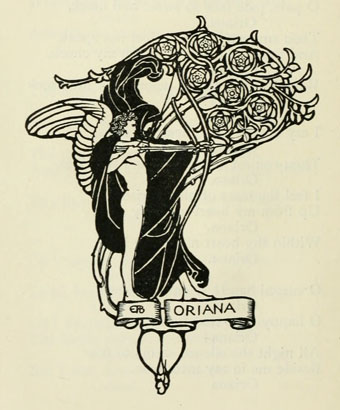
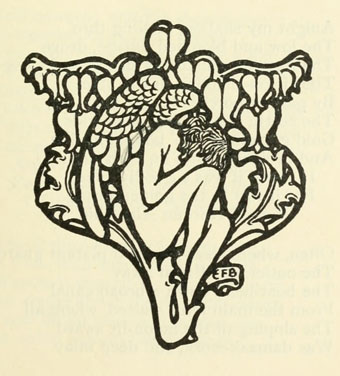
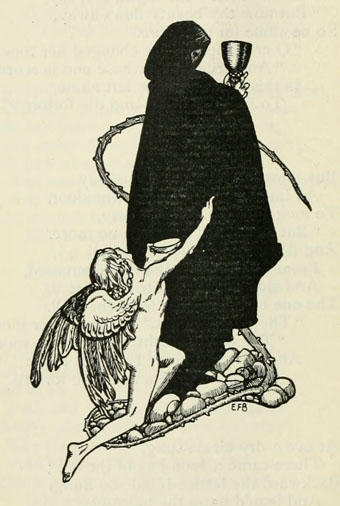
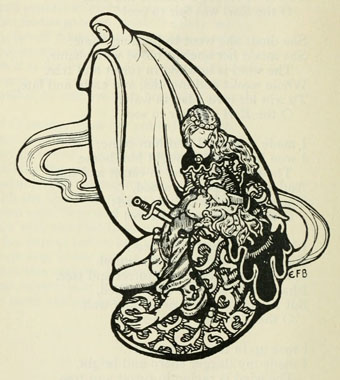
Drawings from an edition of Alfred Tennyson’s Poems illustrated by British artist Eleanor Fortescue-Brickdale (1872–1945) which was published by George Bell & Sons in 1905. The book was part of a series of illustrated poetry collections that included several books featured here in previous posts: Poems by John Keats and Poems by Percy Bysshe Shelley both illustrated by Robert Anning Bell, and The Poems of Edgar Allan Poe illustrated by William Heath Robinson. There was also an edition of Browning illustrated by Byam Shaw at whose art school Ms Fortescue-Brickdale was employed as a teacher. Her Tennyson drawings aren’t entirely to my taste, I’ve omitted the full-page works which are rather static pre-Raphaelite-derived things. Far better are these vignettes whose heavy outlines and sinuous curves resemble both Heath Robinson’s early illustrations and Pamela Coleman Smith‘s famous Tarot card designs. As usual the Internet Archive has the whole book and (should anyone require more Tennyson) Ms Fortescue-Brickdale’s take on that Victorian staple Idylls of the King.

brickdale02.jpg

brickdale03.jpg

brickdale04.jpg

Continue reading “Eleanor Fortescue-Brickdale’s illustrated Tennyson”

Weekend links 111

thefox.jpg

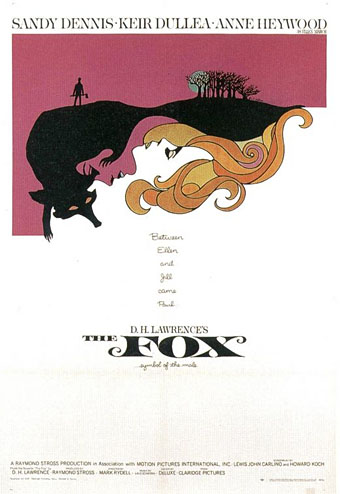
The Fox (1968). Design by Bill Gold, art by Leo & Diane Dillon.

Mark Rydell’s The Fox may be regarded unfavourably now for its retrograde idea of a lesbian relationship but that’s still a great poster by the Dillons. Equally retrograde (well it was 1957) is Anders als du und ich, a film about wayward German youth directed by ex-Nazi propagandist Veit Harlan:

Klaus is a young man in post-war Berlin. He is drawn to his friend Manfred and, under the encouragement of their acquaintance, Dr. Winkler, explores the underground world of gay clubs and electronic music. His family begins to learn of his other life and do everything they can to set him straight.

A saving grace is the conspicuous deployment of Oskar Sala’s Trautonium. They’re deviants—of course they like weird electronic music! Sala’s instrument was his own invention which means it has a unique pre-Moog sound, famously used by Alfred Hitchcock in the score for The Birds. YouTube has a collection of the electronica moments from Anders als du und ich. Wait for the wrestling scene…

Netherwood: Last Resort of Aleister Crowley by A Gentleman of Hastings. Related: Jimmy Page’s Lucifer Rising sessions part 1 and part 2.

• “This coming 16 June, [BBC] Radio 4 will be a wall-to-wall Joycefest, kicking off at 9am and running until midnight.”

A World Where Architecture is the Driving Force Behind Society, Core77 on the Cités Obscures of François Schuiten.

• At The Hooded Utilitarian an examination of the thorny problem of adapting Lovecraft for the comics medium.

• Plates from La Plante et ses Applications Ornementales (1897–1900) by Eugene Grasset.

• Coilhouse found a rough copy of Todd Haynes’ Superstar: The Karen Carpenter Story.

Three Quick Ways to Introduce Yourself to the Work of Harlan Ellison.

Daniel Buren’s Monumenta 2012 at the Grand Palais, Paris.

Our Sorrows, a new video from Julia Holter.

I, Cyclops: Monocularity in a 3-D World.

JG Ballard: The Concordance.

• RIP Pete Cosey.

• Pete Cosey with Miles Davis et al, November 1973: Ife | Turnaroundphrase