Weekend links 821

tevis.jpg

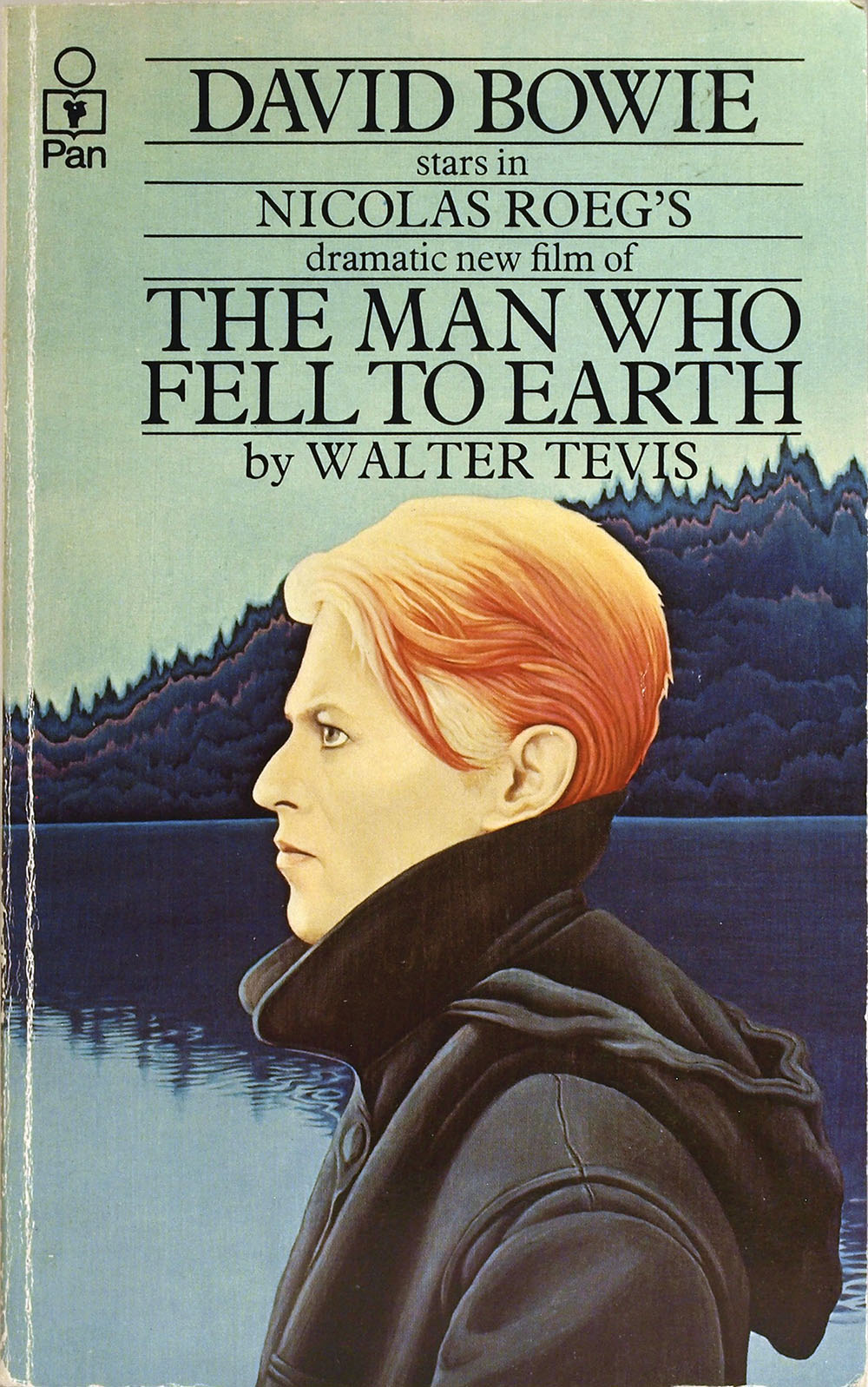
The first UK paperback edition, 1976. Cover art by David Bowie’s illustrator friend George Underwood.

• At the BFI: “Humanity, lost and found”. The original Sight and Sound review by Tom Milne of The Man Who Fell to Earth which was released 50 years ago this month. The film is another Nicolas Roeg project whose lofty reputation today has made everyone forget the bewildered or even hostile reaction it generated at the time, including from the US distributor, Paramount, who hated it. Milne, by contrast, had read the novel it was based on, and paid close attention to what the film’s writer, Paul Mayersberg, described as its “minefield of images”.

• Among the new titles at Standard Ebooks, the home of free, high-quality, public-domain texts: The Varieties of Religious Experience by William James.

• Issue 13 of Verbal magazine features an interview with Michael Moorcock, Iain Sinclair in the “Talking Books” section, and more.

• New music: 4 Hours (DVATION 2026 Version) by Clock DVA; -Music For Oriental Hotel Okinawa Resort & Spa- by Harikuyamaku.

• The Shaw Brothers Cinema YouTube channel has whole feature films from the studio’s huge archive free to view.

• At Colossal: “Historic architecture emerges from stone in Matthew Simmonds‘ ethereal sculptures”.

• “Music with Balls”: Terry Riley performing live with an arrangement of shiny silver spheres on KQED TV in 1969.

• Mixes of the week: DreamScenes – March 2026 at Ambientblog, and Motorik by Jon Savage.

• “What is electronic music?” Daphne Oram explains.

• RIP Country Joe MacDonald.

Stardust (1941) by Artie Shaw And His Orchestra | Stardust (1959) by Martin Denny | Stardust (1985) by Yasuaki Shimizu & Saxofonettes
Weekend links 707

genkosai.jpg

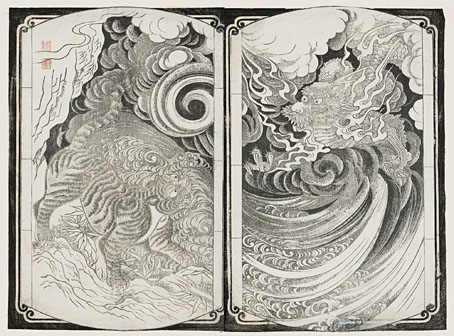
Dragon and Tiger—Designs for Lacquer Inro (no date) by Mori Genkosai.

• “But where have all those copies of Corridor of Mirrors gone? Sometimes I entertain the thought that an obsessive collector has amassed them in his library lined with looking-glasses, so that nobody else can possess the book but he, and he can see them all, multiplied to infinity, as he stalks up and down in his scarlet smoking hat and velvet coat, and gloats.” Mark Valentine on the mysterious unavailability of Corridor of Mirrors (1941), a novel by Chris Massie. The film adaptation made a few years later is one I’ve managed to miss, despite its starring Eric Portman and featuring the first screen appearance of Christopher Lee. Future viewing, I think.

• “The intrepid logician Kurt Gödel believed in the afterlife. In four heartfelt letters to his mother he explained why.” Alexander T Englert explains Gödel’s explanations.

• At Open Culture: Hortus Eystettensis (1613), “the beautifully illustrated book of plants that changed botanical art overnight”.

• Mix of the week: Aquarium Drunkard presents The Secret Hemisphere: New Age, Fusion and Fourth World, 1970–2002.

• New music: Phases Of This And Other Moons by Field Lines Cartographer.

• Why Graphic Culture Matters is a new book of essays by Rick Poynor.

• At Spoon & Tamago: Japanese Designer New Year’s Cards of 2024.

• Steven Heller’s font of the month is Chutz.

• At Dennis Cooper’s it’s Barbara Steele Day.

The Hall Of Mirrors In The Palace At Versailles (1970) by John Cale & Terry Riley | The Hall Of Mirrors (1977) by Kraftwerk | The Room Of Mirrors (2000) by Harold Budd

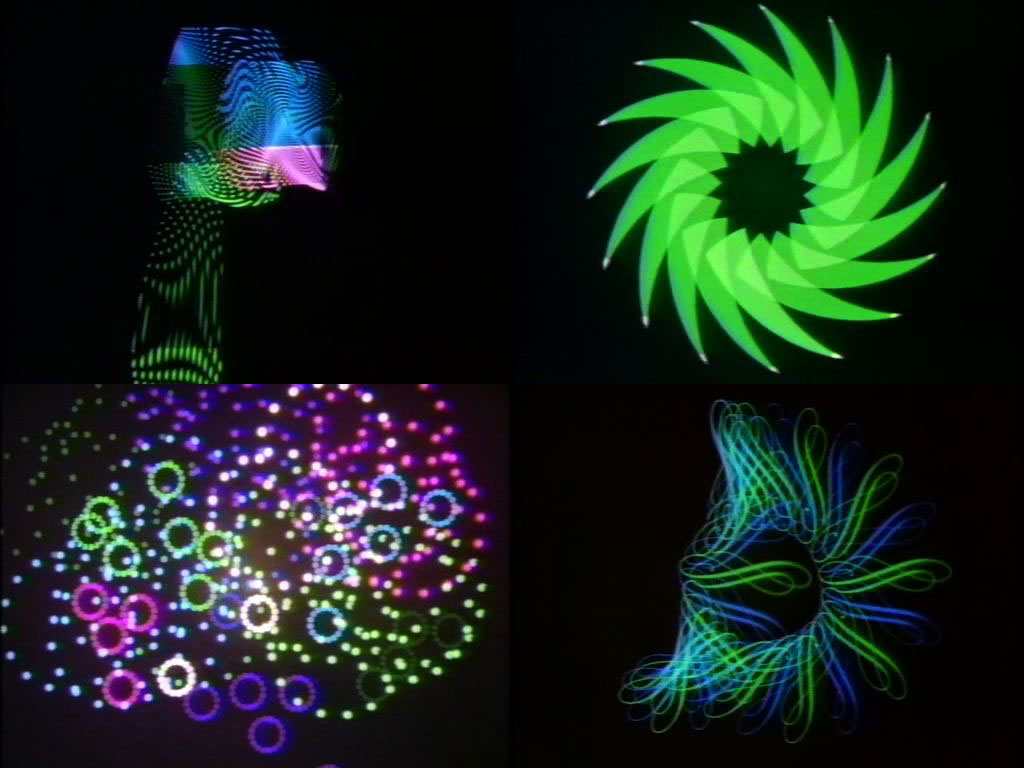
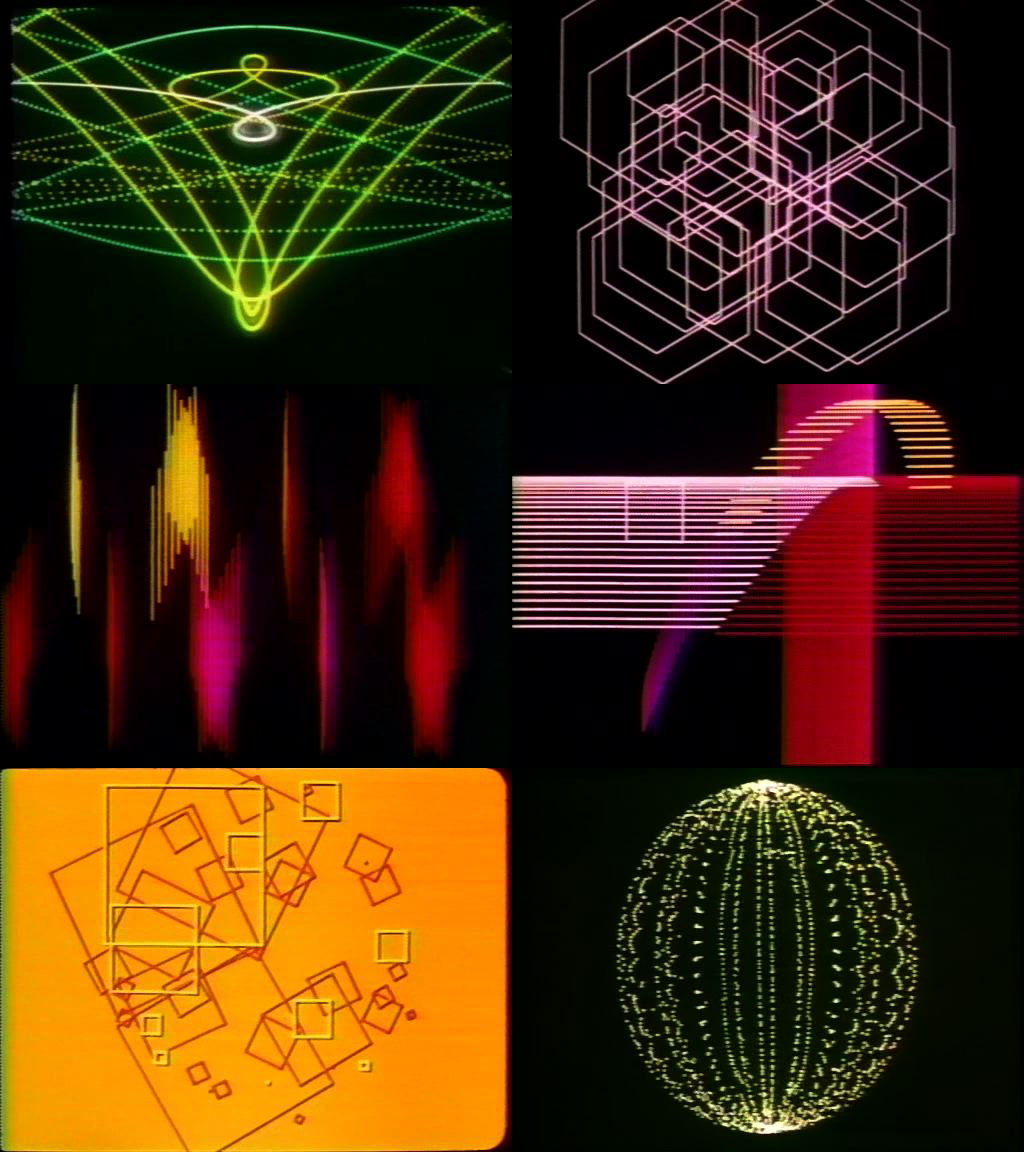
The World of John Whitney

whitney1.jpg

John Whitney’s abstract films haven’t always been easy to see on YouTube, and when they do turn up they’re often poor quality, so this was a welcome discovery, a 38-minute compilation of Whitney shorts taken from a Japanese laserdisc. A couple of the items mentioned in the on-screen contents list are absent from the video. The actual contents are as follows:

Arabesque (1976)
Matrix III (1972)
Matrix I (1971)
Permutation (1968)
Catalog (1961)

whitney2.jpg

Catalog is a showreel of Whitney’s earliest film experiments, a compilation within the compilation. Many of Whitney’s films are among the earliest examples of computer animation, made in the days when creating any kind of computer graphics meant laboriously plotting co-ordinates into a program which would then be fed into a machine the size of a wardrobe; the resulting video output was captured on film by a camera pointed at a monitor, a process you can see in operation in a short demonstration of Whitney’s working methods, Experiments in Motion Graphics (1967). Colour overlays and superimposition transform these simple cathode-ray shapes into things of beauty, with Whitney’s soundtracks being the icing on the cake: Arabesque is accompanied by the santur playing of Manoochehr Sadeghi, while Matrix III features an extract from Terry Riley’s Poppy Nogood And The Phantom Band.

Elsewhere on { feuilleton }
The abstract cinema archive

Weekend links 571

valck.jpg

Habit d’Astrologue (c. 1700) by Gerard Valck.

• “The Appointed Cloud begins with the high-pitched, keening sound of many bagpipes noisily playing at once—and then the music slowly coalesces, approaching a peaceful, tranquil hum. This gives way to fast-paced repetitive pulses, reminiscent of the minimalist works of composers such as Terry Riley and Philip Glass. Then the bagpipes join in once more, in a ferocious swarm of energy.” Geeta Dayal on the music of Yoshi Wada.

• “How can we conceive of the time of climate change, the time of planetary death? The House on the Borderland tried to conceive of exactly this a century ago. Yes, the narrator’s acts are fruitless. He gets haplessly carted about the universe to witness the end of time, which never really ends, is always at the edge, nearing an asymptote, on the borderland.” Namwali Serpell journeys through space and time with William Hope Hodgson.

• The Bureau of Lost Culture: DJ Food hosts a podcast discussion with Tony Bennett, founder and publisher of Knockabout Comics.

• Mixes of the week: Isolated Mix 111 (plus interview) by Ian Boddy, and a Wire mix (plus interview) by Teresa Winter.

• Fantastic visions and unknown worlds: Edwin Pouncey on Van Der Graaf Generator’s sleeve art.

• At Spoon & Tamago: Sculptor Kenichi Nakaya reconfigures ubiquitous Japanese rural crafts.

• My Bloody Valentine’s Kevin Shields: “We wanted to sound like a band killing their songs.”

• At Wormwoodiana: More earth mysteries are explored in Northern Earth magazine.

• New music: Black Horses Of The Sun by Dave Bessell.

The Exotica Project: One Hundred Dreamland 45s

• At Dennis Cooper’s: Hans Richter Day.

Mdou Moctar‘s favourite music.

Earth Floor (1985) by Michael Brook | Earth Tribe (1993) by Transglobal Underground | Earth Lights (2012) by Belbury Poly

Weekend links 338

lee.jpg

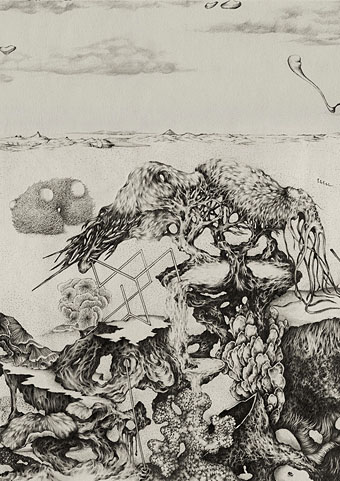
At the mountains of madness, fragment I (2014–16) by Céli Lee.

Spirits of Place, edited by John Reppion: new writings from Bryndís Björgvinsdóttir, Vajra Chandrasekera, Maria J. Pérez Cuervo, Warren Ellis, Alan Moore, Silvia Moreno-Garcia, Kristine Ong Muslim, Dr. Joanne Parker, Mark Pesce, Iain Sinclair, Gazelle Amber Valentine and Damien Williams.

• “Are we wrong to neglect [Jean Cocteau]? We are.” Kevin Jackson reviews Jean Cocteau: A Life, a biography by Claude Arnaud that’s finally available in an English edition (translated by Lauren Elkin & Charlotte Mandell). Related: Jean Cocteau speaks to the year 2000.

Void Beats / Invocation Trex by Cavern of Anti-Matter has been one of my favourite music releases this year. Tim Gane talks about the inadvertent origin of the group, and there’s also the welcome news of a reissue for the scarce first album, Blood Drums.

• Pauline Oliveros: 1932–2016; Geeta Dayal looks back on the life of US composer Pauline Oliveros, including reflections from, amongst others, Betsey Biggs, Fred Frith, Terry Riley, and Morton Subotnick.

• The relaunched Jayde Design website is selling copious Moorcock publications and ephemera, back issues of New Worlds magazine, and much else besides, including rare works of my own.

• New from Mute Records: Richard H. Kirk #7489 (Collected Works 1974–1989) and Sandoz #9294 (Collected Works 1992–1994).

• Drawings by Austin Osman Spare are on display for the next two weeks at the Atlantis Bookshop, London.

The Architecture of the Overlap: Sir John Soane’s Museum, London, scanned in three dimensions.

• Mixes of the week: Secret Thirteen Mix 201 by Félicia Atkinson, and FACT mix 579 by Jenny Hval.

• “No one has the slightest idea what is and isn’t cultural appropriation,” says Fredrik deBoer.

• I’m never keen on end-of-year lists but I’ll read any list that John Waters writes.

• “The Driller Killer and the humanist behind the blood and sickening crunch”.

• More Lovecraft: Stories to make you say UGH! by Pete Von Sholly.

Alan Moore talks to Stewart Lee.

At The Mountains Of Madness (1968) by H.P. Lovecraft | Mountains Falling (2001) by Bluebob | Mountains Crave (2012) by Anna von Hausswolff