Weekend links 669

claveloux.jpg

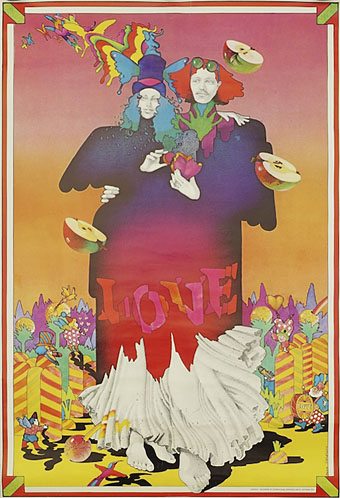
Love (1973), a poster by Nicole Claveloux.

• “Warner Brothers had been keen on a Rolling Stones movie. Jagger was keen on being a movie star. But Donald Cammell’s script was no Beatles’ jolly japes musical comedy…” Des Barry examines the ninth minute of Cammell & Roeg’s Performance.

• “…part of what made his 1970s work so original was the degree to which his band cross-pollinated guitar with synthesizer.” Aquarium Drunkard explores the esoteric jazz-rock of Steve Hillage.

• Magma, the cosmic jazz-rock group from France, have been around for 50 years without making a music video. Hakëhn Deïs is their first.

There was half-Tarkovsky embedded in async, “Solari” and “Stakra” and “Walker”, a hand outstretched to those great poems of living and light that we call films. “I had a strange dream last night,” Andrey Tarkovsky wrote in one of the diary entries collected in Instant Light, “I was looking up at the sky and it was very, very light and soft; and high, high above me it seemed to be slowly boiling, like light that had materialised like the fibres of a sunlit fabric, like silken living stitches in a piece of Japanese embroidery.”

David Toop remembers Ryuichi Sakamoto

• “Floor796 is an ever-expanding animation scene showing the life of the 796th floor of the huge space station…”

• The Electrifying Dreamworld of The Green Hand: Dan Clowes on the comic-art of Nicole Claveloux.

• At Bandcamp: Andy Thomas on the post-punk pop subversion of David Cunningham.

• At Unquiet Things: An enigmatic baroness and her collection of skulls.

• New music: River Of Dreams by Romance & Dean Hurley.

• Steven Heller’s font of the month is Ray Gun.

• Mix of the week: DreamScenes – April 2023.

• RIP Al Jaffee.

Skulls Of Broken Hill (1996) by Bill Laswell | The Bees Made Honey In The Lion’s Skull (2008) by Earth | Black Skulls (2018) by Jóhann Jóhannsson

Weekend links 658

ein-dor.jpg

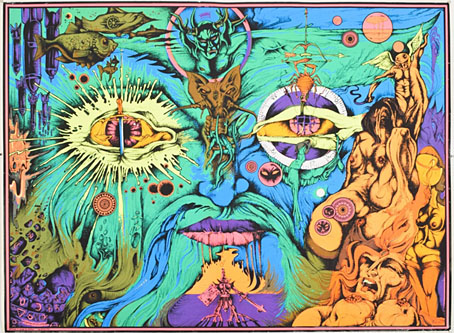
Also Sprach Zarathustra (1972), a blacklight poster by Asher Ein Dor.

• “Squaring the Circle (The Story of Hipgnosis) is a reasonably informative, if rather dry, look at a subject with much more potential for exploration,” says Dan Shindel, reviewing Anton Corbijn’s feature-length documentary about the album-cover design team. Sounds like a missed opportunity, on the whole, although the history of Hipgnosis has been so thoroughly explored over the course of several books (including a very recent one by Aubrey Powell) that any documentary seems almost superfluous. What I’d most like to see is something we’ll never have, a film about the company directed by the late Storm Thorgerson. And on that note, Thorgerson’s two-part documentary about art and drugs, The Art of Tripping (previously), has resurfaced on YouTube here and here.

• “LunaNet consists of a set of rules that would enable all lunar satellite navigation, communication and computing systems to form a single network similar to the Internet, regardless of which nation installs them. Setting lunar time is part of a much bigger picture. ‘The idea is to produce a Solar System internet,” says Gramling. ‘And the first part would be at the Moon.'” Elizabeth Gibney reports on plans to create a consistent time zone for the Moon.

• “Listening to 12, one cannot help but be struck by this deep expression of Sakamoto’s pain, of his human frailty, strength, and uncertainty about the future.” Geeta Dayal on Ryuichi Sakamoto’s latest album.

• At Public Domain Review: Illusory Wealth: Victor Dubreuil’s Cryptic Currencies by Dorinda Evans.

• At Aquarium Drunkard: Journey to inner space with The Groundhogs.

• DJ Food investigates the High Meadows psychedelic poster site.

• New music: Sub-Photic Scenario by Runar Magnusson.

• At Wyrd Daze: Disco Rd: 23 pages 23 minutes.

The Strange World of…Chris Watson.

Lunar Musick Suite (1976) by Steve Hillage | Lunar Cruise (1990) by Midori Takada & Masahiko Satoh | Luna Park (2006) by Pet Shop Boys

Twinkle, twinkle little stars

turner1.jpg

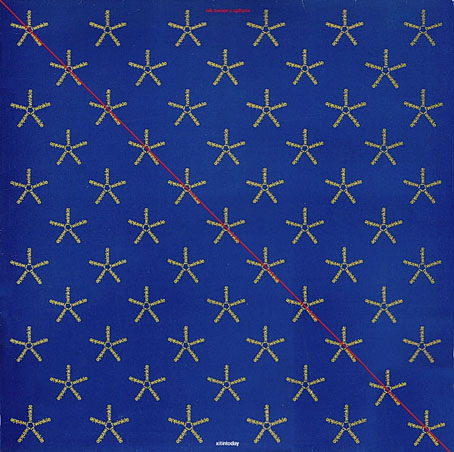
Xitintoday (1978) by Nik Turner’s Sphynx.

It’s been a long time since I’ve had a reason to write about Barney Bubbles but I’ve finally worked out why one of his more mysterious album covers looks the way it does.

When Nik Turner was unceremoniously kicked out of Hawkwind in 1976 he headed to Cairo to consider his next move. While there he recorded an hour or two of flute improvisations inside the sarcophagus in the King’s Chamber of the Great Pyramid of Cheops. The resulting tapes provided the basis for his first solo album, Xitintoday, which was released in 1978 on the Charisma label, and credited to Nik Turner’s Sphynx. Steve Hillage produced the album, helping to craft the meandering solos into a suite of songs based on passages from The Egyptian Book of the Dead. Xitintoday is one of the more unusual concept albums from a decade filled with such things. I’ve always liked it, in many ways it’s closer to Hillage’s oeuvre than Turner’s, as well as being very different to anything else in the Hawk-sphere.
turner2.jpg

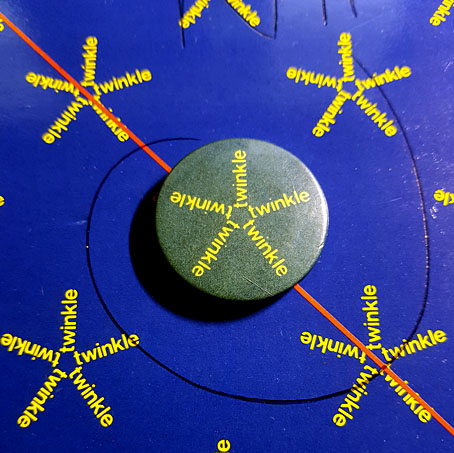
A faded promo badge. The ballpoint scrawl is Mr Turner’s autograph.

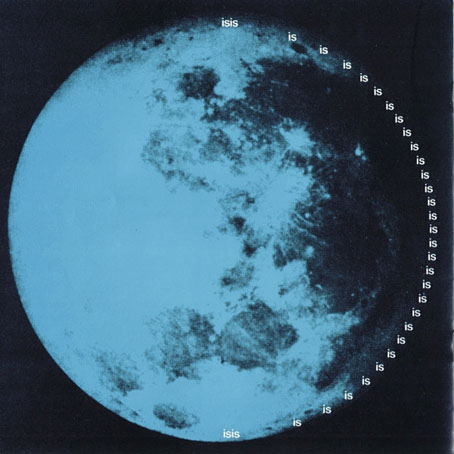
Barney Bubbles’ design for the album is also very different to anything else in the Hawk-sphere, an example of what might be called his High Modernist period, when the hippy motifs and decorative pastiches of his earlier work were replaced with bold, flat colours and playful graphic designs. Xitintoday was released with a square booklet containing lyrics, notes about the mythological theme, and a series of pictures which combine diagrams and Ancient Egyptian reliefs with calligram-like wordplay. The back cover of the album exemplifies the latter, with the word “Day” spelled out in much smaller words reading “Night”; inside the booklet there’s a page for Isis the Moon Goddess where the words “Isis is is is is…” form a curve around a photograph of the Moon. The cover design continues the cosmic theme with a field of star shapes in which each star is created by the word “Twinkle”. The star field makes sense in the context of the booklet but I’ve wondered for a long time why Barney Bubbles thought it was a suitable cover design rather than simply being another booklet page.
turner3.jpg

The solution arrived last week when work-related research had me looking through old design books for examples of Ancient Egyptian ornamentation. One of these, The Grammar of Ornament (1856) by Owen Jones, contains several pages of full-colour plates filled with Egyptian pattern samples.

egypt1.jpg

And on one of those pages there are these two squares which made me think immediately of the Xitintoday cover. This might seem tenuous when the cover design doesn’t feature any red dots but Barney Bubbles was an avid Egyptophile, avid enough to name his son after one of the Egyptian gods. A quick search revealed many more examples of this pattern which are closer matches for the cover design.
egypt2.jpg

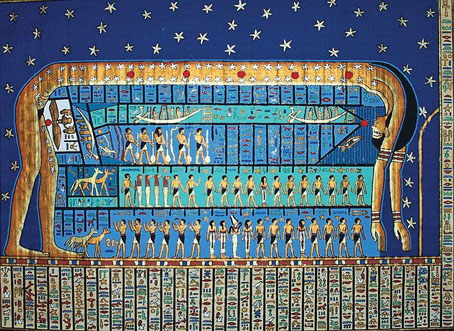
It turns out that the yellow star on a blue background was a common way of representing the night sky in Egyptian art, you’ll find the same stars in wall paintings and on the ceilings inside royal tombs.

egypt3.jpg

For years I’ve regarded the Xitintoday cover as being uncharacteristically random and abstract, surprisingly so when Bubbles designs from the same period are all so smart and well-considered. This discovery puts the Sphynx album in the same category, a design which avoids many more obvious solutions for a combination of the very old and the very new. Another feature of Barney Bubbles design is a kind of “Aha!” moment, when your appreciation of the design catches up with the thinking behind it. The appreciation this time has taken an outrageously long time to arrive but I’m pleased to have got there in the end.

Previously on { feuilleton }
Led Zeppelin IV: Jimmy Page versus Little Bo-Peep
The Grammar of Ornament revisited
On the pyramid

Weekend links 630

mishima.jpg

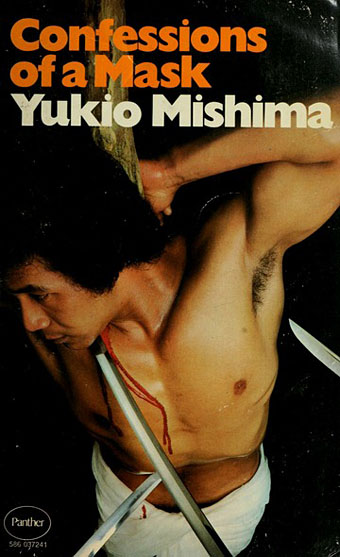
Photo by Roger Phillips, 1977.

• “…these films seem decidedly more modern than the films that followed close behind them.” Pamela Hutchinson on pre-code Hollywood.

• Space travel is time travel: NASA shows us galaxies as they were billions of years ago.

• Reverb Machine explains how Brian Eno created Ambient 1: Music For Airports.

• At Dennis Cooper’s: Spotlight on…Yukio Mishima Confessions of a Mask (1949).

• Mix of the week: The Chill Out Tent Kosmische Mix by Tarotplane.

• Old music: The Glastonbury Experience (Live 1979) by Steve Hillage.

• Deep Space 13: Stephen Mallinder’s favourite soundtracks.

• Sex and pathology: David Robb on 80 years of Cat People.

• New music: Expo Botanica by Cosmic Analog Ensemble.

Behind The Mask (1979) by Yellow Magic Orchestra | Red Mask (1981) by Cabaret Voltaire | A Ritual Mask (1983) by Peter Hammill

Weekend links 627

aldridge.jpg

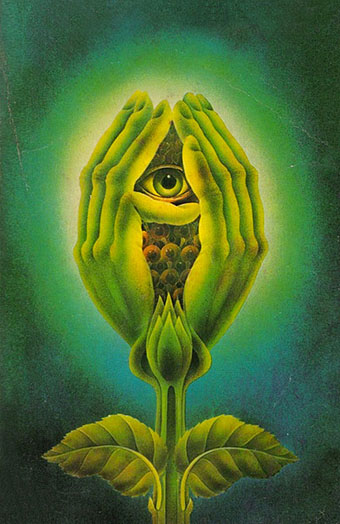
Cover art by Alan Aldridge for The Secret Life of Plants, 1975. Via.

• At Aquarium Drunkard: Alice Coltrane and band in a furious live performance at the Berkeley Community Theatre, 1972. The audio is on YouTube, and was also released on (unofficial) vinyl a couple of years ago, but you can download the whole set at Dimeadozen. (Free membership required.)

• “Black Square is tragic; it’s absurd; it can be bewildering or funny; it’s certainly metaphysical; and now it serves as a precursor for works and projects yet to be imagined.” Andrew Spira on the precursors of Black Square by Kazimir Malevich.

• “The possibility of plant consciousness cuts two ways, depending on whether you see plants as friend or foe, benevolent or threatening.” Elvia Wilk on the secret lives of plants.

• New/old music: Robot Riot by Stereolab. A previously unreleased recording from the mid-90s which will appear on the fifth instalment in the Switched-On compilation series.

• “Dare’s good, but Love And Dancing broke the mould and kicked off the whole modern dance scene.” Ian Wade on 40 years of remix albums.

• Coming soon from Strange Attractor: Arik Roper: Vision of The Hawk.

• At Unquiet Things: Deborah Turbeville’s unseen Versailles.

• “Thinking like a scientist will make you happier”.

• At Dennis Cooper’s: Karel Zeman Day.

Plantasia (1976) by Mort Garson | Musik Of The Trees (1978) by Steve Hillage | The Secret Life Of Plants (1979) by Stevie Wonder