Roger Dean: artist and designer

Kieran at Sci-Fi-O-Rama was in touch recently asking me to contribute a paragraph about a favourite Roger Dean picture for this feature about the artist. The following splurge of polemic was the result, something I’d been intending to write for a while. Since so many words would have overwhelmed the other contributions it’s being presented here while Kieran’s post has a variety of shorter appreciations and further examples of Dean’s art and design.
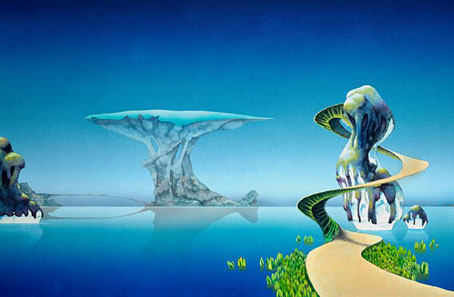
dean1.jpg

Pathways (1973). A slightly reworked version of the original painting.

“Science fiction is unfortunate in having a most unsatisfactory framework of existence—it’s considered literary kitsch. I believe it should be the mainstream of literature because all the books that have become important down the generations of civilisation have been books about ideas. Superficially, science fiction would seem to offer the most scope for idea content, but the promise is unfulfilled. Good ideas and good writing rarely coincide. All too often the medium is used for entertainment alone and its potential beyond this should be obvious to everyone. I don’t just mean in the sense of fantasy technology. The potential for anticipating human evolution is there and perhaps the means to bring it about and definitely the means to bring about a social evolution.”

Roger Dean, interviewed in Visions of the Future (1976).

If popularity is often a curse as well as a blessing, it’s been Roger Dean‘s curse to see his work dismissed along with many other products of a decade—the 1970s—with more than its share of cultural heroes and villains. Music journalists in Britain have for years given the impression that the arrival of the Sex Pistols in 1976 swept away all that preceded them, in particular bands such as Yes whose album covers had helped raise the visibility of Dean’s art to an international level. This is not only a lazy assumption, it’s also wrong. When Yes released Going For the One in 1977 it was their first studio album in three years, yet despite the punk explosion it went to no. 1 in the UK album charts, while a rare single release from the band made the UK top ten. Yes were playing sell-out tours in Europe and the US in 1977 and 78, as were Pink Floyd whose The Wall was massively popular worldwide in 1979. Punk didn’t sweep prog away, what happened with its advent was that progressive rock and everything associated with it—Roger Dean’s art included—became critically disreputable almost overnight, such that no music journalist would dare say anything good about it. That disrepute has persisted for thirty years despite a lasting and indelible influence. This is an old argument but some facts often need restating anew. *
dean6.jpg

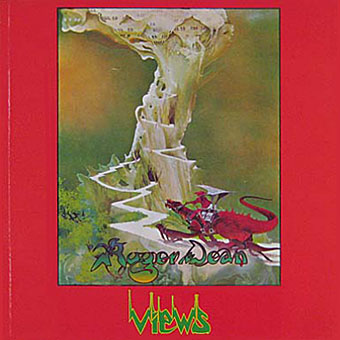
Views (1975).

I was 13 in September 1975 when Roger Dean’s first collection of his illustration and design work, Views, was published. At that time, I hadn’t heard any of the music to which his paintings and drawings were attached, and I didn’t even see a copy of the book until February 1976 when I happened to be in London on a school trip and found a big pile of what I guess was the second edition in Foyle’s book shop. This appeared at exactly the right moment. I wasn’t listening to the music but I was reading a lot of science fiction, and was starting to notice and imitate the work of various paperback artists. I recognised many of the pictures in Views from the covers displayed in the window of our local record shop, Cobweb, whose shopping-bag logo was a cowled magician figure à la Dean or Rodney Matthews. It’s difficult to say what struck me about Dean’s work at the time since you rarely articulate your preferences at that age. I think I liked the consistency of vision and the invention which blended the organic and mechanical, the architecture which looked at once ancient and futuristic, and the flat landscapes which put lone pine trees into rocky terrain familiar from Japanese and Chinese prints. For a teenager his style was also relatively easy to imitate if you forgot about basic things such as imagination and finesse, and I spent a year producing a lot of badly-drawn reptiles posed against lurid watercolour skies.
Continue reading “Roger Dean: artist and designer”

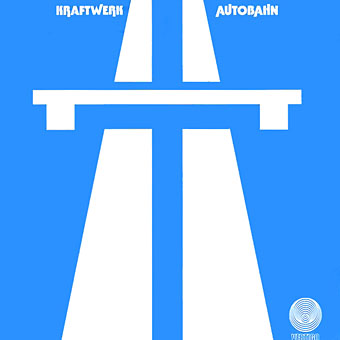
Who designed Vertigo #6360 620?

autobahn1.jpg

Autobahn by Kraftwerk; Vertigo #6360 620.

Colin Buttimer was in touch last week to let me know he’d copied my Barney Bubbles post (with my permission) to his excellent new site, Hard Format, which is devoted to the art of music design. In the intro to that piece he repeats something he’d mentioned to me earlier, namely his belief that Barney Bubbles designed the UK release of Kraftwerk’s Autobahn album in 1974. I thought this unlikely at first but the more I’ve been thinking about it the more possible it seems. So here’s a quick run through the evidence in the hope that someone out there may have more information to either confirm or deny the theory.

Continue reading “Who designed Vertigo #6360 620?”

Guy Peellaert, 1934–2008

diamond_dogs.jpg

Diamond Dogs (1974).

Many people know this classic album sleeve even if they don’t recognise the name of the Belgian artist who painted it. Guy Peellaert died this week and this is easily his most famous picture. I remember being very struck by its appearance in the local record shop window which always displayed gatefold album sleeves opened out as above. By then the notorious dog’s genitals would have been removed from the picture to protect the delicate sensibilities of Bowie’s listeners; the copy here is from a later CD reissue.

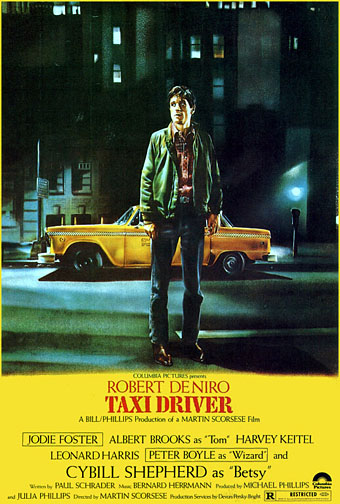
taxi_driver.jpg

Taxi Driver (1976).

Peellaert’s work was very visible in the 1970s, especially his book of rock star portraits, Rock Dreams, a ubiquitous pop culture item along with Roger Dean’s Views and Alan Aldridge’s psychedelic whimsy. I always liked the Bowie cover, it hinted at weirder music than the rather mundane post-Velvets/Mott the Hoople rock which the album contained, but much of the work in Rock Dreams seemed garish and awkward. Far more successful was Peellaert’s painting for Martin Scorsese’s Taxi Driver, undoubtedly commissioned on the strength of his earlier work but superior to nearly everything in his book.

Peellaert’s official site has several galleries of his paintings.

Elsewhere on { feuilleton }
The album covers archive
The illustrators archive

Alan Aldridge: The Man With Kaleidoscope Eyes

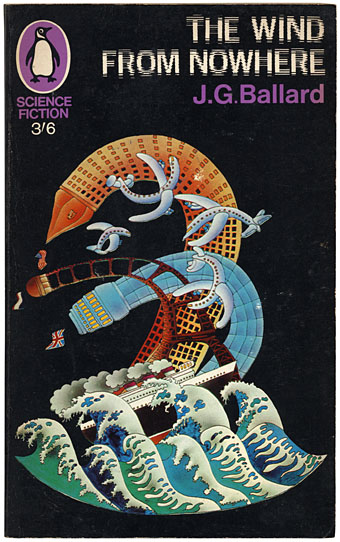
wind_from_nowhere.jpg

I’ve never been all that keen on Alan Aldridge‘s brand of psychedelic art but it’s worth noting here the (London) Design Museum retrospective which runs from 10 October to 25 January, 2009. Aldridge’s work as a designer and illustrator for Penguin Books in the Sixties impresses me more than his subsequent illustrated Beatles lyrics and The Butterfly Ball and the Grasshopper Feast (1973), a pair of books which seemed ubiquitous in the 1970s. Flickr has a decent selection of his book covers which included a run of sf paperbacks in 1967. Ballard’s The Wind from Nowhere is the very slight debut novel which the author prefers to forget. Where Ballard in Penguin is concerned, David Pelham’s work a few years later was a far more suitable match.

Seeing Aldridge honoured with a big retrospective make me wonder why Roger Dean hasn’t yet been given the same accolade. Dean for me is by far the better artist in terms of distinctive and memorable imagery; he’s also a better draughtsman and far more imaginative designer (not to mention having always been a speculative architect). I suspect Dean’s reputation is still blighted by his associations with Yes and the general antipathy which that band’s name generates in a certain middle-aged sector of Britain’s cultural commentariat. Ballard’s name was equally blighted in literary circles by his science fiction associations and it was Barcelona, not London, which honoured him with a major exhibition recently. There may be some home-grown reappraisals in the offing but I won’t hold my breath.

Elsewhere on { feuilleton }
The book covers archive
The illustrators archive

Previously on { feuilleton }
Ballard in Barcelona
The New Love Poetry
Penguin Labyrinths and the Thief’s Journal
Penguin designer David Pelham talks
Barney Bubbles: artist and designer

Barney Bubbles: artist and designer

barney1.jpg

Image-heavy post! Please be patient.

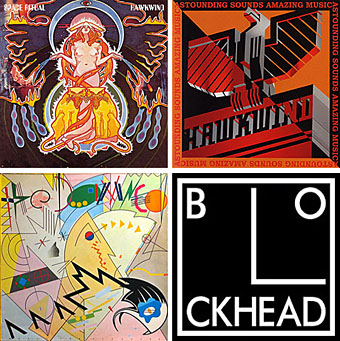
Four designs for three bands, all by the same designer, the versatile and brilliant Barney Bubbles. A recent reference over at Ace Jet 170 to the sleeve for In Search of Space by Hawkwind made me realise that Barney Bubbles receives little posthumous attention outside the histories of his former employers. Since he was a major influence on my career I thought it time to give him at least part of the appraisal he deserves. His work has grown in relevance to my own even though I stopped working for Hawkwind myself in 1985, not least because I’ve made a similar transition away from derivative space art towards pure design. Barney Bubbles was equally adept at design as he was at illustration, unlike contemporaries in the album cover field such as Roger Dean (mainly an illustrator although he did create lettering designs) and Hipgnosis (who were more designers and photographers who drafted in illustrators when required).

Colin Fulcher became Barney Bubbles sometime in the late sixties, probably when he was working either part-time or full-time with the underground magazines such as Oz and later Friends/Frendz. He enjoyed pseudonyms and was still using them in the 1980s; Barney Bubbles must have been one that stuck. The Friends documentary website mentions that he may have worked in San Francisco for a while with Stanley Mouse, something I can easily believe since his early artwork has the same direct, high-impact quality as the best of the American psychedelic posters. Barney brought that sensibility to album cover design. His first work for Hawkwind, In Search of Space, is a classic of inventive packaging.

Update: BB didn’t work with Mouse in SF, I’ve now been told.

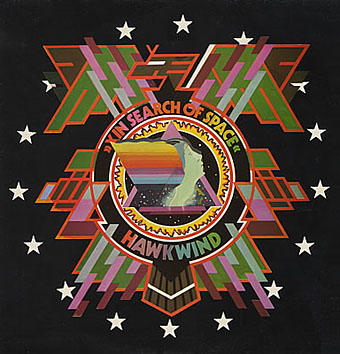
in_search_of_space.jpg

Hawkwind: In Search of Space (1971).

It’s fair to say that Hawkwind were very lucky to find Barney Bubbles, he immediately gave their music—which was often rambling and semi-improvised at the time—a compelling visual dimension that exaggerated their science fiction image while still presenting different aspects of the band’s persona. In Search of Space is an emblematic design that opens out to reveal a poster layout inside. One of the things that distinguishes Barney Bubbles’ designs from other illustrators of this period is a frequent use of hard graphical elements, something that’s here right at the outset of his work for Hawkwind.

This album also included a Bubbles-designed “Hawklog”, a booklet purporting to be the logbook of the crew of the Hawkwind spacecraft. I scanned my copy some time ago and converted it to a PDF; you can download it here.

Continue reading “Barney Bubbles: artist and designer”