Things

thing01.jpg

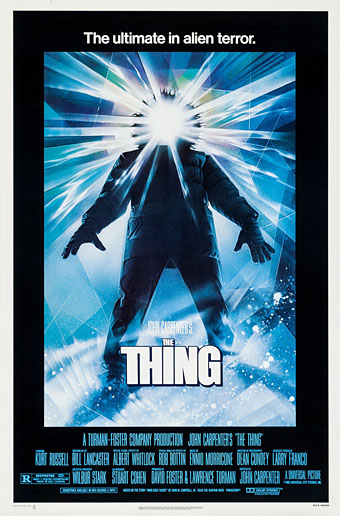
Art by Drew Struzan.

One of my current commissions is a piece of art for a book based on John Carpenter’s The Thing, due to be published next year. This was a request I agreed to immediately, having been astonished by the film when it appeared in 1982 (I saw it three times), and having rated it ever since as Carpenter’s best, as well as one of my all-time favourite horror films. I haven’t started on the planned piece just yet but the commission encouraged me to upgrade my DVD copy of the film to the Blu-ray version, and to also read for the first time John W. Campbell’s “Who Goes There?”, the short story that was the origin of both Carpenter’s film and The Thing From Another World (1951) directed by Christian Nyby. Reading the story set me hunting around for other interpretations of Campbell’s alien.
thing02.jpg

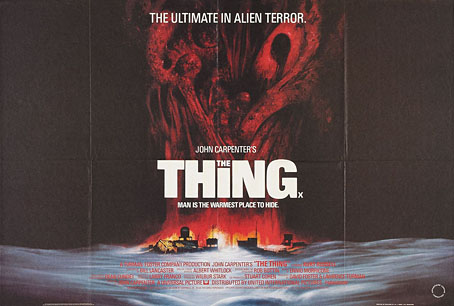
UK poster. Art by Les Edwards.

The story was instructive in several ways, the first being how closely Bill Lancaster’s script for the Carpenter film follows the story’s outline. The paperback collection I was reading has an introduction by James Blish which complains about the Howard Hawks/Christian Nyby production turning the polymorphous alien into another clone of Frankenstein’s monster. That’s true but the Nyby film still scared me to death when I first saw it aged 11 or so, and it has its merits. Lancaster not only stayed closer to the original shape-shifting premise but also kept many of the character names, plus details such as the blood test and the Thing’s attempt at the end to build a machine to escape from the encampment. The unforgettable opening, however, with the lone helicopter pursuing the dog, is all Lancaster’s.
thing03.jpg

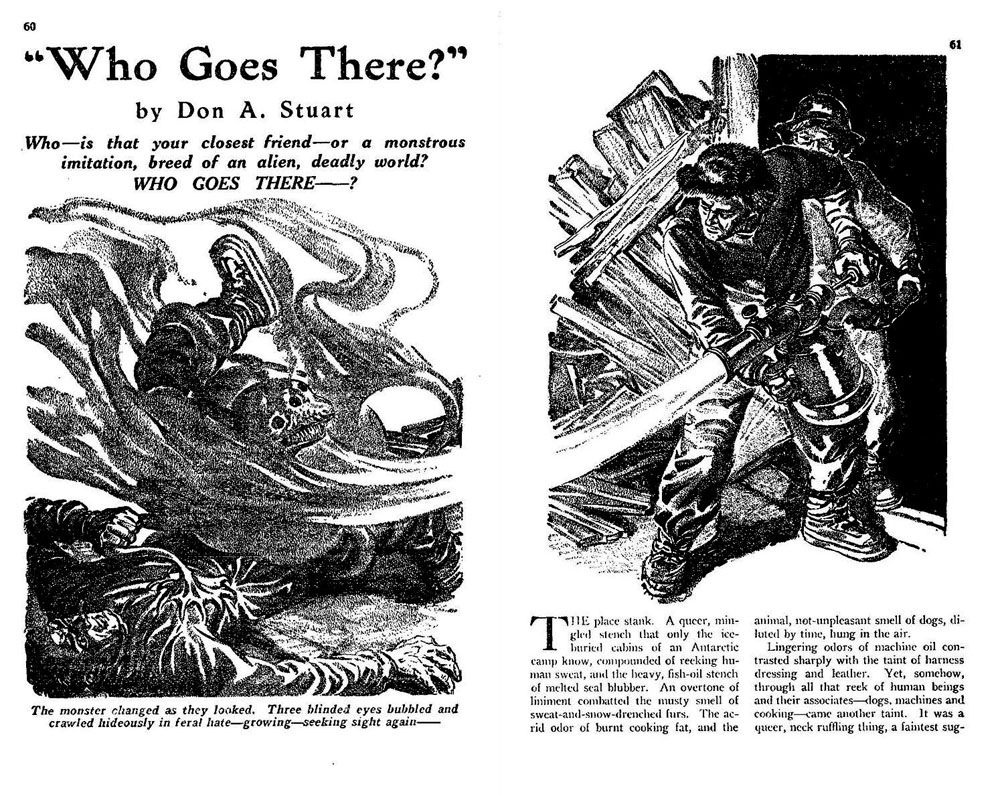
Astounding Science-Fiction, August 1938; artist unknown. “Don A. Stuart” was a pseudonym for John W. Campbell, at that time the newly appointed editor of Astounding. Campbell’s editorship changed the name of the magazine from Astounding Stories to Astounding Science-Fiction.

It was face up there on the plain, greasy planks of the table. The broken haft of the bronze ice-axe was still buried in the queer skull. Three mad, hate-filled eyes blazed up with a living fire, bright as fresh-spilled blood, from a face ringed with a writhing, loathsome nest of worms, blue, mobile worms that crawled where hair should grow—

Campbell’s description of the ice-bound alien is better than some of his writing elsewhere. I’m used to tempering my judgement when visiting stories written for the pulps but Campbell’s writing is really awful, and a reminder of why I never got very far with the early SF writers. Weird Tales magazine had its share of ham-fisted journeymen (and women), but Campbell’s contemporaries such as Clark Ashton Smith and HP Lovecraft read like the most finessed and mandarin prose stylists in comparison. Well, The Thing isn’t the first great film to be based on a poor-quality story so we can at least thank Campbell for his scenario, although how much of it was his own has never been clear. The idea of ancient aliens in Antarctica (some of which are amorphous shape-shifters) had already been explored by HP Lovecraft in At the Mountains of Madness; Lovecraft’s story was published in 1936 by Astounding Stories, the same magazine that published “Who Goes There?” two years later. This lineage, and the possible influence, makes The Thing one of the foremost Lovecraftian films even without all of its tentacled abominations.
thing04.jpg

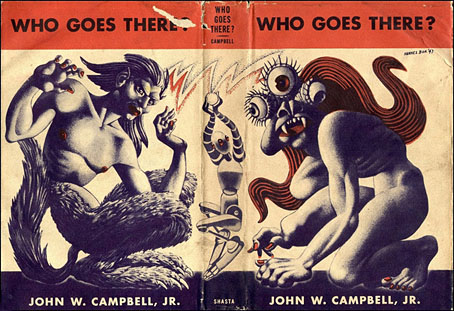
Art by Hannes Bok.

The story provided the title of Campbell’s debut collection of short fiction in 1948. I’ve known the Hannes Bok cover art for many years but hadn’t realised until recently that the three-eyed monster on the front was a Bokian rendering of Campbell’s alien. The figure on the back is presumably a human/husky hybrid, while I’d guess the robot relates to one of the author’s other stories.
Continue reading “Things”

Le labyrinthe and Coeur de secours

kamler1.jpg

Le labyrinthe (1969).

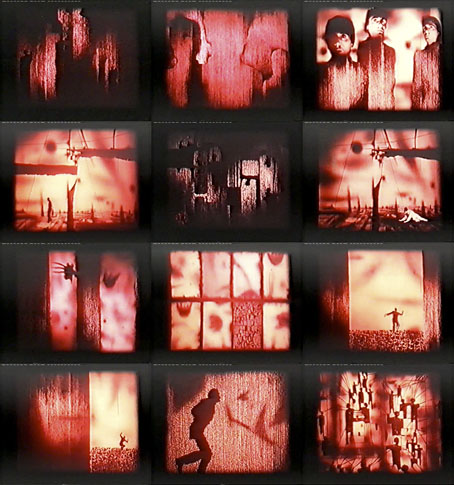
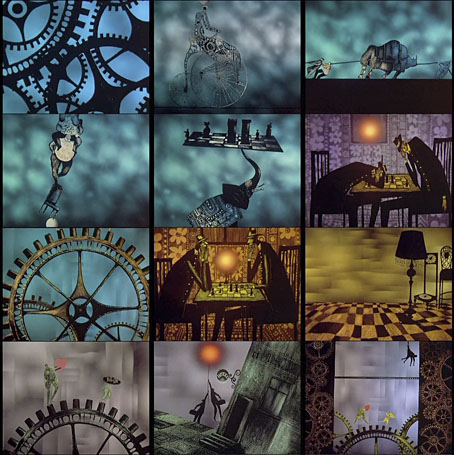
Among the new arrivals at Ubuweb there’s the very welcome addition of more animated films by Polish director Piotr Kamler. Kamler’s incredible Chronopolis (1982) was posted there late last year, a longer work than these shorter films which are nonetheless fascinating in themselves. For a start they show the range of Kamler’s animation which differs radically from film to film. Le labyrinthe is the kind of thing SF artist Richard Powers might have made had he been offered an animation commission: a human figure paces through increasingly threatening corridors and empty spaces until the winged creatures that haunt the zone bear down on him. Coeur de secours is more a sequence of events than anything that might be easily summarised; I’d seen this one years ago on Channel 4 but didn’t remember a thing about it. Chronopolis was notable for its electronic score by Luc Ferrari, and both the earlier films have similar soundtracks created by Bernard Parmegiani and Francois Bayle respectively. All these films, Chronopolis included, are collected on a recent DVD which I’ll definitely be buying. Kamler’s work, like that of Patrick Bokanowski and the Quay Brothers, goes places that films with much larger budgets can never reach.

kamler2.jpg

Coeur de secours (1973).

Previously on { feuilleton }
Chronopolis by Piotr Kamler

Weekend links: Apocalypse not now

apocalypse.jpg

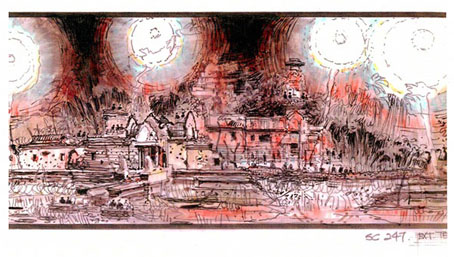
The Kurtz compound prior to destruction. An Apocalypse Now storyboard, one of a number which will be included among the extras on the Blu-Ray release of Francis Coppola’s film when it appears in the UK next month. The film is given a new cinema release on May 27th.

Radio broadcaster Harold Camping, a man denounced by fellow Christians as a false prophet, achieved one thing at least this week by making himself and his followers a global laughing-stock after the Rapture failed to materialise. I would have put money on him blaming those terrible gays somewhere along the way, such complaints being so common among a certain brand of American fundamentalist that you could write their sermons for them. Sure enough, here’s the old fool blathering about “lespianism” and describing the beautiful city of San Francisco as a cesspool. Shall we chalk this up as another victory for the gays, Harold? Related: No dogs go to heaven.

The internet has always been a home for ridicule but occasions like this bring out the wags in droves. The Oatmeal showed us how God is managing the Rapture using a Windows Install Wizard, and also pointed to a selection of sarcastic tweets. Meanwhile, this page has a comprehensive catalogue of previous apocalypse dates; the biggy is next year, of course.

Burroughs himself was no stranger to prosecution. In 1962 he was indicted on grounds of obscenity. Naked Lunch was not available in the US until 1962 and in the UK until 1964. The writer Norman Mailer and the poet Allen Ginsberg had to defend the book in court before the ruling could be reversed. In Turkey, it is now our turn to stand up for the novel.

Turkish writer Elif Shafak criticising the paternalism of the Turkish state in trying to protect its people from troubling novels. Related: William Burroughs publisher faces obscenity charges in Turkey.

An A–Z of the Fantastic City by Hal Duncan. “This guidebook leads readers and explorers through twenty-six cities of yore (Yore, while included, is one of the shorter entries).” Illustrated by Eric Schaller.

• The creepiest Alice in Wonderland of all, Jan Švankmajer’s semi-animated Alice (1988), receives a very welcome re-issue on DVD this month. With Brothers Quay extras and other good things.

smith.jpg

Robert E Howard’s sinister magus from the Conan stories, Thoth-Amon, as depicted by Barry Windsor-Smith. From a portfolio of five Robert E Howard characters, 1975.

What is computer music (or does it matter)? Related: A History of Electronic/Electroacoustic Music (1937–2001), 511 (!) downloadable pieces.

Unearthly Powers: Surrealism and SF: Rick Poynor explores the Tanguy-like strangeness of Richard Powers.

Magic Trip: Ken Kesey’s search for a kool place.

The Library of Congress National Jukebox.

Vladimir Nabokov’s butterflies.

Amy Ross’s Wunderkammer.

Rapture (1981) by Blondie | Apocalypse (1990) by William Burroughs | Rapture (2000) by Antony and the Johnsons.