Weekend links 40

peterloo.jpg

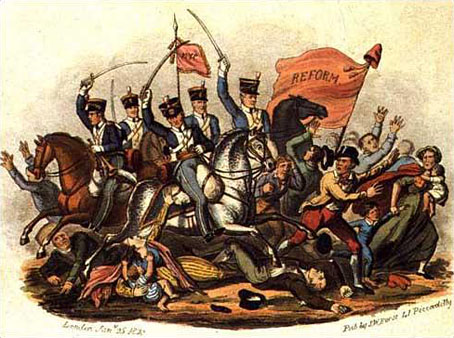
Manchester, August, 1819: yeomanry on horseback charge a crowd of demonstrators; London, November, 2010: Mounted police charge demonstrators; London, December, 2010: “…police horses have charged the crowd once and appear to be about to do so again.”

Rise like lions after slumber
In unvanquishable NUMBER!
Shake your chains to earth, like dew
Which in sleep had fall’n on you:
YE ARE MANY–THEY ARE FEW.

Percy Shelley, The Masque of Anarchy (1819).

• Amid the rest of the week’s tumult, discussion and activity around the censoring of David Wojnarowicz’s A Fire in My Belly film at the National Portrait Gallery, Washington DC, continues to rumble on. I’d missed this appraisal of the exhibition at The Smart Set. Hide/Seek: Too shocking for America features an interview with Jonathan Katz, co-creator of the exhibition in the eye of the storm:

“When,” Katz asks, “will the decent majority of Americans stand against a fringe that sees censorship as a replacement for debate?” Hide/Seek sought to conquer what Katz calls “the last acceptable prejudice in American political life” – but the conservative right, rampant after last month’s midterm elections, won’t relinquish their prejudices without a fight. And so, “an exhibition explicitly intended to break a 21-year blacklist against the representation of same-sex desire,” says a dispirited Katz, “now finds itself in the same boat.”

Related: Q&A with Hide/Seek curators Jonathan Katz and David C. Ward. The Smithsonian Institution issued a fatuous statement saying they stand by the exhibition despite having forced the removal of one of its works. One of the NPG commissioners resigned in protest at the gallery’s capitulation to political pressure. Other protestors were banned from the Smithsonian after playing a video of the work on an iPad. There’s video of the iPad protest here and the protestors have their own blog. In my earlier post on the subject I noted that the actions of censorious Catholics have given Wojnarowicz’s work far more public exposure than it would otherwise receive. The LATimes has details of some of the galleries throughout the US showing the video as a result of its removal in Washington.

• Related to the above, Bruce Sargeant and His Circle: Figure and Form, a book by artist Mark Beard about the work of his “Bruce Sargeant” alter ego. Homotography has a preview.

• “We focus most strongly at the margins, on the music that others may be blind to. We don’t care whether it is electronic, metal, jazz, folk, classical, noise, world music or whatever. We are as excited by the experimental, as we are exhausted by the ephemeral. We listen. We mosh. We think. We dance. We write words. We capture images. We hope to do justice to the art which inspires us. We are The Liminal”.
rotary.jpg

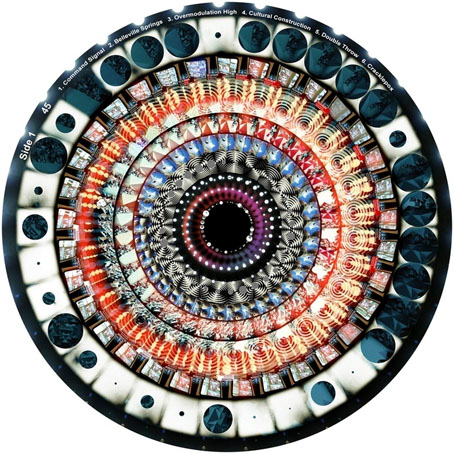
Rotary Signal Emitter, a vinyl zoetrope by audiovisual duo Sculpture.

Rest Easy Sleazy, a small mix dedicated to Peter Christopherson. Related: A Peter Christopherson tribute mix. Another mix: Mixhead was a 1997 promo CD by Portishead.

• Related to the above: What if we could touch our music again? (Hello? Some of us still play—and create—CDs and vinyl…) Is the mix tape as object-of-seduction a dead concept in a virtual world? “We traded connection for convenience,” says I Miss My Pencil. Their proposed solution, C60 Redux, is an RFID reader plus speakers, packaged in a smart 12-inch case.

• Iannis Xenakis: How an architect took music back to mathematical roots. Related: the Xenakis exhibition at MOCA, Los Angeles.

The Body Electric at Ikon, Birmingham, is the first retrospective exhibition in the UK of work by New Zealand artist Len Lye.

Hayley Campbell has a blog. This week you can read about her contribution to Jamie McCartney‘s Great Wall of Vagina.

More David Lynch: he really does love cherry pie but isn’t 100% sure how magnets work. I sympathise on both counts.

2019: A Future Imagined. Visual Futurist Syd Mead reflects on the nature of creativity and how it drives the future.

Quashed Quotatoes by Michael Wood, reviewing a new edition of Finnegans Wake.

New Weird Australia.

• Portishead’s 2008 performance for the Canal+ show Concert Privé is one of their best filmed concerts. YouTube has the whole thing.
Robert Anning Bell’s Tempest

bell1.jpg

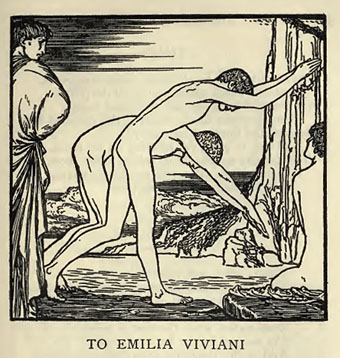
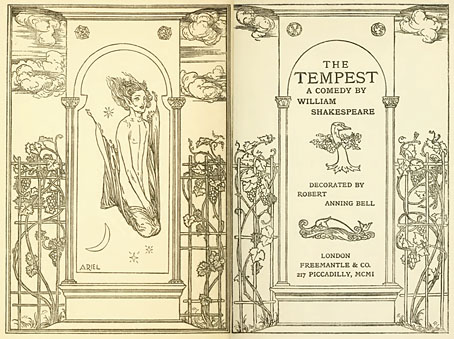
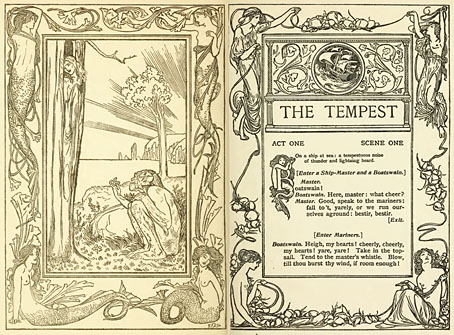
British artist and designer Robert Anning Bell (1863–1933) illustrates Shakespeare in this 1901 edition at the Internet Archive and the work seemed to give him an excuse to embellish many of the pages with writhing mer-folk. His adaptation isn’t as striking as William Heath Robinson’s Midsummer Night’s Dream from 1914 but then few books are. In style Bell is closer to his contemporary Charles Ricketts with very open line work and no heavy black areas. Ricketts produced his own version of Ariel’s Song to Ferdinand for The Magazine of Art in 1895 but doesn’t seem to have illustrated much more of The Tempest as far as I’m aware, although his Vale Press did issue an edition of Shakespeare’s complete works. It hadn’t occurred to me before how few illustrated editions there are of The Tempest; this seems surprising given the fantastic nature of the story. It might be that illustrated plays have never sold so well despite there having been a number of illustrated Midsummer Night’s Dreams. I’d love to have seen Harry Clarke tackling Ariel and Caliban.

bell2.jpg

bell4.jpg

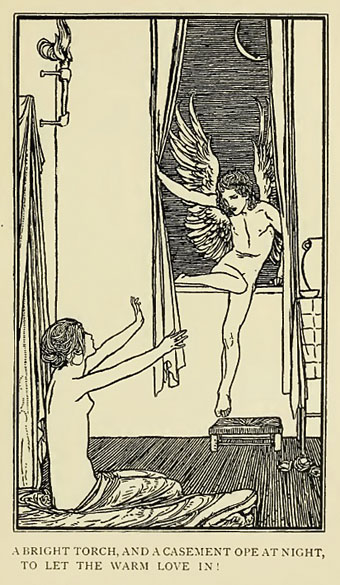
Also at the Internet Archive is a 1902 edition of Shelley’s poems illustrated by Bell (above) and an 1897 edition of Keats in the same series (below). Great poetry doesn’t necessarily lend itself to illustration so it’s no surprise that these books are less interesting than the Shakespeare.

bell3.jpg

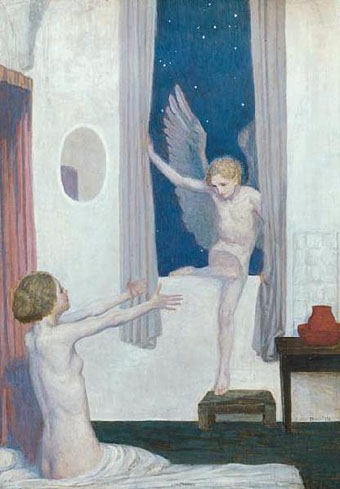
Bell later reworked his illustration for Keats’s Ode to Psyche as a painting which he called Cupid’s Visit. I much prefer the drawing to the painting.

bell5.jpg

Cupid’s Visit (1912).

Elsewhere on { feuilleton }
The illustrators archive

Previously on { feuilleton }
Charles Ricketts’ Hero and Leander
Another Midsummer Night
Arthur Rackham’s Midsummer Night’s Dream
The art of Charles Robinson, 1870–1937
William Heath Robinson’s Midsummer Night’s Dream

Watchmen

watchmen.jpg

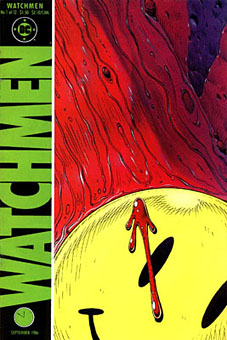
This year sees the 20th anniversary of the publication of Watchmen by Alan Moore and Dave Gibbons. The landmark comic book, one of the few to deserve the designation “graphic novel”, remains a particular favourite of mine, and one that still excites for its consummate command of the comics medium. The following is a very long round table discussion with Watchmen‘s creators from issue 100 of Fantasy Advertiser, first published in March 1988. It’s surprising that this doesn’t seem to have been posted anywhere else on the web as it’s an excellent discussion about this great book.

Spoiler warning: this piece discusses in depth just about every revelation in the story so you’d be advised to skip it if you haven’t read the book.

MARTIN SKIDMORE: Alright, let’s have a starting point… just what is it about Watchmen that distinguishes it from other…
STEVE WHITAKER: Cream cheeses?
MS: …superhero comics on the market?
DAVE GIBBONS: Is this in the form of direct questions to us, or…
FIONA JEROME: No, we’re all gonna talk.
DG: Well, I’ll have a schnoozle then…
SW: The thing that I think distinguishes Watchmen from other comics is that the series holds together more like a novel. Your climax isn’t in the last 3 panels in Watchmen 12. There are long quiet tracts with exciting bits or…moderately exciting bits (LAUGHTER) In terms of Jack Kirby Wham! Smash! Pow! it’s all very quiet. There’s a lot of suffering but…
MS: …it’s all emotional rather than physical suffering.
ALAN MOORE: It’s a difficult question for me and Dave to answer, probably one that you could answer better, but if I had to say anything then it’s the degree of structure that me and Dave have applied to it—I can’t think of many examples of that degree of structure, that degree of layering.
FJ: I was going to say: especially visually you don’t get such a use of motif certainly not in American comics.
MS: Doug Moench has used it occasionally.
FJ: But not with the same complexity and not filling-in with written structure as well.
PETER HOGAN: The thing is: you’re given a world. The characters, alright, they’re based on the Charlton Characters but they’re new as of page 1. Even so, they’re characters with a history that comes out over the course of the thing… Their world has a history… it has a cohesion to it.
SW: Something that quite interests me now we’re talking about structure and stuff, is the symmetry—there is a real symmetry to Watchmen and the way the characters are set up.
DG: Two arms… two legs. (LAUGHTER)
MS: Perhaps the Comedian and Rorschach…
SW: I was thinking more of Osterman and Ozymandias.
MS: That’s right—the intellectual and physical, chaos and law…
AM: It’s difficult pinning down what’s symmetrical to what—I mean to me, at least to some extent, there’s an equally good case for contrasting Nite Owl and Rorschach.

Continue reading “Watchmen”