Atget’s corners

seine1.jpg

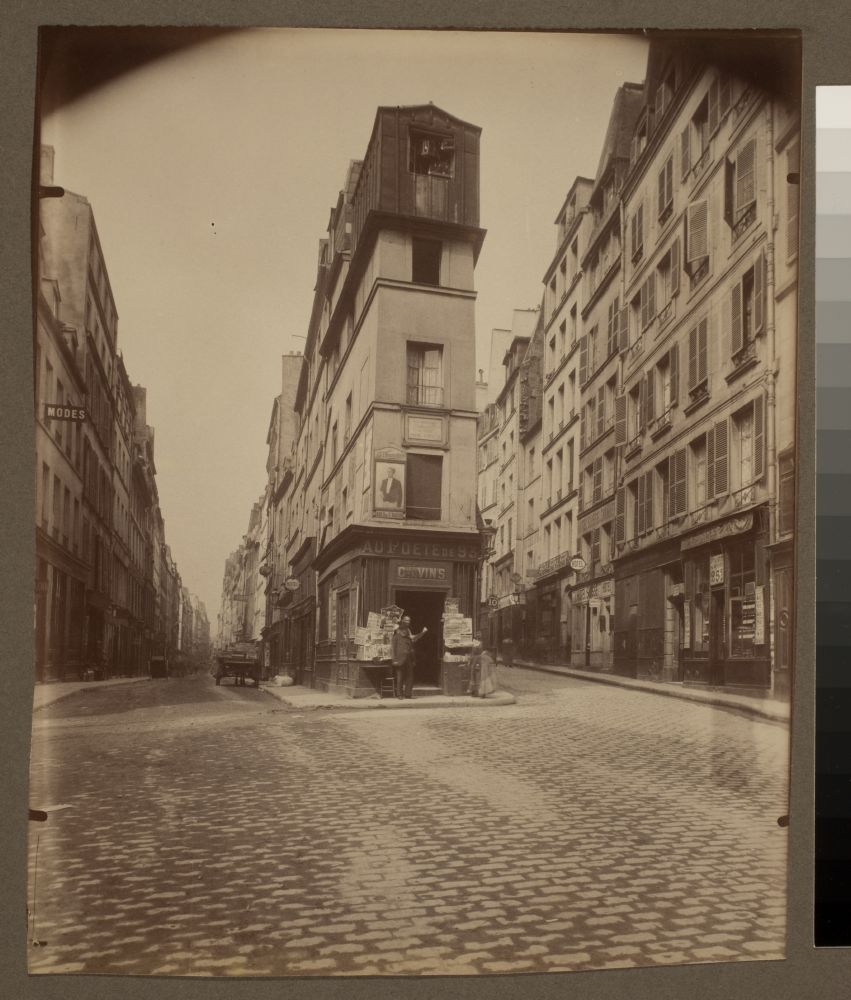
Un coin, rue de Seine (1924).

Photographer Eugène Atget had a thing for the architectural promontory, as do I for that matter, and this photo of a street corner in the rue de Seine, Paris, has always been a favourite. Atget liked the location enough to photograph it at least twice from different angles. The long exposures bleach the sky and turn passing figures into ghostly blurs.

seine2.jpg

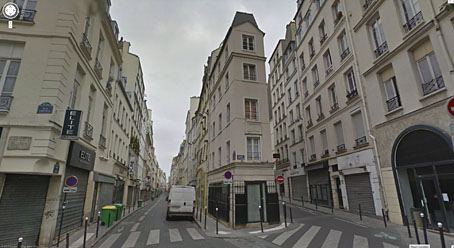
Coin rue de Seine (1924).

seine3.jpg

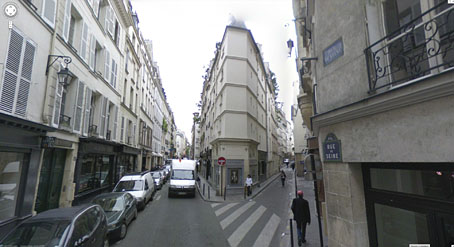
Opening up Google Maps to see how the street looks today left me astonished when I realised I’d walked past this very corner without realising it was the location of Atget’s photos. The rue de Seine is one of two streets giving access to the rue des Beaux-Arts, the location of L’Hôtel where Oscar Wilde died. Matters weren’t helped by my walking in the opposite direction to this view so I didn’t notice the narrow corner. In any case the street looks very different today from Atget’s gloomy intersection.

clery1.jpg

Maison d’Andre Chenier en 1793–97, rue de Cléry (1907).

Equally as clean and unremarkable is another narrow building in the rue de Cléry which in 1907 was sporting some kind of wooden structure on its upper floor. Google’s cameras tend to diminish whatever space they photograph but the streets seem smaller today when cluttered with bollards, cars, bikes and the ubiquitous green bins of Paris.

clery2.jpg

Previously on { feuilleton }
Rue St. Augustin, then and now
Brion Gysin’s walk, 1966
L’Hôtel, Paris

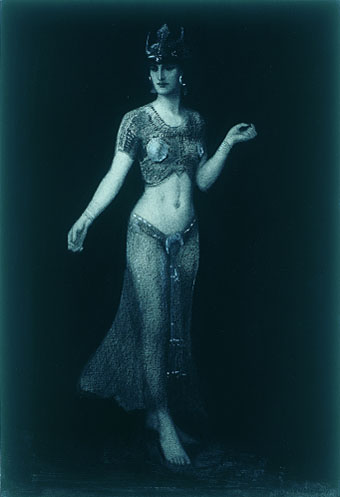
Several more Salomés

durnov.jpg

Cover of Salome by Oscar Wilde (1903) by Modest Alexandrovich Durnov.

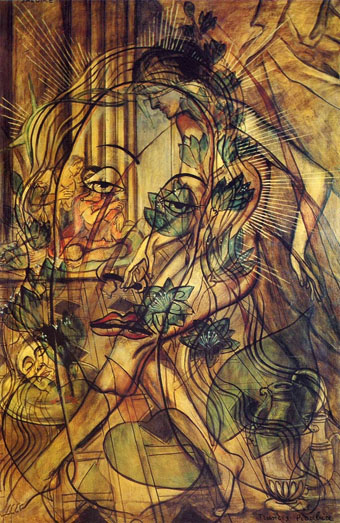
Gathering a few more Salomé renderings which have caught my attention recently. The biggest surprise is the one from Picabia since he’s an artist who these days is almost always associated with the Cubists and Dadaists. In the 1920s he returned to figurative painting and produced a number of pieces in this style. The overlaying of images reminds me of some of Hans Bellmer’s drawings.

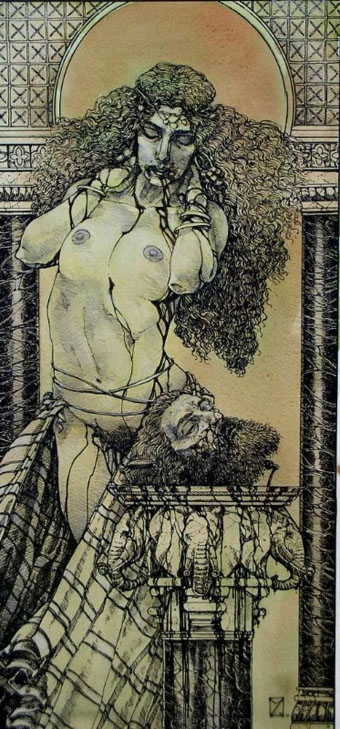
Michael Zulli is an American comic artist whose work I’ve always liked a great deal. No information about his drawing, unfortunately, so I can’t say whether it’s a one-off or part of a larger project.

wilmer.jpg

Salomé (1917) by John Riley Wilmer.

picabia.jpg

Salomé (c. 1928) by Francis Picabia.

kalmakov.jpg

Salomé Sphinx (1928) by Nicholas Kalmakoff.

zulli.jpg

Salomé (no date) by Michael Zulli.

Elsewhere on { feuilleton }
The Salomé archive

Le Cantique des Cantiques

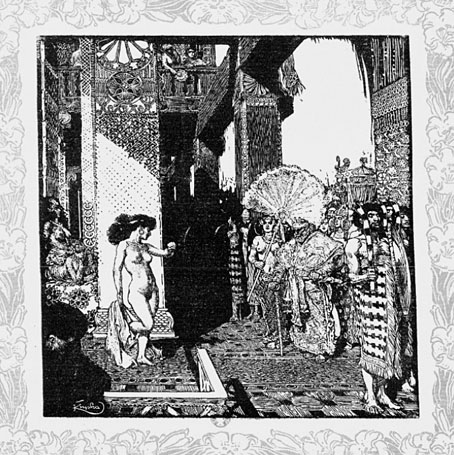
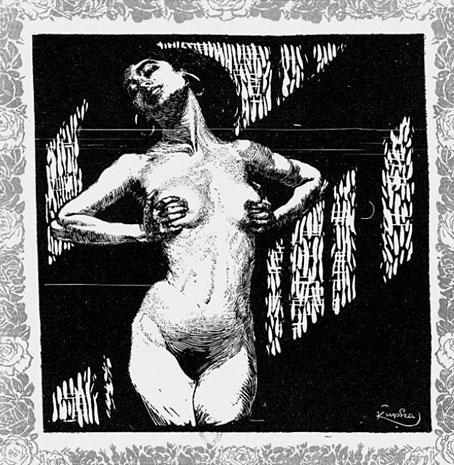
kupka1.jpg

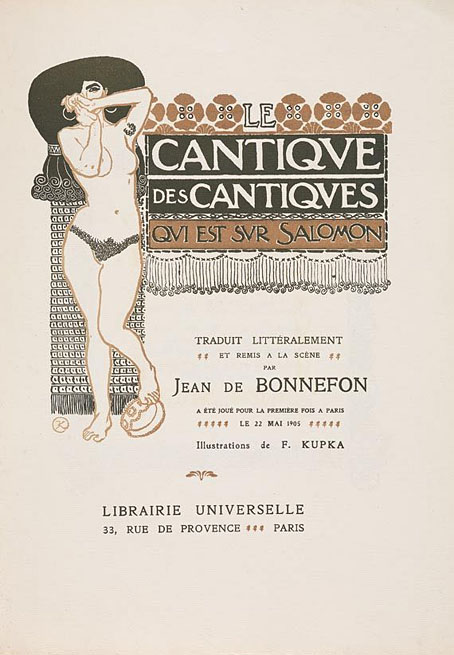
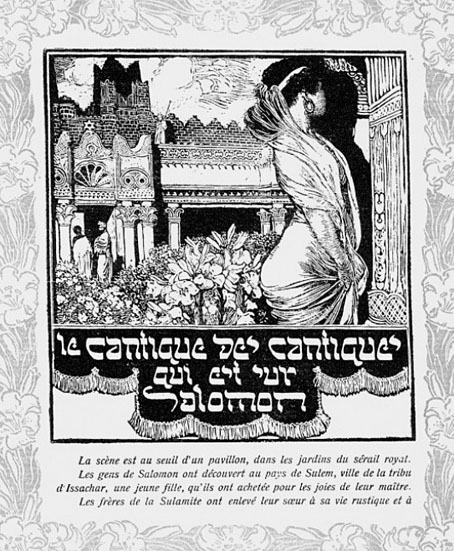
An oddity from the career of František Kupka, Le Cantique des Cantiques (1905) in this version is a stage presentation of the Song of Solomon by Jean de Bonnefon. Kupka provided a series of illustrations in a style similar to his Symbolist paintings which in the original printing are decorated with coloured borders. The copies here are from a bad scan at Gallica whose page I’ve been unable to find again. For the moment there are better copies to be seen at eBay. The drama is very much oriented towards the sexual exotica which Oscar Wilde had rendered notorious in Salomé, and which underpins so many of the obsessions of the period. A few years after this Kupka was in a different world entirely, following new directions into abstract art.

kupka6.jpg

kupka5.jpg

kupka3.jpg

Continue reading “Le Cantique des Cantiques”

Weekend links 154

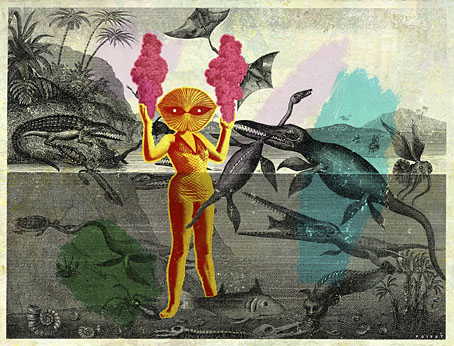
poizat.jpg

Collage by Chloé Poizat.

Xenis Emputae Travelling Band plays the Music of John Dee, and free at Bandcamp: Victorian Machine Music by Plinth, the “creaking, winding, piping, chiming and wood-knocking of Victorian parlour music machines”.

Jeremy Willard on Mikhail Kuzmin, “the Oscar Wilde of Russia”. Related: Conner Habib on the Disinfo podcast discussing pornography, sexuality, and whether sex be a revolutionary act.

Ed Vulliamy paid a visit to Hawkwind’s Hawkeaster festival. The Hawks’ Warrior On The Edge Of Time album is released in a remastered edition next month.

• Blasts from the past: Mahavishnu Orchestra, live in France, August 23rd, 1972, and Ashra (Manuel Göttsching & Lutz Ulbrich) in Barcelona, 1981.

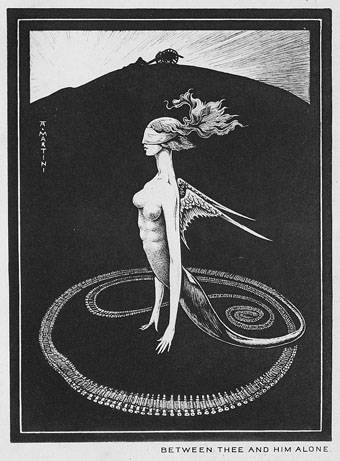
martini.jpg

An illustration by Alberto Martini for Raw Edges (1908) by Perceval Landon.

NASA’s cover designs for Space Program manuals, guidebooks, press kits, reports and brochures.

PingMag—”Art, Design, Life – from Japan”—makes a welcome return as an active blog.

Suzanne Treister‘s Hexen 2.0 Tarot designs.

Listening to records that no longer exist

The architectural origins of the chess set

The Bohemian Realm of Absinthiana

Les sources d’une île: a Tumblr

Hammer Without A Master (1998) by Broadcast | Test Area (1999) by Broadcast | Make My Sleep His Song (2009) by Broadcast & The Focus Group

Wildeana 9

dine.jpg

Dorian Gray (1968) by Jim Dine; one of a series of prints for an illustrated edition. Rainbows didn’t become a gay symbol until Gilbert Baker’s flag design ten years later.

Continuing an occasional series.

• “…the Public is a very curious thing; it is sometimes perverse, and even obstinate, and it has evidently made up its mind to like the plays of Mr. Oscar Wilde.” Callum at Front Free Endpaper found a sceptical review of The Importance of Being Earnest in The Sketch for 20th February, 1895.

• “Wilde’s vision of Socialism, which at that date was probably shared by many people less articulate than himself, is Utopian and anarchistic.” George Orwell, writing in 1948, looks back at Wilde’s The Soul of Man Under Socialism.

Oscar Wilde between Paris and Brighton: Research at the excellent Charles Ricketts & Charles Shannon blog following Wilde’s travels in the early months of 1891.

Wilde Ride by Anthony Paletta: “Oscar Wilde spent a year in the US and met the likes of Walt Whitman and Henry James.”

• There’s plenty of Wildeana at Pinterest.

Elsewhere on { feuilleton }
The Oscar Wilde archive