Beardsley reviewed

studio1.jpg

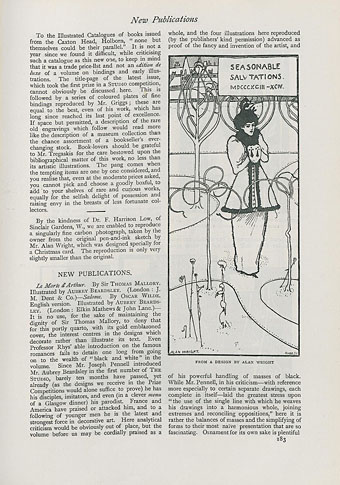
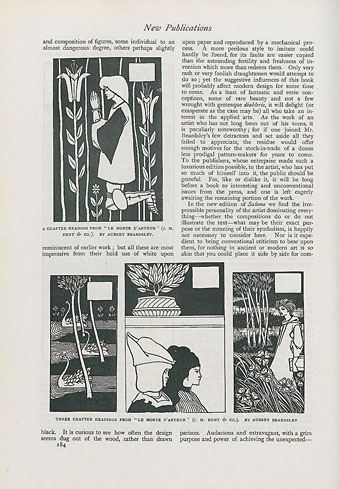
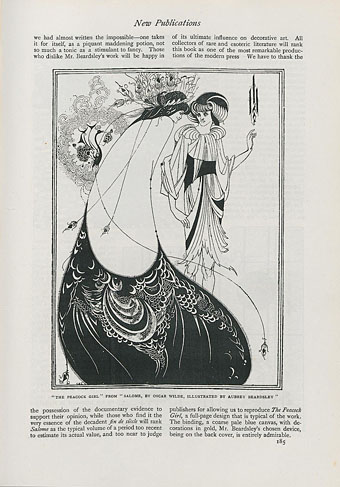
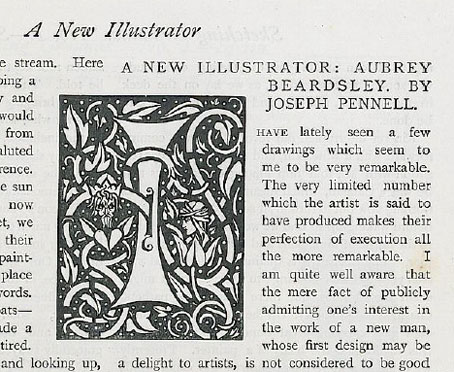
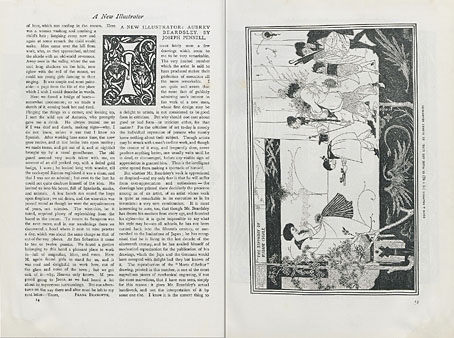
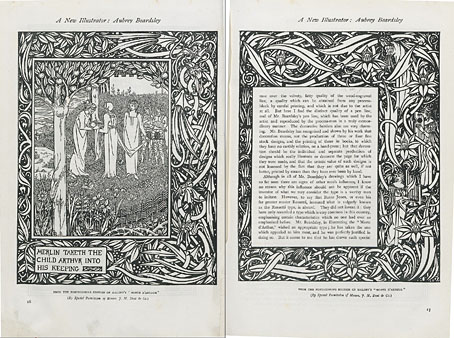
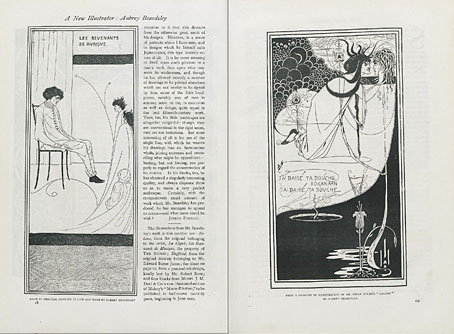
More Aubrey Beardsley ephemera. These pages are from the bound edition of The Studio for 1894, reviews of two of Beardsley’s earliest publications: the first editions of Le Morte d’Arthur (which was published in multiple volumes), and the illustrated edition of Oscar Wilde’s Salomé which sealed Beardsley’s reputation as a major force in the art of the 1890s. The reviews lavish praise on both works, unsurprisingly since Beardsley had received the magazine’s support from the very first issue. It’s interesting to note even at this early stage mention of the rumblings of discontent which would grow increasingly loud in the following years. Also that The Peacock Skirt is here given the name The Peacock Girl.

studio2.jpg

NEW PUBLICATIONS. Le Morte d’Arthur. By Sir Thomas Mallory. Illustrated by Aubrey Beardsley. (London: J. M. Dent & Co.)—Salome. By Oscar Wilde. English version. Illustrated by Aubrey Beardsley. (London: Elkin Mathews & John Lane.)—It is no use, for the sake of maintaining the dignity of Sir Thomas Mallory, to deny that for this portly quarto, with its gold emblazoned cover, the interest centres in the designs which decorate rather than illustrate its text. Even Professor Rhys’ able introduction on the famous romances fails to detain one long from going on to the wealth of “black and white” in the volume. Since Mr. Joseph Pennell introduced Mr. Aubrey Beardsley in the first number of The Studio, barely ten months have passed, yet already (as the designs we receive in the Prize would alone suffice to prove) he has his disciples, imitators, and even (in a clever menu of a Glasgow dinner) his parodist. France and America have praised or attacked him, and to a following of younger men he is the latest and strongest force in decorative art. Here analytical criticism would be obviously out of place, but the volume before us may be cordially praised as a whole, and the four illustrations here reproduced (by the publishers’ kind permission) advanced as proof of the fancy and invention of the artist, and of his powerful handling of masses of black.

While Mr. Pennell, in his criticism—with reference more especially to certain separate drawings each complete in itself—laid the greatest stress upon “the use of the single line with which he weaves his drawings into a harmonious whole, joining extremes and reconciling oppositions,” here it is rather the balances of masses and the simplifying of forms to their most naive presentation that are so fascinating. Ornament for its own sake is plentiful and composition of figures, some individual to an almost dangerous degree, others perhaps slightly reminiscent of earlier work; but all these are most impressive from their bold use of white upon black. It is curious to see how often the design seems dug out of the wood, rather than drawn upon paper and reproduced by a mechanical process. A more perilous style to imitate could hardly be found, for its faults are easier copied than the astounding fertility and freshness of invention which more than redeem them. Only very rash or very foolish draughtsmen would attempt to do so; yet the suggestive influences of this book will probably affect modern design for some time to come.

As a feast of fantastic and eerie conceptions, some of rare beauty and not a few wrought with grotesque diablerie, it will delight (or exasperate as the case may be) all who take an interest in the applied arts. As the work of an artist who has not long been out of his teens, it is peculiarly noteworthy; for if one joined Mr. Beardsley’s few detractors and set aside all they failed to appreciate, the residue would offer enough motives for the stock-in-trade of a dozen less prodigal pattern-makers for years to come. To the publishers, whose enterprise made such a luxurious edition possible, to the artist, who has put so much of himself into it, the public should be grateful. For, like or dislike it, it will be long before a book so interesting and unconventional issues from the press, and one is left eagerly awaiting the remaining portion of the work.

studio3.jpg

In the new edition of Salome we find the irrepressible personality of the artist dominating everything—whether the compositions do or do not illustrate the text—what may be their exact purpose or the meaning of their symbolism, is happily not necessary to consider here. Nor is it expedient to bring conventional criticism to bear upon them for nothing in ancient or modern art is so akin that you could place it side by side for comparison. Audacious and extravagant, with a grim purpose and power of achieving the unexpected—we had almost written the impossible—one takes it for itself, as a piquant maddening potion, not so much a tonic as a stimulant to fancy. Those who dislike Mr. Beardsley’s work will be happy in the possession of the documentary evidence to support their opinion, while those who find it the very essence of the decadent fin de siècle will rank Salome as the typical volume of a period too recent to estimate its actual value, and too near to judge of its ultimate influence on decorative art. All collectors of rare and esoteric literature will rank this book as one of the most remarkable productions of the modern press. We have to thank the publishers for allowing us to reproduce The Peacock Girl, a full-page design that is typical of the work, The binding, a coarse pale blue canvas, with decorations in gold, Mr. Beardsley’s chosen device, being on the back cover, is entirely admirable.

Elsewhere on { feuilleton }
The Aubrey Beardsley archive

Aubrey Beardsley in The Studio

ab1.jpg

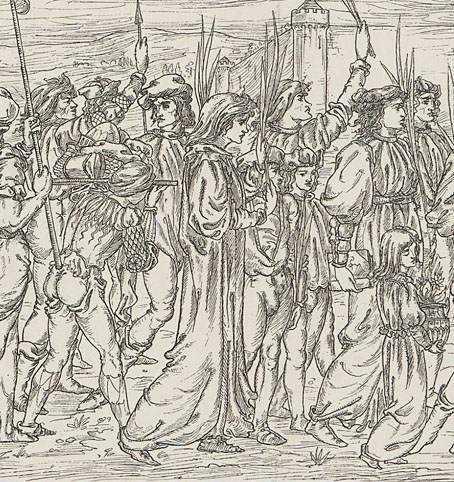
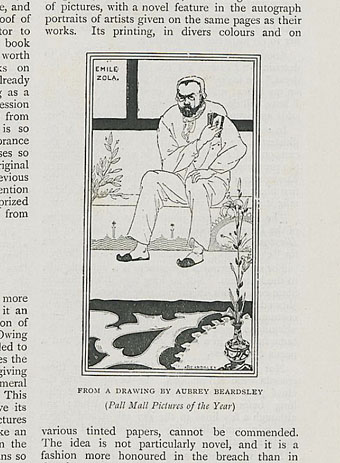
Aubrey Beardsley in the year 1893 was 21, and on the threshold of being catapulted to fame (and notoriety) via his illustrations for Oscar Wilde’s Salomé. Some of Beardsley’s drawings in the distinctive style he called “Japanesque” had already appeared in The Pall Mall Magazine, and he was hard at work on some 600 illustrations and embellishments for Dent’s Le Morte D’Arthur which began publication in 1894. Some of those illustrations are featured in the glowing introduction by Joseph Pennell which appeared in the first issue of The Studio magazine in April 1893 (when Beardsley was still only 20), a title that became the leading showcase for the British end of the Art Nouveau movement in the 1890s. Pennell’s appreciation also included Beardsley’s Joan of Arc’s Entry into Orleans, a piece which showed how much the artist’s early work owed to Mantegna, and the first drawing of Salomé which later helped secure the Wilde commission. The Joan of Arc picture was reproduced as a fold-out supplement in the magazine’s second issue.

ab2.jpg

All the major Beardsley books refer to Pennell’s article but I’ve never had the opportunity to see it in full until now, thanks to the excellent online archives at the University of Heidelberg. There are many volumes of the international editions of The Studio at the Internet Archive but for some reason these don’t include the early numbers; at Heidelberg we can now browse the missing issues. In the first volume in addition to Beardsley there’s a piece about Frederic Leighton’s clay studies for paintings and sculptures, illustrations by Walter Crane and Robert Anning Bell, and an article on whether nude photography can be considered art. In this last piece several of the examples happen to be provided by Frederick Rolfe aka Baron Corvo, and Wilhelm von Gloeden, two men who we now know had other things on their mind when they were photographing Italian youths.

The collected volumes of The Studio from 1893 to 1898 may be browsed or downloaded here. I’ve not had time to go through the rest of these so I’m looking forward to discovering what else they may contain.

ab3.jpg

ab4.jpg

ab5.jpg

Detail from Joan of Arc’s Entry into Orleans.

ab6.jpg

Elsewhere on { feuilleton }
The Aubrey Beardsley archive

Wildeana 10

wilde.jpg

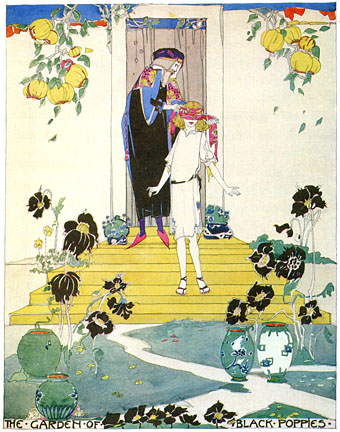
Illustration from The House of Pomegranates (1914) by Jessie M. King.

Continuing an occasional series. Recent Wildean links.

• It’s a measure of a writer’s success if the characters or stories they create resonate sufficiently with future generations to be subject to new interpretations. Among Oscar Wilde’s contemporaries this has happened to Arthur Conan Doyle and Bram Stoker, both of whom Wilde knew. Increasingly it’s been happening to Wilde’s own fiction, especially in the case of Dorian Gray whose tragedy assumes the status of a modern myth. At Cannes this year, Clio Barnard premiered a contemporary retelling of Wilde’s The Selfish Giant. Bleeding Cool has some clips. The social realism is a long way from Wilde’s tale but that shows how flexible these fables can be.

• Jessie M. King’s illustrations for Wilde’s The House of Pomegranates have appeared here before but the copies posted at The Golden Age are the usual quality scans.

Rick Gekoski: “Visiting the US, I am reminded of Oscar Wilde’s tour there in 1881, which allowed him to become an orator and a celebrity.”

Paper Dolls by David Claudon based on the characters from The Importance of Being Earnest. (Thanks to Gabe for the tip.)

Elsewhere on { feuilleton }
The Oscar Wilde archive

Weekend links 174

ikuma.jpg

Dress (2012) by Nao Ikuma.

• Two of my Cthulhu artworks can currently be seen in the Ars Necronomica exhibition at the Cohen Gallery, Brown University, Providence, RI. The exhibition is part of NecronomiCon, and runs to September 13th. In related news, my steampunk illustration has been nominated in the Visual category of this year’s Airship Awards. Winners will be announced at Steamcon V in October.

• “…the story of how a small cabal of British jazz obsessives conducting a besotted affair with the style arcana of Europe and America somehow became an army of scooter-borne rock fans…” Ian Penman looks back at the culture of Mod for the LRB.

• “What is it about the writer in the First World that wants the Third World writer to be nakedly political, a blunt instrument bludgeoning his world’s ills?” Gina Apostol on Borges, Politics, and the Postcolonial.

If someone had designed a work regime perfectly suited to maintaining the power of finance capital, it’s hard to see how they could have done a better job. Real, productive workers are relentlessly squeezed and exploited. The remainder are divided between a terrorised stratum of the, universally reviled, unemployed and a larger stratum who are basically paid to do nothing, in positions designed to make them identify with the perspectives and sensibilities of the ruling class (managers, administrators, etc) – and particularly its financial avatars – but, at the same time, foster a simmering resentment against anyone whose work has clear and undeniable social value. Clearly, the system was never consciously designed. It emerged from almost a century of trial and error. But it is the only explanation for why, despite our technological capacities, we are not all working 3–4 hour days.

On the Phenomenon of Bullshit Jobs by David Graeber

Ron Rosenbaum talks to Al Pacino about all the usual stuff, and reveals some detail about the actor’s obsessive interest in Oscar Wilde’s Salomé.

• More queer history: The Brixton Fairies and the South London Gay Community Centre, Brixton 1974–6.

• At Dangerous Minds: Anthony Burgess and the Top Secret Code in A Clockwork Orange

• Every day for 100 days, Jessica Svendsen redesigned a Josef Müller-Brockmann poster.

LondonTypographica: Mapping the typographic landscape of London.

• Mix of the week: Secret Thirteen Mix 083 by Demdike Stare.

• At Strange Flowers: Alfred Kubin the writer.

Derek Jarman’s sketchbooks.

Rick Poynor on Collage Now.

• Thomas Leer: Private Plane (1978) | Tight As A Drum (1981) | Heartbeat (1985)

Ads for The Yellow Book

yb1.jpg

More Beardsley ephemera, and more from the recently upgraded NYPL Digital Collections. These US ads for The Yellow Book date from late 1894 to early 1895, a couple of months before Oscar Wilde was arrested and Aubrey Beardsley had to leave the magazine despite having no connection with Wilde’s activities.

What’s most interesting for me about these ads is the small vignettes, two of which I’m sure I haven’t seen before. This suggests that there’s still material in the pages of The Yellow Book which has been overlooked despite the many books which collect Beardsley’s art. The Internet Archive has several volumes of the magazine but I’ve been daunted in the past by its thousands of pages of not-so-interesting Victorian prose. (The Savoy was the superior publication where quality of writing was concerned.) Maybe it’s time to take a deep breath and dive in.

yb2.jpg

yb3.jpg

yb4.jpg

yb5.jpg

Elsewhere on { feuilleton }
The Aubrey Beardsley archive