Wildeana 12

wilde.jpg

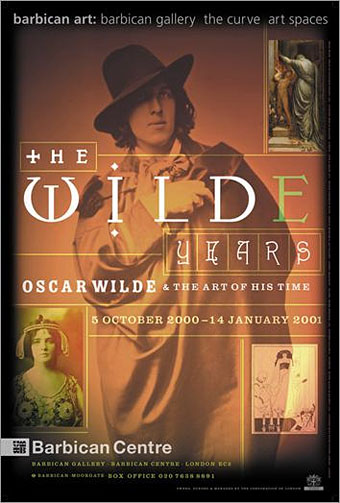
The Wilde Years (2000), a poster by Jonathan Barnbrook for an exhibition at the Barbican Centre, London.

Continuing an occasional series. Recent (and not-so-recent) Wildean links.

Sander Bink writes that Beardsley-esque artist Carel de Nerée tot Babberich was in Paris in the summer of 1900, the summer of the Exposition Universelle which has been a subject of many posts here. Did he meet Oscar Wilde? It’s a possibility.

• “Was Oscar Wilde’s outlandish personality more influential than his writing?” asks George Woodcock.

These were the years when Zola was at the height of his international fame but Wilde pans the fashionable Naturalist school by contrasting it with another phenomenon that was then sweeping through Europe: Russian fiction. One of the small gems of these volumes is a cluster of very interesting and little-known articles on modern Russian novels. Wilde rated Turgenev, Tolstoy and Dostoevsky far above “the obscene brood of pseudo-realists which roosts in the Cloaca maxima of France” and welcomed their influence on modern literature. He was certainly among the first critics to review the English translations of Crime and Punishment and Injury and Insult, praising Dostoevsky’s command of detail and ability to probe into “the most hidden springs of life”.

Stefano Evangelista on Wilde’s world of journalism

• “An idea that is not dangerous is not worthy of being called an idea at all.” A print by ObviousState.

Robert McCrum looks at The Picture of Dorian Gray for the Guardian‘s 100 Best Novels.

• Oscar Wilde provides the Pinterest legions with a thousand and one quotes.

Elsewhere on { feuilleton }
The Oscar Wilde archive

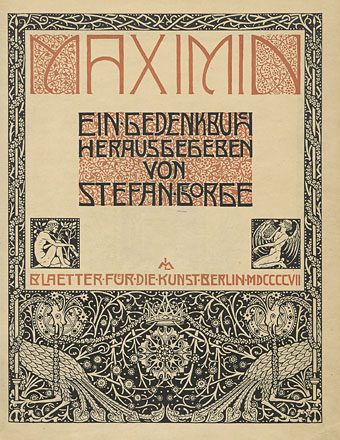
Maximin: ein Gedenkbuch by Stefan George

maximin01.jpg

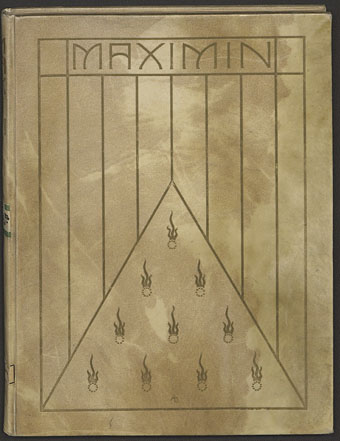
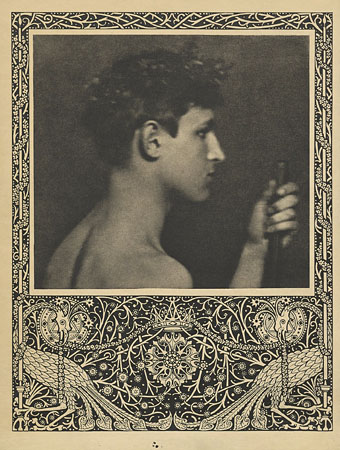
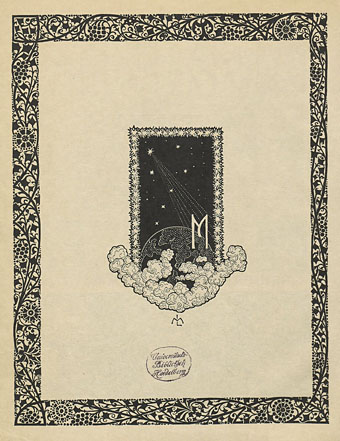
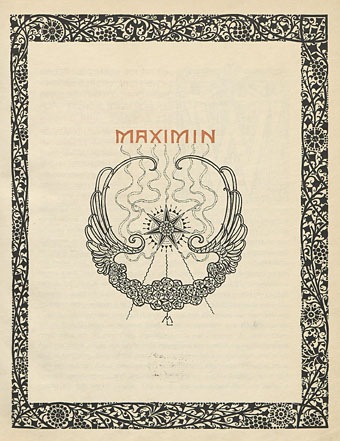
This is a strange and beautiful book, a loving paean to a dead boy-poet from another poet, Stefan George (1868–1933), published in 1907. The “Maximin” of the title was Maximilian Kronberger (1888–1904) who was around 14 when he met George; the older man was 34 at the time. George was apparently smitten by the boy, and devastated when he died from meningitis two years later. Maximin: ein Gedenkbuch (A Memorial Book) is the result, a collection of mournful poems, beautifully designed and illustrated by Melchior Lechter in that rectilinear Art Nouveau style which the artist made his own. The memory of the dead Maximin became for George a quasi-religious obsession which makes Maximin the bible of the homosocial cult that George subsequently encouraged.

maximin02.jpg

What’s most surprising about all this behaviour is that it did nothing at all to harm his reputation, even among the Nazis who later revered his poetry. George was a contemporary of Oscar Wilde but the pair were poles apart in character, George’s chilly, high-minded aestheticism preserving him from the brickbats aimed at Wilde and others. Nonetheless, the inherent camp that results from the combination of such a remote attitude combined with flagrant boy-worship secured for George a place alongside Wilde in Philip Core’s essential Camp: The Lie that Tells the Truth (1984):

Strangely enough his overtly (if classically) homosexual verses, his preference for beautiful youth, and his severe black-clad dignity, all became immensely popular in the land of brüderschaft (brothers’ love). The camp Classicism of his ‘academy’ of the spirit, in surroundings of neo-Classical kitsch, hit just the right middle ground between Edwardian sentimentality and Hitlerian Imperialism.

Maximin: ein Gedenkbuch may be browsed or downloaded at the University of Heidelberg. There’s a more academic examination of George’s homoerotics here. Further page samples follow.

maximin03.jpg

maximin04.jpg

maximin05.jpg

Continue reading “Maximin: ein Gedenkbuch by Stefan George”

Ostia, a film by Julian Cole

ostia1.jpg

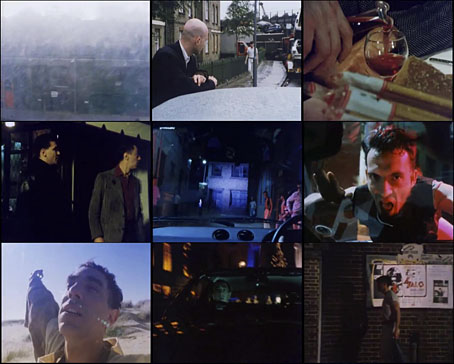
One of Derek Jarman’s many unfilmed projects was PPP in the Garden of Earthly Delights, a study of the last days in the life of director Pier Paolo Pasolini seen through a prism of references to the director’s cinematic work, and also the paintings of Hieronymus Bosch. Jarman’s proposal exists as a synopsis rather than a screenplay, presenting a series of isolated scenes: the film set for the final scene from Salò, or the 120 Days of Sodom (1975); an expensive restaurant; a street at night where Pasolini is cruising for sex; a cheap restaurant; a petrol station; an area of waste ground where Pasolini is killed by the rent boy he’s picked up. The foreground events parallel moments from Pasolini’s life and death, while the background would have featured characters from his earlier films, and various Boschian figures or motifs. The synopsis was printed in the Derek Jarman issue of Afterimage in autumn 1985, and it’s likely that the outline contributed to Julian Cole’s film, Ostia, which was made as a final-year student project a year later.

Ostia is unusual for being a film in which Derek Jarman is the lead actor, although when you see his acting it’s not so surprising that he kept himself out of his own films; Cole says on a commentary track for Ostia that some of Jarman’s performance was so bad it had to be cut. There is the curiosity value of seeing him playing the part of Pasolini, something that Jarman suggested when they were discussing the film.

The title refers to the name of the Tyrrhenian resort near Rome where Pasolini was murdered in November 1975, and the narrative favours the theory that Pasolini wasn’t so much murdered as assassinated by an establishment for whom he was a continual thorn in the side. The unforgettable Salò uses De Sade as a frame to explore the worst period of Italian Fascist brutality at the end of the Second World War. Many of those who were complicit in wartime atrocities were still active in Italian society in 1975, and even without the film’s other excesses they wouldn’t have been impressed by Pasolini’s dwelling on the crimes committed during the period of the Salò Republic, or his allusion to the Marzabotto massacre. Pasolini was also a vocal Marxist, of course (Jarman’s synopsis throws some barbs at this), and heavily critical of the deleterious effects of consumerism on post-war Italian society. The assassination theory carries some weight, in other words, even if the face-value explanation—a rough-trade assignation gone awry—seems just as likely. Philo Bregstein’s documentary, Whoever Says the Truth Shall Die (1981) explores the theory in a roundabout fashion, while Ostia (The Death of Pasolini) (1986) by Coil looks at the tragedy through a symbolic lens. “Kill to keep the world turning.”
ostia2.jpg

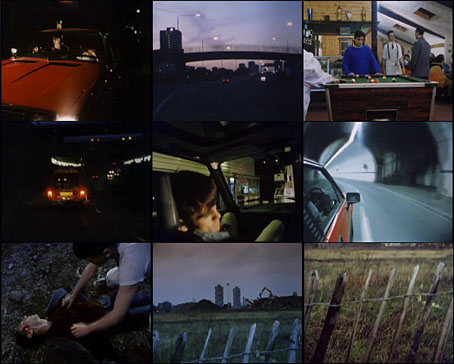
Julian Cole was working with a micro-budget so beyond the token presence of an Alfa Romeo like the one Pasolini drove (and which was driven over him on the beach) there’s no attempt at verisimilitude. All the scenes are shot in London locations circa 1986, and the dour skies of the metropolis are no match for the perfect blue of Italy. Cole’s film can’t help but be less ambitious than Jarman’s project but at least it got made. Viewed today Ostia has an unavoidable melancholy quality; Cole says that Jarman had just been diagnosed with HIV when they were making the film, and he refused to kiss actor David Dipnall because of this; at the time little was known about the infectiousness of the illness. Dipnall himself, in an unrelated chain of circumstances, died of AIDS a few years later. Ostia is also a reminder of how Pasolini’s death has gained a martyr-like quality among a certain group of gay men, making it a kind of cinematic equivalent to the martyrdom of Oscar Wilde 70 years earlier. It can be seen as an extra on the BFI’s Derek DVD or watched here.

Previously on { feuilleton }
Derek Jarman In The Key Of Blue
The Dream Machine
Jarman (all this maddening beauty)
Sebastiane by Derek Jarman
A Journey to Avebury by Derek Jarman
Derek Jarman’s music videos
Derek Jarman’s Neutron
Mister Jarman, Mister Moore and Doctor Dee
The Tempest illustrated
In the Shadow of the Sun by Derek Jarman
Derek Jarman at the Serpentine
The Angelic Conversation
The life and work of Derek Jarman
Salomé: the font

salomefont01.jpg

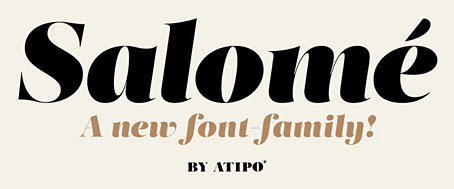
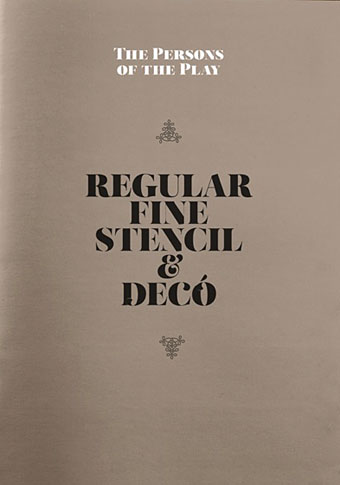
This isn’t the first font that’s been named after Salomé but Salome (without accent) by Rebecca Alaccari and Patrick Griffin was a revival of an earlier design, Cantini, from 1972, whereas Salomé is an original creation by Spanish design studio Atipo. The Atipo design itself owes something to the 1970s being reminiscent of François Boltana’s Stilla (1973), albeit without the eccenticities that make Boltana’s typeface so redolent of the period. Salomé comes in four styles, all of them variations on the extra-bold weights of Didone typefaces.

salomefont02.jpg

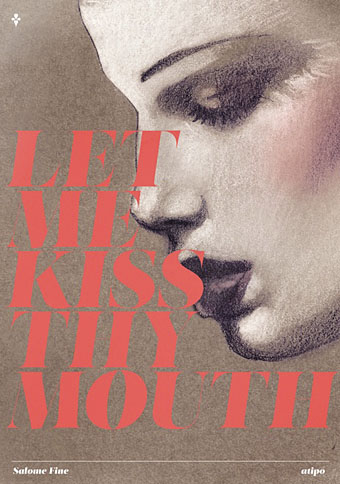
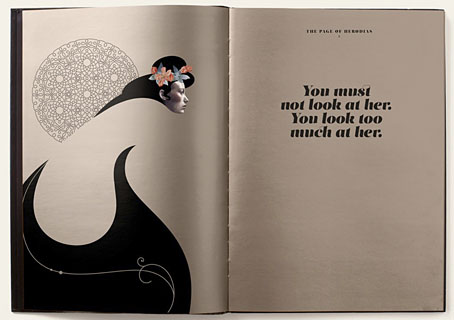
Having a predilection for this look the design appeals to me even without its associations. Atipo add to the attraction by promoting their font family with some gorgeous illustrations juxtaposed against quotes from Oscar Wilde’s play. None of the poster designs or the booklet pages below are credited on the website. The on-screen booklet highlights significant moments from the play with illustrations that manage to be Beardsley-like without going down the pastiche route. This is the way to show off a new font design, it’s just a shame the booklet isn’t available as a pdf. The icing on the cake is that the regular style of Salomé is available for free so long as you help promote it via Twitter or Facebook. The complete family is available for a very reasonable price. Now I have to find something to create that’s worthy of the design.

salomefont03.jpg

salomefont04.jpg

Continue reading “Salomé: the font”

Wildeana 11

wilde1.jpg

The Happy Prince And Other Tales (1888).

Continuing an occasional series. Recent Wildean links.

Jeanette Winterson makes a persuasive case for the importance of Wilde’s stories for children: “Wilde had a streak of prophecy in him. The children’s stories can be read as notes from the future about Wilde’s fate. It is as though the little child in him was trying to warn him of the dangers his adult self would soon face. ‘Every single work of art is the fulfilment of a prophecy’, he writes in De Profundis.”

• At the Morgan Library & Museum: a collection of Wilde’s manuscripts and letters, including the MS of The Selfish Giant, one of the stories discussed in Winterson’s piece.

• At The Smart Set: “Oscar Wilde abandoned journalism and hated fashion – so why is his essay The Philosophy of Dress so important?” asks Nathaniel Popkin.

wilde2.jpg

The Pictures of Sappho from The Woman’s World.

• Wilde’s The Philosophy of Dress led to his being asked to edit The Lady’s World in 1887, a magazine he promptly renamed The Woman’s World. He was editor for two years. A collected run of the magazine may be browsed here.

Elsewhere on { feuilleton }
The Oscar Wilde archive