The Importance of Being Oscar

macliammoir1.jpg

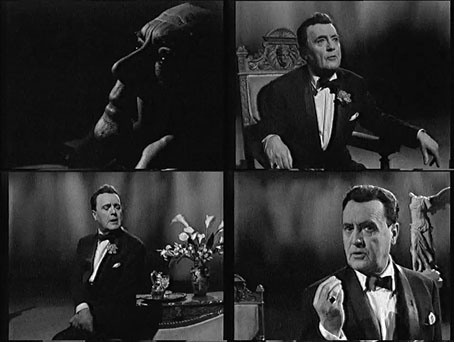
Picking up where we left off, I was thrilled to find that Micheál MacLiammóir’s one-man dramatised biography of Oscar Wilde had finally made it to YouTube. The Importance of Being Oscar was MacLiammóir’s 100-minute magnum opus, an acclaimed condensation of Wilde’s life and work first performed at the Gate Theatre, Dublin, in 1960. Hilton Edwards produced for partner MacLiammóir who subsequently took his show around the world, including performances on Broadway.

MacLiammóir’s monologue interleaves sketches of Wilde’s life with substantial extracts from the major works—An Ideal Husband, The Picture of Dorian Gray, The Importance of Being Earnest, De Profundis, and The Ballad of Reading Gaol—with the actor/writer often taking two roles in the same scene. The readings are deeply felt; this would have been a very personal project, not only for its subject being a fellow Irishman and playwright but also for MacLiammóir and Edwards’ status as gay men in Ireland at a time when they could never be open about their private lives. (Or openly secretive: Barbara Leaming’s biography of Orson Welles makes it clear that iniquitous laws did nothing to stifle the pair in their pursuit of other men.) Accounts of Wilde’s post-trial life are inevitably sombre but MacLiammóir notes that even prison couldn’t suppress Wilde’s sense of humour. A literary conversation with one of the warders is recounted, along with the famous barb thrown at Marie Corelli: “Now don’t think I’ve anything against her moral character, but from the way she writes she ought to be in here.” If MacLiammóir’s performance seems a little overwrought in the television studio it would have appeared less so on the stage.
macliammoir2.jpg

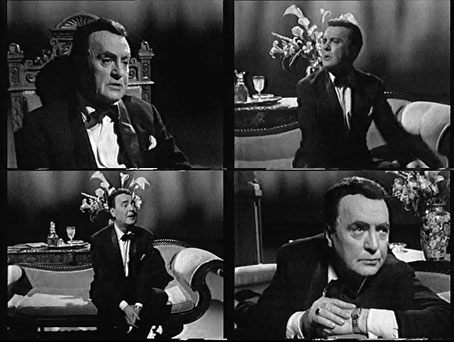
The BBC filmed The Importance of Being Oscar in the mid-60s, and I think that recording may be the one linked here, a version I recall being shown during an evening of Wilde-related TV in the late 1980s. Prior to this MacLiammóir had played Wilde himself for a televised dramatisation of the courtroom appearances broadcast by the BBC in 1960. This was a key year for reappraisals of Wilde’s reputation which also saw the cinema release of Oscar Wilde (with Robert Morley) and The Trials of Oscar Wilde (with Peter Finch). The latter is the superior film and performance even if Finch looks nothing like Wilde. Public attitudes were changing but all the films and TV plays at this time remained evasive about the precise nature of Wilde’s infractions. The Importance of Being Oscar follows this pattern with a fade to black after Wilde’s arrest; the second act opens with MacLiammóir as the judge passing sentence on Wilde and procurer Alfred Taylor. Circumspection doesn’t detract from the power of the monologue which has been revived in recent years, most notably by Simon Callow, another great Wilde enthusiast and also the biographer of MacLiammóir’s young protégé, Orson Welles.

Now that MacLiammóir’s monologue has resurfaced I’ll be hoping someone uploads John Hawkesworth’s Oscar (1985), a three-part television biography with Michael Gambon playing Wilde.

Elsewhere on { feuilleton }
The Oscar Wilde archive

Return to Glennascaul, a film by Hilton Edwards

glennascaul.jpg

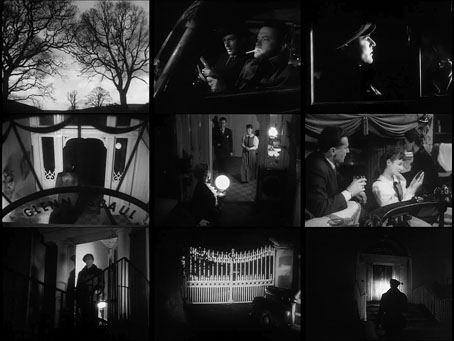
Another return, and another short ghost story. Return to Glennascaul (1951) has been presented at times as Orson Welles’ Ghost Story even though it was written and directed by Welles’ friend, Hilton Edwards. Welles is the narrator, and plays himself in the framing section. The story is a version of the old “Vanishing Hitchhiker” urban legend reworked as “a story that is told in Dublin”. What’s most interesting for Welles enthusiasts is that the film reunited Orson with both Hilton Edwards and Micheál MacLiammóir, the directors of Dublin’s Gate Theatre who gave Welles his professional theatre debut at the age of 16. The young Welles had been a keen actor and director of his school’s drama productions so while hiking through Ireland one summer he turned up at the Gate Theatre smoking a cigar and declared himself ready for any leading roles they might have. Edwards and MacLiammóir were amused by his audacity so they took him on. Return to Glennascaul was an opportunistic byproduct of Welles’ film production of Othello (alluded to in the opening scene) for which MacLiammóir had been cast in the role of Iago. MacLiammóir published a very entertaining diary account of the making of the film, Put Money in Thy Purse in 1952. He’s also named as co-producer of Return to Glennascaul which may be watched here.

As usual { feuilleton } will be taking a break for a few days so the archive feature will be summoning posts from the past. Have a good one, and mind how you go.

Weekend links 239

crystal.jpg

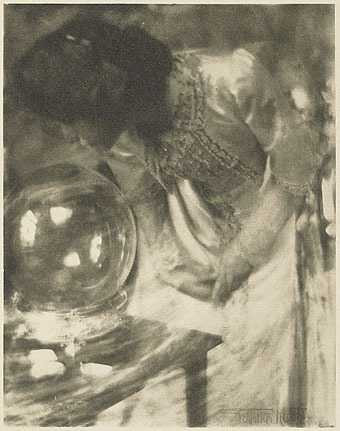
The Crystal Gazer (or The Magic Crystal, 1904) by Gertrude Käsebier.

• “I had to resort to extreme violence”: how Hipgnosis revolutionised the album sleeve. Aubrey Powell, last surviving member of the design team, talks to Joe Muggs.

• Mixes of the week: Radio Belbury: Programme 14; The Conjurer’s Hexmas by SeraphicManta; Secret Mix 139 by A Closer Listen.

• Social progress, high-speed transport and electricity everywhere: Iwan Rhys Morus on how the Victorians invented the future.

• At Cinephilia & Beyond: “The most complete investigation into the origins and making of Citizen Kane.”

Poor Souls’ Light: seven curious tales for the end of the year, and a dedication to Robert Aickman.

• Music and the Occult: Stuart Maconie and Rob Young spend an hour in the magick circle.

Alejandro Jodorowsky and Iain Sinclair in conversation at the British Library, July 2014.

• From 1972: An unpublished Victor Moscoso interview by Patrick Rosenkranz.

The Spooky Story Behind Hollywood’s Favourite Mansion.

The Lost World of British Tape Recording Clubs.

• 2014 was a year of outrage.

Wyrd Daze issue 11

Inspirograph

• Pepper-Tree (1984) by Cocteau Twins | Otterley (1984) by Cocteau Twins | Aikea-Guinea (1985) by Cocteau Twins

The Nose, a film by Alexandre Alexeieff & Claire Parker

nose.jpg

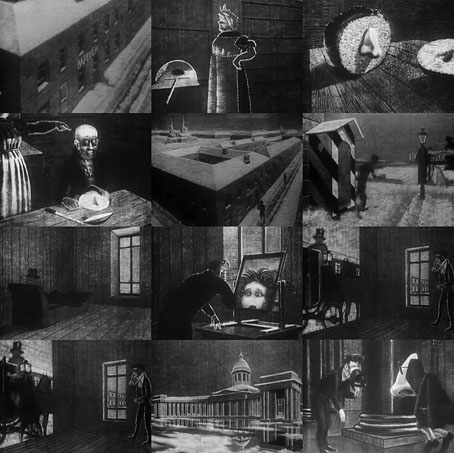
The last time I wrote about the animated films of Alexandre Alexeieff & Claire Parker the only copies available were low-grade things on YouTube which have long-since vanished (one of many reasons I don’t embed YT players in these posts). Happily a new copy of The Nose (1963) has appeared that’s not only better quality but isn’t split into two as was the case earlier.

The Nose is based on the Gogol story of the same name, a tale of a St Petersburg official who wakes to find his nose has left his face and is masquerading as a civil servant. I’ve not read Gogol’s story but I do have Nabokov’s book about Gogol which dwells not only on the prominent nose of the author, but also his traumatic death which was hastened in part by a quack physician who treated Gogol by applying leeches to his nose. Neither story or film contain anything as horrific. The film version is a wordless animation made using the pinscreen technique which Alexeieff & Parker developed in order to create greyscale animated films without recourse to smudgy materials like pencil, pastel, charcoal, etc. As I’ve mentioned before, the most notable application of this technique is the prologue the pair created for Orson Welles’ film of The Trial (1962). What’s striking about the Alexeieff & Parker use of the pinscreen is how skilfully they use it to manipulate light and shade. Where other animators like Jacques Drouin used the technique more impressionistically, Alexeieff & Parker’s films at times give the impression of watching an animated engraving. The Nose is one of their finest pieces. (Thanks to Gabe for the tip!)

Previously on { feuilleton }
Alexandre Alexeieff and Claire Parker

Weekend links 194

roberts.jpg

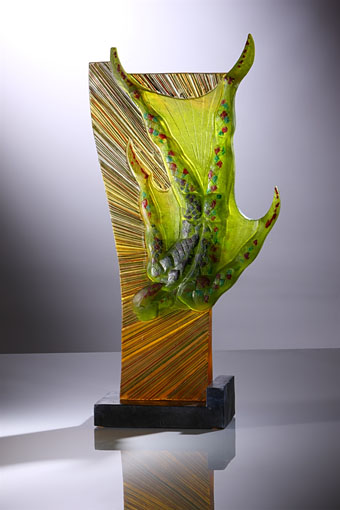
Untitled glass sculpture by Richard Roberts.

Lord Horror: Reverbstorm, my collaboration with David Britton, makes The Quietus list of Literary Highlights of 2013. At the same site there’s Russell Cuzner talking to English Heretic. “His methodology takes in magick, psychogeography and horror film geekdom, along with firm roots in Britain’s industrial music culture of the early 1980s, to form potent, novel topographies of an otherwise unconnected world of occultists and psychopaths.”

• A slew of London links this week: Geoff Manaugh on how the capital was redesigned to survive wartime blackouts, a piece which inadvertently explains why you see so much black-and-white street furniture in post-war films | Bob Mazzer’s photos of the London Underground in the 1970s and 1980s | Philipp Ebeling’s photos of the capital and its inhabitants today.

• “Science has become an international bully. Nowhere is its bullying more outrageous than in its assault on the phenomenon known as subjectivity.” David Gelernter on “The Closing of the Scientific Mind”. Related: “When Science Becomes Scientism” by Stanislav Grof.

• My favourite book about Orson Welles is This is Orson Welles (1992), a collection of Peter Bogdanovich’s interviews with Welles edited by Jonathan Rosenbaum. Bogdanovich’s interview tapes can now be heard at the Internet Archive.

• Brian Dillon on Dada collagist Hannah Höch who he calls “art’s original punk”, and Sean O’Hagan talking to another collage artist, Linder Sterling, who says “Lady Gaga didn’t acknowledge I wore a meat dress first”.

• One Hundred Years Of Weird Fear: Daniel José Older on HP Lovecraft’s literature of genealogical terror. More fear (and Lovecraft): Will Wiles on the growth of Creepypasta.

The Last Alan Moore Interview? A lengthy discussion with Pádraig Ó Méalóid. Shunning interviews hasn’t done Cormac McCarthy any harm so if I was Alan I wouldn’t worry.

• And speaking of Cormac McCarthy, the headline of the week: “Cormac McCarthy’s ex-wife busted after pulling gun from vagina during alien argument“.

• Where the bodies are buried: Mick Brown presents a potted biography of Kenneth Anger who offers a few reluctant quotes.

• A short animation for gore-obsessed kids: Pingu’s The Thing by Lee Hardcastle.

Helen Yentus designs a 3D-printed slipcase for a novel by Chang-rae Lee.

Ralph Steadman‘s illustrations for Alice’s Adventures in Wonderland.

• Mix of the week: Secret Thirteen Mix 103 by Lustmord.

Collage art at Pinterest.

No Escape (1966) by The Seeds | Pushin’ Too Hard (1966) by The Seeds | No Escape (1979) by Cabaret Voltaire | Pushin’ Too Hard (1982) by Paul Parker