Michael Powell’s Bluebeard revisited

powell1.jpg

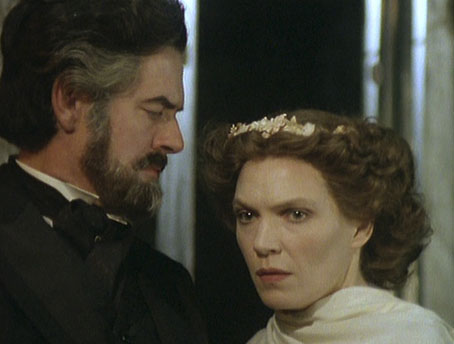
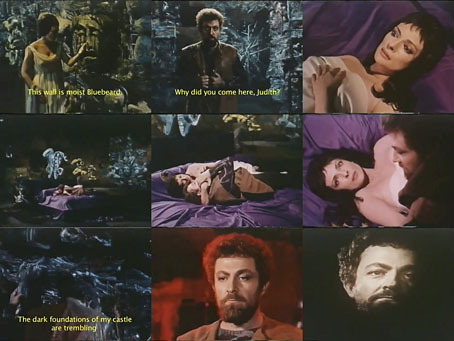
Yesterday’s post prompted me to look again for one of Michael Powell’s scarcest films, his television version of Bartók’s Bluebeard’s Castle made for  Süddeutscher Rundfunk in 1963. Sure enough, it’s now on YouTube in a watchable copy taken from VHS tape. Herzog Blaubarts Burg (to use its German title) was made post-Peeping Tom when the director’s career was at its lowest ebb, and while the production values don’t match those he’d been used to in the 1940s he was no doubt happy to be working at all after being vilified by the UK press. Norman Foster is Bluebeard and Ana Raquel Satre plays Judith, with the libretto being a German translation with English subtitles. I ought to note here that I’ve not read the second volume of Powell’s biography (mea culpa) so the only information I have about this comes from Ian Christie’s Arrows of Desire: The Films of Michael Powell and Emeric Pressburger (1985). Christie doesn’t have much to say about it other than pointing out that Norman Foster financed the film, and that it’s seldom been screened in Britain: IMDB has the first UK screening as 1978, just prior to the time when Powell and Pressburger began to receive to some belated recognition.
powell2.jpg

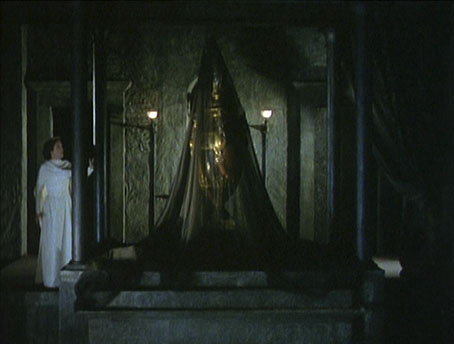
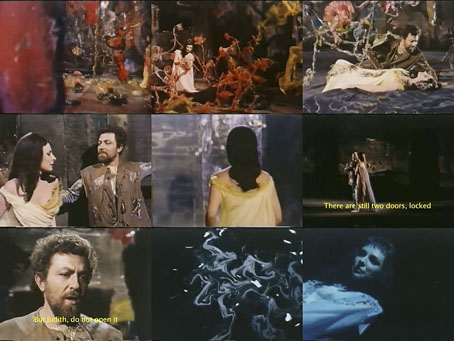
The YouTube copy suffers in the sound department by being a muffled mono transmission but it’s the visuals which will be of most interest to Powell aficionados. Powell & Pressburger’s regular production designer Hein Heckroth created the multi-coloured labyrinth which serves as the castle. The overall effect is stagey but contains some unique details, such as the rune-etched standing stones shown at the opening and close, and also some painted moments similar to those seen during the celebrated dance sequence in The Red Shoes (1948). Powell’s staging is much more vivid and artificial than Leslie Megahey’s 1988 adaptation whose Gothic gloom remains a personal favourite. Despite its shortcomings, when compared to the other Powell films that came after—the two Australian features, the Children’s Film Foundation commission which reunited him with Pressburger—this is far closer to the greatest works of the Archers era, and provides a more satisfying career coda for the man who directed The Red Shoes and The Tales of Hoffmann.

Previously on { feuilleton }
Joseph Southall’s Bluebeard
Leslie Megahey’s Bluebeard
Powell’s Bluebeard
The Tale of Giulietta

Long Live the New Flesh: The Films of David Cronenberg

cronenberg.jpg

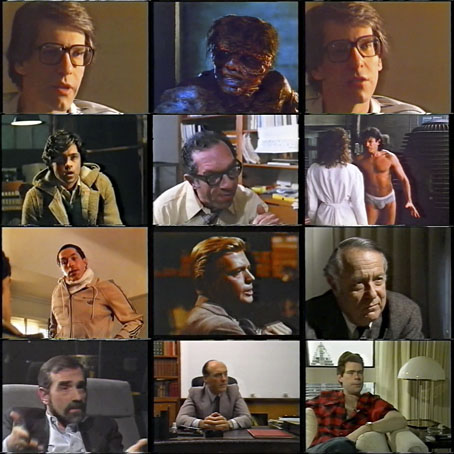
I used to have this documentary on tape but it vanished years ago so it’s good to find it again on YouTube. Long Live the New Flesh: The Films of David Cronenberg was directed by Laurens C. Postma and broadcast on British television in 1987 as a tie-in with the UK release of Cronenberg’s The Fly. The writer was Chris Rodley who subsequently directed some equally good documentaries of his own including the South Bank Show feature about the making of Naked Lunch (now present as an extra on the Naked Lunch DVD), A Very British Psycho about Michael Powell’s Peeping Tom (clips of which can be found in this film), and Donald Cammell: The Ultimate Performance.

Postma’s film captures Cronenberg when he was starting to gain visibility outside the science fiction and horror genres he’d mostly been working in up to this point. Among the interviewees are Martin Scorsese, an early champion, and Stephen King, whose The Dead Zone Cronenberg adapted in 1983. In the critical corner there’s the late film critic Robin Wood who the producers possibly chose on account of his being the voice of dissent in Piers Handling’s 1983 study of Cronenberg’s films The Shape of Rage. Wood isn’t as tiresomely ideological here as he is in Handling’s book (where you can play a drinking game if you count the times he uses the phrase “bourgeois patriarchal capitalism”) but he still seemed to find something reactionary and “unprogressive” (in a political sense) about Cronenberg’s work. Elsewhere there are clips of the films from Shivers on, and I’d forgotten about the comparisons Rodley and Postma make between Cronenberg’s work and Michael Powell’s still astonishing Peeping Tom.

Long Live the New Flesh is 67 minutes long and unfortunately chopped into chunks on the YouTube copy. Watch it here:

Part 1 | part 2 | part 3 | part 4 | part 5 | part 6 | part 7

Devils debris

devils.jpg

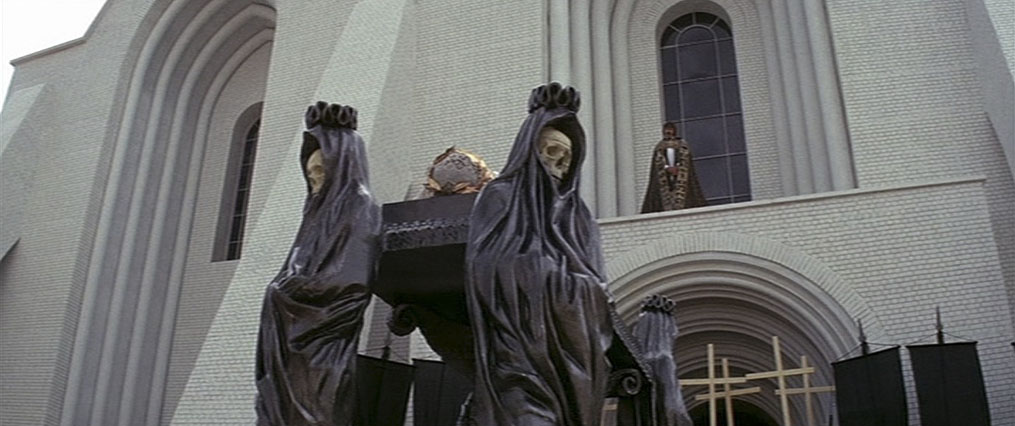
The Devils (1971).

There is only one English feature director whose work is in the first rank. Michael Powell is the only director to make a clear political analysis in his films, his work is unequalled. The Life and Death of Colonel Blimp is the finest English feature, and A Canterbury Tale and A Matter of Life and Death are not far behind. When he made these films he was heavily criticized for his treatment of serious themes. Blimp was banned by Churchill and remained in a savaged version for nearly forty years, a plea for tolerance and regard for the enemy as human made at the height of the war there is no more courageous English film. It is a tragedy he has made so few films in the last twenty years, none in the last ten, and a lasting condemnation of all those who make films. He was a major casualty of the spurious social realism of the sixties, whose practitioners have grown fat and invaded the media with their well-scrubbed minds.

Thus Derek Jarman writing in 1980. Ian Christie quoted Jarman’s sentiments in Arrows of Desire: the films of Michael Powell and Emeric Pressburger (1985), pointing to the shared attitudes of the two directors, especially their outsider stance. There were other correspondences: both maintained an abiding interest in the artistic scope of cinema; both were marginalised by the British film world during their lives then lauded after their deaths. Michael Powell for years attempted to produce a film of The Tempest; Derek Jarman, of course, succeeded.

return1.jpg

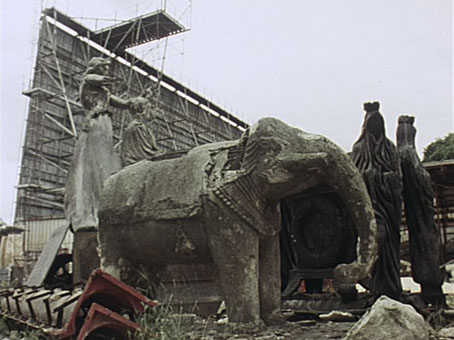
Return to the Edge of the World (1978).

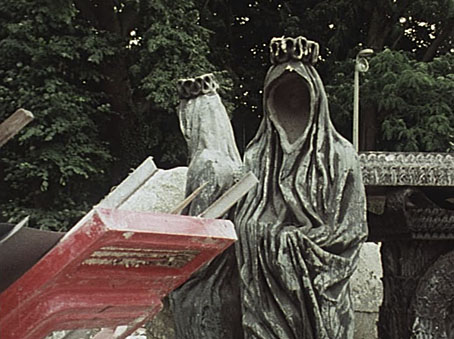
Then there’s this odd coincidence from Return to the Edge of the World, a short documentary made in 1978 in which Powell and actor John Laurie returned to the Scottish island of Foula where they’d made Powell’s first feature film, The Edge of the World in 1937. The film opens with shots of Pinewood studios and the very first things we see are this pair of abandoned statues which anyone who’s seen Ken Russell’s The Devils will recognise from an early scene. Derek Jarman was the production designer on The Devils so these would have been created according to his instruction. I only noticed this recently when watching Return to the Edge of the World again as it’s now an extra on the BFI DVD of Edge of the World. No need to dwell on the inadvertent symbolism of abandoned statues and languishing careers.

Powell and Pressburger’s marvellous The Life and Death of Colonel Blimp was reissued recently. John Patterson discussing its writer and director tells us why the most English of movies often benefit from an outsider’s perspective.

return2.jpg

Previously on { feuilleton }
Rex Ingram’s The Magician
The Devils on DVD
Derek Jarman’s music videos
Derek Jarman’s Neutron
Mister Jarman, Mister Moore and Doctor Dee
Powell’s Bluebeard
The Tale of Giulietta
The Tempest illustrated
In the Shadow of the Sun by Derek Jarman
The Angelic Conversation
The life and work of Derek Jarman

Rex Ingram’s The Magician

magician1.jpg

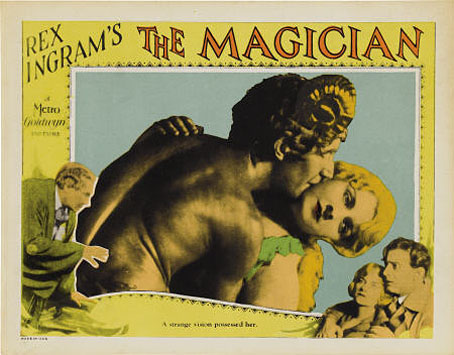
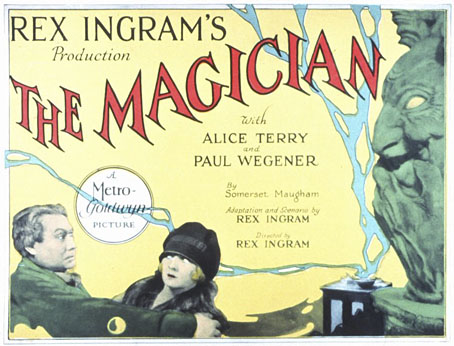
The Magician (1926), Rex Ingram’s curious occult horror film, receives a rare screening with live music accompaniment at the Brighton Fringe Festival on Tuesday, 22nd May. The film is notable for being based on the 1908 Somerset Maugham novel of the same name whose modern-day magus character, Oliver Haddo, was modelled on Aleister Crowley. The screening will feature an introduction by Gary Lachman, and a live soundtrack by the fabulous Ragged Ragtime Band, featuring members of Blondie, Indigo Octagon, Raagnagrok and Time. Booking details and other information here.

magician2.jpg

Maugham’s book has always been easier to find than Ingram’s film, more’s the pity when the film—despite some flaws—is the superior article. Read today, the novel comes across as a template for the standard Dennis Wheatley tale of middle-class innocents imperilled by grandiloquent villainy. A young couple, Arthur Burdon and his fiancée, Margaret, are pitted against Haddo’s extravagant diabolisms; for assistance they have a friend, Dr Porhoët, a Van Helsing type, older than the couple and with a convenient (but purely intellectual) interest in the occult. Haddo kidnaps Margaret and forces her with hypnosis into an unconsummated marriage. Haddo’s goal is to create artificial life—homunculi—and for that he requires a virgin’s blood. Maugham later described his novel as “lush and turgid”, an honest and accurate appraisal. Aleister Crowley was amused at being portrayed as a “Brother of the Shadows” but pretended to be scandalised by Maugham’s alleged plagiarism which he condemned in a Vanity Fair review that he signed “Oliver Haddo”. The best parts of the novel certainly owe something to other authors, usually the scenes concerning the sinister magus and his occult activities; the rest of the characters are lifeless by comparison. Some of the better passages read like HP Lovecraft writing Dorian Gray, and Maugham not only quotes from Walter Pater but also (uncredited) from Wilde’s Salomé.

magician4.jpg

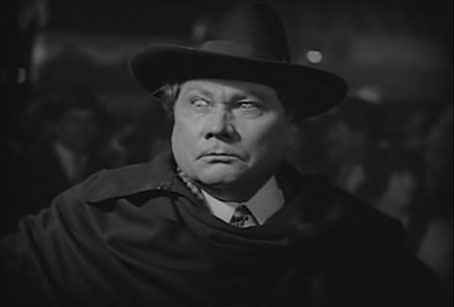
Paul Wegener as Oliver Haddo.

Continue reading “Rex Ingram’s The Magician”

Leslie Megahey’s Bluebeard

bluebeard01.jpg

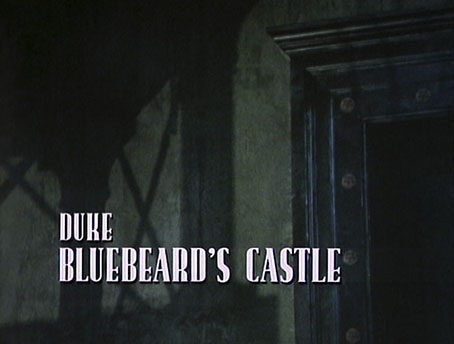
Back in the days when the BBC’s television output challenged its audience rather than pandered to it, Leslie Megahey was a name I always looked out for. During the 1970s and 80s, Megahey was one of the corporation’s outstanding producers and directors, and since his tastes often ran very close to mine seeing his name in a magazine listing was an alert for some essential viewing. Favourite Megahey documentaries would include his Omnibus film about (and interview with) György Ligeti in 1976, and the two-part Arena special about Orson Welles in 1982 that persuaded the director to talk at length for the first time about his career. Megahey’s arts films included drama documentaries about the French painters David and Gericault, and two dramas with painting themes, Cariani and the Courtesans (1987), and Schalcken the Painter (1979), the latter being an exceptional adaptation of the Sheridan Le Fanu ghost story. Duke Bluebeard’s Castle was one of the last of his BBC films, an adaptation of the Bartók opera that had this Bartók obsessive hopping with delight when it was screened in 1988.

bluebeard02.jpg

Bluebeard and Judith.

Bartók’s only opera was written in 1911, and is easier to adapt than most, being a single act of an hour or so in length with only two performers, Bluebeard (bass) and Judith (soprano). Given this it’s surprising there haven’t been more filmed versions. I wrote something a while back about the seldom-seen Michael Powell version; then there’s a version from 1981 by Miklos Szinetár scored by the London Philharmonic Orchestra with Georg Solti conducting. Megahey’s film also features the London Philharmonic with Adam Fischer conducting. Robert Lloyd and Elizabeth Laurence are the performers.

bluebeard03.jpg

The libretto by Béla Balázs turns the old fairy tale into a psychodrama that’s also one of the first post-Freud operas, with the audience being asked in the prologue “Where is the stage? Is it outside, or inside?” Judith is ushered into the castle by Bluebeard to find seven locked doors: her curiosity and her demands to discover what lies behind the doors (or inside the mind of her husband-to-be) seals her fate. In some of the fairy tale versions the brothers of the bride arrive at the last moment to rescue their sister; not so here.

Continue reading “Leslie Megahey’s Bluebeard”