Weekend links 672

heilbronn.jpg

Le Vice Errant (1902) by Vincent Lorant-Heilbronn.

• “So however surreal those cities, the invisible ones that he builds, they have their counterpart in the real. They always have their counterpart in visible cities.” Darran Anderson on Italo Calvino’s Invisible Cities.

• At Wormwoodiana: Mark Valentine on the centenary of The Riddle and Other Stories by Walter de la Mare, with special attention paid to The Vats, a very strange story.

• New music: A Bad Attitude by African Head Charge; Lapsed Gasps by Push For Night + Jon Mueller; Forevervoiceless by Brian Eno.

The strands of medicine, consciousness expansion, intoxication, addiction, and crime were tightly entangled in fin-de-siècle Paris, where ether and chloroform circulated among bohemian demi-mondaines alongside morphine, opium, cocaine, hashish, and wormwood-infused absinthe. These solvents were often carried in small glass vials and medicine bottles by the asthmatic, tubercular, and neurasthenic, added to patent tonics and syrups, and, on occasion, to cocktails: an ether-soaked strawberry floating in champagne produced a heady rush, the fruit preventing the volatile liquid from evaporating too quickly. Literary references to ether abounded, either as a signifier of decadence or as a literary prop to shift a realistic narrative into the landscape of dreams and symbols, where its dissociative qualities became a portal to strange mental states, psychological hauntings, uncanny doublings, and slippages of space and time.

Mike Jay on Jean Lorrain and the ether dreams of fin-de-siècle Paris

• At Aquarium Drunkard: Jim Jarmusch and Carter Logan talk about the recording of Silver Haze, their first album as Sqürl.

James Balmont offers a beginner’s guide to the films of Dario Argento.

• At Unquiet Things: Rachael Bridge’s Luminous, Technicolor Shadows.

• Mix of the week: A mix for The Wire by Erika.

Ether Ships (1978) by Steve Hillage | Ether (1998) by Redshift | Ether (2000) by Coil

Weekend links 654

crm.jpg

Drawing for a New Year’s Card (c. 1900) by Charles Rennie Mackintosh.

• “Almanacs appealed to the perennial lust for wonder and weirdness in the world. They were the fantastic literature of the day.” Mark Valentine on English Almanacs 1500–1800. Reading this had me wondering whether Old Moore’s Almanac is still being published. Yes, it is.

• “Meet the designer of the fanciful subway entrances to the Paris Métro.” Susannah Gardiner on the architecture, design and anarchist philosophy of Hector Guimard.

• “Apocalypse is not alien to HR Giger,” says Steven Heller, reviewing Atomkinder, a book of the artist’s early cartoons for which he also provided an introduction.

• “Nabokov loved film, hopelessly.” Luke Parker on a short poem, The Cinema (1928), from Vladimir Nabokov’s Berlin years.

• From Loki to Behemoth: waves of the English coastline photographed by Rachael Talibart.

• Mix of the week: Winter Solstice 4: “In C” by ambientblog.

• At Dennis Cooper’s: Grace Zabriskie Day.

Atom Sounds (1978) by Jackie Mittoo | Atom Blaster (1985) by Vangelis | Atomic Buddha (1998) by Techno Animal

Weekend links 649

chihuly.jpg

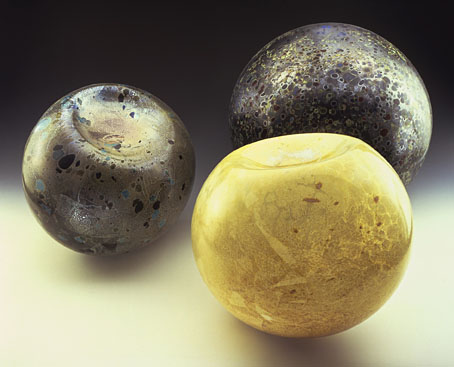
Niijima Floats: Mottled Blue Black Float with Silver Leaf (1991) by Dale Chihuly.

• “Blue whale songs fall below the range of human hearing. If you want to listen to one, to actually hear its ethereal patterns of wobbly pulses and haunting moans, you have to speed it up by at least two-fold. But according to Hildebrand and McDonald’s instruments, the tonal frequencies of the songs had been sinking to even greater depths for three straight years. ‘This is weird,’ Hildebrand thought. To figure out if it was just an anomaly or something more, Hildebrand and McDonald embarked on a quest to find some really old songs. Eventually they got their hands on some of the earliest known recordings, created by the Navy in the 1960s and stored on analog cassettes. They were floored. The frequencies had declined by 30 percent over 40 years.” Kristen French on a mysterious development in blue whale songs.

• “She didn’t see it as a game, or for divination, but as a model of the universe.” Joanna Moorhead on the Tarot designs of Leonora Carrington.

• “A collection of blogs about every topic”: ooh.directory. (Ta to whoever added this place to the list.)

• New music: Pop Ambient 2023 by Various Artists, and Aeolian Mixtape by Quinta.

• At Public Domain Review: The Tanzmasken of Lavinia Schulz and Walter Holdt.

• At Wormwoodiana: Mark Valentine on mazes and labyrinths. (Previously)

• At Spoon & Tamago: Paper-cut cityscapes by kirie artist Hiroki Saito.

• At Smithsonian Magazine: The Unrivaled Legacy of Dale Chihuly.

• Mix of the week: Neo-Medieval Mix by Moon Wiring Club.

• Old music: Back To The Woodlands by Ernest Hood.

• At Dennis Cooper’s: Jacques Rivette Day.

Weyes Blood’s favourite music.

(Gorgeous Curves Lovely Fragments Labyrinthed On Occasions Entwined Charms, A Few Stories At Any Longer Sworn To Gathered From A Guileless Angel And The Hilt Edges Of Old Hearts, If They Do In The Guilt Of Deep Despondency.) (2004) by Akira Rabelais | The Private Labyrinth (2008) by The Wounded Kings | Labyrinths (2018) by Jonathan Fitoussi & Clemens Hourrière

Weekend links 644

binnie.jpg

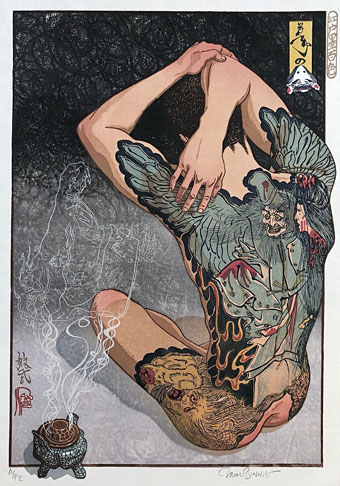
Yoshitoshi’s Ghosts (2004) by Paul Binnie.

• “The later Grand Etteilla series, printed well into the nineteenth century, and the present-day proliferation of Tarot decks, following ephemeral fads and fashions, all trace their origins to this beautiful and beguiling creation from the enigmatic Egyptophile at 48 Rue de L’Oseille.” Kevin Dann on the Livre de Thot Tarot (ca. 1789) by Jean-Baptiste Alliette, better known as “Etteilla”.

• “Death is not a subject he has ever shied away from, in his fiction or conversation. Indeed, he has measured other writers by how seriously they address it.” Richard B. Woodward on his friend, Cormac McCarthy, and McCarthy’s new novels. There’s an exclusive extract from The Passenger here.

• “…addicts, psychopaths, lovelorn outsiders, cult leaders, lesbian and gay icons…you name it, the vampire has become it.” Christopher Frayling on the perennial popularity of the vampire, and a new book collection of vampire film posters.

Robert Wilson‘s new production of Ubu Roi by Alfred Jarry is “a sinister, multilingual pantomime bathed in red light and looped in noise…fittingly violent, absurd, ominous and infantile”.

• “What kind of music goes with a show that originates in deep space?” Aquarium Drunkard on Sonny Sharrock’s final recordings, the soundtrack music for Space Ghost Coast To Coast.

• At Wormwoodiana: Mark Valentine takes a fresh look at the health of secondhand bookshops in Britain.

• Tokyo nightlife photographed by Hosokawa Ryohei.

• New music: Approach by Lawrence English.

The Passenger (1977) by Iggy Pop | The Passenger (1987) by Siouxsie And The Banshees | The Passenger (1997) by Lunachicks

Weekend links 642

wheel.jpg

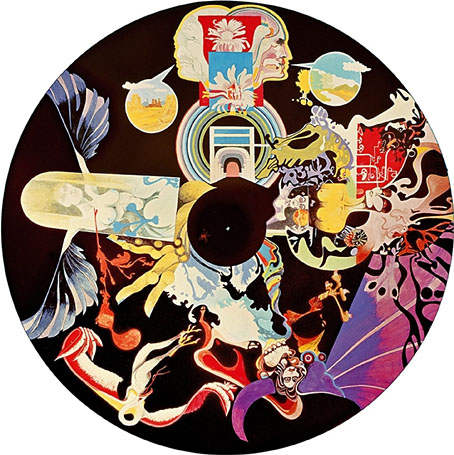
A light wheel. Via.

• “Part of the instrument’s draw is its fallibility. Famously, or perhaps infamously, every Rhodes is different: some freakishly responsive, some with keys that stick like glue, and all with uneven registers, darker corners, and sweet spots.” Hugh Morris on the delicate art of reinventing the Fender Rhodes.

Rambalac’s YouTube channel of first-person walks through Japanese locations is a vicarious pleasure, especially on a big screen. It’s not all city streets but if you like urban meandering then Tokyo walk from day to rainy night – Higashi-Ikebukuro, Mejiro, Ikebukuro is a good place to start.

• At Igloomag: Chang Terhune interviews Stephen Mallinder in a gratifyingly lengthy piece which covers Mallinder’s recent solo recordings and collaborations, his work with students on his sound-art course, and (unavoidably) the late Richard H. Kirk and Cabaret Voltaire.

What I think might be a useful approach—perhaps impractical, but bear me out—I think that if we were to reconnect magic and art as a starting point, because they’re practically the same thing anyway, make art the product of your magical experiments, the way that Austin Spare did for example, then that would give magic an enormous sense of purpose and I think it would also lend art the vision that it seems to be lacking at present. A lot of modern art seems rather empty and hollow conceptualism that lacks any real vision or substance or power. A linking of magic and art would help both of those fields. Then, once you’ve done that, maybe linking art and science. There’s plenty of work already done in that regard.

Alan Moore talking to Miles Ellingham about the usual concerns plus his new story collection, Illuminations

Wheels of Light: Designs for British Light Shows 1970–1990 is a book by Kevin Foakes (aka DJ Food) which will be published later this month by Four Corners Books. The author talks about his book here.

• “The Sandjak of Novi Pazar always sounded as if it were a title, like the Sultan of Zanzibar or the Dame of Sark…” Mark Valentine on discovering outdated maps in forgotten books.

• “My brief was to find tracks that had been left by the wayside or disregarded.” Lenny Kaye on 50 years of his influential garage-rock compilation Nuggets.

• Mixes of the week: XLR8R Podcast 768 by Lawrence English, and King Scratch (Musical Masterpieces from the Upsetter Ark-ive) by Aquarium Drunkard.

• At Dennis Cooper’s: Spotlight on Shirley Jackson The Haunting of Hill House (1959).

• Steven Heller’s font of the month is Slag.

• This Wheel’s On Fire (1968) by Julie Driscoll, Brian Auger & The Trinity | Cosmic Wheels (1973) by Donovan | Wheels On Fire (1985) by Haruomi Hosono