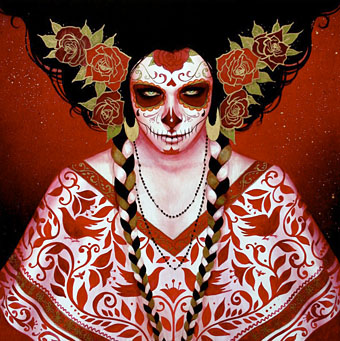
Weekend links 32

ji1.jpg

Red Quechquemitls (2010) by Sylvia Ji.

• The Blackout Mix, a pay-what-thou-wilt 49-minute mixtape, “specially designed to accompany (or simulate) a human-plant interaction”. Art by Arik Roper, music selection by Jay Babcock.

An ode to the many evolved virtues of human semen: “the penis is capable of dispensing a sort of natural Prozac” says Jesse Bering.

• The new John Foxx CD & DVD release, D.N.A., has a Jonathan Barnbrook cover, a new collaboration with Harold Budd and a disc of short films.

• “I have been copying Margaret Hamilton my whole life, and I am proud to admit it. The Wicked Witch of the West, the jolie laide heroine of every bad little boy’s and girl’s dream of notoriety and style, whose twelve minutes of screen time in The Wizard of Oz can never be topped … I’m a big butch-lesbian hag. I love the ones with chips on their shoulders and heavy attitude. They’re my real favorites.” John Waters always gives great interviews.

• Listen to a track from the forthcoming Brian Eno album while you’re reading Kristine McKenna’s interview with the man himself at Arthur mag. Includes an appreciation by Alan Moore.
ji2.jpg

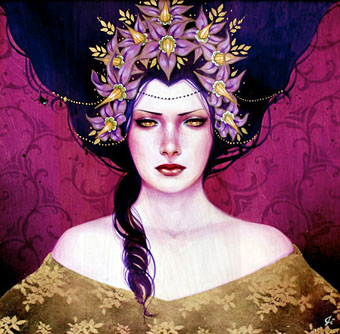
Atropa Bella Donna (2009) by Sylvia Ji.

• Steven Severin is touring the UK this month, performing a live accompaniment to screenings of Jean Cocteau’s The Blood of a Poet. He’s at the Tyneside Cinema this Tuesday. Other dates can be found on his website.

• “I know it’s a very emotive subject and you’re either for it or against it but for a jobbing self-employed musician such as me – bootlegging (CD copying) is just killing us.” Finding The Spaces Between: musician Chris Carter (Throbbing Gristle, Chris & Cosey, et al) interviewed.

Mile End Pugatorio (1991), a one-minute film-poem by Guy Sherwin and Martin Doyle. Related: four one-minute movies by The Residents.

• Gijs Van Vaerenbergh installed an Upside Dome at the St. Michiel Church in Leuven, Belgium.

• Sidney Sime illustrates Lord Dunsany at Golden Age Comic Book Stories.

Europe according to gay men. There’s more at Mapping Stereotypes.

• There’s never a dull moment in the High Desert.

• Generative art by Leonardo Solas.
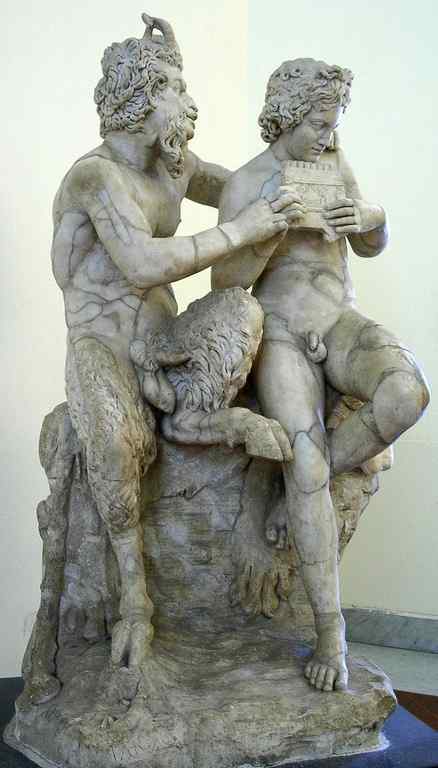
The Great God Pan

pan_daphnis.jpg

Pan teaching Daphnis to play the panpipes; Roman copy of a Greek original from the 3rd-2nd centuries BCE by Heliodoros.

“The worship of Pan never has died out,” said Mortimer. “Other newer gods have drawn aside his votaries from time to time, but he is the Nature-God to whom all must come back at last. He has been called the Father of all the Gods, but most of his children have been stillborn.”

So says a character in The Music on the Hill, one of the slightly more serious stories from Saki’s The Chronicles of Clovis (1911). Saki’s Pan is a youthful spirit closer to a faun than the goatish creature of legend. But being a gay writer whose tales regularly feature naked young men (surprisingly so, given the time they were written) I’m sure Saki would have appreciated the Roman statue above. There’s nothing chaste about this Pan with his “token erect of thorny thigh” as Aleister Crowley put it in his lascivious 1929 Hymn to Pan, a poem which caused a scandal when read aloud at his funeral some years later. The Roman statue was for a long while an exhibit in the restricted collection of the Naples National Archaeological Museum where all the more scurrilous and priapic artefacts unearthed at Pompeii were kept safely away from women, children and the great unwashed. These are now on public display and include the notorious statue of a goat being penetrated by a satyr.

Continue reading “The Great God Pan”

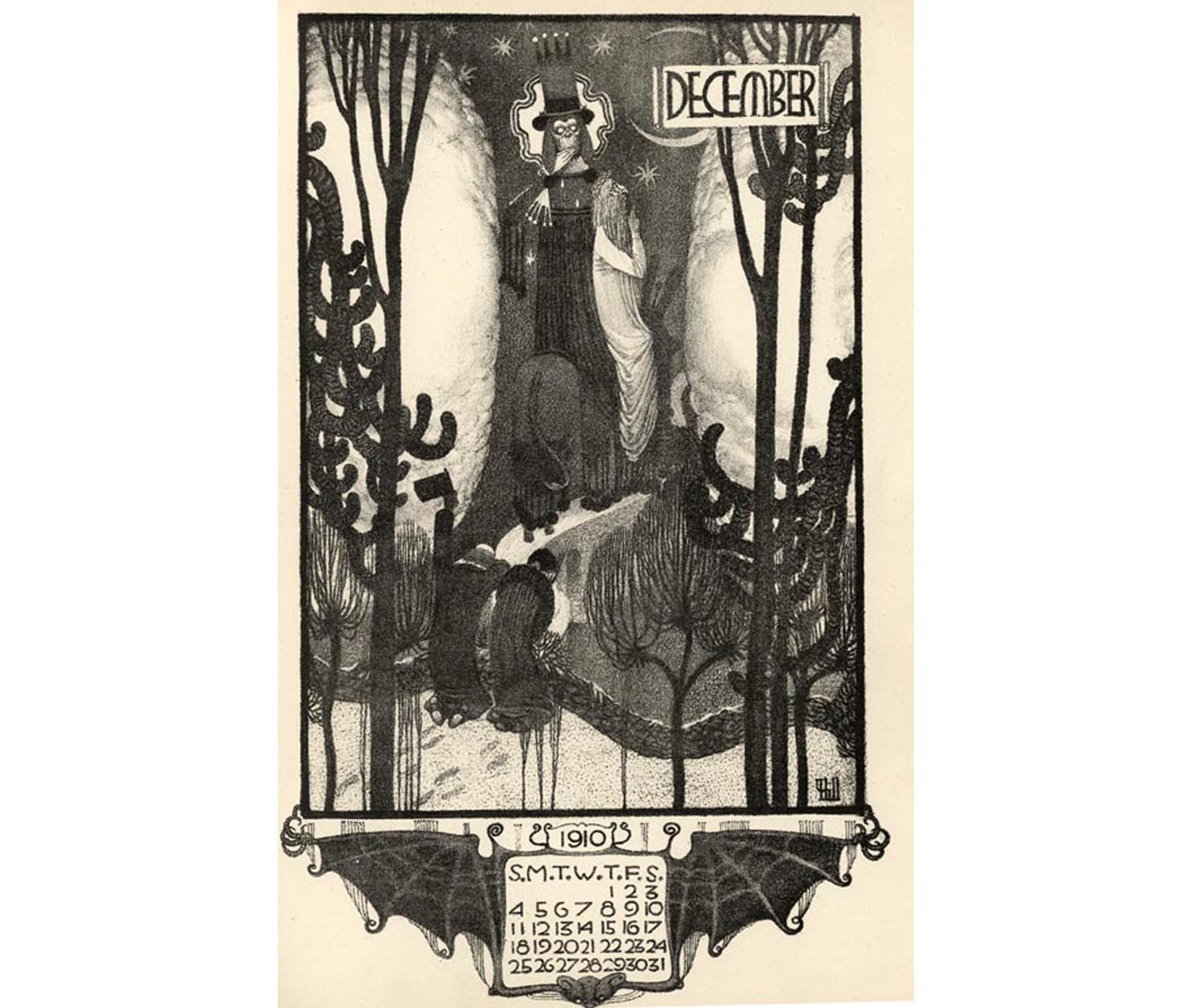
December and Vernon Hill

hill1.jpg

Who was Vernon Hill? A good question since he’s another of those illustrators about whom detailed information is in short supply. He was born in Halifax, England, which makes him a Yorkshireman, and this page gives his birth date as 1887. A biographical note here states that:

Hill was primarily a wood-carver, most of whose illustrative work was done in the years 1910–12. His major achievements here were his designs for Ballads Weird and Wonderful and The New Inferno, both of which were collections of verse, the literary form most suitable for symbolic illustration. An important influence on him was Blake; it is seen in his often symmetrical compositions, the differences of scale of his figures, and their physique (which also show Hill’s feeling for sculpture).

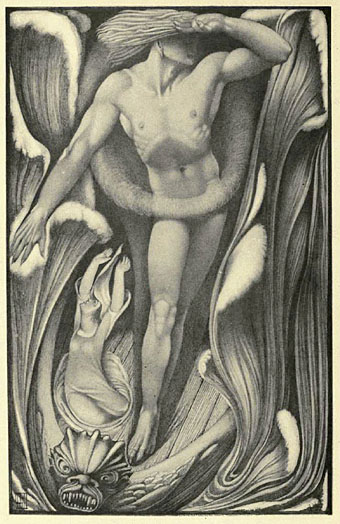
Hill’s curious depiction of the year’s end comes from a set of equally curious lithograph illustrations for John Lane, The Arcadian Calendar (1910), produced in a style which resembles a hybrid of Sidney Sime and other post-Beardsley artists. This seems to have been atypical, unfortunately, subsequent book work shows more fully his Blake influence. The Demon Lover is one of the better illustrations from Ballads Weird and Wonderful (1912) which can be downloaded at the Internet Archive.

hill2.jpg

The Demon Lover.

Elsewhere on { feuilleton }
The illustrators archive

Previously on { feuilleton }
Sidney Sime and Lord Dunsany
Harry Clarke’s The Year’s at the Spring

Dorothy Lathrop’s Three Mulla-mulgars

lathrop1.jpg

A Kipling-esque jungle tale by Walter de la Mare with Sidney Sime-esque illustrations by Dorothy Lathrop (1891–1980). The Three Mulla-mulgars was published in 1919 and is another book which can be downloaded at the Internet Archive. Inevitably (and conveniently), Golden Age Comic Book Stories has two pages of Ms Lathrop’s work including a number of colour plates from the book.

lathrop2.jpg

Bud Plant’s Dorothy Lathrop page

Elsewhere on { feuilleton }
The illustrators archive

Previously on { feuilleton }
Sidney Sime and Lord Dunsany
Harry Clarke’s The Year’s at the Spring

Sidney Sime and Lord Dunsany

sime1.jpg

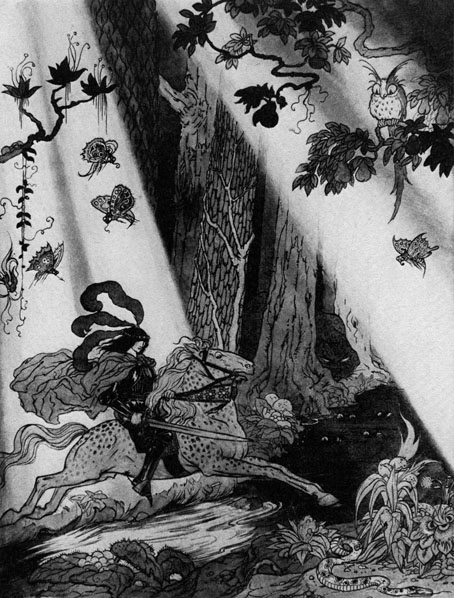
‘We would gallop through Africa’ from A Dreamer’s Tales.

More from the book scans at the Internet Archive. Lord Dunsany was Edward John Moreton Drax Plunkett, 18th Baron of Dunsany and a writer of a number of fantasy tales beginning with The Gods of Pegana in 1905. His work is notable these days for having been a huge influence on the early stories of HP Lovecraft who once divided his literary output into his Poe pieces and his Dunsany pieces. Dunsany found an ideal illustrator in Sidney Sime who started out as a Beardsley pasticheur but developed his own slightly comical variant on the kind of exotica favoured by Edmund Dulac and Kay Nielsen.

Of the Dunsany/Sime books, Archive.org has The Sword of Welleran (1908), A Dreamer’s Tales (1910), The Book of Wonder (1912) and Tales of Wonder (1916). These stories are frequently too whimsical for my tastes—I’ve never been very keen on Lovecraft’s Dunsany pieces either—but they’re still worth a look for anyone interested in the lighter side of 20th century fantasy.

sime2.jpg

‘The City of Never’ from The Book of Wonder.

Elsewhere on { feuilleton }
The illustrators archive

Previously on { feuilleton }
HP Lovecraft’s favourite artists