Women in Love

wil2.jpg

To see the past from the vantage point of the present is to be able to judge the effect of the past on the present.

Ken Russell (The International Dictionary of Films and Filmmakers, Vol. 2, 1984)

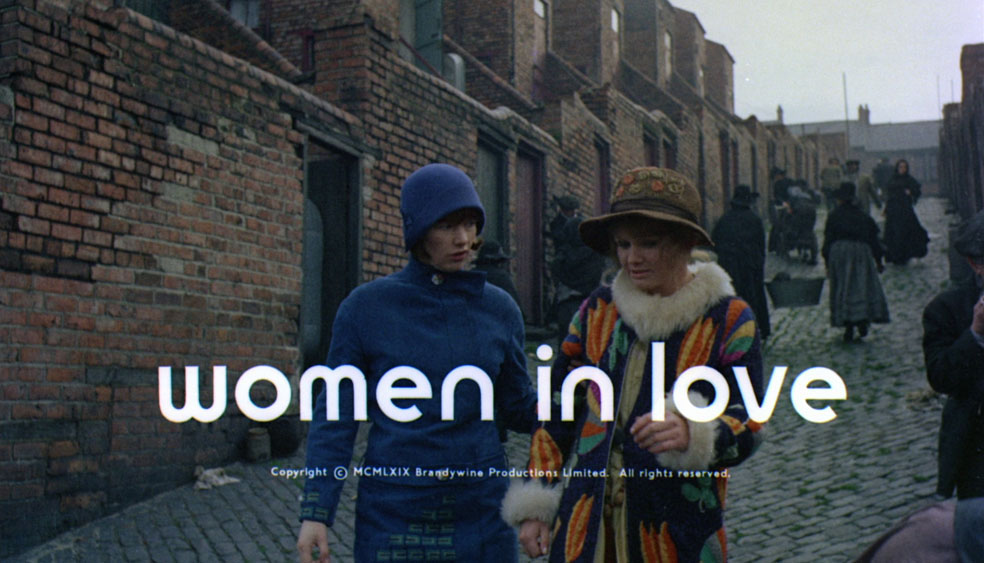
Among the film viewing this week was a Blu-ray preview of Ken Russell’s Women in Love (1969), courtesy of the BFI. I’d not see Russell’s film for a long time so watching it again in such exceptional quality was almost like seeing it for the first time. Russell’s comment about the past versus the present was made in the context of his many biographical films, a series he began at the BBC and continued into his feature career. But with the passage of time the films themselves become products of the past, and so we can’t help but see them in a different light. Almost as much time has passed since Women in Love was made as separates the film itself from the year in which it begins, just after the end of the First World War; if we don’t see the 1960s as so historically remote today it’s partly because the culture of that period continues to cast a huge shadow over the present.
wil3.jpg

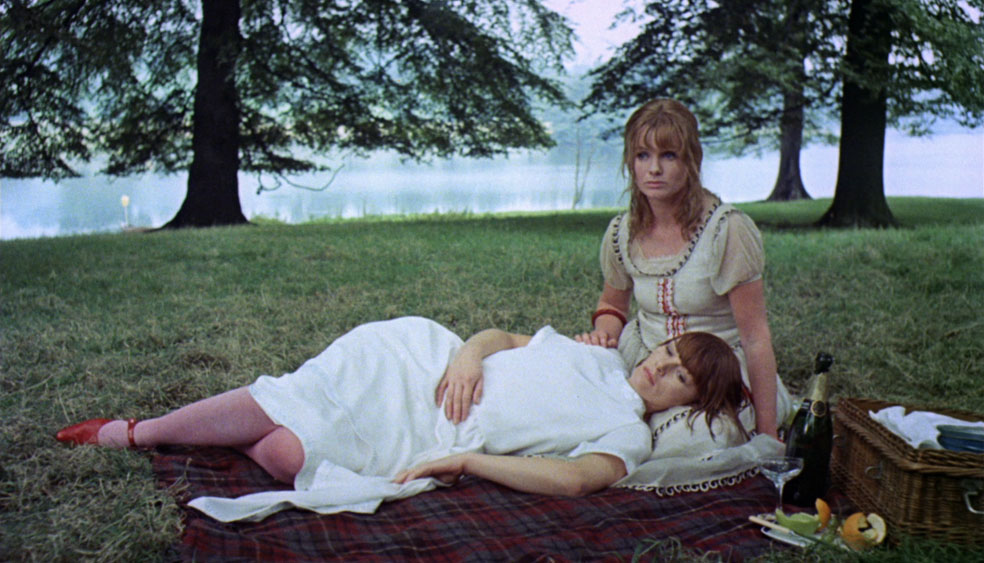
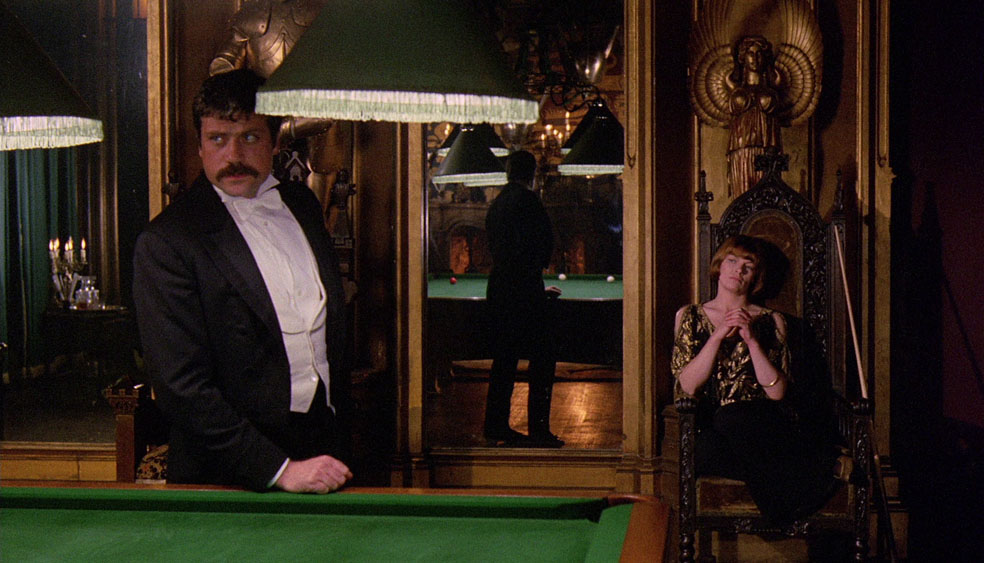
Women in Love contrasts the progress of a pair of sisters, Gudrun Brangwen (Glenda Jackson) and Ursula Brangwen (Jennie Linden), who form couples with two very different men, Gerald Crich (Oliver Reed) and Rupert Birkin (Alan Bates). Gudrun is an artist, Ursula a schoolteacher; Gerald is a wealthy mine-owner, Rupert a school inspector. Rupert’s theorising about love and human relations provides the intellectual heart of the story, as well as being a comment upon it, with each of the four main characters reacting in different ways to the imperatives of love. Rupert acts as a mouthpiece for DH Lawrence’s beliefs, and it’s the theorising which seems closer to the questioning spirit of the 1960s than it does to 1918. Rupert’s desire to live somewhere with more than one person, and free of the constraints of clothing, has parallels with some of the nature movements of the period (as well as Lawrence’s own desires) but also sounds like the yearnings of a hippy idealist. Ursula is the most grounded of the quartet—when we first see her in the school she’s giving the children a nature lesson—and complains about Rupert’s lofty spirituality once their relationship begins.
wil6.jpg

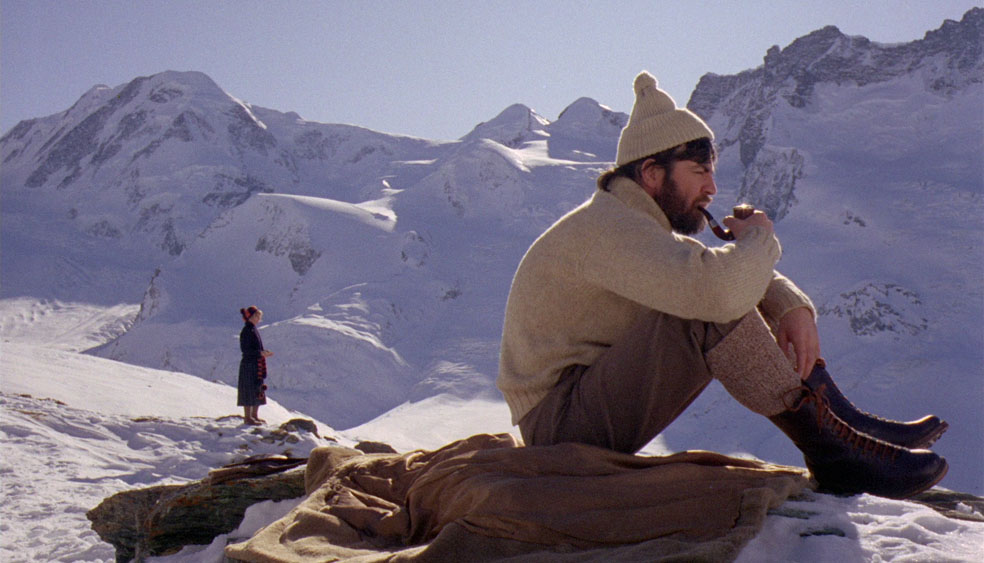
Gerald and Gudrun, by contrast, are too remote from each other to be fully complementary. Gerald complains that when tragedy strikes the Crich family—as it does midway through the film—nothing can ever be right, a prophesy that fulfils itself for his family and his relationship. Gudrun, meanwhile, yearns for artistic as well as romantic freedom; she finds both when the quartet take a holiday in the Alps. Vladek Sheybal’s Loerke is a bisexual artist whose liberated attitude embodies some of Rupert’s philosophy as well as proving more stimulating company for Gudrun. Ursula merely complains that Loerke doesn’t know how to properly depict a horse. Eleanor Bron is the other key character, Rupert’s former lover, and one of Lawrence’s sterile aristocrats. She falls out with Rupert after he spoils her pretentious attempt to emulate a Russian ballet performance.
wil7.jpg

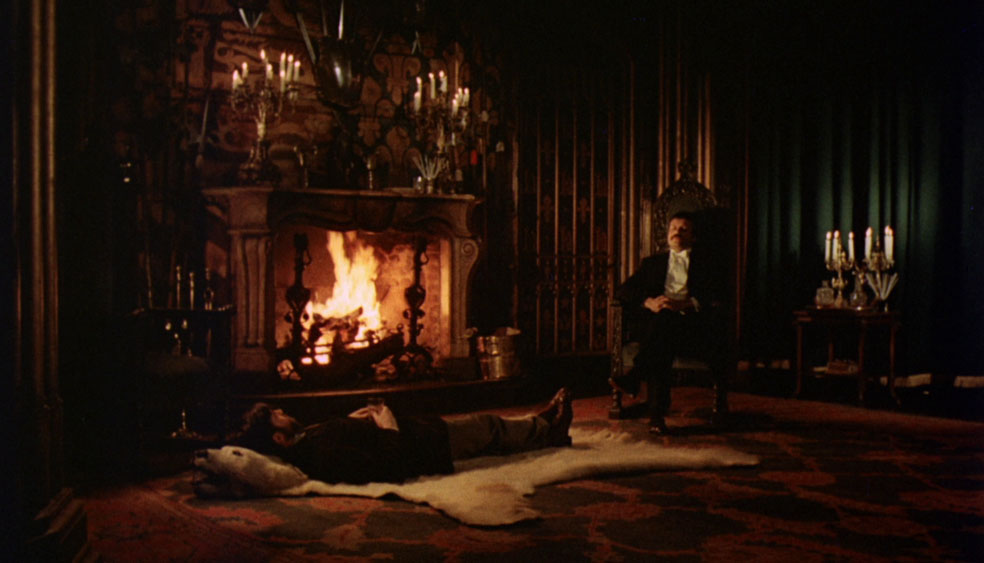
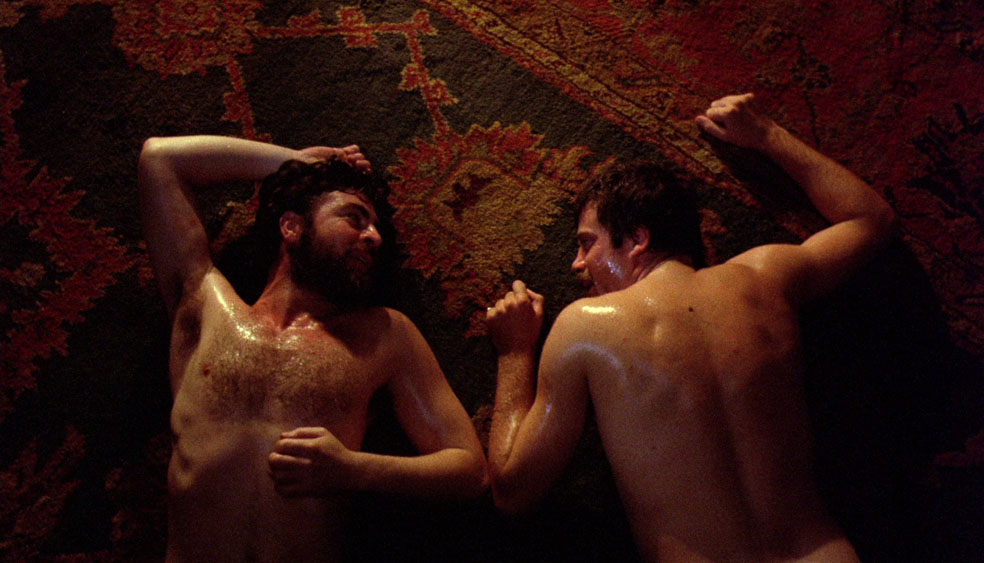
Women in Love is the first of Russell’s features that’s distinctively his own even though it lacks the exuberance of his later work. Several of the actors turn up in later films: Reed had already appeared in the BBC dramas The Debussy Film and Dante’s Inferno; Glenda Jackson was in Russell’s next feature The Music Lovers, playing Tchaikovsky’s wife, Antonina Miliukova, a role prefigured in Gudrun and Loerke’s bedroom masquerade. Russell said he worked without credit on the script but the first draft was the work of producer Larry Kramer who tried the project with a few directors before finding Russell. Kramer’s involvement underlines Rupert’s insistent desire to bond physically with close male friends (specifically Gerald), although there’s never any spoken suggestion that sex should take place. Kramer followed Women in Love with a script for Charles Jarrott’s terrible musical version of Lost Horizon (1973), a film he disowns but which made him wealthy enough to concentrate solely on fiction and works for the stage. His post-Hollywood work explores the lives of gay American men from a variety of perspectives, in the light of which Women in Love might be seen as an attempt to smuggle an acceptance of bisexual desire into the mainstream without any overt proselytising or tragic narratives. Rupert’s attempt to bond with Gerald climaxes (so to speak) in the famous nude wrestling scene, an event which doesn’t seem so surprising now but which was a confrontational moment for audiences in 1969.
wil4.jpg

That scene may also be free of any deliberate homoeroticism but Russell recalled how South American censors made it seem more so by cutting the scene:

Gerald simply locked the door then there was a cut to the two men lying naked on the carpet side by side, panting. It became known as The Great Buggering Scene and filled the cinemas for months. So much for the subtleties of censorship.
wil5.jpg

The BFI Blu-ray is the usual pristine transfer which emphasises the colour and detail in Billy Williams’ photography. Among the extras there are audio commentaries by Ken Russell and Larry Kramer, a 49-minute conversation with Billy Williams, interviews with Glenda Jackson, and Second Best (1972), a previously unreleased short film, based on a story by DH Lawrence, which stars Alan Bates. With the recent BFI releases of Russell’s TV films, and the earlier release of The Devils, I’m hoping we may see more of his work given this careful treatment. (And when do we get a Blu-ray of The Devils?)

Women in Love is released on August 22nd.

Previously on { feuilleton }
The Planets by Ken Russell
Devils debris
The Devils on DVD
Ken Russell, 1927–2011
Salome’s Last Dance

Weekend links 297

floridxfauna.jpg

Crimson Metallic Emergent Skull Crystal Pendant by Kristen Phillips aka Floridxfauna.

The Noise-Arch Backup at the Internet Archive is 30GB of mp3s from noise-arch.net, a collection of cassette-based releases and artwork: “material represented includes tape experimentation, industrial, avant-garde, indy, rock, diy, subvertainment and auto-hypnotic materials…” 30GB is an intimidatingly large amount of material so it’s better to browse The Noise-Arch Archive, a selection of 468 releases.

• The week in erotica: Claire Voon on Ancient Erotic Dreams and Explicit Scenes in the New York Public Library Collection; Melanie Porter on Great Grandporn: Hardcore Pornography of the Silent Era; Cathy Camper on The Comics of Dale Lazarov: Illustrated Explorations of Sexual Inventiveness.

Void Beats/Invocation Trex by Cavern of Anti-Matter (Holger Zapf, Joe Dilworth & Tim Gane) was released this week. The opening number is Tardis Cymbals. Tom Furse condensed the 73-minute album into a 17-minute mini-mix.

Indeed, if you had to “place” ­Williams—put him alongside writers with whom he had something in common—it would be with the mystical autodidacts, the backstreet Rosicrucians more than with the pipe-smoking, tweedy Inklings. To that extent, the only unsatisfactory thing about Grevel Lindop’s book is its title. True, Williams went to Oxford when war broke out and became friends with the famous circle around C. S. Lewis. But he was not an Inkling in spirit. He was not at home in Oxford, and his arrival, far from consolidating the Inklings, actually broke them up by bewitching Lewis, and making Lewis neglect the central friendship of his life, that with ­Tolkien. Another scholar of Old English literature, C. L. Wrenn, said that meeting Williams made you realize why inquisitors thought they had the right to burn people. Tolkien agreed: “Williams is eminently combustible.”

Certainly, Williams’s books had an influence on the Inklings. Lindop is right to say that the central plotline of Many Dimensions suggests the story of The Lord of the Rings. In the Williams novel, it is a stone of great power, rather than a ring, but it has the same effect on those who bear it: They become its possession, not its possessor.

AN Wilson reviews Charles Williams: The Third Inkling by Grevel Lindop

• Russ Fischer recommends five films by Andrzej Żuławski (RIP). Possession (1981) is still the easiest to find, and a good place to start. I enthused about On The Silver Globe (1977–87) last year.

England’s Hidden Reverse: A Secret History of the Esoteric Underground by David Keenan has been published in a revised and expanded edition by Strange Attractor.

The Preservation Man (1962): Artist and collector Bruce Lacey (RIP) filmed by Ken Russell for the BBC’s Monitor.

Barry Adamson: “I’ve been called the outsider’s outsider”.

• At Dangerous Minds: Six degrees of Marty Feldman.

• Mix of the week: FACT mix 536 by Not Waving.

• The Alan Clarke page at the BFI shop.

Umberto Eco (RIP): Porta Ludovica

Possessions (1980) by The Residents | Possessed (1992) by The Balanescu Quartet | Possessed (2001) by Sussan Deyhim & Shirin Neshat

Weekend links 288

gourmelin.jpg

Untitled drawing by Jean Gourmelin.

• Yet another book featuring my design work (interiors this time) has been published in the past week. Leena Krohn: Collected Fiction is an 850-page selection of novels, novel extracts and short works from a prolific Finnish author of the fantastic. Many of the selections are being published in English for the first time:

From cities of giant insects to a mysterious woman claiming to be the female Don Quixote, Leena Krohn’s fiction has fascinated and intrigued readers for over forty years. Within these covers you will discover a pelican that can talk and a city of gold. You will find yourself exploring a future of intelligence both artificial and biotech, along with a mysterious plant that induces strange visions. Krohn writes eloquently, passionately, about the nature of reality, the nature of Nature, and what it means to be human. One of Finland’s most iconic writers, translated into many languages, and winner of the prestigious Finlandia Prize, Krohn has had an incredibly distinguished career. Collected Fiction provides readers with a rich, thick omnibus of the best of her work—including novels, novellas, and short stories. Appreciations of Krohn’s work are also included.

• “Not only is the nature of Rollin’s choice of images close to [Clovis] Trouille’s, the director structures his movies in a similar fashion, crowding his movies with dreamy horror iconography. Rollin has specifically cited the influence of Trouille’s paintings on his work alongside that of other Surrealist painters working in a figurative style.” Tenebrous Kate explores the influences (and influence) of Jean Rollin’s erotic horror films.

• “[Morton] Subotnick might just have been the first person to get a club full of people—including the entire Kennedy family—dancing to purely electronic music when he played his Silver Apples Of The Moon at the opening night of New York’s legendary Electric Circus.” Robert Barry interviews the pioneering composer.

• “What I actually wanted to do was make music that contained all that was new in the 20th century,” says Irmin Schmidt in an interview with Bruce Tantum. Good to read that Rob Young is writing a biography of Can.

• “…gay mainstream culture was never really about expressing individuality, for me. It always seemed very conformist,” says Bruce LaBruce in conversation with Mike Miksche.

• At Dangerous Minds: Paul Gallagher on the making of Ken Russell’s The Devils, and Martin Schneider on the return of Paul Kirchner’s wordless comic strip, The Bus.

• Two years ago a group of Russian urban explorers climbed the Pyramid of Cheops at night. They’ve just returned from South America, and have a report here.

• In the wake of their new album, Kannon, Jason Roche asks “Are drone-metal icons Sunn O))) the loudest band on the planet?”

Junji Ito returns to horror with two new titles. Related: Fuck Yeah Junji Ito.

• Mix of the week: FACT mix 527 by Jóhann Jóhannsson.

Anna von Hausswolff‘s favourite albums.

Touch (Beginning) (1969) by Morton Subotnik | Rapido De Noir (1981) by Irmin Schmidt & Bruno Spoerri | The Gates of Ballard (2003) by Sunn O)))

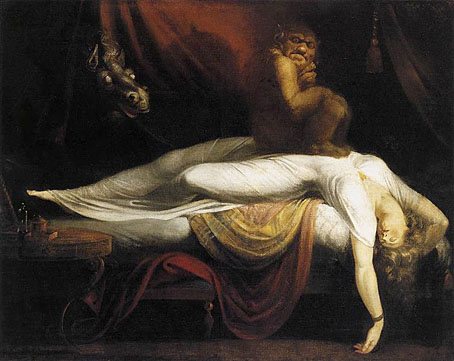
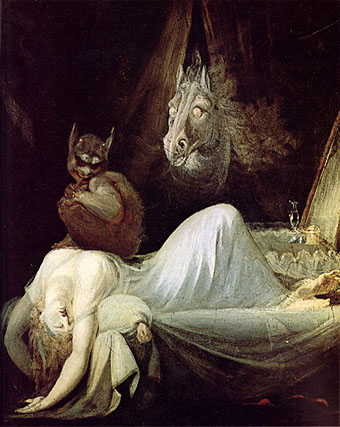
Fuseli’s Nightmare

nightmare1.jpg

The Nightmare (1781).

Christopher Frayling’s Nightmare: The Birth of Horror (1996) opens with a prologue examining Henry Fuseli’s most celebrated painting:

Henry Fuseli, who later wrote that “one of the most unexplored regions of art are dreams”, and who was said to have supped on raw pork chops specifically to induce his nightmare, made his name with this painting. And engraved versions, produced in 1782, 1783 and 1784, distributed the image across Europe, until Fuseli’s masterpiece became the way of visualising bad dreams.

Although The Nightmare was painted just before the Romantic craze in Western Europe—which revelled in peeling back the veneer of rational civilisation to reveal the “natural” being or the raw sensations beneath, sometimes through the gateway of dreams—it was well-known to the writers and painters of the early nineteenth century. One of them wrote that “it was Fuseli who made real and visible to us the vague and insubstantial phantoms which haunt like dim dreams the oppressed imagination”.

The Nightmare was fascinating—and scary—because it operated at so many different levels at once. It was set in the present (the stool and bedside table are “contemporary” in style), and it was concerned not so much with an individual’s nightmare—the usual subject-matter of dream paintings, often involving famous individuals and their prophecies—as with nightmares in general. It was not A Nightmare, but The Nightmare; not a vision but a sensation. This gave it a direct impact, unmediated by history, which put a lot of critics off.

nightmare2.jpg

The Nightmare (1791).

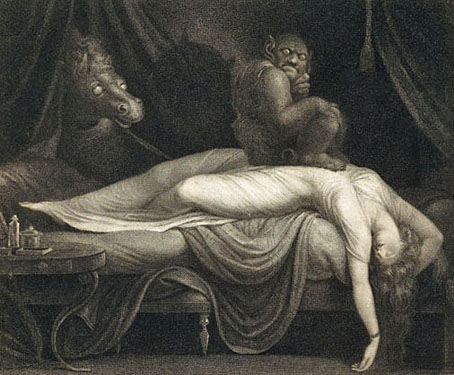
Later generations of critics have had no such problems, of course, nor have the legions of artists and cartoonists who’ve plagiarised and parodied this memorable scene. I had a vague notion of collecting some of the derivations but a quick image search reveals an endless profusion of squatting figures and thrusting horse heads. Wikipedia did provide two of the engraved versions, however. Of the two paintings above I’ve always preferred the later one: the incubus, or “mara” as Frayling calls it, looks more sinister, and the horse head has become an almost unavoidable sexual symbol. No wonder that Siegmund Freud had a copy of The Nightmare on the wall of his waiting room.

nightmare3.jpg

Engraving by Thomas Burke (1783).

Continue reading “Fuseli’s Nightmare”

Narcose, a film by Julie Gautier

narcose1.jpg

Hallucinations without drugs:

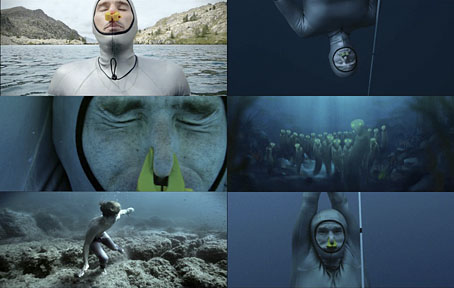
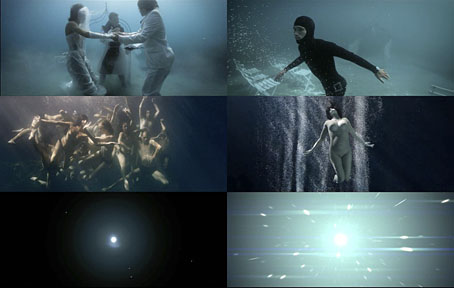
Deep water freediving exposes its practitioners to a form of narcosis, which induces several symptoms, among which a feeling of euphoria and levity that earned this phenomenon its nickname of “raptures of the deep”. The short film relates the interior journey of Guillaume Néry, the apnea world champion, during one of his deep water dives. It draws its inspiration from his physical experience and the narrative of his hallucinations.

Also without much CGI trickery since most of the shots in Julie Gaultier’s film have been filmed underwater by actor-divers. Guillaume Néry reenacts a dive without oxygen tank to a depth of 125 metres. The effect is a little like Altered States crammed into 10 minutes, albeit without Ken Russell’s religious preoccupations.

narcose2.jpg