Weekend links 64

magritte.jpg

The Sixteenth of September (1956) by René Magritte.

To Magritte admirers, The Sixteenth of September is a deceptively realistic work painted in 1956, one of a series in which the artist plays tricks with light and time of day. It shows a crescent moon impossibly shining through the dark mass of a tree, against a dawn sky.

To [Marc] Bolan fans, the painting has an entirely different significance: 16 September 1977 was the date the singer was returning home in the small hours from a night out, in a Mini driven by his girlfriend Gloria Jones. […] Fans say the tree in the painting closely resembles the sycamore the car crashed into, and the moon was at the same phase on 16 September 1977. (more)

• New Yorkers finally got a successful vote for gay marriage making New York state the sixth and largest in the US giving full marriage rights to its gay citizens. One of America’s conservative journals, National Review, made the striking point that forty years ago New York was in the vanguard of gay liberation while Spain under Franco was a dictatorship with no gay rights at all. No one then would have bet on Spain beating New York to gay marriage rights as it did in 2005. Allow me to note that we still only have civil unions here in the UK.

• Related: Queer Beacon: LGBT spaces in New York City by Kian Goh, and at Scientific American: The Intelligent Homosexual’s Guide to Natural Selection and Evolution, with a Key to Many Complicating Factors by Jeremy Yoder.

• A pair of intrepid photographers breach the midnight security at St Paul’s Cathedral to bring back photos of the building rooftop. Related (and looking like a good location for a British equivalent of Stalker), photos of the disused Thorpe Marsh Power Station, Yorkshire.

• Mixtape of the month: the ATP I’ll Be Your Mirror collection by Portishead, a great blend of rock, rap and electronic odds-and-ends. Also a dash of Alan Moore & Stephen O’Malley.

Eddie Campbell is blogging again. Welcome back to the madhouse, Eddie. His smart and witty daughter, Hayley Campbell, continues to file regular bulletins from her London bunker.

• Your Tumblrs this week: Fuck Yeah Ken Russell and Fuck Yeah Powell & Pressburger.

Robot Flâneur: Exploring Google Street View.

Paris Visages by Marco Gervasio.

• “Push the button, Max!

Written On The Forehead (2011) by PJ Harvey.
Wild Salomés

wildesalome.jpg

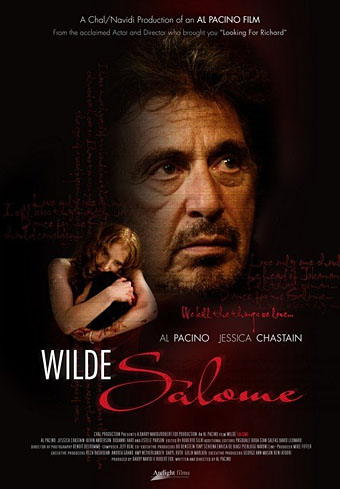
So there’s a poster for Al Pacino’s forthcoming drama-documentary about the Oscar Wilde play but I’ve yet to see any release details. The tagline connects Salomé with The Ballad of Reading Gaol: “We kill the thing we love.”

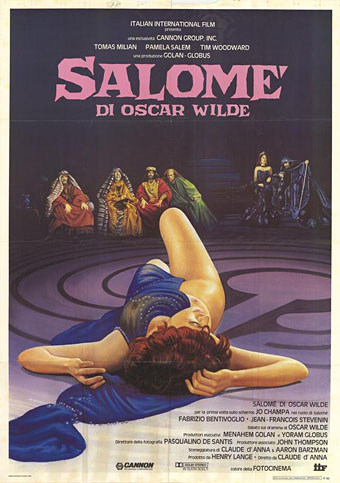
salome1986.jpg

Searching around for posters turned up this item for an Italian-French co-production of the Wilde play directed by Claude d’Anna. I’ve not seen this but it can’t be any worse than Ken Russell’s version so it may be worth seeking out.

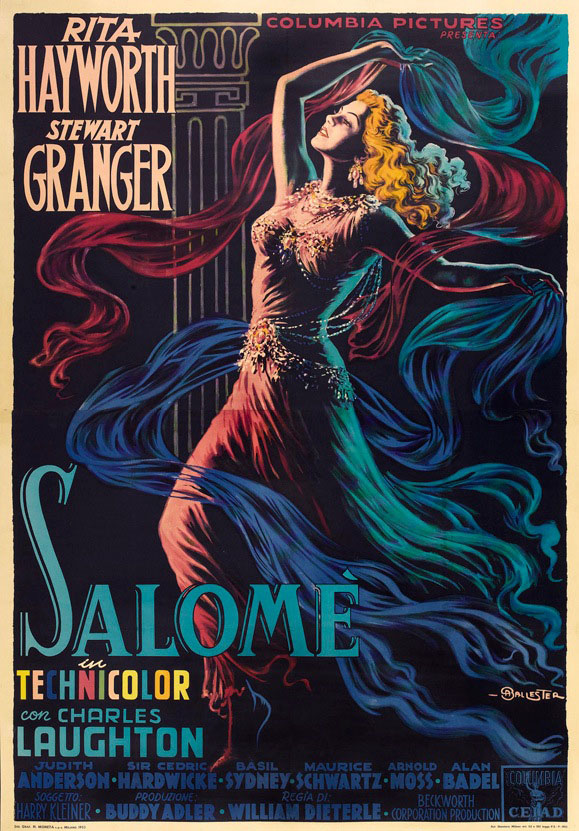
salome1953.jpg

Far better poster-wise is this splendid creation by Anselmo Ballester for the Italian release of the 1953 Hollywood film (which isn’t based on the play). Rita Hayworth was too old for the role, and the film is simultaneously lavish and dull in the way that so many sword-and-sandal epics manage to be, but the poster is a gem. This site has many more examples of Ballester’s poster art.

Elsewhere on { feuilleton }
The Oscar Wilde archive
The Salomé archive

Passage 15

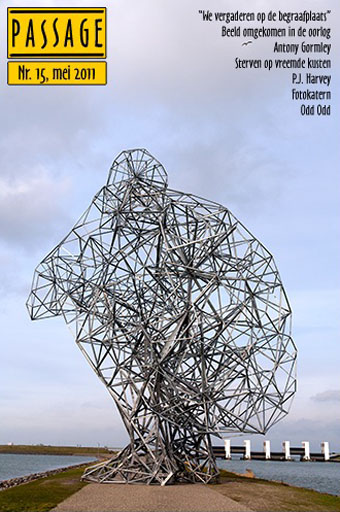
passage15.jpg

Directing your attention elsewhere again today, to the latest edition of Passage the Dutch webzine run by my good friend Ed Jansen. Number 15 is described thus:

Passage 15 is, with a few exceptions, entirely devoted to art. Images govern our lives, literally and figuratively. Gaudier-Brzeska nearly a hundred years ago and Antony Gormley today affect our way of looking. Odd Nerdrum does so with his painting on a very different way. The music of Polly Jean Harvey made us curious about her sources of inspiration. The piece about Gallipoli is actually a kind of enormous footnote to her latest cd “Let England Shake”. The photo section provides an overview of exhibitions and performances in the past few months in and around The Hague, Netherlands.

Seeing Gaudier-Brzeska’s sculptures reminds me that I haven’t seen Ken Russell’s film of the artist’s life, Savage Messiah, for many years. The large Antony Gormley work on the cover (Exposure) makes a welcome change from the artist’s cast-iron clones. I’m still waiting for Gormley to create the Ejaculating Man, a seawater-spurting statue he proposed for Seattle. It was rejected, of course, and it’s difficult to imagine any American city exhibiting something of that nature given the current climate. Maybe he should try Amsterdam.

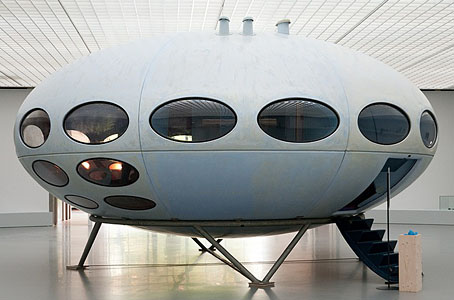
futuro.jpg

Back at Ed’s work, his varied Flickr stream includes some recent views of Futuro, a mobile holiday home designed by Matti Suuronen in 1968. What was once futuristic now has a Jetsons-like retro glamour.

Previously on { feuilleton }
Passage 14
Passage 13
Passage 12
Passage 11
Passage 10

Echoes of Aubrey

life2.jpg

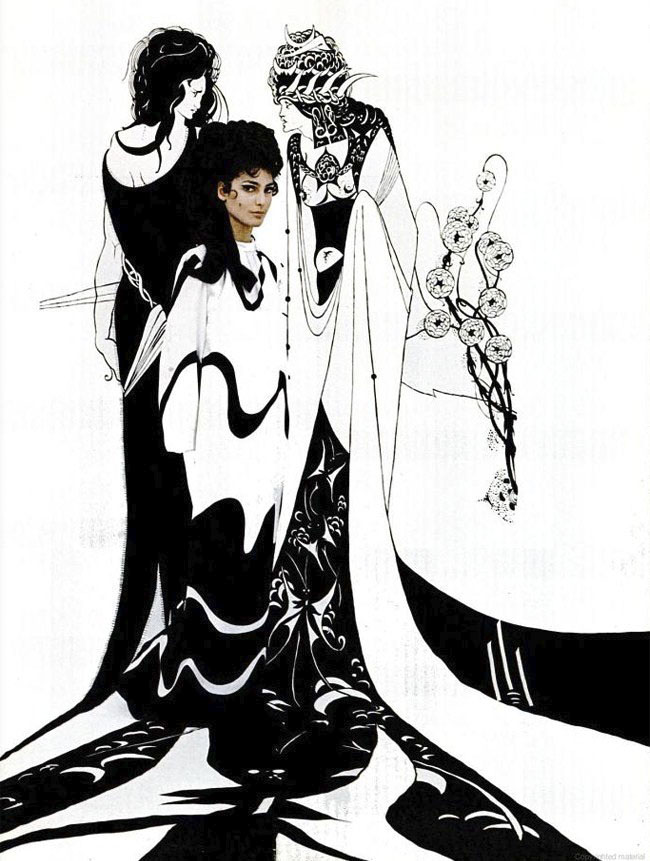
More of Aubrey Beardsley’s posthumous influence and more of the delightful collision between the 1890s and the 1960s. Monsieur Thombeau turned up this striking fashion shoot from LIFE magazine for 1967 showing a model posed against one of the Salomé drawings. A couple of days after this was posted, a reader wrote to point me to this list of films featuring Beardsley artwork. Most of those I knew about already but I certainly hadn’t heard of Death Bed: The Bed That Eats (1977), a low-budget horror film about which we’re told:

A large, black, four-poster bed, possessed by a demon, is passed from owner to owner. The demon was a tree, who became a breeze and seemingly fell in love with a woman he blew past. The demon then took human form and conjured up a bed. While he was making love with the woman she died and his eyes bled onto the bed, causing it to become possessed. Those who come into contact with the bed are frequently consumed by it (victims are pulled into what is apparently a large chamber of digestive fluids beneath the sheets). The bed demonstrates a malevolent intelligence as well as some psychokinetic and limited telepathic abilities to manipulate dreams. A running commentary or chorus is supplied by the ghost—if that is the correct word—of an artist (who would appear to be Aubrey Beardsley, though this is never stated directly) trapped behind a painting on the wall.

That’s a posthumous fame Aubrey never would have anticipated. If anyone has seen this, let us know what you thought.

carryon.jpg

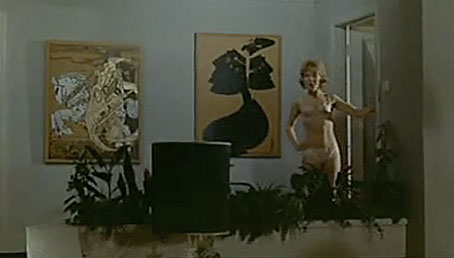
Carry On Loving (1970).

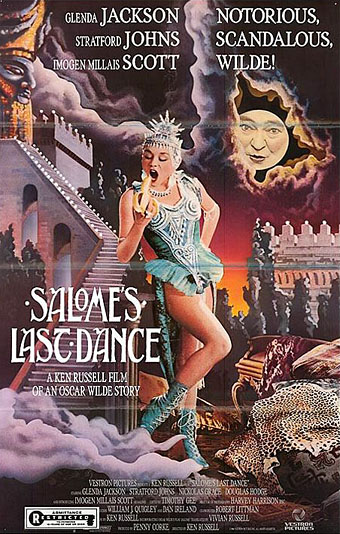
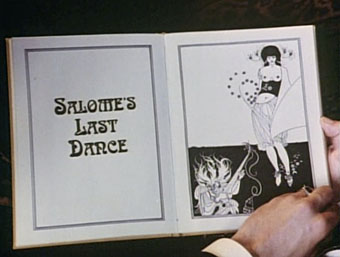
Absent from the list of films is Ken Russell’s Salome’s Last Dance, which features the Salomé pictures again in its title sequence, and Carry On Loving, one of the dreadful British sex comedies which has an entire scene set in a modish pad decorated with Beardsley prints. Watch the scene in question here, if you must.

galleryfive.jpg

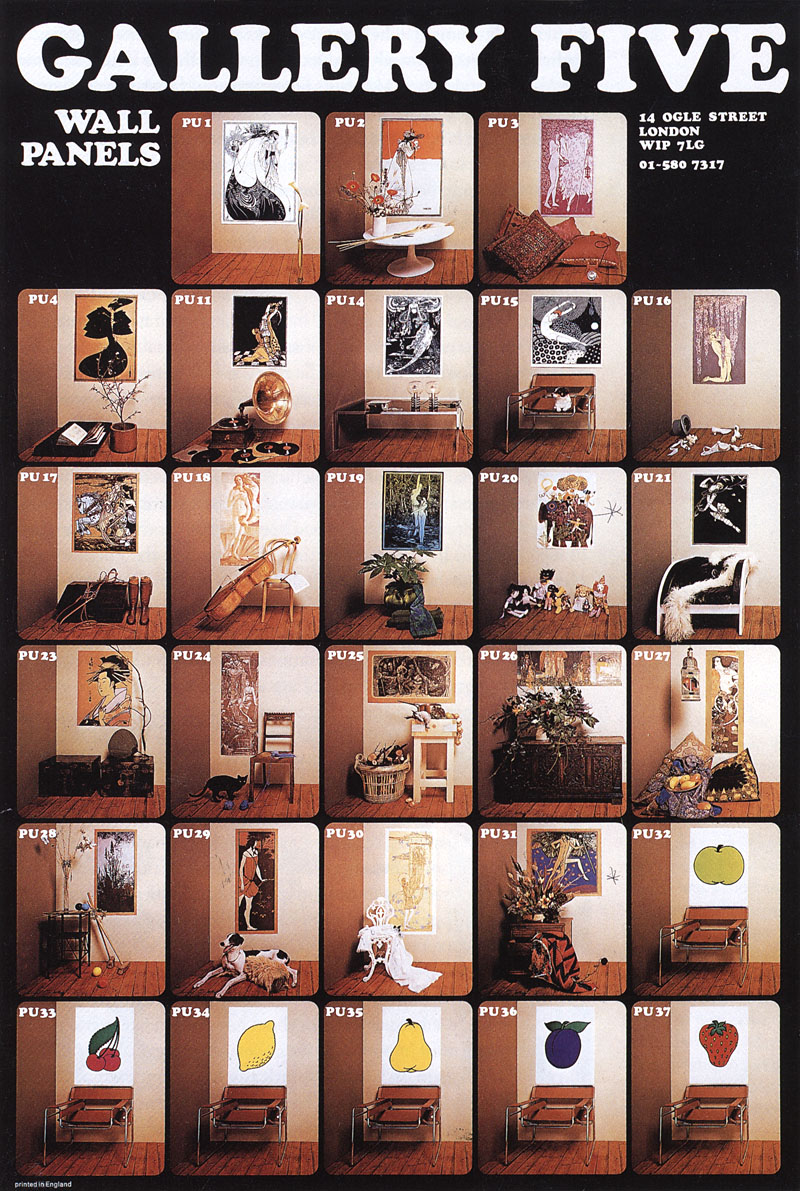
The prints were produced by a London company, Gallery Five, in the late 60s, and their ad shows they were also selling works by Kay Nielsen (seen in the Carry On clip), John Austen, Charles Ricketts, George Barbier, Jessie King and others. Gallery Five did much to popularise Beardsley’s art among people who might otherwise have never noticed his work, and their products turn up in many films and TV dramas of the period. Finally—although it’s by no means the last word on this subject—the V&A has two great Beardsley-derived ads for Elliott Boots by Paul Christodoulou here and here.

Elsewhere on { feuilleton }
The Aubrey Beardsley archive

Salome’s Last Dance

salome1.jpg

More Wildeana. It’s taken me over two decades to watch this film, and while I can’t really say it was worth the wait it was more entertaining than I expected. Salome’s Last Dance was directed in 1988 by Ken Russell and is his own typically mannered adaptation of the Wilde play. It appeared around the same time as his adaptation of another Victorian work, Bram Stoker’s The Lair of the White Worm, and it was the latter film which caused me to lose my patience with Russell’s excesses and so ignore this one. In Salome’s Last Dance we have Oscar Wilde and Lord Alfred Douglas visiting Alfred Taylor’s London brothel one night in 1892 where Taylor and company stage a performance of Wilde’s banned play.

salome2.jpg

Aubrey Beardsley’s illustrations appear in the title sequence.

If you’re a Wilde enthusiast there are at least two ways you may take this; you can be appalled by Russell’s “translation” of Wilde’s words (Salomé was written in French then translated for English publication in 1894; there’s no reason to re-translate a version the author approved), a translation which is really more of an adaptation, with much of the poetic monologue removed and the tone lowered for a general audience—Wilde’s “Iokannen” is vulgarised to “John the Baptist” throughout. Or you can try and enjoy what is at least a complete performance of the play, even though it more often resembles Carry On Salomé than anything one might have expected Sarah Bernhardt to perform. Injecting a Symbolist drama with slapstick and grotesquery is probably inevitable given the director (Russell is also co-writer and he plays—badly—the role of the Cappadocian). I found it impossible to decide whether Russell was sending up the play because he found it too pompous or whether he felt that an audience wouldn’t sit still for it otherwise. Whatever his intention, the premise is intriguing enough to inspire speculation as to how it might have been treated by other hands.

Continue reading “Salome’s Last Dance”