Fuseli’s Nightmare

nightmare1.jpg

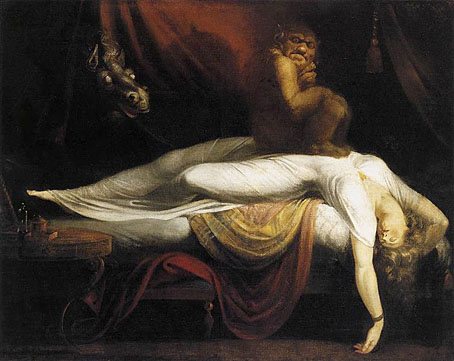
The Nightmare (1781).

Christopher Frayling’s Nightmare: The Birth of Horror (1996) opens with a prologue examining Henry Fuseli’s most celebrated painting:

Henry Fuseli, who later wrote that “one of the most unexplored regions of art are dreams”, and who was said to have supped on raw pork chops specifically to induce his nightmare, made his name with this painting. And engraved versions, produced in 1782, 1783 and 1784, distributed the image across Europe, until Fuseli’s masterpiece became the way of visualising bad dreams.

Although The Nightmare was painted just before the Romantic craze in Western Europe—which revelled in peeling back the veneer of rational civilisation to reveal the “natural” being or the raw sensations beneath, sometimes through the gateway of dreams—it was well-known to the writers and painters of the early nineteenth century. One of them wrote that “it was Fuseli who made real and visible to us the vague and insubstantial phantoms which haunt like dim dreams the oppressed imagination”.

The Nightmare was fascinating—and scary—because it operated at so many different levels at once. It was set in the present (the stool and bedside table are “contemporary” in style), and it was concerned not so much with an individual’s nightmare—the usual subject-matter of dream paintings, often involving famous individuals and their prophecies—as with nightmares in general. It was not A Nightmare, but The Nightmare; not a vision but a sensation. This gave it a direct impact, unmediated by history, which put a lot of critics off.
nightmare2.jpg

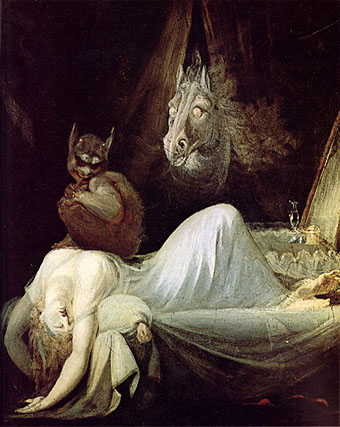
The Nightmare (1791).

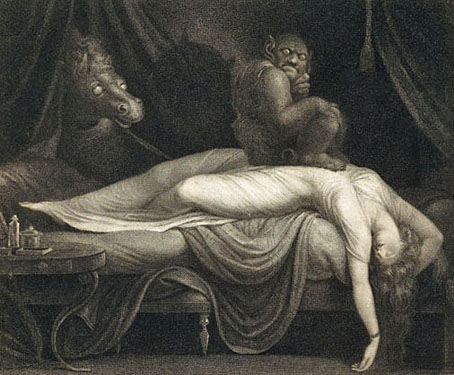
Later generations of critics have had no such problems, of course, nor have the legions of artists and cartoonists who’ve plagiarised and parodied this memorable scene. I had a vague notion of collecting some of the derivations but a quick image search reveals an endless profusion of squatting figures and thrusting horse heads. Wikipedia did provide two of the engraved versions, however. Of the two paintings above I’ve always preferred the later one: the incubus, or “mara” as Frayling calls it, looks more sinister, and the horse head has become an almost unavoidable sexual symbol. No wonder that Siegmund Freud had a copy of The Nightmare on the wall of his waiting room.
nightmare3.jpg

Engraving by Thomas Burke (1783).
Continue reading “Fuseli’s Nightmare”

Narcose, a film by Julie Gautier

narcose1.jpg

Hallucinations without drugs:

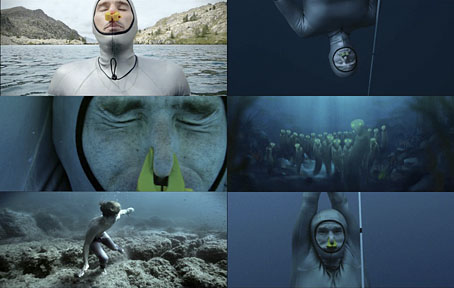
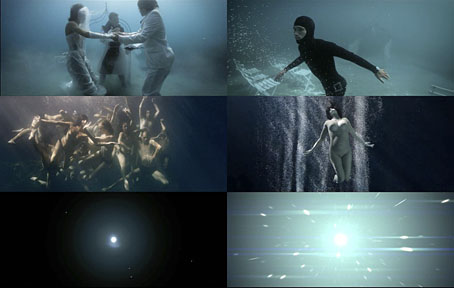
Deep water freediving exposes its practitioners to a form of narcosis, which induces several symptoms, among which a feeling of euphoria and levity that earned this phenomenon its nickname of “raptures of the deep”. The short film relates the interior journey of Guillaume Néry, the apnea world champion, during one of his deep water dives. It draws its inspiration from his physical experience and the narrative of his hallucinations.

Also without much CGI trickery since most of the shots in Julie Gaultier’s film have been filmed underwater by actor-divers. Guillaume Néry reenacts a dive without oxygen tank to a depth of 125 metres. The effect is a little like Altered States crammed into 10 minutes, albeit without Ken Russell’s religious preoccupations.

narcose2.jpg

Weekend links 198

boty.jpg

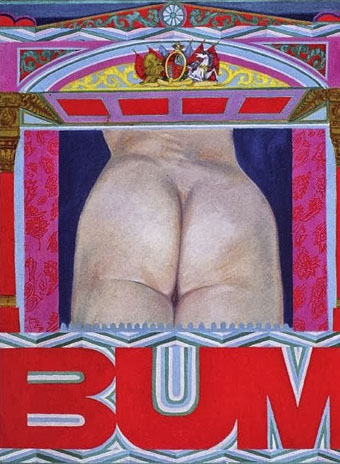
Bum (1966) by Pauline Boty.

Eleanor Birne on Pauline Boty, “the only prominent female Pop artist among a generation of famous men”. Ken Russell’s Pop Art documentary, Pop Goes the Easel (1962), which features Boty, may be seen here. Two years later Boty was back with Ken Russell playing the part of the prostitute from The Miraculous Mandarin in a film about Béla Bartók. That’s something I’d love to see. There’s more about her painting, and the work of other female Pop artists, here.

• Why Are We Sleeping? Mark Pilkington on the music world’s recurrent interest in the philosophy of GI Gurdjieff. Pilkington’s most recent Raagnagrok release with Zali Krishna, Man Woman Birth Death Infinity, was reviewed by Peter Bebergal.

• Cinematic details: Frames-within-frames in The Ipcress File (1966), and the typography of 2001: A Space Odyssey (1968).

highrise.jpg

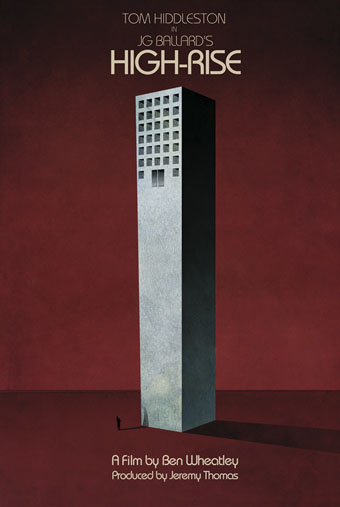
A Jay Shaw poster for Ben Wheatley’s forthcoming film of High-Rise.

• “…a large cavity must be dug in the bird’s shoulder and filled with ball bearings.” Christine Baumgarthuber on the dubious delights of The Futurist Cookbook.

• Why Tatlin Can Never Go Home Again: Rick Poynor on the difficulties of finding a definitive representation of an artwork online.

Jay Parini reviews Inside a Pearl: My Years in Paris by Edmund White. At AnOther Donatien Grau talks to White about fashion.

• At Bajo el Signo de Libra (in Spanish): the homoerotic and occasionally Surrealist art of Pavel Tchelitchew.

• At 50 Watts: Kling Klang Gloria: Vintage Children’s Books from Austria.

• The motorbike girl gangs of Morocco photographed by Hassan Hajjaj.

Geoff Manaugh on how LED streetlights will change cinema.

Stylus “is an experiment in sound, music and listening”.

• Mix of the week: Secret Thirteen mix 106 by Senking.

• At Pinterest: JG Ballard

This Is Pop? (1978) by XTC | Pop Muzik (1979) by M | Pop Quiz (1995) by Stereolab

The Planets by Ken Russell

planets0.jpg

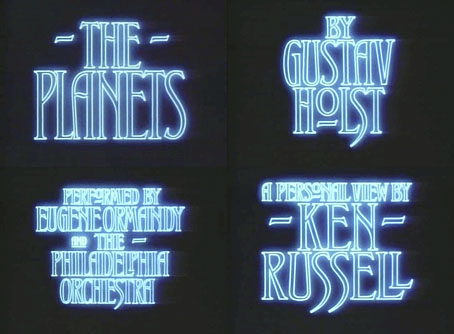
This 1983 film from Ken Russell bears comparison with Michael Powell’s film of Bluebeard’s Castle in being another television adaptation by a famous director of a well-known piece of music that few people have heard about or managed to see. (Derek Jarman often spoke of Powell and Russell as two rare talents frequently ignored or slighted in their own country.) Russell’s film was made specially for The South Bank Show, the weekly arts programme of the ITV network in Britain. As with most South Bank Show films it was screened once then vanished into the archives. There was a later laserdisc release in the US but laserdiscs are now as redundant as CD-ROMs. I’ve yet to hear of a DVD release.

planets1.jpg

Mars, the Bringer of War.

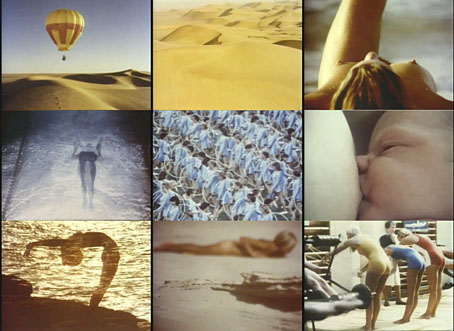
The Planets was Russell’s first film after Altered States (1980), and shares some of that feature’s cosmic moments, especially in the Neptune section. The Planets also seems heavily indebted to Godfrey Reggio’s Koyaanisqatsi which had been released to great acclaim the year before. Where Reggio matched unique shots to a unique score by Philip Glass, Russell produced a collage work that matches stock footage to each section of the Holst suite. The result is very effective in places, although after subsequent decades of music videos and YouTube mixology the effect is less impressive than it was when first broadcast. Among the hundreds of images some familiar Russell obsessions appear: Nazis, naked women and the inevitable crucifixion. I don’t think he managed to get any nuns into this one but the Pope gives a Catholic flavour to the Uranus section. Since the whole piece is wordless it’s left to the viewer to decide how much these juxtapositions are ironic or sincere. The music is performed by the Philadelphia Orchestra conducted by Eugene Ormandy.

planets2.jpg

Venus, the Bringer of Peace.

The Planets can’t be viewed on YouTube at the moment, probably for the usual copyright reasons, but there is a watchable copy on this Russian video site. Given the quantity of recordings of The Planets it’s understandable if there isn’t a great demand for Russell’s version but it still seems unfairly overlooked.

Continue reading “The Planets by Ken Russell”

Devils debris

devils.jpg

The Devils (1971).

There is only one English feature director whose work is in the first rank. Michael Powell is the only director to make a clear political analysis in his films, his work is unequalled. The Life and Death of Colonel Blimp is the finest English feature, and A Canterbury Tale and A Matter of Life and Death are not far behind. When he made these films he was heavily criticized for his treatment of serious themes. Blimp was banned by Churchill and remained in a savaged version for nearly forty years, a plea for tolerance and regard for the enemy as human made at the height of the war there is no more courageous English film. It is a tragedy he has made so few films in the last twenty years, none in the last ten, and a lasting condemnation of all those who make films. He was a major casualty of the spurious social realism of the sixties, whose practitioners have grown fat and invaded the media with their well-scrubbed minds.

Thus Derek Jarman writing in 1980. Ian Christie quoted Jarman’s sentiments in Arrows of Desire: the films of Michael Powell and Emeric Pressburger (1985), pointing to the shared attitudes of the two directors, especially their outsider stance. There were other correspondences: both maintained an abiding interest in the artistic scope of cinema; both were marginalised by the British film world during their lives then lauded after their deaths. Michael Powell for years attempted to produce a film of The Tempest; Derek Jarman, of course, succeeded.

return1.jpg

Return to the Edge of the World (1978).

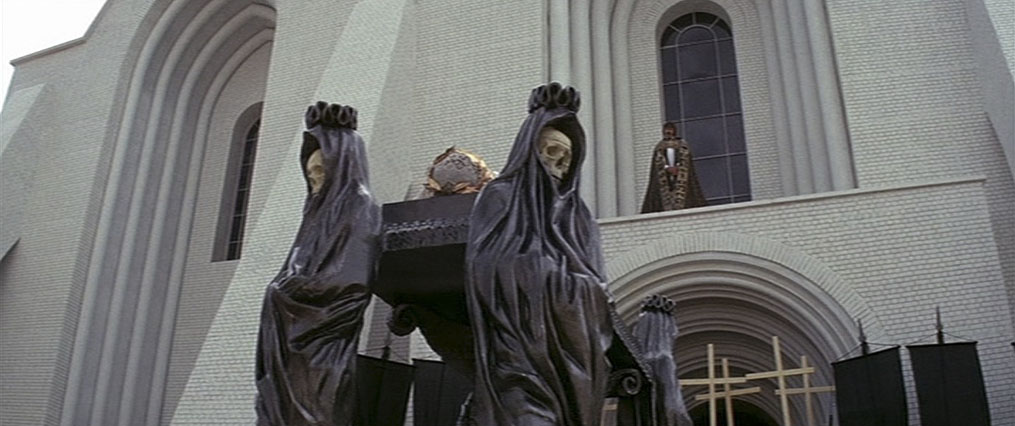
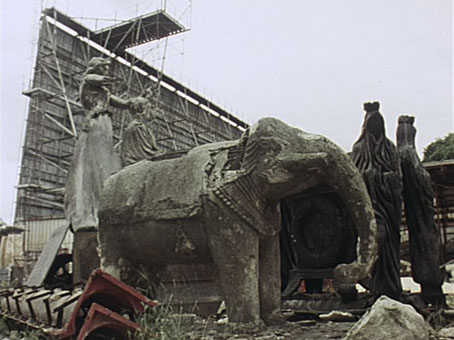
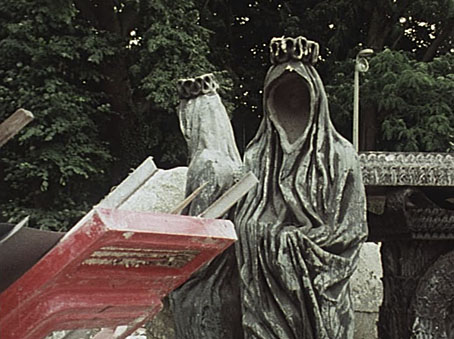
Then there’s this odd coincidence from Return to the Edge of the World, a short documentary made in 1978 in which Powell and actor John Laurie returned to the Scottish island of Foula where they’d made Powell’s first feature film, The Edge of the World in 1937. The film opens with shots of Pinewood studios and the very first things we see are this pair of abandoned statues which anyone who’s seen Ken Russell’s The Devils will recognise from an early scene. Derek Jarman was the production designer on The Devils so these would have been created according to his instruction. I only noticed this recently when watching Return to the Edge of the World again as it’s now an extra on the BFI DVD of Edge of the World. No need to dwell on the inadvertent symbolism of abandoned statues and languishing careers.

Powell and Pressburger’s marvellous The Life and Death of Colonel Blimp was reissued recently. John Patterson discussing its writer and director tells us why the most English of movies often benefit from an outsider’s perspective.

return2.jpg

Previously on { feuilleton }
Rex Ingram’s The Magician
The Devils on DVD
Derek Jarman’s music videos
Derek Jarman’s Neutron
Mister Jarman, Mister Moore and Doctor Dee
Powell’s Bluebeard
The Tale of Giulietta
The Tempest illustrated
In the Shadow of the Sun by Derek Jarman
The Angelic Conversation
The life and work of Derek Jarman