The Book of the Lost

botl.jpg

A recurrent feature of the music landscape of the late 80s and early 90s was the “soundtrack for an imaginary film”, a sub-genre that proved especially popular among the electronica crowd when DJs realised they needed a description to justify their collections of downtempo instrumentals. Two of my favourite examples were produced away from the dance world: John Zorn’s Spillane (1987), and Barry Adamson’s solo debut Moss Side Story (1989), both of which took their thematic cues from crime novels and film noir. The artists on the Ghost Box label haven’t gone down the imaginary film route but many of the tracks on the Belbury Poly and Advisory Circle albums are reminiscent of TV theme tunes from the 1970s. The closest you get to an imaginary film in the Belbury sphere is the unseen giallo horror in Peter Strickland’s Berberian Sound Studio with its score by Ghost Box allies Broadcast, and a title sequence by Julian House.

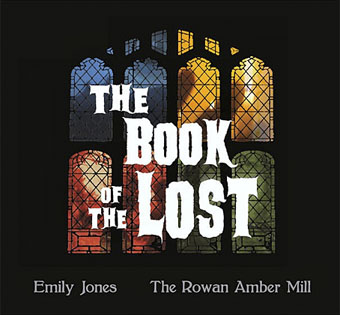
Given all of this, The Book of the Lost, a collaboration between Emily Jones and The Rowan Amber Mill, is a logical next step: a CD collection offering a theme from a forgotten TV series “shown on Sunday nights in the late ’70s and early ’80s” which broadcast four of the equally forgotten horror films upon which the accompanying songs are based. Between each song you hear a brief snatch of dialogue, just enough to whet the appetite without getting too involved. One of the films referred to, The Villagers, belongs to that current of British folk-horror that runs through Witchfinder General, and Blood on Satan’s Claw, to Ben Wheatley’s intoxicatingly weird A Field in England. Pastiching aside, all projects of this kind depend upon the quality of the music, and the folk-inflected songs here are very good, as is the Book of the Lost theme itself which is as spookily evocative as Jon Brooks’ Music for Thomas Carnaki.
botl2.jpg

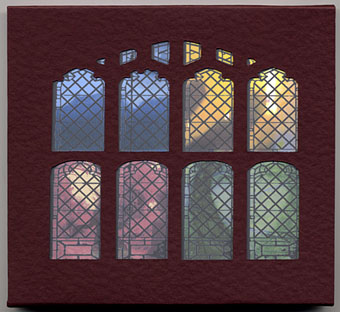
If that wasn’t enough, there’s a special numbered edition of the CD which comes packaged in a die-cut slipcase (above) containing cards giving details of each of the films. In addition to promotional artwork there’s also a synopsis, a production history and even a cast list. Other films are mentioned in passing—The House that Cried Wolf, Ghosts on Mopeds—that imply there was a lot more happening in Wardour Street in the 1970s than we previously suspected.

The Book of the Lost isn’t officially released until January but it’s available for purchase now at the project website.

Previously on { feuilleton }
The Outer Church
The Ghost Box Study Series
A playlist for Halloween: Hauntology
The Séance at Hobs Lane
Ghost Box

A mix for Halloween: Ectoplasm Forming

Ectoplasm Forming by Feuilleton on Mixcloud

Presenting the eighth Halloween playlist, and this year I decided it was time to finally make a proper mix of my own. Reluctance in years past has been mainly a result of the time it takes me to put things like this together, hours spent pondering the order of the tracks, and fine-tuning transitions.

This year’s mix is rather heavy on the drones and eldritch atmospherics with little in the way of songs. There are some rhythms, however. I’ve also taken the opportunity to highlight the ongoing excellence of Emptyset, some of whose recordings I’ve been helping design recently. Their Medium album involved installing a quantity of electronic equipment in an allegedly haunted building, a process similar to that undertaken by the unfortunate doctor in The Legend of Hell House, albeit with better results.

The tracklist is on the Mixcloud page but I’m repeating it here with dates added for each recording. One likes to be thorough.

The Legend of Hell House – Dialogue (1973)
Emptyset – Demiurge: Of Blackest Grain To Missive Ruin (Paul Jebanasam Variation) (2012)
Arne Nordheim – Solitaire (1969)
David Lynch – The Air Is On Fire Pt. 7 (2007)
Ben Frost – The Carpathians (2009)
The Wyrding Module – Subtemple Session II (edit) (2013)
:Zoviet*France: – On The Edge Of A Grain Of Sand (1996)
John Zorn – Lucifer Rising (2002)
Jarboe – A Sea Of Blood And Hollow Screaming… (2009)
The Haxan Cloak – Excavation (Part 1) (2013)
Emptyset – Medium (2012)
Jon Brooks – Experiments With A Medium (2011)
Wendy Carlos – Visitors (2005)
The Advisory Circle – Eyes Which Are Swelling (2007)
Bernard Szajner – Chant Funèbre (1981)
Emptyset – Function: Vulgar Display Of Power (Roly Porter Variation) (2012)

Previously on { feuilleton }
A playlist for Halloween: Hauntology
A playlist for Halloween: Orchestral and electro-acoustic
A playlist for Halloween: Drones and atmospheres
A playlist for Halloween: Voodoo!
Dead on the Dancefloor
Another playlist for Halloween
A playlist for Halloween

Interzone: A William Burroughs Mix

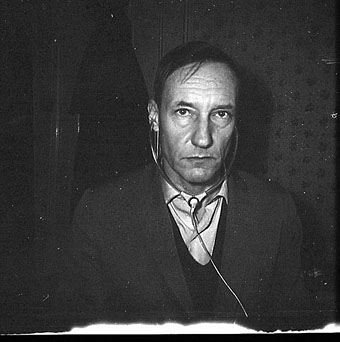
burroughs.jpg

Interzone is a selection of William Burroughs recordings mixed with electronic music and other pieces such as extracts from Howard Shore & Ornette Coleman’s Naked Lunch soundtrack:

A tribute to ‘El Hombre Invisible’. It features some of my favourite readings, to which I’ve added music by John Zorn (from his Burroughs-inspired work), Tod Dockstader, Arne Nordheim and others. Also in the mix are radio recordings and vocal cut-ups by the man himself.

The curator is Mixcloud user Timewriter, one of whose mixes I linked to last Halloween. I was surprised to find I’d already downloaded the Burroughs mix from the Timewriter blog, Include Me Out, but hadn’t managed to listen to it. Better late than never. This week seems a good time to draw attention to both the mix and that blog in general which features among its posts a quantity of Burroughs-related ephemera. Many of the mix readings are from the albums of Burroughs’ tape recordings from the 1960s, including Nothing Here Now But The Recordings, the collection of tape experiments released by Industrial Records in 1981. The latter is essential listening for anyone who appreciates Burroughs’ early novels; some of its pieces such as Last Words of Hassan Sabbah sound less like readings of the author’s work than actual artefacts from the books themselves.

Elsewhere on { feuilleton }
The William Burroughs archive

A playlist for Halloween: Orchestral and electro-acoustic

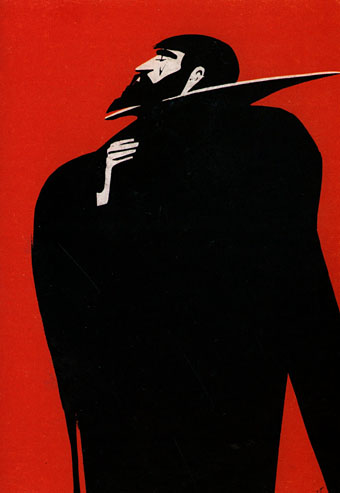
kass.jpg

Bluebeard (1982) by János Kass.

I thought I might not be able to do a fresh playlist this year, so much has already been covered by the previous lists (see the links below to earlier posts).

The search for new tonalities and timbres in 20th-century orchestral music led many composers to produce works that sound like—and have been used as—horror film soundtracks although you’ll never find critical discussion acknowledging such a vulgar reaction. This is a very masculine list although some of the performers are women. I might have included Diamanda Galás but she was in the first list, as was Delia Derbyshire with her associates in White Noise, the subject of a longer post here.

The Isle of the Dead (1909) by Sergei Rachmaninov
Mentioned here a few days ago, Rachmaninov’s suitably sombre piece is one of many compositions to borrow the medieval Dies Irae hymn for one of its themes.

Bluebeard’s Castle (1911) by Béla Bartók
Frank Zappa once said that his initial response upon hearing the music of Edgard Varèse was “These chords are mean; I like these chords.” I feel the same about Bartók’s music which can get very mean indeed. The obvious piece to mention would be the Adagio from Music for Strings, Percussion and Celeste which Stanley Kubrick used in The Shining. Instead I’ve selected Bartók’s only opera, a psychodrama for two performers and orchestra in which Bluebeard’s new wife, Judith, explores the castle (which also represents her husband’s character) only to find everything there stained with blood.

Visage (1961) by Luciano Berio
In which Berio records his wife and frequent collaborator, Cathy Berberian, then dissects her vocalisations to disturbing effect. “Visage contains no singing, and virtually no words,” says Martin Butler. “The product of days of gruelling recording for Berberian (leaving her physically damaged), it instead consists of her laughter, moans and groans, snorts and wheezes, and gibberish, all brilliantly edited, filtered, distorted and mixed with electronic backing. It is a remarkable demonstration of the power of the wordless voice. The effect is shocking and extreme, but also hilarious and touching – and often all these things simultaneously.”

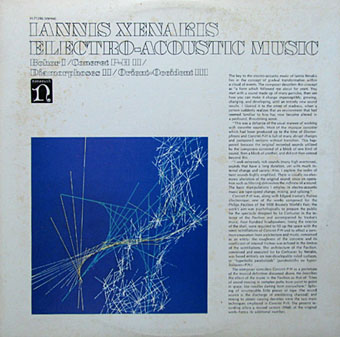
Bohor (1962) by Iannis Xenakis
In addition to making some of the most thrilling and advanced new music of the 20th century, Xenakis chose great titles for his compositions, frequently unusual words. Bohor is a recording of layered sound sources that include a Laotian mouth organ, prepared piano, Iraqi and Hindu jewellery, and should ideally be heard with the sounds surrounding the listener. Intended by its composer to represent “the onset of madness”.

xenakis.jpg

Design by Paula Bisacca.

Uaxuctum: The Legend of the Maya City, Destroyed by Themselves for Religious Reasons (1966) by Giacinto Scelsi
And speaking of great titles… The Italian composer uses orchestra, a choir and an Ondes Martenot to convey an ancient apocalypse. Part III was selected by Robbie Robertson (along with works by other composers listed here) for the Shutter Island soundtrack.

Lontano (1967) by György Ligeti
Stanley Kubrick used Ligeti’s music in three of his films. Lontano‘s piercing harmonics and growling chords prowl through The Shining together with pieces by Bartók and Penderecki.

Black Angels: Thirteen Images from the Dark Land (1970) by George Crumb
Many of the pieces here jangle the nerves but none more than Crumb’s composition for string quartet, glass and metal instruments, a part of which is used in The Exorcist. Composed “in time of war”, it’s a howl of despair whose opening manages to be even more disturbing than Penderecki’s Threnody for the Victims of Hiroshima. The 1990 Kronos Quartet recording is essential.

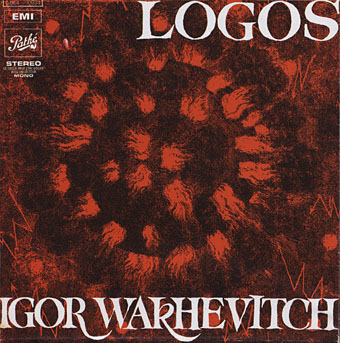
logos.jpg

Logos (Rituel Sonore) (1970) by Igor Wakhévitch
“Sound ritual for pop group, mixed choir and magnetic tape.” The first album by the elusive French composer, a composition for a ballet, described by Alan Freeman as “a soprano singer, strange orchestral textures and percussives (drums, cymbals, gongs, etc.) blended with effects and processing. As the ominous percussion sets off with drum-rolls and ritualistic tension, the mood is of a looming anticipation of what is to come. Here we go through phases of weird swirling effects, vivid reverb and atmosphere. The tension becomes overpowering, yet we are led on…”

The Dream of Jacob (1974) by Krzysztof Penderecki
The Polish composer wrote for film soundtracks as well as the concert hall so it’s no surprise that his work can be heard in The Exorcist, The Shining and Shutter Island. The atmosphere of sustained malevolence in this piece is perfect for Kubrick’s haunted house. Whatever Jacob was dreaming about, it wasn’t pleasant.

zorn.jpg

Design by Heung-Heung Chin.

Necronomicon (2004) by John Zorn
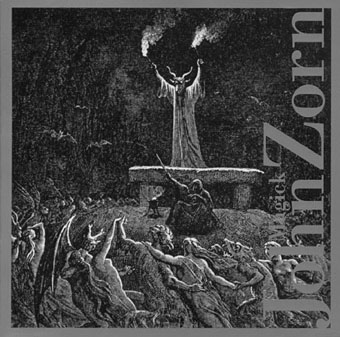
A five-part composition for string quartet from Zorn’s Magick album.

Previously on { feuilleton }
Powell’s Bluebeard
A playlist for Halloween: Drones and atmospheres
A playlist for Halloween: Voodoo!
Dead on the Dancefloor
Another playlist for Halloween
A playlist for Halloween
The music of Igor Wakhévitch

The Hourglass Sanatorium by Wojciech Has

hour-glass1.jpg

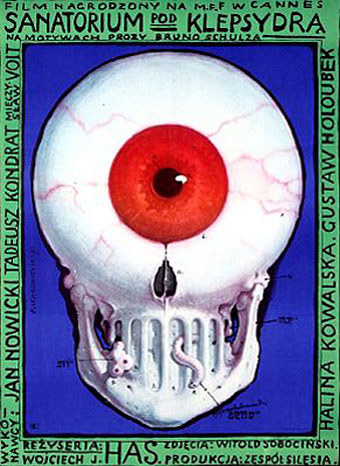
The original Polish poster by the incredible Franciszek Starowieyski.

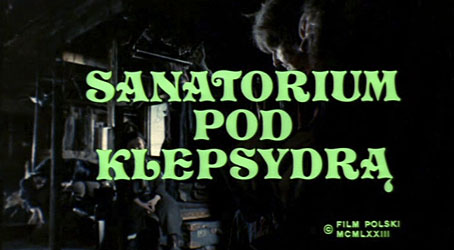
The shrinking pool of films still unavailable on DVD contracted by at least one title recently with the surprise appearance in the UK of The Hourglass Sanatorium (Sanatorium pod klepsydra; 1973) from the distinctively-named Mr Bongo Films. I’ve been waiting to see this for at least twenty years so being able to walk into Fopp and buy a copy for a mere £12 strikes me as one of those small but rarely acknowledged miracles of contemporary existence.

hour-glass2.jpg

Director Wojciech Has is  better known for his long and weird 1965 adaptation of the equally long and weird Saragossa Manuscript, a rambling semi-fantastical novel by Jan Potocki from around 1805. David Lynch described Saragossa as “Simultaneously horrific, erotic and funny…this is one mother of a film,” and the same description could be applied to The Hourglass Sanatorium, as far as I’m aware the only other excursion Has made into full-on strangeness. If anything, Sanatorium outdoes the earlier film on just about every level. Readers familiar with the writings of Bruno Schulz will already have recognised the title as being a truncated variant of Sanatorium Under the Sign of the Hourglass, the second and final collection of Schulz’s unique and very strange stories.

Continue reading “The Hourglass Sanatorium by Wojciech Has”