Weekend links 303

belbury.jpg

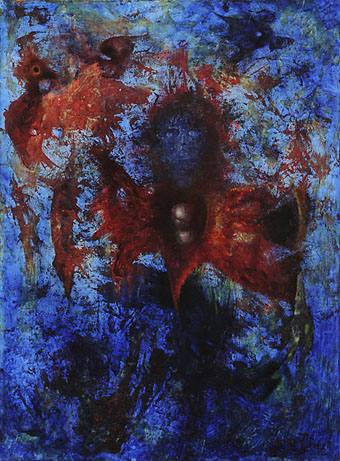
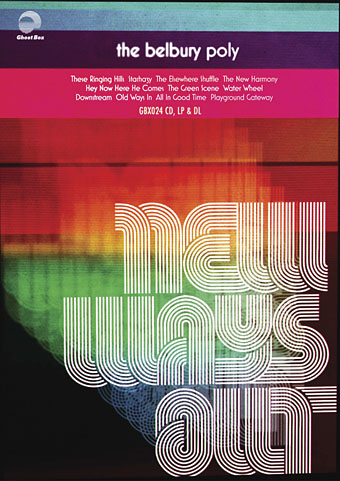
Design by Julian House.

• The last major release by Ghost Box recording artists Belbury Poly was The Belbury Tales in 2012, so news of a new album is most welcome. New Ways Out by The Belbury Poly (that definite article is a fresh addition) will be released next month. The Belbury Parish Magazine has links to larger copies of Julian House’s artwork for this and the recent release from Hintermass, The Apple Tree.

But before New Ways Out appears there’s a compilation album from A Year In The Country released at the end of April. The Quietened Village is “a study of and reflection on the lost, disappeared and once were homes and hamlets that have wandered off the maps or that have become shells of their former lives and times. Audiological contents created by Howlround, Time Attendant, The Straw Bear Band, Polypores, The Soulless Party, The Rowan Amber Mill, Cosmic Neighbourhood, A Year In The Country, Sproatly Smith, David Colohan and Richard Moult.” I’ve been fortunate to hear an advance copy, and it’s an excellent collection.

• “London’s architecture has become laughably boorish, confidently uncouth and flashily arid,” says Jonathan Meades in a review of Slow Burn City: London in the Twenty-First Century by Rowan Moore.

I feel very ill, physically and mentally ill when I hear Christmas carols. I feel so angry, so much like getting out a sniper’s rifle when I hear that kind of music. And Broadway shows with their sentimental songs, those kinds of things are terrifying for me because they call up memories from far back and I don’t necessarily know what they are but they just break me, they break my heart, they break my soul. Iannis Xenakis, the great Greek composer, he said the same thing. He couldn’t listen to the music his mother had played to him when he was young, because it was akin to thinking of someone who was disemboweled. And so for me, if I do a song that’s what you’d say is pretty, my interpretation takes it to another place because it shows the death of the virgin, the animal that goes out in the spring and then gets shot by a hunter. It is prettiness that is very alarming to me, so I tend to do a juxtaposition of something that might be pretty with something that is harsh, just because I feel that they occur in life together.

Diamanda Galás talking to Louise Brown about her work

The Fantastical Otherworlds of Adam Burke: S. Elizabeth talks to the artist behind Nightjar Illustration.

• “I try to frighten myself”: Master musician and curator David Toop on his extraordinary cassette tape archives.

• Silver Machine: Hawkwind’s Space Rock Journey throughout Science Fiction and Fantasy by Jason Heller.

• Mixes of the week: Secret Thirteen Mix 179 by Mesmeon, and a new Italian Occult Psychedelia Festival Mix.

• Offset Identities: Kenneth FitzGerald on graphic designer Barney Bubbles.

The Cine-Tourist lists some of the many cats in the films of Chris Marker.

John Patterson on Ran (1985), Akira Kurosawa’s last great masterpiece.

• Britain’s scarecrows photographed by Colin Garratt.

Strange Flowers explores the city of Turin.

The Museum of Talking Boards

Giallo-themed playing cards

Origami bookmarks

Silver Machine (1972) by Hawkwind | Silver Machine (1973) by James Last | Silver Machine (1988) by Alien Sex Fiend
All About Being Loud

lemmy.jpg

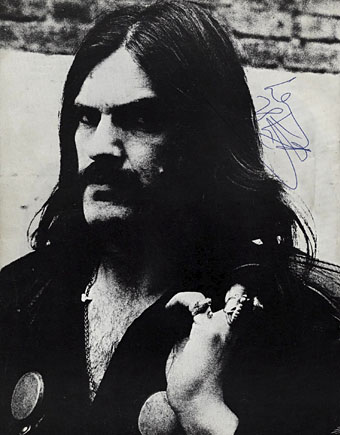
Photo by Motorcycle Irene.

It was very loud. The crowd roared and some yelled “It’s not loud enough!” Lemmy said “Oh” and turned his amp up more, before they went into Keep Us On The Road which was very loud until Lemmy’s amp gave up its internal struggle and was replaced on the run while Eddie (Clarke, the guitarist) played the riff over and over. At the end of the number earlier complaints bellowed “Turn it up, it’s not loud enough!” to which Lemmy rejoined—”I can’t get it no damn louder, shut your trap”. Never the less, the new amp was miked up thru the P.A., so Lost Johnny was very, very loud and The Watcher was louder still. At the end of it Lemmy apologized for being so quiet and said the band were as disappointed as everyone else about not being louder. Then they played Iron Horse, which was as loud as a Tube train running through your inner ear or as loud as the First World War if they crammed the whole thing together and held it in a phone booth.

Paul Sutcliffe, gig review, Sounds

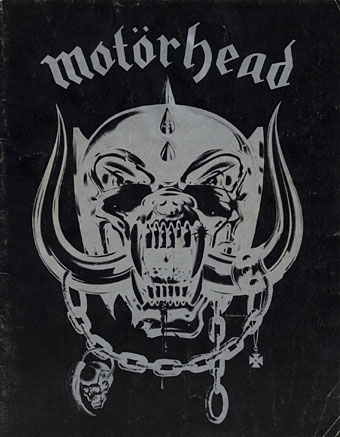
Paul Sutcliffe’s quote is on the back page of a Motörhead tour programme from 1978, a publication that’s also the source of the moody signed portrait above. Despite hanging around with metal-heads and bikers in my idle youth I never got to see Motörhead live, the tour programme—signed by all three band members, and aptly titled All About Being Loud—was a gift from a friend. Years ago I scanned the whole thing and turned it into a PDF to send to another friend so I’ve uploaded it here. Most tour programmes are rather pedestrian affairs but the Motörhead one shows the band’s sense of humour, being a collection of quotes testifying to the loudness of their shows with the page backgrounds filled out by ads for hearing aids. The Q&A notes for each band member are also revealing for mentioning three songs from the psychedelic 60s. Lemmy always spoke of his fondness for classic rock’n’roll (Motörhead covered Louie Louie in their early days) but it’s a surprise seeing him list Sour Milk Sea by Jackie Lomax as his favourite single. His album choice—Back In The USA by The MC5—is more the kind of thing you’d expect. Eddie Clarke’s favourite single is Purple Haze, while the late Phil Taylor has Itchycoo Park by The Small Faces listed with Anarchy In The UK.

motorhead.jpg

Art by Joe Petagno.

So I never got to see Motörhead play but in 1984 I did provide the cover art for Hawkwind’s Night Of The Hawks EP, a 12-inch single that featured Lemmy as guest bassist and vocalist on his first recording with the group after being sacked following a drug bust in 1975. I may no longer like the artwork but the EP was also dedicated to Barney Bubbles so it was a good thing to be involved with. As for Lemmy, everyone will be (and is) linking to Ace Of Spades but I’d offer Capricorn from the Overkill album as a memorial number. I always liked Jimmy Miller’s reverberant production, and the lyrics make it a musical self-portrait.

Weekend links 283

wassmann.jpg

Behind by Lisa Wassmann.

• “Without space art, nobody would know what Mars would look like.” Artist David A. Hardy talking to Nadja Sayej about a life spent painting the cosmos and—briefly—working for Hawkwind. Visions of Space, an exhibition of astronomical art, is at the Wells & Mendip Museum throughout November.

• Mixes of the week: Something Beautiful Happened by Cafe Kaput; Autumn Vybes: Mist, Mystery and Motion by Abigail Ward; and Secret Thirteen Mix 166 by Ron Morelli.

• More Ghost Box: Two new singles in the Other Voices series will be released next month. And the label is profiled in the latest issue of Electronic Sound magazine.

It breaks my heart when one writer tells another what she can or cannot do. I once knew a woman, a professor of literature, who said that Flaubert had no right to write Madame Bovary because he was a man. Such dangerous foolishness! This is just another form that dogmatic thinking takes. And it seems to me that the imagining mind—which is also a profoundly human mind—must be unfettered, boundless. To write from the perspective of another’s world demands a generous and a rigorous leap of the spirit; it demands empathy and mindfulness. Writing is so much about subverting dogmatisms of all kinds, above all the ones that insist you cannot go there! You must not say that! Writers need to go anywhere, to take anything on. And the only rule is to do it well.

Rikki Ducornet in a retrospective feature at Dennis Cooper’s blog

• “Horror at its best has always existed outside the mainstream,” says Brian Ennis in another celebratory piece about Thomas Ligotti.

• Alan Clarke & David Rudkin’s Penda’s Fen receives another cinema screening next week at the Sallis Benney Theatre, Brighton.

• “[David] Lynch’s films abound with gnomic pronouncements and incantations,” says Dennis Lim.

Stars of the Lid play a tremendous hour-long set at St. Agnes Church in Brooklyn.

Drawn in Stereo: a book of music-related art and illustration by Michael Gillette.

• At Dangerous Minds: Only the coolest people get to sit in the wicker peacock chair.

Everything Is Erotic Therefore Everything Is Exhausting by Johanna Hedva.

Moon Mist (1961) by The Out-Islanders | River Mist (1989) by Brian Eno | Black Mist (Long Version) (2013) by Pye Corner Audio

Weekend links 281

fini.jpg

Chimère du soir (1961) by Leonor Fini. Réalisme irréel is an exhibition of Fini’s work currently running at the Weinstein Gallery, San Francisco.

• ” ‘Paris invented the flâneur,’ he notes, ‘and continues to press all leisurely and attentive walkers into exercising that pursuit, which is an active and engaged form of interaction with the city, one that sharpens concentration and enlarges imaginative empathy and overrides mere tourism.’ ” David L. Ulin reviewing The Other Paris by Luc Sante.

• “A lot of posters promise so much that how can they ever deliver?” Nicolas Winding Refn talking to Mat Colegate about his book, The Act Of Seeing, a collection of posters for exploitation films.

• “Sexuality is present throughout and often subverts a narrative we might read entirely differently from a straight poet.” Callum James reviews Physical by Andrew McMillan.

This movie will lose a lot of people along the way, but then again, as far back as 1962, Ballard wrote a manifesto for a new form of science fiction, Which Way to Inner Space?, in which he insisted that “from now on, most of the hard work will fall, not on the writer, but on the readers. The onus is on them to accept a more oblique narrative style, understated themes, private symbols and vocabularies.” This is exactly what Wheatley wants from his audience.

Mike Holliday comparing Ben Wheatley’s forthcoming film of High-Rise with JG Ballard’s novel. Ballard’s suggestion for a new SF now seems increasingly like a road not taken. But that’s another discussion entirely…

The Lost Library of John Dee, an exhibition of books owned by the Elizabethan magus, opens at the Royal College of Physicians museum, London, in January.

Clive Hicks-Jenkins has been writing about his illustration heroes including Alexander Alexeieff.

Cameron: Cinderella of the Wastelands. The exhibition has just finished but the art is still online.

• Mixes of the week: FACT Mix 518 by Fis, and Secret Thirteen Mix 165 by Damien Dubrovnik.

• At Dirge Magazine: Tenebrous Kate on Fantômas, the French King of Crime.

• Suitably seasonal: Polish Night Music by David Lynch & Marek Zebrowski.

Kickin’ In, a previously unreleased EP of music by Patrick Cowley.

Jean-Michel Jarre‘s favourite albums.

Seeing It As You Really Are (1970) by Hawkwind | Seeing Out The Angel (1981) by Simple Minds | Seeing Red (1998) by Red Snapper

The Chronicle of the Cursed Sleeve

blacksword7.jpg

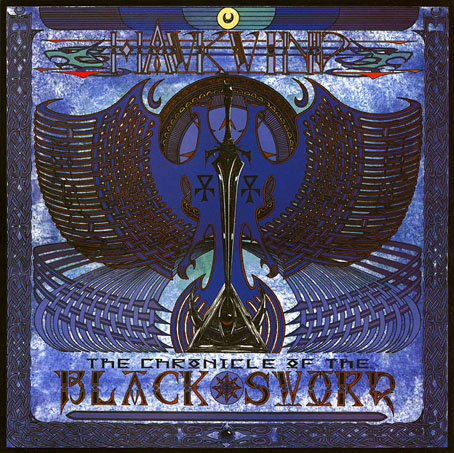
A copy of the cover art that I attempted to colour-correct some years ago to compensate for the poor print reproduction.

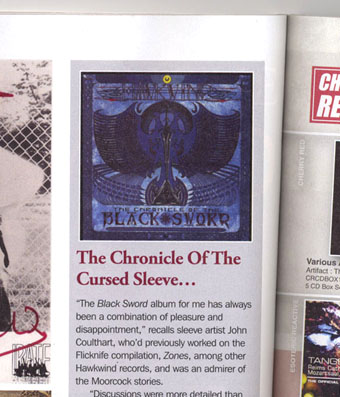
This month I’m in Record Collector magazine talking in a sidebar feature about my work on the Hawkwind album The Chronicle of the Black Sword. The issue is Hawkwind-heavy, with a Nik Turner interview, a history of Flicknife Records (the label that released COTBS), and a retrospective feature on the Black Sword album which was released in December 1985. My words were slightly cut to fit the allotted space but I can run the full text here in which I describe my ambivalent feelings towards this particular cover.

blacksword8.jpg

The Black Sword album for me has always been a combination of pleasure and disappointment. I was very pleased initially to hear that Hawkwind were writing a concept based on the Elric books, a series I’d enjoyed for many years. Cover discussions were a little more detailed than usual since this design was sketched out beforehand then approved by the Dave Brock and co. Prior to this I’d been creating something vague after equally vague requests; communication back then was all done via post and call box as I didn’t own a phone.

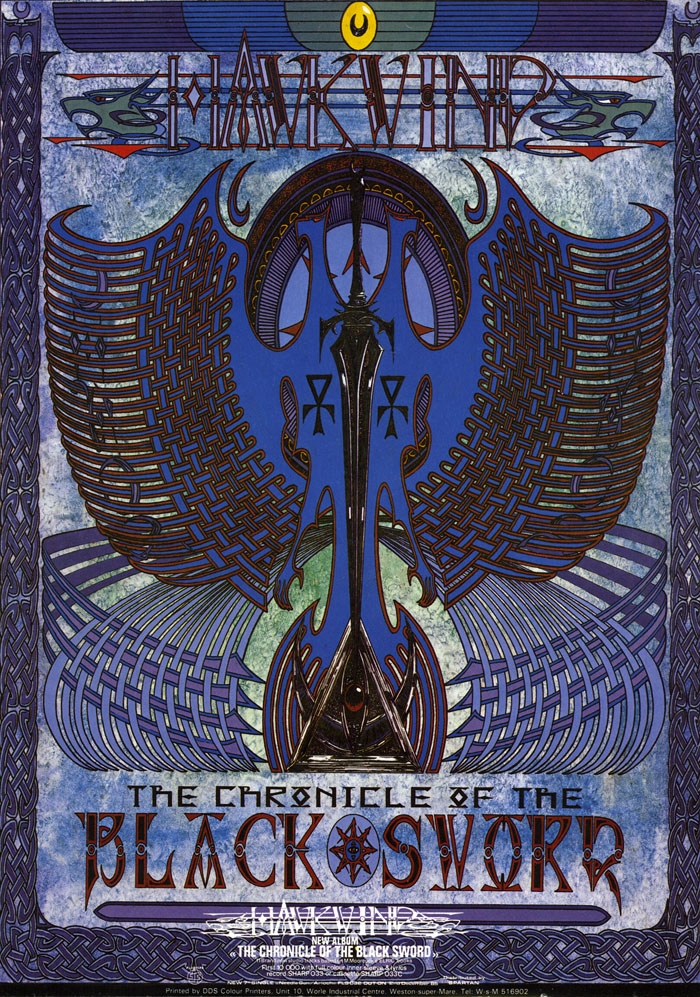
This was the first album where I was able to create an integrated front and back cover design. A friend had recently found me a copy of George Bain’s Celtic Art: Its Methods of Construction (1951), a study of the creation of Celtic knotwork, and I was keen to use this somehow. Rather than do a cover that looked like a fantasy paperback the idea was to use the knotwork style to create something that was suitably Hawkish whilst also fitting the Elric theme. The front cover has some nods back to earlier Hawkart in the winged sphere—which goes back to Barney Bubbles and his obsession with Ancient Egypt—and the eye-in-a-triangle, a symbol which first appeared on the cover of the Hawklog booklet in the In Search of Space album, and which I scattered throughout many of my Hawkwind designs.

All the lettering on the album was hand-drawn (not very well in places) using letterforms based on Bain’s examples from the books of Kells and Lindisfarne. I drew the track listing onto the artwork for the back cover, a decision that later proved to be a bad one when the band decided to change the running order of the songs, hence the large purple square that spoils the design. My lack of any direct contact with the record company made problems like this inevitable; I was trying to do graphic design at a distance without having any communication at all with the printers responsible for the sleeve. Before digital design, the creation of an album cover could be a complicated business involving photo-mechanical transfers, knockout areas, overlays, typesetters and more; if you weren’t in direct contact with the printer (or somebody who was) then you simply had to hope for the best.

This process of design-at-a-distance led to the disaster with the cover printing, the front of which has an unwarranted blue cast that dulled the impact of the sleeve and, for me, ruined the whole thing. You can see how the cover should have looked by comparing the background colours of front and back; the front was also printed in its true colours on the back page of the 1985 tour programme. It was this, and the messy appearance of the lettering on the back, that pushed me further towards ending my involvement with Hawkwind and doing something of my own over which I’d have complete control.

blacksword1.jpg

The retrospective feature in the magazine includes a picture of the back cover of the tour programme (above) so those familiar with the album can see the difference in reproduction. The difference isn’t so noticeable on the copies posted here after I tried altering the tones of the cover. Over the years I’ve grown used to the blueness but the back cover remains blighted by its purple boxes.

Continue reading “The Chronicle of the Cursed Sleeve”