
Weekend links 63

solaris.jpg

Polish poster by Andrzej Bertrandt for Andrei Tarkovsky’s 1972 film of Solaris.

• Stanisław Lem’s Solaris receives its first ever direct English translation by Bill Johnston (only on Audible for the moment), all previous editions having been sourced from a poor French translation. An all-too-common state of affairs for non-English fiction where bad or bowdlerised translations persist for years.

• Now that Minnesota politician Michelle Bachmann is running for US president it’s a good time to examine her views when (theoretically) her actions could one day impact on us all. The Daily Beast gathered together some of her worst pronouncements, including the following about gay people: “It’s a very sad life. It’s part of Satan, I think, to say that this is gay.” Her husband describes his attempts to counsel (ie: cure) gay teenagers with the words “Barbarians need to be educated.” It’s no surprise that both these people find confirmation of their views in the usual narrow interpretation of Christian doctrine. Not all American Christians are this ignorant or offensive, of course. The Heartland Proclamation calls for “an end to all religious and civil discrimination against any person based on sexual orientation and gender identity and expression”.

Journalist Andrew Sullivan in 2003 proposed a label for people like Bachmann: “I have a new term for those on the fringes of the religious right who have used the Gospels to perpetuate their own aspirations for power, control and oppression: Christianists. They are as anathema to true Christians as the Islamists are to true Islam.” It’s a term that ought to have more widespread use.
solaris-czech.jpg

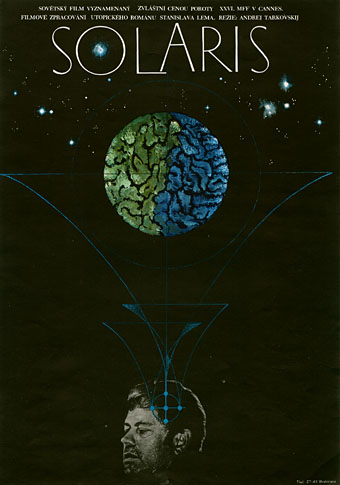
Czech poster for Solaris. No designer credited.

• Probing the secrets of psilocybin: “Scientists at the Johns Hopkins University School of Medicine have zeroed in on the dose levels of the ‘sacred mushroom’ chemical capable of yielding positive, life-changing experiences, while minimizing the chance of transient negative reactions in screened volunteers under supportive, carefully monitored conditions.”

• Rick Poynor relates a visit to the Frederic Marès Museum, Barcelona, home to the 50,000 objects Marès collected over his lifetime. Further details of the collection can be found at the museum website.

In her 1969 essay “The Pornographic Imagination,” [Susan] Sontag insisted that Story of O could be correctly defined as “authentic” literature. She compared the ratio of first-rate pornography to trashy books within the genre to “another somewhat shady subgenre with a few first-rate books to its credit, science fiction.” She also maintained that like science fiction, pornography was aimed at “disorientation, at psychic dislocation.”

If so, that aim is far more interesting than what most generic “mainstream” novels set out to do. No one could describe O as predictable or sentimental. Its vision was dark and unrelenting; everything about it was extreme. Sontag also compared sexual obsession (as expressed by Réage) with religious obsession: two sides of the same coin.

Carmela Ciuraru on the story of The Story of O by Pauline Réage.

• “No hay banda! There is no band. It is all an illusion.” David Lynch will be opening a Club Silencio in Paris (Montmartre, of course). Facebook pages here and here.

• Sad to say that Chateau Thombeau is now closed but Thom has begun a more personal journal here.

• Picture galleries of the Vorticists at the Tate here and here. Related: Into the Vortex.

• Illuminated Persian pages from 1604 at BibliOdyssey.

• Tape drawings by Chris Hosmer.

• Miles Davis and co. at the Isle of Wight Festival, 1970: part 1 | part 2 | part 3 | part 4
Miwa Yanagi’s fairy tales

yanagi.jpg

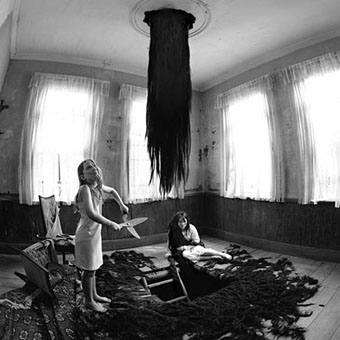
Rapunzel (2004).

Emphasising the “grim” in the Brothers Grimm is what Japanese artist Miwa Yanagi achieves with Fairy Tale, a series of staged photos. It’s a familiar approach, of course, mining childhood for a darker subtext, and the effect is reminiscent in places of earlier explorers of this disturbing territory such as David Lynch and Jan Švankmajer. But Yanagi adds some twists of her own, not least the alarming figures of young girls masked to resemble old women. Despite being based on tales from the West, there’s a distinctly Eastern flavour to some of these scenes: in Rapunzel the usual golden locks have become a black torrent which can’t help but seem sinister when one recalls the legacy of supernatural hair in ghost stories like Yotsuya Kaidan.

fairytale.jpg

There’s a catalogue of these works available although the text may well be Japanese-only. And speaking of Švankmajer, it’s worth noting again that Alice is now available on DVD. David Moats enthuses about the film here.

Thanks to Gabriel for the Yanagi tip!

Previously on { feuilleton }
Kwaidan
The art of Maleonn Ma

Deutsche Kunst und Dekoration #11

dkd11-01.jpg

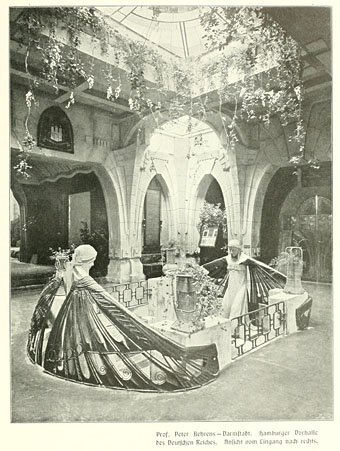
Continuing the delve into back numbers of Deutsche Kunst und Dekoration, the German periodical of art and decoration. Volume 11 covers the period from October 1902 to March 1903, and is almost solely devoted to the many design exhibits from the Prima Esposizione Internazionale d’Arte Decorativa Moderna, a major exposition held in Turin in the summer of 1902. As with the Secession work in the previous edition, many of the featured pieces here are familiar from books about the art and design of the period but DK&D shows them in greater detail. Peter Behrens’ vestibule (above) is one of these, a very advanced design which looks ahead to the stylisations of Art Deco. As before, anyone wishing to see these samples in greater detail is advised to download the entire volume at the Internet Archive. There’ll be more DK&D next week.

dkd11-02.jpg

The vestibule ceiling panel.

dkd11-03.jpg

Another Behrens design which would have still looked modern twenty years later.

Continue reading “Deutsche Kunst und Dekoration #11”

Weekend links 40

peterloo.jpg

Manchester, August, 1819: yeomanry on horseback charge a crowd of demonstrators; London, November, 2010: Mounted police charge demonstrators; London, December, 2010: “…police horses have charged the crowd once and appear to be about to do so again.”

Rise like lions after slumber
In unvanquishable NUMBER!
Shake your chains to earth, like dew
Which in sleep had fall’n on you:
YE ARE MANY–THEY ARE FEW.

Percy Shelley, The Masque of Anarchy (1819).

• Amid the rest of the week’s tumult, discussion and activity around the censoring of David Wojnarowicz’s A Fire in My Belly film at the National Portrait Gallery, Washington DC, continues to rumble on. I’d missed this appraisal of the exhibition at The Smart Set. Hide/Seek: Too shocking for America features an interview with Jonathan Katz, co-creator of the exhibition in the eye of the storm:

“When,” Katz asks, “will the decent majority of Americans stand against a fringe that sees censorship as a replacement for debate?” Hide/Seek sought to conquer what Katz calls “the last acceptable prejudice in American political life” – but the conservative right, rampant after last month’s midterm elections, won’t relinquish their prejudices without a fight. And so, “an exhibition explicitly intended to break a 21-year blacklist against the representation of same-sex desire,” says a dispirited Katz, “now finds itself in the same boat.”

Related: Q&A with Hide/Seek curators Jonathan Katz and David C. Ward. The Smithsonian Institution issued a fatuous statement saying they stand by the exhibition despite having forced the removal of one of its works. One of the NPG commissioners resigned in protest at the gallery’s capitulation to political pressure. Other protestors were banned from the Smithsonian after playing a video of the work on an iPad. There’s video of the iPad protest here and the protestors have their own blog. In my earlier post on the subject I noted that the actions of censorious Catholics have given Wojnarowicz’s work far more public exposure than it would otherwise receive. The LATimes has details of some of the galleries throughout the US showing the video as a result of its removal in Washington.

• Related to the above, Bruce Sargeant and His Circle: Figure and Form, a book by artist Mark Beard about the work of his “Bruce Sargeant” alter ego. Homotography has a preview.

• “We focus most strongly at the margins, on the music that others may be blind to. We don’t care whether it is electronic, metal, jazz, folk, classical, noise, world music or whatever. We are as excited by the experimental, as we are exhausted by the ephemeral. We listen. We mosh. We think. We dance. We write words. We capture images. We hope to do justice to the art which inspires us. We are The Liminal”.

rotary.jpg

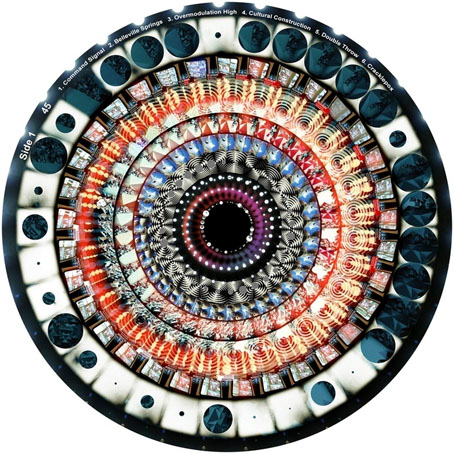
Rotary Signal Emitter, a vinyl zoetrope by audiovisual duo Sculpture.

Rest Easy Sleazy, a small mix dedicated to Peter Christopherson. Related: A Peter Christopherson tribute mix. Another mix: Mixhead was a 1997 promo CD by Portishead.

• Related to the above: What if we could touch our music again? (Hello? Some of us still play—and create—CDs and vinyl…) Is the mix tape as object-of-seduction a dead concept in a virtual world? “We traded connection for convenience,” says I Miss My Pencil. Their proposed solution, C60 Redux, is an RFID reader plus speakers, packaged in a smart 12-inch case.

• Iannis Xenakis: How an architect took music back to mathematical roots. Related: the Xenakis exhibition at MOCA, Los Angeles.

The Body Electric at Ikon, Birmingham, is the first retrospective exhibition in the UK of work by New Zealand artist Len Lye.

Hayley Campbell has a blog. This week you can read about her contribution to Jamie McCartney‘s Great Wall of Vagina.

More David Lynch: he really does love cherry pie but isn’t 100% sure how magnets work. I sympathise on both counts.

2019: A Future Imagined. Visual Futurist Syd Mead reflects on the nature of creativity and how it drives the future.

Quashed Quotatoes by Michael Wood, reviewing a new edition of Finnegans Wake.

New Weird Australia.

• Portishead’s 2008 performance for the Canal+ show Concert Privé is one of their best filmed concerts. YouTube has the whole thing.

Bohren & Der Club Of Gore

bohren.jpg

Black Earth by Bohren & Der Club Of Gore.

How to sustain the atmosphere of something you’ve enjoyed without flogging the work itself to death by repeated viewing? In the case of Twin Peaks, the subject of yesterday’s post, you can indulge yourself with spin-off merchandise like this Garmonbozia T-shirt. Or you could try playing the Twin Peaks Murder Mystery Board Game. I own the latter and while it provides some amusement the reduction of the first season’s enigmas to a set of board game rules doesn’t really work that well. Better by far are the two soundtrack CDs by Angelo Badalamenti, Twin Peaks and Fire Walk With Me, and the first Julee Cruise album, Floating Into The Night. And if that’s still not enough, there’s always Bohren & Der Club Of Gore.

Bohren… are a German “doom jazz” outfit whose origins in the hardcore scene and their enthusiasm for Black Sabbath explains both their name and the appearance of CD covers like the one for Black Earth (2002). But the music within contradicts all expectations. I was first alerted to them a few years ago when I saw them described as being “like the Twin Peaks soundtrack”. An initial “yeah, sure…” scepticism crumbled upon hearing their third album, Sunset Mission (2000), which really does sound like a continuation of Angelo Badalamenti’s slow, dark jazz scores. The fourth album, Black Earth, is better in many ways since it sounds less derivative, further reducing the rhythms to a slow crawl in the manner of doom metal band Earth. In place of the riffs of the doom-meisters you get a sullen saxophone wailing in the dark. Black Earth was followed by the even more minimal Geisterfaust (2005) which happens to have a blue flower on its cover. Coincidence or not? Their most recent album, Dolores (2008), lets some light return with an organ and vibraphone augmenting the slow evolution of each piece. Bohren & Der Club Of Gore are a great band who deserve wider recognition. If you’re a Lynch enthusiast then Sunset Mission and Black Earth are the ones to go for, I’ve been playing them continually all week.

MySpace page
Prowler | Midnight Black Earth

Previously on { feuilleton }
Through the darkness of future pasts
Earth in Manchester