Weekend links 20

wulfing.jpg

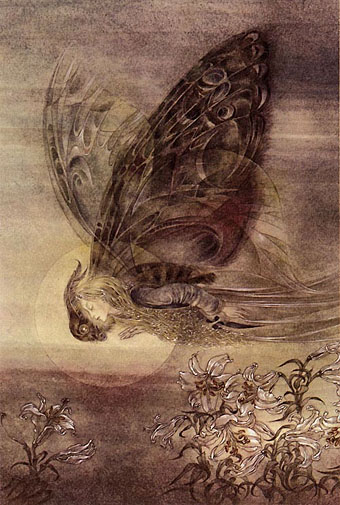
Transfiguration (1952) by Sulamith Wülfing.

• Observatory posted photos of its Lovecraft art exhibition; see if you can spot my pics. Related: Write Club has more photos. Also, A Word From Our Sponsor.

Taking the broooooaaaaad view of things: A Conversation with James Grauerholz on William S. Burroughs and Magick. Related: Beat Memories—The Photographs of Allen Ginsberg.

• Adam Curtis on BP and the Axis of Evil; how the the Anglo-Iranian Oil Company became British Petroleum and helped give Iran over to the Ayatollahs.

• The Quietus interviews Peter Christopherson (TG, Coil, etc) and Dr John.

The Strange World of Adolf Hoffmeister at A Journey Round My Skull.

An Artists’ Dialogue On CocoRosie’s Grey Oceans at Stereogum.

Werner Herzog and David Lynch combine their talents.

Jon Savage on The Residents versus The Beatles.

• BUTT magazine interviews James Bidgood.

• The Daily Drop Cap.

The Gay Rub.

Can on German TV in 1971.

Weekend links 12

archigram.jpg

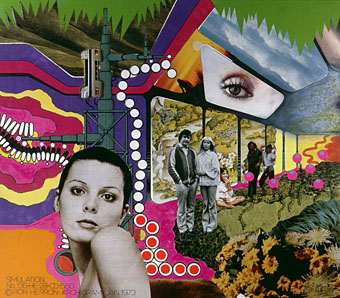
Simulation No. 136 (1973); From the Archigram Revival Project.

Scientific American looks at DMT: “the only psychedelic known to occur naturally in the human body”. Related: Hofmann’s Elixir: LSD and the New Eleusis, a book from the Beckley Foundation Press.

• “People weren’t quite sure what this guy was doing.” Colin Marshall talks to Eno biographer David Sheppard.

• LA FAN presents its debut group show, Eve in the Garden of Lost Angels, curated by Milla Zeltzer, at Optical Allusion Gallery, downtown Los Angeles, from May 15 to June 12, 2010.

Masturbation: literature’s last taboo. The words “last” and “taboo” should never be used together; taboos don’t vanish, they migrate.

Announcing the Text: Development of the Title Page, 1470–1900.

The Anachronism is an award-wining Steampunk short about two children who discover the wreck of a giant squid submarine on a beach near their home.

Out There is a brand new, bi-annual, international magazine for gay men and their friends.

The Big Picture looks at the eruption of Eyjafjallajokull.

Expo 2010 opens in Shanghai on May 1st.

• (Walter) Benjamin in Extremis.

Nathalie returns to Bomarzo.

• Acronymic songs of the week: Lucy In The Sky With Diamonds (1967) by The Beatles; The Stars That Play With Laughing Sam’s Dice (1967) by The Jimi Hendrix Experience; London Social Degree (1968) by Billy Nicholls; Love’s Secret Domain (1991) by Coil.

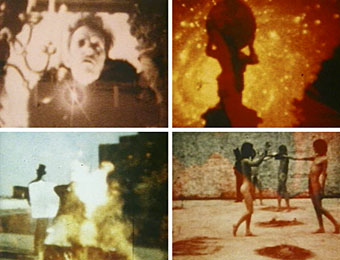
In the Shadow of the Sun by Derek Jarman

shadow_sun.jpg

Extending the recent pagan theme, Ubuweb posts Derek Jarman’s determinedly occult and oneiric film, In the Shadow of the Sun (1980), notable for its soundtrack by Throbbing Gristle. This was the longest of Jarman’s films derived from Super-8 which he made throughout the 1970s between work as a production designer and his feature films. He never saw the low resolution, grain and scratches of Super-8 as a deficiency; on the contrary, for a painter it was a means to achieve with film stock some of the texture of painting. Michael O’Pray described the process and intent behind the film in Afterimage 12 (1985):

In 1973, Jarman shot the central sequences for his first lengthy film, and most ambitious to date, In the Shadow of the Sun, which in fact was not shown publicly until 1980, at the Berlin Film Festival. In the film he incorporated two early films, A Journey to Avebury a romantic landscape film, and The Magician (a.k.a. Tarot). The final sequences were shot on Fire Island in the following year. Fire Island survives as a separate film. In this period, Jarman had begun to express a mythology which he felt underpinned the film. He writes in Dancing Ledge of discovering “the key to the imagery that I had created quite unconsciously in the preceding months”, namely Jung’s Alchemical Studies and Seven Sermons to the Dead. He also states that these books “gave me the confidence to allow my dream-images to drift and collide at random”. The themes and ideas found in Jubilee, The Angelic Conversation, The Tempest and to some extent in Imagining October are powerfully distilled in In the Shadow of the Sun. Jarman’s obsession with the sun, fire and gold (which spilled over in the paintings he exhibited at the ICA in 1984) and an ancient mythology and poetics are compressed in In the Shadow of the Sun with its rich superimposition and painterly textures achieved through the degeneration “caused by the refilming of multiple images”. Jarman describes some of the ideas behind In the Shadow of the Sun:

“This is the way the Super-8s are structured from writing: the buried word-signs emphasize the fact that they convey a language. There is the image and the word, and the image of the word. The ‘poetry of fire’ relies on a treatment of word and object as equivalent: both are signs; both are luminous and opaque. The pleasure of Super-8 is the pleasure of seeing language put through the magic lantern.” Dancing Ledge p.129

Ubuweb also has some of the short films which were used as raw material for the longer work: Journey to Avebury (1971) (with an uncredited soundtrack by Coil), the Kenneth Anger-esque Garden of Luxor (1972), and Ashden’s Walk on Møn (1973).

Update: The Ubuweb films have been removed so I’ve taken out the links. The one for In the Shadow of the Sun now goes to a copy at YouTube.

Previously on { feuilleton }
Derek Jarman at the Serpentine
The Angelic Conversation
The life and work of Derek Jarman

The skull beneath the skin

skull1.jpg

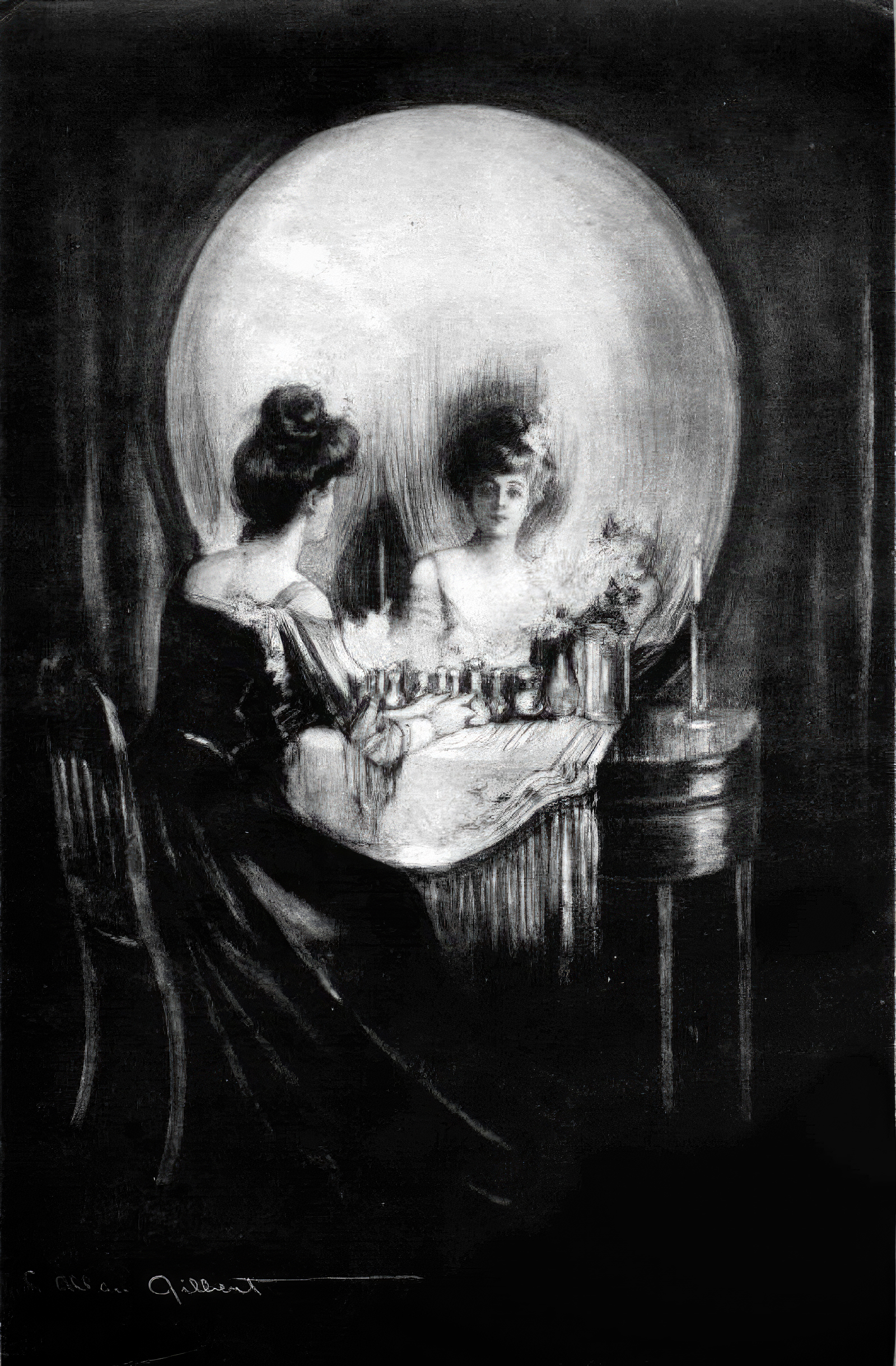
All Is Vanity by Charles Allan Gilbert (1892).

The subliminal skull is another of those perennial motifs that recur in art from time to time, and one which has become especially prevalent since the late 19th century. There seem to be a number of reasons for this, the most obvious being that if you’re going to show how clever you are by hiding one image inside another you may as well make the hidden thing something that everyone recognises. A secondary reason would seem to be the waning power of the vanitas theme. As painting became more pictorially sophisticated it wasn’t enough to simply show a skull and expect people to accept this with a stern moral as the principal content. Hence the development of death as a non-skeletal character in Symbolism and the reduction of skulls in pictures to a kind of playful game.

Holbein’s anamorphic skull in The Ambassadors is probably the grandfather of all the later versions but the more recent popularity of the hidden motif can be traced back to Charles Allan Gilbert whose 1892 picture, All is Vanity, drawn when he was just 18, was sold to Life Publishing in 1902, and subsequently spread all over the world in postcard form. Despite giving birth to a host of imitators, Gilbert’s picture is the one that still inspires artists and photographers up to the present day.

Continue reading “The skull beneath the skin”

The Angelic Conversation

angelic_jarman.jpg

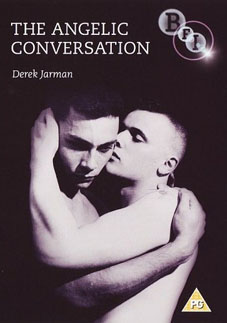
Title by John Dee, words by William Shakespeare, narration by Judi Dench and music by Coil; Derek Jarman’s oneiric film/poem is released on DVD, along with two other works.

The BFI releases three Derek Jarman films together—Caravaggio (1986), Wittgenstein (1993) and The Angelic Conversation (1985)—all digitally restored and re-mastered for DVD and each with extensive and illuminating extra features.

The films were made with the BFI Production Board, whose aim was to foster innovation in British filmmaking, thus providing a natural home for Jarman’s artistic sensibility. These three films represent highpoints in his career and are perhaps the most enduring in their appeal and relevance to contemporary audiences.

Intense, dreamlike, and poetic, The Angelic Conversation is one of the most artistic of Derek Jarman’s films. With his painter’s eye, Jarman conjured, in a beautiful palette of light, colour and texture, an evocative and radical visualisation of Shakespeare’s love poems.

Of the 154 sonnets written by Shakespeare, most were written to an unnamed young man, commonly referred to as the Fair Youth. Here, Judi Dench’s emotive readings of 14 sonnets are coupled with ethereal sequences; figures on seashores, by streams and in colourful gardens. The disruption of these magical scenes with images of barren and threatening landscapes echoes perfectly the celebration and torment of love explored in the sonnets.

Shot on Super-8 before being transferred to 35mm film, the unique technical approach results in a striking aesthetic, with Coil’s languorous soundtrack completing the intoxicating effect.

Previously on { feuilleton }
James Bidgood
Kenneth Anger on DVD…finally
Un Chant d’Amour by Jean Genet