Weekend links 789

ullman.jpg

Niemand (1990) by Micha Ullman.

The Diary of a Nobody (1964) by Ken Russell, John McGrath, Weedon Grossmith & George Grossmith. A recent posting at Play For Forever, an archive of hard-to-find/unreissued British TV drama.

• New music: Paul St. Hilaire With The Producers by Paul St. Hilaire; Atoms In The Void by Ivan the Tolerable & Hawksmoor; The Cosmic Tones Research Trio by The Cosmic Tones Research Trio.

• At Public Domain Review: Julie Park explores the history of the camera obscura.

• At The Wire: Read an extract from Philosophy of Jazz by Daniel Martin Feige.

• At Unquiet Things: Jana Heidersdorf’s fairy tale subversions.

• At Colossal: Five decades of land art by Andy Goldsworthy.

• The Strange World of…Marissa Nadler.

• RIP Robert Wilson.

Nobody (1968) by Larry Williams & Johnny Watson with Kaleidoscope | “There Is Nobody” (1976) by Brian Eno | Nobody (1978) by Ry Cooder

Weekend links 788

goya.jpg

The Witches’ Flight (1798) by Francisco Goya.

• At Wormwoodiana: Mark Valentine reviews the latest book from Tartarus, a biography of T. Lobsang Rampa by R.B. Russell. You don’t hear much about Rampa today but, as Mark says, old copies of his books have for many years been common sights on the Spiritualism/Occult shelves of British bookshops. Rampa wasn’t a Tibetan monk as he claimed in his first book, The Third Eye, but a very non-Tibetan Englishman, Cyril Henry Hoskin, whose stories about his early years evolved following press investigations into a claim of being possessed by the spirit of a Tibetan doctor named Tuesday Lobsang Rampa. Hoskin maintained the Rampa persona for the rest of his life, writing many more books about the mystic East, as well as accounts of his contact with the planet Venus and his psychic connection with his Siamese cat. The Rampa books were very popular in the 1960s—my mother had three or four of them—despite continual accusations that their author was a fraud.

• New music: The Hadronic Seeress And Other Wyrd Tales by The Wyrding Module; Master Builder by Xeeland; Resurrection Of The Foghorns by Everyday Dust.

• The twelfth installment of Smoky Man’s exploration of The Bumper Book of Magic has been posted (in Italian) at (quasi), and in English at Alan Moore World.

• Rivers of galaxies: Mark Neyrinck on the cosmic web and other metaphors that describe the largest structures in the Universe.

• “Curation becomes subservient to metrics.” Derek Walmsley on how Spotify distorts genre histories.

• At Spoon & Tamago: Erica Ward presents Tokyo as a living, breathing organism.

• At the BFI: Chloe Walker chooses 10 great films by one-time directors.

• At Unquiet Things: How Yuko Shimizu rewires ancient stories.

• Steven Heller’s font of the month is Jana Thork.

• RIP Ozzy Osbourne.

Web Weaver (1974) by Hawkwind | The Web (1985) by Cabaret Voltaire | Web (1992) by Brian Eno
Weekend links 771

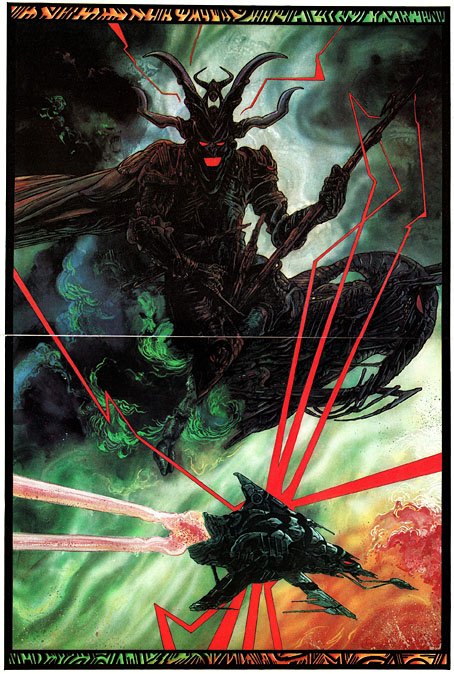
druillet.jpg

A page by Philippe Druillet from Salammbo (1980).

• At the BFI: Alex Ramon suggests 10 great British films of 1975 (the Britishness of Barry Lyndon seems a little debatable), while Jonathan Romney talks to the Quay Brothers about their latest exhibition and Sanatorium Under the Sign of the Hourglass.

• At Public Domain Review: The Cameraman’s Revenge (1912), an early animated film by Wladyslaw Starewicz concerning the domestic affairs of a pair of beetles.

Saga de Xam (previously), the science-fictional bande dessinée by Nicolas Devil and Jean Rollin, will be published in English for the first time in June.

When I first came across Ernest Berk, I assumed he was somebody’s Ursula Bogner style joke. An anti-Nazi exile turned fearless electronic pioneer, who had been a dancer in the Weimar Republic and worked both with Max Reinhardt and with Peter Zinovieff? Who nobody had ever heard of? I smelled a rat, but was wrong: Berk was very real. He was one of many dancers who fled Nazism and ended up at Dartington Hall, a school founded by wealthy hobbyists in Devon which has been slightly fancifully described as the ‘English Bauhaus’; he danced and choreographed at Glyndebourne and Covent Garden, and in the 1950s, became interested in the electronic music that was emerging out of his native Cologne. Berk gradually built a studio in Camden where he would be able to compose music for his own ballets…

Owen Hatherley on the legacy of the emigré composers who found refuge in Britain from the 1930s on

• “…distant and unrelated juxtapositions are at the very heart of Surrealism—both in France and in Japan.” Leanne Ogasawara on Surrealism in Japan.

• “What’s happening? Where are we? What about the investigation?” Mark Harris on Alan Sharp and Arthur Penn’s Night Moves.

• At Bandcamp: Dark Dreams and Bright Nightmares: Jim Allen‘s artist guide to Coil.

• At Colossal: Winners of the 2025 British Wildlife Photography Awards.

• DJ Food found more psychedelic posters from the web.

Wildlife (1987) by Penguin Cafe Orchestra | Night Moves/Fear (1988) by Jon Hassell/Farafina | Dark Dreams (1989) by Brian Eno

Weekend links 768

glitch.jpg

The Mona Lisa as it looks run through the Random Pixelate setting in Glitch Lab.

• “We don’t have enough Dada in this world of too much data. Something is needed to break-through the over-curated simulacrum that is the online world in order to let in a bit of non-artificial light. One way to make a break is through the deliberate cultivation of the glitch.” Justin Patrick Moore on circuit-bending, glitch music and Surrealist composition.

• The seventh installment of Smoky Man’s exploration of The Bumper Book of Magic has been posted (in Italian) at (quasi). There’s an extract in English at Alan Moore World.

• New music: Remember The Clouds by Philippe Deschamp, and Requiem For The Ontario Science Centre by Tony Price.

• Michael Brooke offers suggestions for where to begin with Polish film director Wojciech Has

• At Printmag: A new book shares the artistic odyssey of Iranian designer Farshid Mesghali.

The Letraset Graphic Materials Handbook for the year 1987.

• Steven Heller’s font of the month is Cubo.

• Yet more Polish film posters.

A cat’s eye view of Japan.

• RIP Roy Ayers.

Glitch (1993) by Moody Boyz | Glitch (1994) by Autechre | Glitch (2011) by Brian Eno And The Words Of Rick Holland

Weekend links 760

varo.jpg

Ermitaño Meditando (1955) by Remedios Varo.

• Public Domain Review announces the Public Domain Image Archive. I’ve added it to the list. Meanwhile, the PDR regular postings include Francis Picabia’s 391 magazine (1917–1924).

• Among the new titles at Standard Ebooks, the home of free, high-quality, public-domain texts: The Well at the World’s End by William Morris.

• At Smithsonian Magazine: “See 25 incredible images from the Wildlife Photographer of the Year Contest”.

The ideas are more complex than the presentation suggests, but not vastly. Neither is it exactly breaking new ground. Art is everywhere, they say, from fingernails to fine dining; art is not a message to be decoded, but takes on new meanings in the mind of each viewer; art allows us to experience emotions in a “safe” context, like a form of affective practice; art helps us to imagine new worlds, thereby expanding the boundaries of what’s possible in the real world. The point isn’t to be original, though, but to distil a lifetime’s worth of practical wisdom and reflection. The result is a kind of joyous manifesto: just the thing to inspire a teenager (or adult) into a new creative phase. Eno and Adriaanse conclude with a “Wish”: that the book helps us understand that “what we need is already inside us”, and that “art – playing and feeling – is a way of discovering it”.

Brian Eno and Bette Adriaanse talking to David Shariatmadari about their new book, What Art Does: An Unfinished Theory

• “Crunchie: The Taste Bomb!” DJ Food unearths four psychedelic posters promoting Fry’s Crunchie bars.

• New music: Music For Alien Temples by Various Artists, and Awakening The Ancestors by Nomad Tree.

• At Wormwoodiana: Mark Valentine lays out a history of the Tarot in England.

Sun Ra & His Intergalactic Research Arkestra live on German TV, 1970.

• At Dennis Cooper’s: Chris Marker Day (restored/expanded).

• At the BFI: Anton Bitel on 10 great Mexican horror films.

Matt Berry’s favourite albums.

Tarot (Ace of Wands Theme) (1970) by Andrew Bown | Tarotplane (1971) by Captain Beefheart And His Magic Band | Tarot One (2012) by Tarot Twilight