Henry Keen’s Dorian Gray

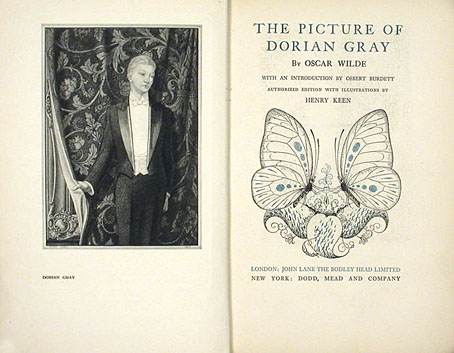
keen1.jpg

Returning to the golden boy again this week with an illustrated edition of Wilde’s novel from 1925. The publisher was Aubrey Beardsley’s old employer, John Lane, and the illustrator was Henry Keen, an artist of singular and dismaying obscurity. Perhaps some of my knowledgeable commenters can provide more information. Keen’s 12 plates look like lithographs but the book also featured ink embellishments and a splendid sunflower/butterfly design on the boards and slipcase.

Continue reading “Henry Keen’s Dorian Gray”

The Great God Pan

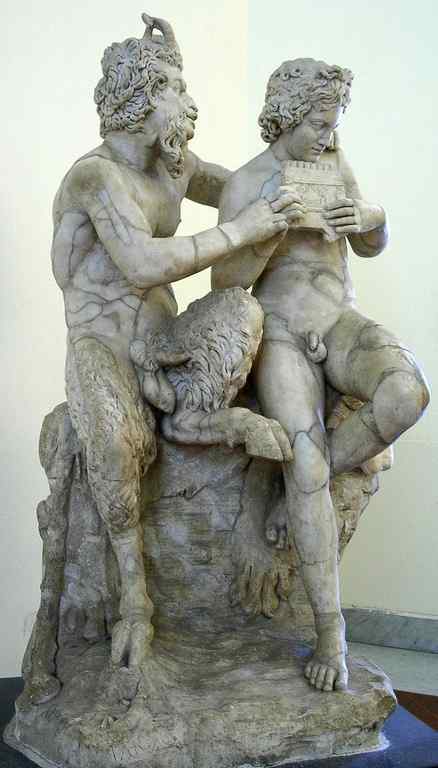
pan_daphnis.jpg

Pan teaching Daphnis to play the panpipes; Roman copy of a Greek original from the 3rd-2nd centuries BCE by Heliodoros.

“The worship of Pan never has died out,” said Mortimer. “Other newer gods have drawn aside his votaries from time to time, but he is the Nature-God to whom all must come back at last. He has been called the Father of all the Gods, but most of his children have been stillborn.”

So says a character in The Music on the Hill, one of the slightly more serious stories from Saki’s The Chronicles of Clovis (1911). Saki’s Pan is a youthful spirit closer to a faun than the goatish creature of legend. But being a gay writer whose tales regularly feature naked young men (surprisingly so, given the time they were written) I’m sure Saki would have appreciated the Roman statue above. There’s nothing chaste about this Pan with his “token erect of thorny thigh” as Aleister Crowley put it in his lascivious 1929 Hymn to Pan, a poem which caused a scandal when read aloud at his funeral some years later. The Roman statue was for a long while an exhibit in the restricted collection of the Naples National Archaeological Museum where all the more scurrilous and priapic artefacts unearthed at Pompeii were kept safely away from women, children and the great unwashed. These are now on public display and include the notorious statue of a goat being penetrated by a satyr.

Continue reading “The Great God Pan”

Art Nouveau illustration

stolba.jpg

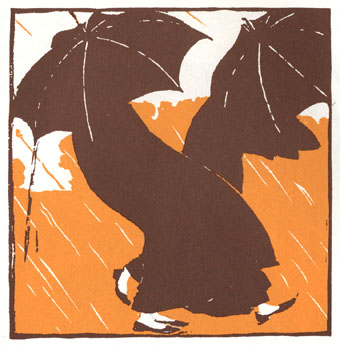
The cover picture of yesterday’s book purchase complements the month, being a woodcut by Leopold Stolba entitled February from a Ver Sacrum calendar for 1903. The book is Art Nouveau: Posters and Designs (1971), a collection edited by Andrew Melvin for the Academy Art Editions series and the book includes some covers for Jugend magazine which coincidentally was the subject of Monday’s post.

letters.jpg

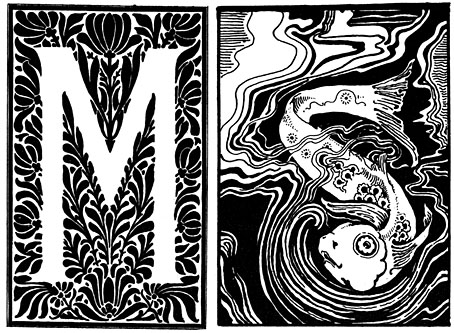
Ornamental letters from The Studio magazine, 1894; no artists credited.

I wrote about another of the books in the Academy series, The Illustrators of Alice, a couple of years ago and while I don’t really need yet another Art Nouveau book, the presence of a few illustrations I hadn’t seen before made the purchase worthwhile. Further examples follow.

Continue reading “Art Nouveau illustration”

Poe at 200

poe.jpg

Poe by Harry Clarke.

Happy birthday Edgar Allan Poe, born two hundred years ago today. I nearly missed this anniversary after a busy weekend. Rather than add to the mountain of praise for the writer, I thought I’d list some favourites among the numerous Poe-derived works in different media.

Illustrated books
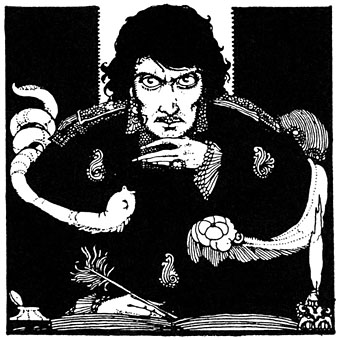
For me the Harry Clarke edition of 1919 (later reworked with colour plates) has always been definitive. Many first-class artists have tried their hand at depicting Poe’s stories and poems, among them Aubrey Beardsley, Gustave Doré, Arthur Rackham, W. Heath Robinson and Edmund Dulac; none complements the morbid atmosphere and florid prose as well as Clarke does. And if it’s horror you need, Clarke’s depiction of The Premature Burial could scarcely be improved upon.

Honourable mention should be made of two less well-known works, Wilfried Sätty’s The Illustrated Edgar Allan Poe (1976) and Visions of Poe (1988) by Simon Marsden. I wrote about Sätty’s collage engravings in Strange Attractor 2, and Sätty’s style was eminently suited to Poe’s work. Marsden’s photographs of old castles and decaying mansions are justly celebrated but in book form often seem in search of a subject beyond a general Gothic spookiness or a recounting of spectral anecdotes. His selection of Poe stories and poems is a great match for the photos, one of which, a view of Monument Valley for The Colloquy of Monos and Una, was also used on a Picador cover for Blood Meridian by Cormac McCarthy.

Recordings
These are legion but among the outstanding one-off tracks I’d note two poems set to music, Dream Within a Dream from Propaganda‘s 1985 album, A Secret Wish, and The Lake by Antony & The Johnsons. The latter appeared on the landmark Golden Apples of the Sun compilation and also on Antony’s own The Lake EP.

Among the full-length works, Hal Willner’s 1997 2-CD collection Closed on Account of Rabies features lengthy readings set to music from a typically eclectic Willner line-up: Marianne Faithfull, Christopher Walken, Iggy Pop, Diamanda Galás, Gavin Friday, Dr John, Deborah Harry, Jeff Buckley (one of the last recordings before his untimely death) and Gabriel Byrne. Byrne’s reading of The Masque of the Red Death is tremendous and the whole package is decked out in Ralph Steadman graphics.

Antony Hegarty appears again on another double-disc set, Lou Reed’s The Raven (2003), a very eccentric approach to Poe which I suspect I’m in the minority in enjoying as much as I do. An uneven mix of songs and reading/performances, Reed updates some Poe poems while others are presented straight and to often stunning effect by (among others) Willem Defoe, Steve Buscemi, Laurie Anderson, David Bowie, Amanda Plummer and Elizabeth Ashley.

Films
Once again, there’s too many films but The Masque of the Red Death (1964) has always been my favourite of the Roger Corman adaptations, not least for the presence of Jane Asher, Patrick Magee and (behind the camera) Nicolas Roeg. I wrote last May about the animated version of The Tell-Tale Heart from UPA. That adaptation, with narration by James Mason, is still on YouTube so if you haven’t seen it yet you can celebrate Poe’s anniversary by watching it right now.

Elsewhere on { feuilleton }
The illustrators archive

Previously on { feuilleton }
The Tell-Tale Heart from UPA
William Heath Robinson’s illustrated Poe
The art of Harry Clarke, 1889–1931

Aubrey Beardsley’s musical afterlife

dilettantes.jpg

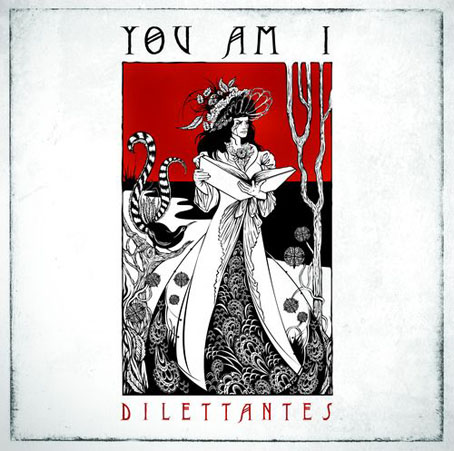
Dilettantes by You Am I (2008). Illustration and design by Ken Taylor.

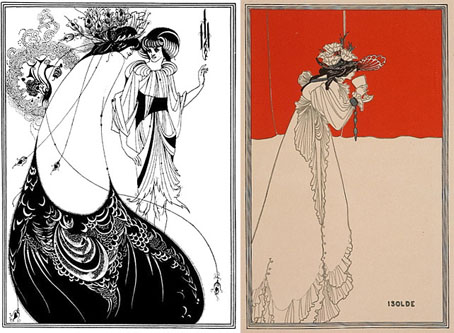
Dilettantes is the eighth studio album from Australian band You Am I which is released this week sporting a very creditable Beardsley pastiche by illustrator Ken Taylor. Sleevage has more details about the creation of the CD package, including preliminary sketches. Those familiar with Beardsley’s work may see in the cover drawing references to The Peacock Skirt and the colour print of Isolde. I like the way Beardsley’s peacock has been exchanged for a more suitably antipodean lyrebird. This isn’t Beardsley’s only influence in the musical world, of course. A few more examples follow.
beardsley1.jpg

left: The Peacock Skirt from Salomé (1894); right: Isolde (1895).
revolver.jpg

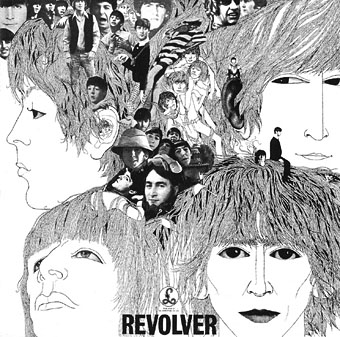
Revolver cover by Klaus Voorman (1966).

The over-familiarity of Klaus Voorman‘s collage/drawing for the cover of Revolver by The Beatles tends to obscure its Beardsley influence but that influence is certainly present in the stylised faces, the figure details and the rendering of the hair. The Beatles themselves were enthused enough with Aubrey to put his face among the pantheon of “people that we like” on the sleeve of Sgt. Pepper a year later. I’d thought for a while that Voorman might have been inspired by the landmark Beardsley exhibition which ran at the V&A in London from May–September 1966. Some correspondence with Raymond Newman, author of Abracadabra, a book about the album, disabused me of that when Raymond confirmed that Voorman in 1966 had already been a Beardsley enthusiast for a number of years.

As well as being possibly the first Beardsleyesque album cover, I wonder whether this was also the first major album release to drop the name of the artist from the front of the sleeve.
see_for_miles.jpg

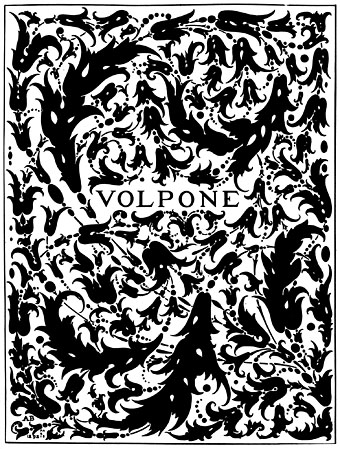
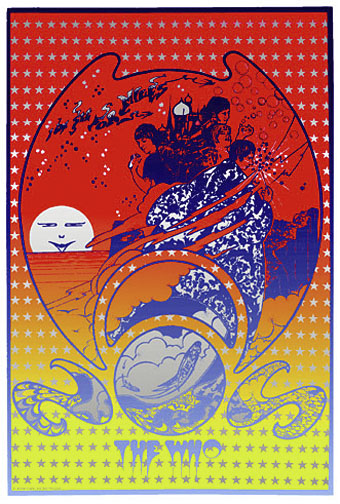
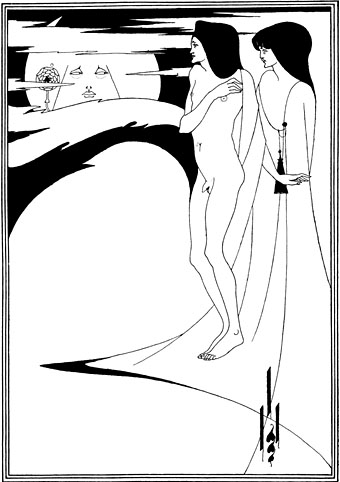
Everyone went psychedelic in 1967, even tough mods like The Who. This Hapshash and the Coloured Coat promo poster for I Can See For Miles (incidentally my favourite Who song) is one of Hapshash’s more overt Beardsley borrowings. The sun (or moon) in the background is a variation on Beardsley’s The Woman in the Moon from Salomé (the face is Oscar Wilde’s) while Pete Townshend’s florid sorcerer’s cloak owes much to Aubrey’s incredible cover design (blocked in gold on the book) for Volpone.
beardsley2.jpg

The Woman in the Moon (1894).

volpone.jpg

Volpone (1897).

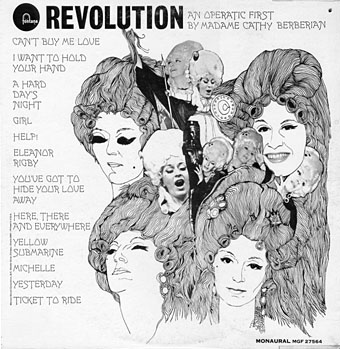
revolution.jpg

From the sublime to the ridiculous. Cathy Berberian was the mezzo-soprano wife of avant garde composer Luciano Berio, with a long career as a singer of serious classical and contemporary classical works. Her rendition of Berio’s Thema (Omaggio a Joyce)–an electroacoustic setting of the “Sirens” prelude from Ulysses–was one of the tracks on the 1967 electroacoustic compilation Electronic Music III discussed here in April. She also had a separate career as an operatic interpreter of pop music and this collection of Beatles songs dates either from 1968 or 69, depending on which source you choose to believe. Whatever the year, the designer pulled off a decent enough copy of the Revolver sleeve. For a taste of the Berberian style, there’s a sample here. And if you’re desperate for the entire album, this page has a copy.

I’m sure this doesn’t exhaust the Beardsley influence in sleeve design, there must be others between 1968 and 2008. Once again, if you know of any further examples, please leave a comment.
humble_pie.jpg

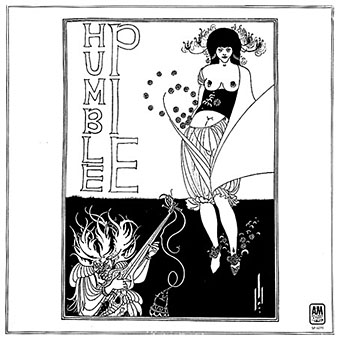
Humble Pie by Humble Pie (1970).

Update: Added Humble Pie’s self-titled third album. The illustration this time is Beardsley’s own, The Stomach Dance from Salomé.
szabo.jpg

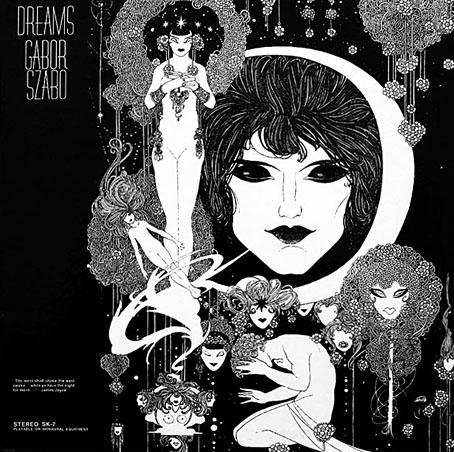
Dreams by Gabor Szabo (1968). Design by David Stahlberg.

Update 2: Therese discovered this great sleeve for an album by the Hungarian jazz guitarist. Closer in style to John Austen’s illustrations for Hamlet 1922) but Austen’s use of black-and-white at the time was very influenced by Beardsley’s work.
witchcraft.jpg

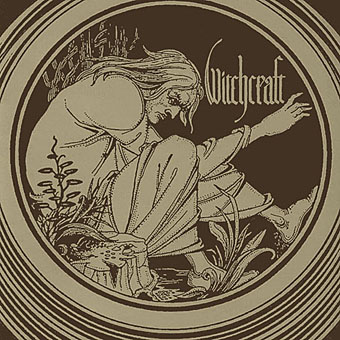
Witchcraft by Witchcraft (2004).

Update 3: Another addition, the debut album from Swedish metal band Witchcraft which uses Beardsley’s Merlin vignette from the Morte Darthur. Thanks to Cyphane for the tip.
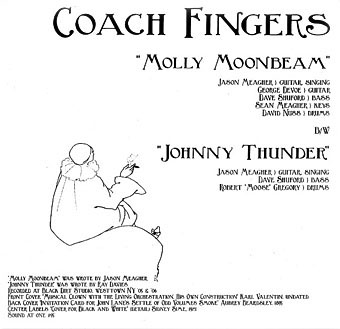
coach_fingers.jpg

Molly Moonbeam by Coach Fingers (2007).
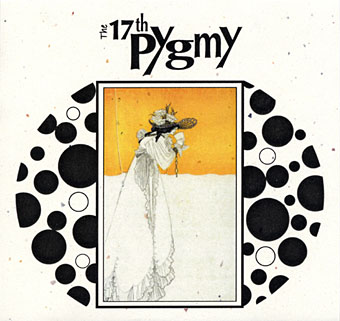
17th_pygmy.jpg

Ballade Of Tristram’s Last Harping by The 17th Pygmy (aka 17 Pygmies) (2007).

Update 4: Added a couple of new discoveries. The 17th Pygmy album apparently includes further Beardsley pieces in its booklet while the Coach Fingers single also has a label featuring designs by Beardsley’s contemporary, Sidney Sime.
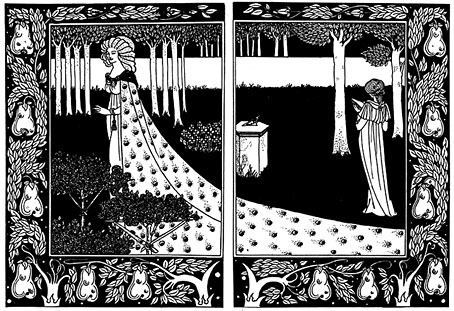
isoud.jpg

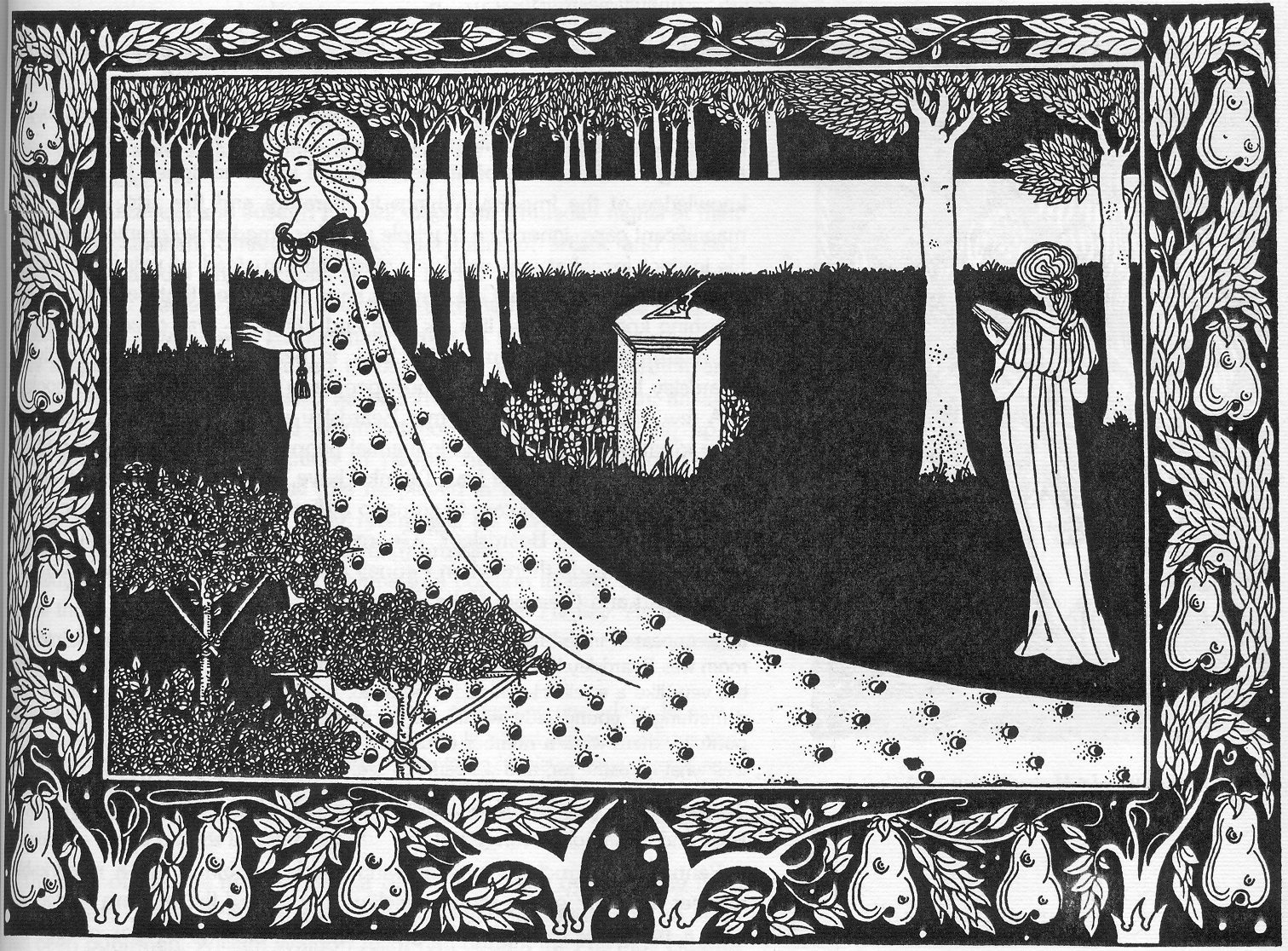
La Beale Isoud at Joyous Gard. (1894).
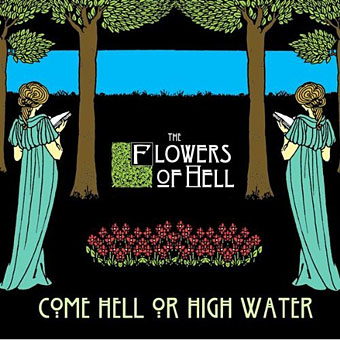
flowers.jpg

Come Hell Or High Water by The Flowers of Hell (2009).

Update 5: Added the Flowers of Hell cover which is based on La Beale Isoud at Joyous Gard. from Le Morte Darthur. The band also has a video which works variations on the same picture.
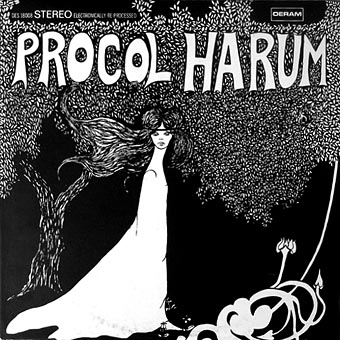
procol.jpg

Procol Harum by Procol Harum (1967).

Update 6: Another one I’d missed, Procol Harum’s debut album doesn’t have a credit for the cover art which is perhaps just as well since it doesn’t stand comparison with some of the works above. The same artwork appeared on later reissues when the album was re-titled A Whiter Shade of Pale.

Elsewhere on { feuilleton }
The album covers archive
The Aubrey Beardsley archive
The illustrators archive