The art of Jessica Harrison

harrison.jpg

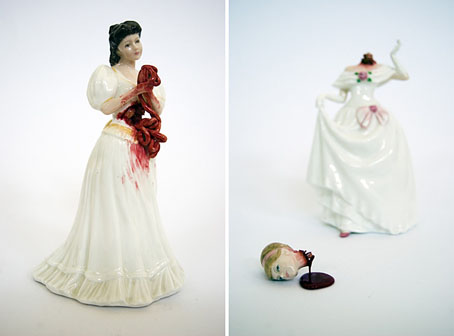
left: Maria (2010); right: Dawn (2010).

British artist Jessica Harrison undermines the saccharine innocence of porcelain figurines in a manner which would no doubt appeal to a Surrealist and black humorist like Jan Svankmajer. As well as these recent pieces, her website features further contemporary takes on Surrealism including a number of pencil drawings, one of which is a self-portrait alluding to that Švankmajer favourite, Giuseppe Arcimboldo.

Previously on { feuilleton }
Surrealism, graphic design and Barney Bubbles
Jan Švankmajer: The Complete Short Films

Marsi Paribatra: the Royal Surrealist

marsi1.jpg

La Menace (1994).

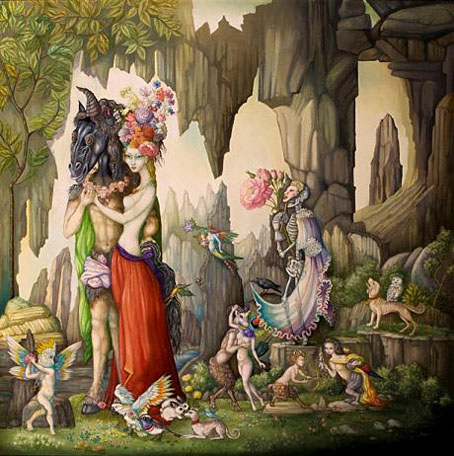
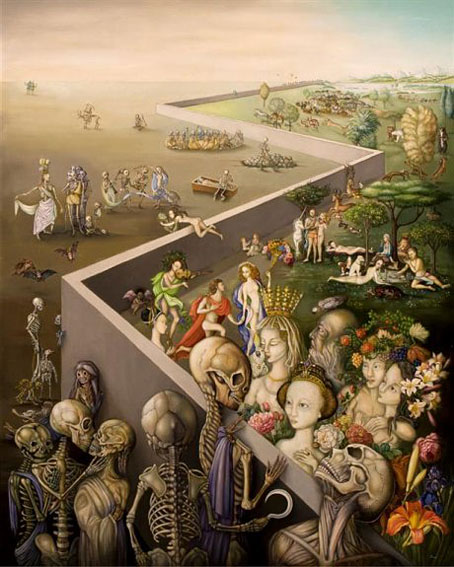
Two paintings by Princess Marsi Paribatra, a member of the royal family of Thailand who lists Dalí, Arcimboldo and Titian among her artistic influences. If it seems surprising that a princess should not only be an accomplished painter but also be possessed of a distinctly vivid imagination we might ask why this is the case. There’s no reason why a member of a royal family shouldn’t be as good a painter as anyone else although it’s the case that here in Britain our views of royalty are inevitably tainted by the uninspiring members of the current House of Windsor. Prince Charles in particular is a singularly dreary and frequently philistine figure, and also a painter whose daubs would never have received any attention at all were it not for his being born into the right family.

This hasn’t always been the case. It used to be that being an aristocrat gave you the free time and the wealth to indulge no end of manias and eccentricities. The British Isles are littered with architectural follies of various kinds built to appease the whims of rich landowners; William Beckford (1760–1844) is renowned for having written the Gothic melodrama Vathek and also for having built the lavish (and unfortunately short-lived) pile of Fonthill Abbey. In the 20th century we had Edward James (1907–1984), a lifelong champion of Surrealism who spent much of his later life building Las Pozas in the Mexican jungle at Xilitla, a concrete fantasia which looks like something dreamed up by Antonio Gaudí and JG Ballard. James collected the work of Leonora Carrington and Dorothea Tanning and I’d imagine him being equally entranced by some of Marsi Paribatra’s paintings. The recurrence of skeletal figures in her work invokes the Mexican Day of the Dead traditions which always excited the Surrealists.
marsi2.jpg

No title or date available.

Dali House has more about Marsi Paribatra’s life and art while further examples of her paintings can be found here and here. Thanks again to Monsieur Thombeau for pointing the way!

Elsewhere on { feuilleton }
The fantastic art archive

Previously on { feuilleton }
Angels of Anarchy: Women Artists and Surrealism
Return to Las Pozas
The art of Leonor Fini, 1907–1996
Surrealist women
Las Pozas and Edward James

Mervyn Peake in Lilliput

This month I’ve been redesigning the Savoy Books edition of The Exploits of Engelbrecht by Maurice Richardson, in preparation for a reprint. This has involved scanning the covers of the issues of Lilliput, the magazine where Richardson’s tales of the dwarf surrealist sportsman first appeared, and one number of these, from May 1950, also includes a feature about nursery rhymes illustrated by Mervyn Peake. The paintings were reprinted in Mervyn Peake: The Man and his Art in 2006 but shrunk onto a single page so this is a chance to see them at a larger size. Also reproduced below is the accompanying article by Leslie Daiken and the Arcimboldo-style cover by Ronald Ferris. Some of the earlier covers by Walter Trier—all of which featured a man, a woman and a dog in a variety of guises—can be seen at VTS.

Update: For more about Mervyn Peake, see also Peake Studies.

peake1.jpg

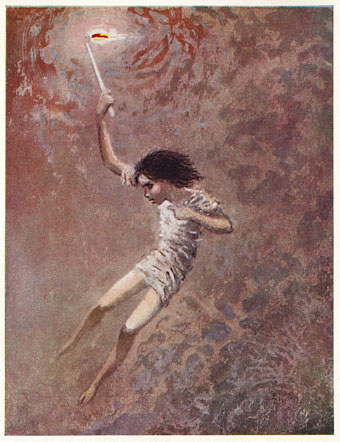
“How many miles to Babylon?”
“Three score miles and ten.”
“Can I get there by candle-light?”
“Yes, and back again.
If your heels are nimble and light
You may get there by candle-light.”

Continue reading “Mervyn Peake in Lilliput”

New things for December

panegyric.jpg

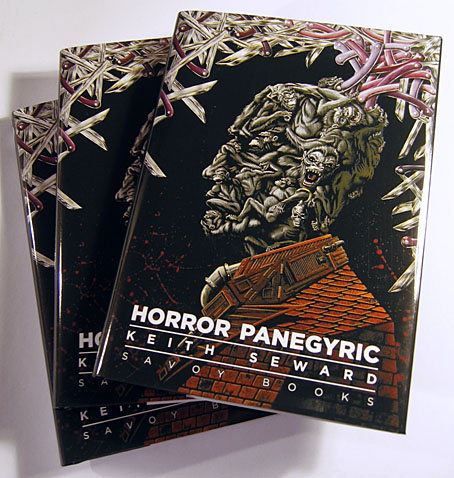
Another delivery of work of mine this week with this new design for Savoy Books. Horror Panegyric is a small volume examining David Britton’s Lord Horror novels, writer Keith Seward being the founder of the web’s best William Burroughs site, RealityStudio, and also an author of avant garde erotic fictions which can be found at his Supervert site. The cover painting for this book was my Arcimboldo-style portrait of Lord Horror which originally appeared on the cover of Reverbstorm #3.

Previously on { feuilleton }
My pastiches