The Mysteries of Myra

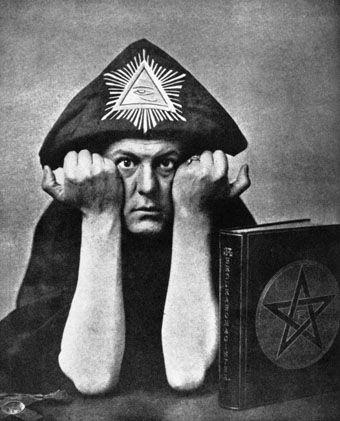
crowley.jpg

Aleister Crowley in 1912.

Back in 1999 I found myself making notes for a short essay on the subtle and often tenuous presence of Aleister Crowley in cinema. Despite Crowley’s reputation in the early years of the 20th century—famously labelled by tabloid hyperbole as “The Wickedest Man in the World”—he doesn’t seem to have ever been filmed. He does have a succession of cinematic avatars, however, in a variety of thrillers and horror films, usually manifesting in the guise of a fictional magus whose exploits will be based on the more lurid public perceptions of the Crowley persona.

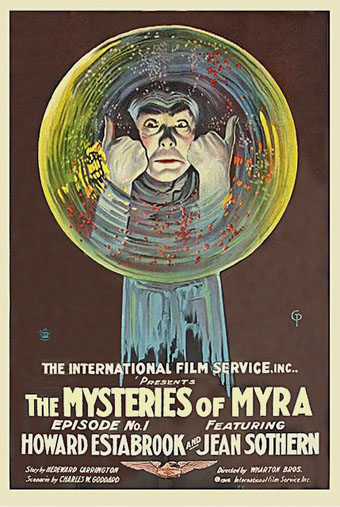
myra1.jpg

After some research my short essay bloomed into a longer essay then began developing into a book-length project which I had the good sense to abandon. The idea still interests me but I didn’t have the time or resources to devote to all the detailed research such a project would require if it was going to be done thoroughly. It was also difficult at that time to see the some of the more obscure films, a crucial early example being Rex Ingram’s 1926 adaptation of The Magician, Somerset Maugham’s first novel whose central character, Oliver Haddo, is based on Crowley. The Magician has now been restored and reissued but at that time it was out of circulation entirely.

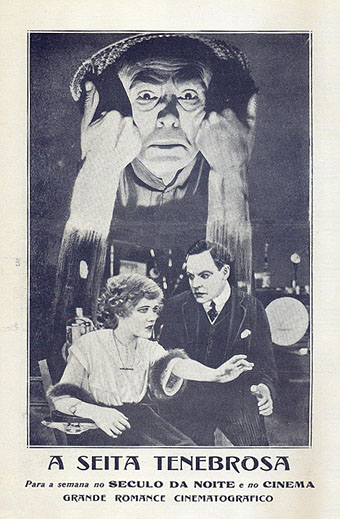
myra3.jpg

A Portuguese magazine ad.

It’s also the case that there always seems to be more to find on this subject, a prime example being The Mysteries of Myra, a lost serial directed by Leopold & Theodore Wharton which has only now come to my attention. If the title seems vaguely familiar it’s because the screenwriter was one Charles W Goddard whose earlier The Perils of Pauline survives as a touchstone for silent melodrama if nothing else. The Mysteries of Myra dates from 1916, and is distinguished by being one of a number of films which received effects advice (and publicity, of course) from Harry Houdini. The Pulp Reader has a précis which includes this toothsome blurb:

BEWARE THE BLACK ORDER! So comes the warning from the spirit of Myra Maynard’s father, who reaches out to her from beyond the grave to warn her of danger from the masters of the occult arts that lurk in the shadows and mark her for murder on her eighteenth birthday. Only the world’s first psychic detective, Dr. Payson Alden, and his friend Haji the Brahman mystic, can save clairvoyant Myra from the terrors of The Grand Master of the Order, who tries to claim not only her fortune but her life by means of suicide-inducing spells, invasion of her chamber by spirit assassins, and even reanimation of the dead by a fire elemental.

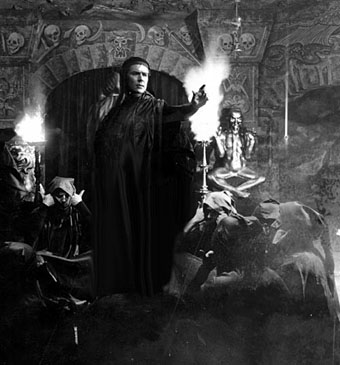
A list of the episode titles reads like a track list for a metal album or a collection of Algernon Blackwood stories: ‘The Dagger of Dreams’, ‘The Poisoned Flower’, ‘The Mystic Mirrors’, ‘The Wheel of Spirit’, ‘The Fumes of Fear’, ‘The Hypnotic Clue’, ‘The Mystery Mind’, ‘The Nether World’, ‘Invisible Destroyer’, ‘Levitation’, ‘The Fire-Elemental’, ‘Elixir of Youth’, ‘Witchcraft’, ‘Suspended Animation’, ‘The Thought Monster’. The Black Order menacing the imperilled Myra (there’s always an imperilled woman in these things) is almost certainly based on Crowley and his acolytes. John Symonds’ biography The Great Beast contains an account of Crowley’s rituals published for appalled American readers in The World Magazine in 1914. That article, and the famous 1912 photo of The Master Therion gesturing in his ceremonial robes, was all the filmmakers would have required to create their villainous cabal.

myra2.jpg

The Black Order at work.

The trouble with this kind of drama is that the description is often a lot more stimulating than the stodgy reality, so it may be for the best if Myra’s exploits have perished. Anyone eager to know more should avail themselves of the photonovel put together by the Serial Squadron using stills (some of which may be viewed here) and a novelisation of the serial story. The book is reviewed at Lovecraft is Missing. Unless anyone knows better, I’d say Aleister Crowley’s curious film career began with Myra’s mysteries.

Previously on { feuilleton }
The Mask of Fu Manchu
Aleister Crowley on vinyl

“Who is this who is coming?”

whistle4.jpg

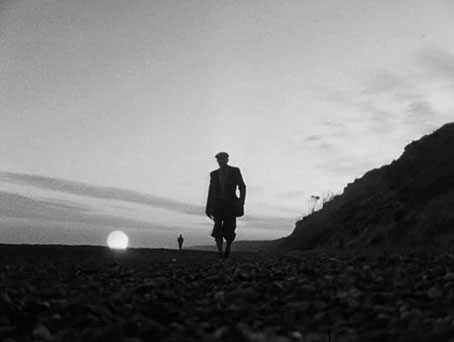
Whistle and I’ll Come to You (1968).

He blew tentatively and stopped suddenly, startled and yet pleased at the note he had elicited. It had a quality of infinite distance in it, and, soft as it was, he somehow felt it must be audible for miles round. It was a sound, too, that seemed to have the power (which many scents possess) of forming pictures in the brain. He saw quite clearly for a moment a vision of a wide, dark expanse at night, with a fresh wind blowing, and in the midst a lonely figure—how employed, he could not tell. Perhaps he would have seen more had not the picture been broken by the sudden surge of a gust of wind against his casement, so sudden that it made him look up, just in time to see the white glint of a sea-bird’s wing somewhere outside the dark panes.

MR James, Oh, Whistle, and I’ll Come to You, My Lad.

One of the alleged highlights of this year’s Christmas television from the BBC was a new adaptation of an MR James ghost story, Oh, Whistle, and I’ll Come to You, My Lad. The film starred John Hurt and came with the same truncated title, Whistle and I’ll Come to You, as was used for Jonathan Miller’s 1968 version, also a BBC production. The story title comes originally from a poem by Robert Burns. The new work was adapted by Neil Cross and directed by Andy de Emmony, and I describe it as an alleged highlight since I wasn’t impressed at all by the drama, the most recent attempt by the BBC to continue a generally creditable tradition of screening ghost stories at Christmas. Before I deal with my disgruntlement I’ll take the opportunity to point the way to some earlier derivations. (And if you don’t want the story spoiled, away and read it first.)

Continue reading ““Who is this who is coming?””

The Great God Pan

pan_daphnis.jpg

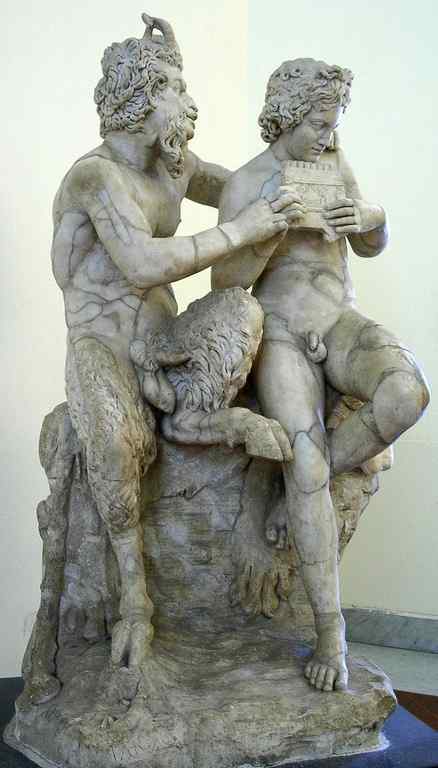
Pan teaching Daphnis to play the panpipes; Roman copy of a Greek original from the 3rd-2nd centuries BCE by Heliodoros.

“The worship of Pan never has died out,” said Mortimer. “Other newer gods have drawn aside his votaries from time to time, but he is the Nature-God to whom all must come back at last. He has been called the Father of all the Gods, but most of his children have been stillborn.”

So says a character in The Music on the Hill, one of the slightly more serious stories from Saki’s The Chronicles of Clovis (1911). Saki’s Pan is a youthful spirit closer to a faun than the goatish creature of legend. But being a gay writer whose tales regularly feature naked young men (surprisingly so, given the time they were written) I’m sure Saki would have appreciated the Roman statue above. There’s nothing chaste about this Pan with his “token erect of thorny thigh” as Aleister Crowley put it in his lascivious 1929 Hymn to Pan, a poem which caused a scandal when read aloud at his funeral some years later. The Roman statue was for a long while an exhibit in the restricted collection of the Naples National Archaeological Museum where all the more scurrilous and priapic artefacts unearthed at Pompeii were kept safely away from women, children and the great unwashed. These are now on public display and include the notorious statue of a goat being penetrated by a satyr.

Continue reading “The Great God Pan”

The Willows by Algernon Blackwood

willows.jpg

Light play on the river Thame by net_efekt.

…the major products of Mr. Blackwood attain a genuinely classic level, and evoke as does nothing else in literature an awed convinced sense of the imminence of strange spiritual spheres of entities.

The well-nigh endless array of Mr. Blackwood’s fiction includes both novels and shorter tales, the latter sometimes independent and sometimes arrayed in series. Foremost of all must be reckoned The Willows, in which the nameless presences on a desolate Danube island are horribly felt and recognised by a pair of idle voyagers. Here art and restraint in narrative reach their very highest development, and an impression of lasting poignancy is produced without a single strained passage or a single false note.

Thus HP Lovecraft in 1927 from his lengthy overview of horror fiction, Supernatural Horror in Literature. Lovecraft was enthusiastic about many of Blackwood’s weird tales, rating him as one of the contemporary masters along with Arthur Machen. A year before his essay he prefaced The Call of Cthulhu with a Blackwood quote and regularly referred to The Willows as one of his favourite stories. Blackwood’s tale continues to find enthusiasts today, among them the Ghost Box music collective whose Belbury Poly CD titled after the story manages to reference in the space of 44 minutes Blackwood, Machen, CS Lewis and The Morning of the Magicians.

belbury.jpg

If your curiosity is sufficiently piqued by this point, you can read the story online at Wikisource or Project Gutenberg. Or you can listen to a reading in a new posting at LibriVox. The perfect thing for autumn and the month of Halloween.

Previously on { feuilleton }
Horror in the shadows
Wanna see something really scary?
Ghost Box
The Absolute Elsewhere