Sorcerers of sound
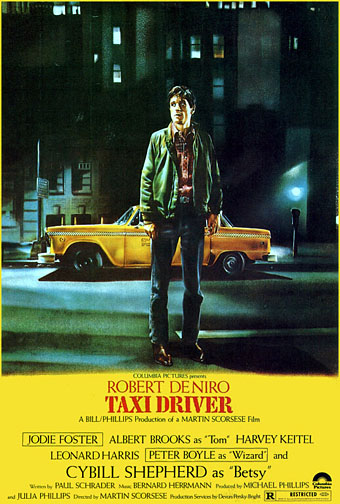
| Simon Reynolds on the 50th anniversary of the Radiophonic Workshop.
East Village Boys
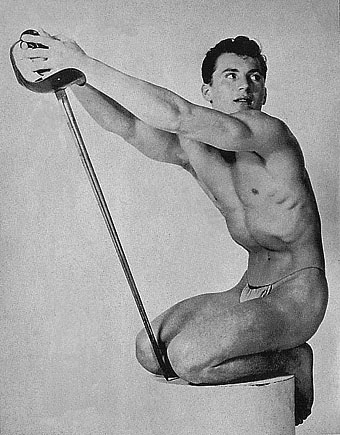
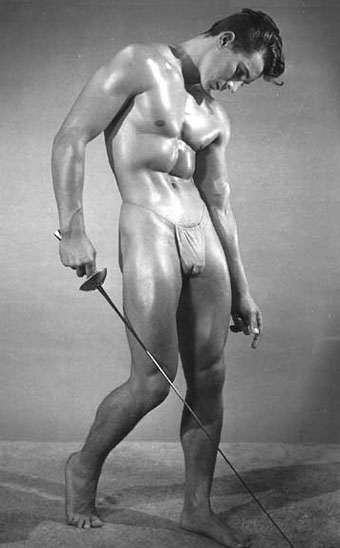
Matthew photographed by Nodeth Vang.
A smart blog with one of the best About descriptions ever: “Cock Culture”. Oh, and sights like this…
Sentenced to a lifetime of stress
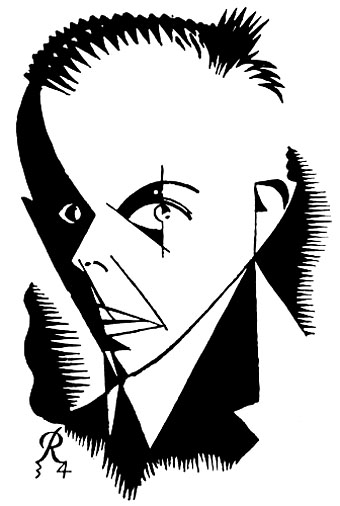
| Lindsay Anderson.
The Corpus Clock
This splendid clock is unveiled by Professor Stephen Hawking later today at Corpus Christi College in Cambridge. If it hadn’t cost a million pounds to develop I’d probably be demanding that someone find me one for Christmas. The mechanical monster perched at the top is explained by its creator:
“It is terrifying, it is meant to be,” said John C Taylor, the creator and funder of an extraordinary new clock to be unveiled tomorrow by Stephen Hawking at Corpus Christi College in Cambridge. “Basically I view time as not on your side. He’ll eat up every minute of your life, and as soon as one has gone he’s salivating for the next. It’s not a bad thing to remind students of. I never felt like this until I woke up on my 70th birthday, and was stricken at the thought of how much I still wanted to do, and how little time remained.”
Unfortunately there are few decent pictures to be had of the device but the Telegraph has an article which describes its “grasshopper escapement”, while the Guardian goes one better with a video of the clock in action.
Update: Longer video at the university site with Dr Taylor explaining the clock in detail.
Previously on { feuilleton }
• Gold robots
• The art of Sergei Aparin
• The art of Almacan
• The sculpture of Christopher Conte
• The Bowes Swan
Carlo Scarpa’s Brion-Vega Cemetery
“I would like to explain the Tomba Brion…I consider this work, if you permit me, to be rather good and which will get better over time. I have tried to put some poetic imagination into it, though not in order to create poetic architecture but to make a certain kind of architecture that could emanate a sense of formal poetry….The place for the dead is a garden….I wanted to show some ways in which you could approach death in a social and civic way; and further what meaning there was in death, in the ephemerality of life—other than these shoe-boxes.” Carlo Scarpa
Dan Hill at City of Sound reminds us (okay, reminds me…) of Carlo Scarpa’s incredible private cemetery via a link to a Wallpaper* photo feature about the place. Scarpa’s final work (he’s buried in the grounds) was built for the Brion family at San Vito d’Altivole, Italy, and completed in 1978.
This construction and other Scarpa buildings often come to mind after encountering some disastrous use of concrete in architecture. Scarpa, like Frank Lloyd Wright, shows how well that meanest of building materials could be used with the application of care and imagination. And Scarpa, like Wright, also favoured attention to detail, with the cemetery providing copious examples of this, notably the motif of a pair of interlaced circles which feature as a prominent window design and recur in tiny elements elsewhere. Those paired circles and the garden itself remind me of the Jantar Mantar at Jaipur. I’m sure I read that one of Scarpa’s influences for the cemetery was Arnold Böcklin’s The Isle of the Dead but I’m unable to find any online reference. For more about that painting, there’s my earlier post on the subject.
• Flickr has a wealth of photographs of the cemetery
• A black & white photo set by Gerald Zugmann
Previously on { feuilleton }
• Hugh Ferriss and The Metropolis of Tomorrow
• The Jantar Mantar
• Arnold Böcklin and The Isle of the Dead
• Frank Lloyd Wright’s future city